
Lyophilised peptides are the stability winner for most research applications, retaining chemical integrity for months to years when residual moisture and headspace are properly controlled. Liquid formats offer faster time-to-bench but degrade more quickly once water is introduced, and reconstituted solutions face a well-documented 28 to 30 day sterility ceiling regardless of the peptide's own chemistry.
Key takeaways for lyophilized vs liquid peptide storage
Researchers deciding between freeze-dried peptides and pre-mixed liquid formulations need a quick reference before committing bench time or budget to either format.
- Lyophilised peptides are the default for long-term storage. They tolerate brief shipping excursions above refrigeration temperature and should carry a residual moisture value under roughly 3% measured by Karl Fischer titration.
- Reconstituted solutions belong in the fridge, not the bench top, and the working vial should be discarded around 28 days if mixed with bacteriostatic water.
- Single-use aliquots frozen in sterile cryovials avoid repeated freeze-thaw cycling and extend the practical life of a batch beyond what one working vial can offer.
- Liquid format makes sense when the application demands immediate use, a topical or oral delivery vehicle, or a vendor-stabilised formulation designed specifically to skip reconstitution.
- Always request a Certificate of Analysis covering mass spectrometry identity, HPLC purity, residual moisture, and endotoxin (LAL) results before accepting a shipment.
Always ask your supplier for the Karl Fischer figure on the batch's COA rather than assuming a "lyophilised" label guarantees dryness.*
What is lyophilization and how does the process work?
Lyophilisation, commonly called freeze-drying, removes water from a peptide solution through three distinct stages, and each one exists to solve a different physical problem.
Freezing comes first. The solution is cooled until the water forms ice crystals, separating from the peptide and any excipients. Get this stage wrong, with ice crystals too large or too small, and you compromise the cake structure that later stages depend on.
Primary drying follows, where a vacuum is applied and the ice sublimates directly from solid to vapour without passing through a liquid phase. This is the step that does most of the moisture removal, and it has to happen below the product's collapse temperature or the cake structure fails.
Secondary drying finishes the job at a slightly higher temperature, removing the unfrozen "bound" water molecules that cling to the peptide surface even after primary drying is complete. This stage determines the final residual moisture value.
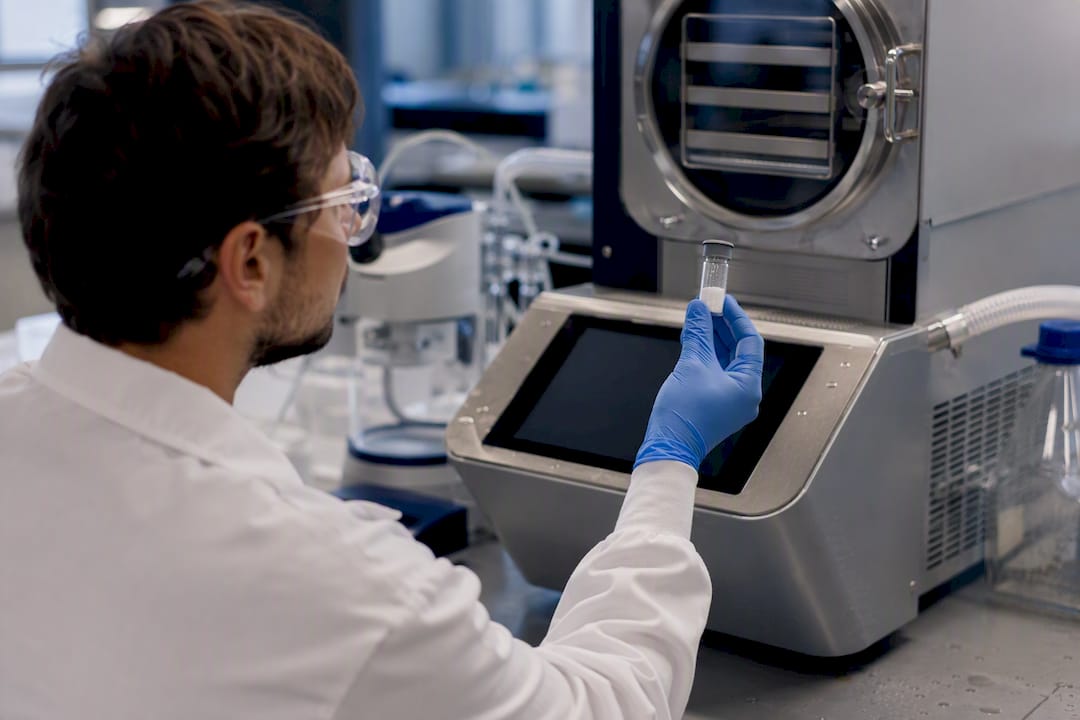
That residual moisture figure is measured by Karl Fischer titration, the compendial method referenced in USP guidance for quantifying trace water in dried products.
For sequences prone to oxidation, some manufacturers flush the vial headspace with an inert gas such as argon or nitrogen before sealing, displacing the oxygen that would otherwise attack vulnerable residues. Excipients like mannitol or trehalose also play a structural role, giving the freeze-dried cake enough bulk to resist collapse during shipping and handling.
Why does water accelerate peptide degradation?
Water is the common denominator behind nearly every major peptide degradation pathway, and understanding which pathway threatens a given sequence tells you how much lyophilisation actually buys you.
Hydrolysis cleaves the peptide bond itself when water molecules attack susceptible linkages, a reaction that simply cannot proceed at a meaningful rate in a dry solid because there is no mobile water to drive it.
Deamidation targets asparagine and glutamine residues, converting them to aspartate or glutamate through a water-mediated mechanism that shows up faster at higher temperatures and higher pH.
Oxidation attacks methionine, cysteine, and tryptophan residues in particular, and dissolved oxygen in an aqueous solution gives these reactions a medium to occur in. Mitigating this risk in solution usually means limiting oxygen exposure or adding antioxidant strategies, though inert headspace gas at the lyophilised stage remains the more reliable first line of defence for sequences carrying these residues.
Aggregation is a physical rather than chemical failure mode, where peptide molecules clump together under the combined pressure of water, heat, and light exposure, sometimes forming visible particulates and sometimes staying invisible while quietly reducing potency.
Microbial contamination is the fifth pathway, and it is unique to reconstituted solutions. Every needle puncture into a rubber septum is a chance to introduce bacteria, which is why sterility, not chemistry, ultimately caps how long a working vial stays usable.
- Hydrolysis and deamidation both require mobile water molecules to proceed.
- Oxidation risk concentrates on Met, Cys, and Trp residues.
- Aggregation is physical, not chemical, and worsens with heat and light.
- Microbial risk grows with every vial puncture, independent of the peptide's own stability.
Pro Tip: If your sequence contains multiple methionine or cysteine residues, ask your supplier whether the lyophilisation run included an inert gas flush. It is a small manufacturing detail that has an outsized effect on long-term potency.
How long do lyophilized and liquid peptides actually last?
Published stability data gives a clearer picture than marketing copy on either side of this comparison, and the numbers favour the dry format by a wide margin.
Peer-reviewed stability programmes, typically run under ICH Q1A-style accelerated and long-term testing protocols, commonly support refrigerated shelf-life assignments of 18 to 36 months for lyophilised peptide products once residual moisture and headspace control are validated at manufacture. Some vaccine-grade lyophilised peptides have documented stability at −80°C for three to five years or longer in clinical-trial registry data, which illustrates just how far freezing extends the picture when moisture is properly excluded from the start.
Reconstituted solutions tell a different story. At room temperature, chemical degradation and microbial risk both climb quickly, and most practical guidance limits an at-bench solution to days rather than weeks. Refrigerated, the commonly cited window stretches to around 28 days, but that number is not really a chemistry result. It is driven by the labelled preservative effectiveness of bacteriostatic water and the accumulating puncture risk on a rubber septum, not by the peptide molecule reaching some inherent half-life. A peptide with excellent aqueous stability can still fail the 28 day rule on sterility grounds alone, and a fragile peptide can fail well before that window closes on chemistry grounds. The two failure modes are separate and both matter.
Residual moisture is the variable that connects all of this. Formulations validated under roughly 3% moisture measured by Karl Fischer titration support the longer end of the stability range. Batches that come in wetter tend to degrade faster regardless of how carefully they are stored afterward. Sequence composition and excipient choice shift these numbers further. Two peptides lyophilised under identical conditions can still show materially different shelf lives if one carries oxidation-prone residues and the other doesn't.
- Lyophilised, refrigerated: 18 to 36 months under validated low moisture.
- Lyophilised, frozen: multi-year stability documented for some sequences.
- Reconstituted, room temperature: days, not weeks.
- Reconstituted, refrigerated: roughly 28 days, sterility-limited.
How do you reconstitute lyophilized peptides correctly?
Reconstitution technique determines whether a stable, well-manufactured lyophilised peptide actually performs the way its COA suggests it should. Get the steps wrong and you can undermine months of careful storage in a single afternoon.
- Choose the right solvent first. Bacteriostatic water suits most standard research peptides. For poorly soluble sequences, a small volume of DMSO is often introduced before diluting further, since DMSO can solubilise peptides that resist aqueous buffers alone. Sterile buffers matched to the peptide's isoelectric point are the third option when pH sensitivity is a concern.
- Calculate the dilution before you draw any liquid. Work out target concentration against vial content and diluent volume, and cross-check the maths rather than eyeballing it. A dilution calculator removes the arithmetic error that is one of the most common causes of wasted batches, and worked examples are laid out in more detail in this guide to peptide dilution calculation.
- Swab the septum with alcohol before every puncture, use a fresh sterile syringe each time, and avoid drawing air back into the vial unnecessarily.
- Filter through a 0.2 micron membrane when sterility is critical for downstream work, following the technique outlined in this sterile filtration guide.
- Aliquot immediately if you don't need the full reconstituted volume right away. Sterile single-use cryovials frozen straight after mixing sidestep the 28 day fridge clock entirely for the portions not yet in use.
Pro Tip: Reconstitute only the volume you expect to use within the discard window. Aliquoting a fresh vial into single-use portions before storage almost always beats trying to stretch one working vial across several weeks of bench work.
What are the best storage and shipping practices for peptides?
Storage rules differ sharply depending on whether a peptide is still in its dry, unopened state or has already been reconstituted into solution.
Unopened lyophilised vials are the most forgiving format in the entire comparison. Refrigerated storage typically supports the 18 to 36 month window discussed earlier, and freezing extends that further for validated low-moisture batches. One detail trips up more labs than it should: avoid frost-free freezers for long-term storage. Their automatic defrost cycles introduce repeated temperature swings and humidity spikes that a manual-defrost or lab-grade freezer does not experience, and that cycling can slowly compromise cake integrity even when the vial itself stays sealed.
Working vials that have already been reconstituted belong in the fridge only, never the freezer, once mixed, because repeated freeze-thaw cycling promotes the aggregation discussed earlier. If a project needs more than one working aliquot's worth of solution, mix smaller batches or freeze single-use portions rather than repeatedly thawing and refreezing one vial.
Shipping favours the dry format for a straightforward reason: without free water available, the reactions that would otherwise run during a warm afternoon in transit have little to work with, which is why dry powder tolerates short ambient excursions that would meaningfully degrade a liquid formulation. That said, insulated packaging and cold-chain handling remain sensible for extended transit times or hot climates, and hygroscopic sequences benefit from dessicator-packed shipping to keep atmospheric moisture from creeping in before the vial is even opened, a topic covered in more depth in this guide to peptide hygroscopicity.
- Unopened lyophilised: fridge for the standard window, freezer to extend it further.
- Avoid frost-free freezers for long-term dry storage.
- Working vials: fridge only, never refreeze once reconstituted.
- Dry powder tolerates brief ambient transit better than any liquid format.
When does a liquid peptide format make more sense?
Stability numbers favour lyophilised powder, but that doesn't make liquid the wrong choice in every situation. Pre-mixed liquid formats earn their place on the bench when the workflow genuinely calls for them.
- Immediate-use applications where a researcher needs to draw and use a peptide the same day benefit from skipping the reconstitution step entirely.
- Topical or oral research formulations are often designed as liquids from the outset, since the delivery vehicle itself requires a solution rather than a dry cake.
- Multi-component stabilised formulations, where a vendor has already optimised buffer, pH, and excipients for a specific combination, can outperform a researcher's own reconstitution attempt.
- Small, time-limited experiments where the full batch will be used within days make the shorter shelf life close to irrelevant.
The trade-off is mostly economic. Liquid formats generally carry a higher unit cost because the formulation work happens upstream, but they lower immediate bench labour by removing weighing, mixing, and calculation steps from the researcher's afternoon.
How do you read a peptide COA before accepting stock?
A Certificate of Analysis is only useful if you know which numbers actually matter, and a short checklist catches most problems before they reach the bench.
- Confirm identity by mass spectrometry. This is the number that tells you the vial actually contains the sequence it claims to.
- Check HPLC purity. Research-grade peptides intended for serious work should carry purity figures clearly stated on the certificate, not just a vague "high purity" claim.
- Read the residual moisture value. A Karl Fischer titration result near or under 3% supports the longer stability windows discussed earlier; anything noticeably higher deserves scrutiny.
- Confirm endotoxin testing by LAL assay and note the lot number for traceability against any stability or contamination issue that surfaces later.
- Inspect the vial visually on arrival. A collapsed cake, visible discolouration, or wet spots on the inside of the vial are signs the lyophilisation cycle failed, and stock showing these signs should be flagged with the supplier immediately rather than used.
- Ask about headspace and packaging. Suppliers offering inert gas flushing, dessicator-packed shipping, or aliquoting services for oxidation-sensitive sequences are worth prioritising for anything containing methionine, cysteine, or tryptophan.
Where can researchers get the practical support this comparison demands?
Applying the guidance above depends on having a supplier that actually documents what it claims. Au Peptide Labs tests its research-grade peptide inventory for purity exceeding 99%, dispatches from Australia within one business day, and reports a 4.6/5 customer satisfaction rating based on verified reviews. Every product is supplied strictly for laboratory research use, not for human or veterinary application.
That fast domestic dispatch matters directly for the storage windows discussed throughout this guide. Shorter transit time means less cumulative exposure to ambient temperature swings before a lyophilised vial reaches a proper freezer, and it reduces the pressure to over-order stock as a buffer against slow shipping.
Beyond the product catalogue, several bench resources support the practices covered here directly: guidance on peptide solubility for solvent selection, a dilution calculator for reconstitution maths, and a packaging materials guide covering dessicator options for hygroscopic sequences. Researchers wanting an additional external reference point on the lyophilised versus liquid decision can also consult this lab guide to lyophilised peptide storage.
What handling and preparation differences matter most day to day?
Beyond shelf life, the two formats demand genuinely different amounts of bench time, and that difference shapes which one fits a given lab's workflow.
Lyophilised powder requires an upfront reconstitution step every time a new vial is opened: solvent selection, dilution calculation, aseptic mixing, and often a filtration step if sterility matters downstream. That's five to ten minutes of careful technique per vial, plus the mental overhead of getting the maths right. The payoff is a peptide that sat safely in a freezer for months without demanding any attention at all.
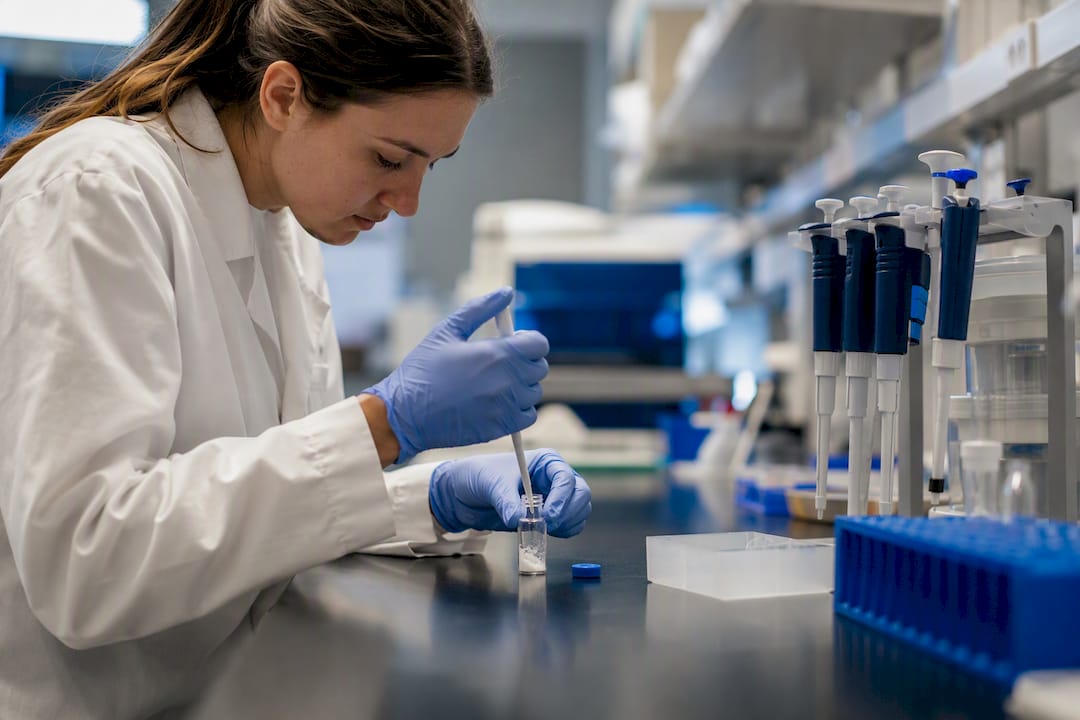
Liquid format removes that preparation step entirely. Draw and use, with no calculation and no mixing technique to get wrong. For a lab running dozens of quick assays in a week, that time saving adds up fast, and it also removes reconstitution error, a genuine source of dosing inconsistency when researchers are working under time pressure or training new staff.
The dosing-error risk cuts in liquid's favour on the preparation side but works against it on the storage side. A liquid vial sitting in a fridge past its practical window degrades silently. Nothing about its appearance changes, but its actual concentration may no longer match the label, whereas a failed lyophilisation cycle usually shows visible signs like a collapsed cake or discolouration long before anyone draws a dose from it.
For labs running frequent, varied experiments across many peptide types, the lyophilised format's upfront preparation cost is usually the better trade against the alternative: managing a fridge full of ageing liquid vials with tightening discard dates all landing on different days.
What does the evidence actually tell us to prioritise?
The stability data is clear enough that the conventional advice on this topic under-serves researchers in one specific way: it treats "lyophilised is more stable" as the end of the analysis, when the more useful insight is that most practical failures in this space come from sterility mismanagement, not chemistry.
A peptide can have excellent inherent stability and still fail because a working vial sat in a shared lab fridge for six weeks under a "should be fine" assumption. The 28 to 30 day rule exists precisely because bacteriostatic water's preservative effectiveness and repeated septum punctures introduce a risk profile that has nothing to do with the peptide's own degradation curve. Treating that number as a hard chemistry deadline, or worse, ignoring it because "the peptide seems fine," both miss the point.
What should researchers prioritise first? Residual moisture data on incoming stock, not marketing claims about purity alone. That's the number worth asking suppliers for before anything else.
— Dr. Authur
Get lyophilized research peptides with the COA data this guide recommends
Everything in this guide points to one practical requirement: a supplier that documents residual moisture, purity, and identity rather than asking researchers to take stability on faith.
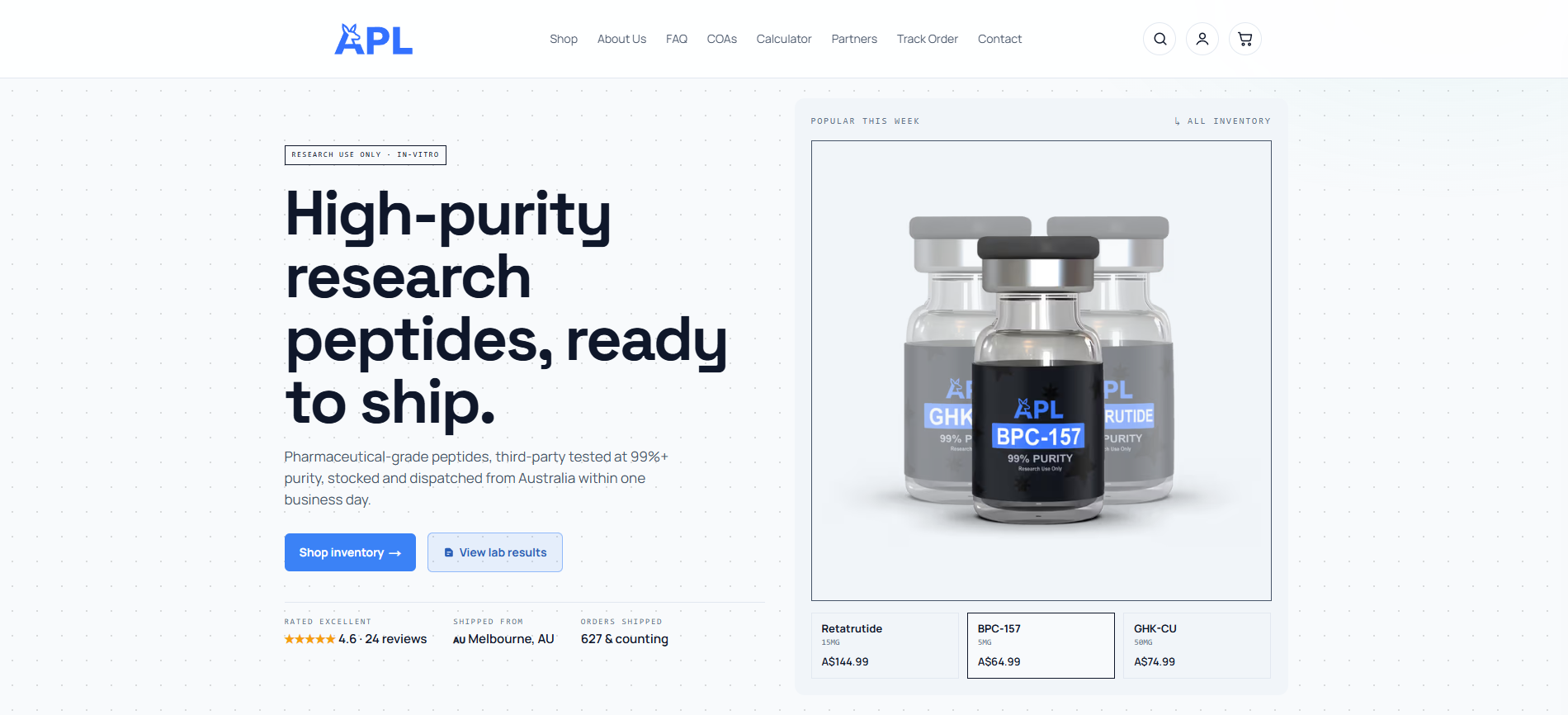
That fast local dispatch is the practical advantage worth weighing against ordering from overseas suppliers with longer, less predictable transit times, particularly for lyophilised stock where minimising time outside a controlled freezer matters. Alongside its core peptide range, Au Peptide Labs also stocks the research supplies this guide covers, including bacteriostatic water, insulin syringes, and alcohol wipes, so reconstitution technique doesn't depend on sourcing consumables from three different vendors. Custom and bulk orders are available for laboratories with recurring needs.
Researchers working with oxidation-sensitive sequences can start with a well-characterised product like LL-37 or SS-31, each supplied with full COA documentation covering identity, purity, and moisture data. Browse the current research peptide range to check stock and place an order for same-day Australian dispatch.
Sources
- Lyophilized vs Non-Lyophilized Peptides: Which Is More Stable? | FormBlends
- How to store peptides: shelf life, fridge vs. freezer & the 30-day myth (2026)
- Peptide storage and handling guidelines | GenScript