
Aupeptidelabs, which stocks and dispatches from Australia, fulfils each of these elements and provides same-day dispatch to reduce cold-chain exposure.
Minimum documentary trust signals to request with every order:
- COA showing HPLC purity and mass spectrometry (MS) confirmation, with net peptide content declared
- Batch or lot number matching the vial label
- Labelled storage temperature on the vial
- Temperature log PDF from the data logger, covering the full transit period
- Safety Data Sheet (SDS) and reconstitution instructions
Pro Tip: Request the COA before dispatch, not on arrival. Reviewing purity and net peptide content in advance lets you reject a non-conforming batch before it enters your cold chain.
What peptide packaging materials must you specify for primary containers?
Primary container selection directly determines whether a peptide reaches the lab in a chemically intact state. Amber borosilicate glass is the standard choice for research peptides: the amber tint attenuates UV and visible light that would otherwise accelerate photodegradation in sequences containing Trp, Tyr or Phe residues, while borosilicate glass offers low extractable ion content compared with soda-lime alternatives. Vial volume should match your aliquot strategy; 1.5–2 mL vials suit single-use aliquots, while 5–10 mL vials are appropriate for bulk reconstitution stocks.
Stopper material is equally consequential:
- Butyl rubber with PTFE or silicone coating provides chemical inertness for most peptide sequences and is the default specification.
- Halobutyl or fluorinated elastomers are appropriate for oxidation-prone sequences (Met, Cys, Trp-rich) where even trace extractables from standard butyl can accelerate degradation.
- Crimped aluminium seals are preferred for long-term storage and tamper evidence; threaded screw caps with PTFE liners are acceptable for working stocks that will be accessed repeatedly within a short period.
Headspace gas matters for sensitive sequences. A nitrogen or argon flush at the time of stoppering reduces residual oxygen inside the vial; argon is marginally denser than nitrogen and provides a slightly more effective oxygen barrier. For Met, Cys or Trp-containing peptides, sequence-dependent storage controls including inert-atmosphere headspace are well-supported by published handling guidance.
Pro Tip: If your peptide contains disulphide bonds, specify PTFE-coated stoppers and an argon headspace flush — standard butyl rubber and residual oxygen are the two most common causes of premature oxidation in cysteine-rich sequences.
Why lyophilised peptides need specific container and stoppering choices
Lyophilised peptides are generally more stable than liquid forms; however, freeze-drying removes bulk water rather than eliminating sensitivity to residual moisture, light, oxygen or thermal cycling. The container-closure system must therefore address all remaining degradation drivers, not just the aqueous phase.
For lyophilised product, the standard specification is:
- Sterile amber glass vials, stoppered under vacuum or inert gas immediately after the lyophilisation cycle
- Crimped immediately after stoppering to prevent atmospheric ingress during handling
- Secondary foil overwrap or sealed barrier pouch to provide an additional moisture and light barrier
Residual moisture is the most frequently underspecified parameter. Published storage guidance supports 24–36 month stability at −20°C for routine sequences when residual moisture is low and thermal cycling is minimised; request a residual moisture specification (% w/w) from your supplier, and treat any value above 3% w/w as a flag for accelerated degradation. Where literature suggests tighter control, desiccant-packed vials or foil-sealed secondary cartons provide additional protection.
Some sequences, particularly those with charged residues prone to moisture deliquescence, may still require −80°C archival storage regardless of lyophilisation quality. Lyophilisation is a stability improvement, not a universal solution.
Which cold-chain packaging options suit Australian shipments?
Australia's geography and climate create specific cold-chain challenges including long interstate legs and hot summer ambient temperatures in major capitals, and limited carrier options for dangerous goods. Refrigerant and insulation choices must be matched to the expected transit duration and seasonal conditions.
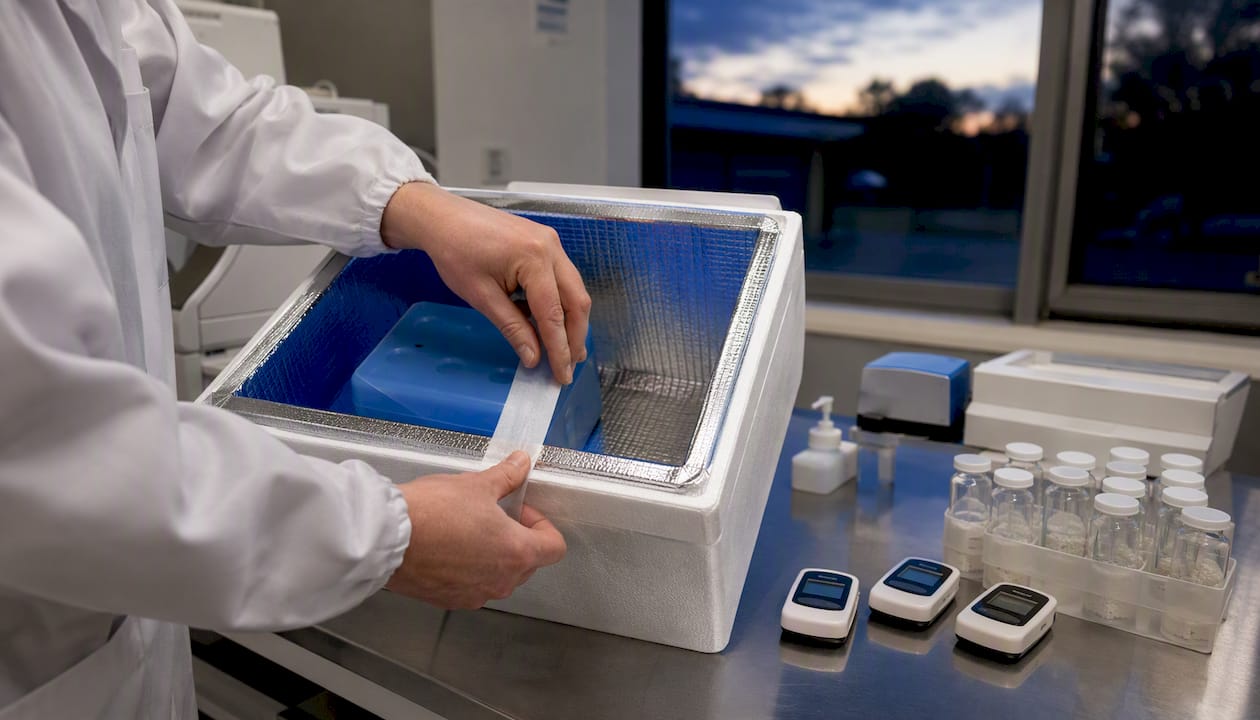
Insulation format determines hold time as much as refrigerant volume. Polyurethane foam shippers provide adequate R-value for most domestic routes; vacuum insulated panels (VIPs) extend hold times significantly for long interstate or remote deliveries. Engineered polystyrene is acceptable for short urban routes in cooler months but is inadequate for summer interstate shipments without supplementary refrigerant.
Practical packing notes:
- Place refrigerant around the insulated chamber, not directly against glass vials, to prevent freeze-damage or condensation on the vial surface.
- Size the refrigerant load for worst-case ambient, not average conditions.
- Avoid scheduling delivery over weekends or public holidays; a 48-hour hold at a depot during a summer weekend can exceed any shipper's rated hold time.
Dry ice shipments require IATA and Australian Dangerous Goods (ADG) Code compliance, including declared quantity and appropriate carrier certification. Confirm carrier capability before specifying dry ice for interstate routes. Domestic fulfilment meaningfully reduces cold-chain handoffs compared with international shipments that pass through customs holds and multiple transfer points.
How desiccants and oxygen control protect peptides in transit
Desiccant selection inside secondary packaging is a frequently overlooked variable. Where your stability data or supplier guidance specifies a target RH, match the desiccant type accordingly.
- Sachet sizing should be calibrated to the internal volume of the secondary package and the expected moisture load during transit; ask suppliers for the desiccant's packet adsorption rate (PAR) to verify adequacy.
- Oxygen scavengers or inert-gas-flushed secondary bagging are appropriate for peptides with Met, Cys or Trp residues, where oxidation is a primary degradation pathway.
- Foil overwrap or sealed barrier pouches provide an additional moisture and oxygen barrier beyond the primary vial closure.
- Visual humidity indicator cards inside the secondary package give a fast accept/reject cue at receipt without requiring analytical testing.
Desiccant belongs in the secondary packaging layer, not inside the primary vial. Placing desiccant inside a sealed vial is not standard practice and can interfere with product integrity.
Pro Tip: Request that your supplier include a humidity indicator card in the secondary packaging. A colour change on arrival is an immediate signal to quarantine and investigate before the product enters inventory.

What temperature monitoring should you demand in every shipment?
| Device type | Evidence format | Best use case |
|---|---|---|
| Single-use freeze indicator | Visual pass/fail | Low-cost screen for freeze-sensitive biologics |
| Time-temperature indicator (TTI) | Visual cumulative exposure | Refrigerated shipments, short transit |
| Multi-use data logger | Downloadable PDF + raw data file | Full traceability, post-excursion investigation |
For research peptide shipments, a multi-use data logger with a downloadable PDF is the minimum standard for any shipment where product integrity is critical. Specify sampling interval (no greater than 15 minutes for transit monitoring), temperature resolution (±0.5°C or better), alarm thresholds aligned with the product's labelled storage range, and calibration date of the logger.
Placement matters: position the recorder next to the product but not touching the glass, and shield it from direct refrigerant contact to avoid localised thermal artefacts that do not reflect product temperature.
If an excursion is recorded, quarantine the shipment immediately. Peer-reviewed handling literature recommends preserving the monitor and all packaging materials for documented investigation rather than accepting subjective assessment of product condition. Download the raw data file before handling the recorder further.
Labelling and documentation required for Australian lab compliance
Every vial label must carry: compound name (including salt or counter-ion form), net peptide content, batch or lot number, manufacture date, expiry or retest date (where provided), and labelled storage temperature. Net peptide content is distinct from gross weight; understanding this distinction is critical for dosing calculations and inventory records. The net peptide content glossary published by Aupeptidelabs explains the convention and supports accurate COA interpretation.
Required documents for each order:
- COA with HPLC purity (percentage) and MS confirmation
- SDS covering handling, storage and disposal
- Reconstitution and handling instructions
- Data logger PDF covering the full transit period
- IATA/ADG dry ice declaration (if applicable)
- Customs and import paperwork for international orders
At receipt, cross-reference the batch number on the vial label against the COA before logging the product into inventory. Accept product into inventory only after visual inspection, COA present, and temperature log either within limits or formally signed off for investigation. Australian regulatory constraints affecting procurement and labelling should inform your internal QA acceptance criteria.
On-receipt inspection: the steps your lab must take immediately
- Inspect outer packaging on arrival; photograph the carton and inner packaging before opening.
- Note refrigerant condition (dry ice remaining, gel pack state) and record ambient temperature at receipt.
- Preserve the temperature recorder; do not power it off or discard it.
- Download the temperature log and review against the product's labelled storage range.
- Quarantine the shipment if excursions are present or documentation is missing; raise a QA hold with the supplier.
- Move product into approved storage (refrigerator or freezer per label) immediately after inspection; log storage location and time in inventory.
- Document any visual anomalies: collapsed lyophilised cake, discolouration, cracked or damaged seals.
For reconstitution, equilibrate the sealed vial to room temperature before opening to prevent condensation from entering the vial and increasing residual moisture. Prepare single-use aliquots at the working concentration, label each aliquot with concentration, date and aliquot number, and avoid repeated freeze-thaw cycles, which accelerate degradation in both lyophilised and reconstituted forms.
Pro Tip: Photograph the data logger display and the vial label together in the same frame at receipt. This creates a time-stamped record linking product identity to temperature history without requiring a separate documentation step.
How to validate packaging and evaluate post-excursion shipments
Packaging qualification requires evidence that the chosen insulated shipper and refrigerant combination was challenged under worst-case ambient conditions representative of the intended route. Request a temperature-mapping summary or challenge test report from your supplier before approving a new shipper configuration.
- Mean kinetic temperature (MKT) provides a useful summary statistic for evaluating cumulative thermal exposure across a shipment, but does not substitute for product-specific stability data when making disposition decisions.
- Post-excursion testing should include HPLC or potency analysis on a retained sample when a significant temperature breach is documented; subjective visual assessment alone is insufficient for high-value or critical-use peptides.
- Acceptance criteria should be defined numerically: for example, maximum cumulative time above a specified temperature, aligned with the supplier's stability data or a formal disposition recommendation.
- Retention samples held by the supplier enable comparative testing after an incident; request a retained reference vial when placing orders for critical sequences.
Cold-chain protection is an integrated supply-chain problem: storage, transport and receiving controls must be qualified together rather than treated as independent steps.
Pro Tip: Ask your supplier for the temperature-mapping protocol used to qualify their shippers. A supplier who cannot provide this document has not validated their cold-chain configuration.
Copy-and-paste ordering checklist for Australian purchasers
Use the following specification when placing orders or briefing suppliers:
Pre-order specification
- Lyophilised product; residual moisture ≤3% w/w
- Amber borosilicate glass vials; volume matched to aliquot strategy
- Butyl rubber stopper (PTFE/silicone-coated); halobutyl or fluorinated elastomer for oxidation-prone sequences
- Nitrogen or argon headspace flush for Met/Cys/Trp-containing sequences
- Crimped aluminium seal; tamper-evident
Packing requirements
- Molecular sieve or silica gel desiccant (PAR-rated for package volume)
- Foil overwrap or sealed barrier pouch
- Insulated shipper sized for worst-case hold time and seasonal ambient
- Active data logger (≤15-minute sampling interval, ±0.5°C resolution, calibrated)
- Refrigerant appropriate to transit duration (dry ice, PCM or gel packs per route)
Documentation to attach
- COA (HPLC purity + MS confirmation, net peptide content declared)
- SDS and reconstitution instructions
- Data logger PDF (full transit coverage)
- Batch/lot number matching vial label
- IATA/ADG declaration if dry ice used
Delivery requirements
- Same-day dispatch for domestic Australian orders to avoid weekend depot holds
- Carrier confirmed for dangerous goods if dry ice is specified
- Delivery window: Monday to Thursday preferred; no weekend holds
- Receipt contact nominated for delivery verification
Post-delivery
- Online access to raw temperature data file or PDF within 24 hours of delivery
- Defined excursion response: quarantine + QA review + supplier disposition recommendation backed by stability data
Domestic Australian suppliers who dispatch same-day reduce the number of cold-chain handoffs and the seasonal exposure risk that long international routes introduce.
What local fulfilment actually changes for Australian labs
The practical gap between a well-specified order and a peptide that arrives in usable condition is almost always a logistics problem, not a chemistry problem. International shipments for Australian labs routinely pass through three to five handling points before reaching the lab, each representing a potential excursion event. Customs holds during Australian summer can expose shipments to ambient temperatures that exceed the rated hold time of even well-insulated shippers.
Seasonal packing adjustments and same-day dispatch are not administrative niceties; they are the two most consequential risk mitigations available for interstate shipments during the October to March period. A supplier who does not adjust refrigerant load for summer conditions or who dispatches on a Friday afternoon has transferred excursion risk to the purchaser without disclosure.
The trust signals that matter most in practice are three: an intact COA with net peptide content declared, a temperature log PDF that covers the full transit without gaps, and a vial label whose batch number matches the COA exactly. Everything else in the specification exists to make those three signals reliable.
Aupeptidelabs: pharmaceutical-grade peptides, dispatched from Australia
Aupeptidelabs stocks pharmaceutical-grade research peptides at greater than 99% purity, with third-party COA and same-day dispatch from Australia. Every shipment includes amber vials with crimped seals, desiccant in secondary packaging, qualified insulated shippers, and an embedded data logger with a PDF temperature record delivered with the consignment. For Australian labs, this means fewer cold-chain handoffs, no customs delays, and documentation that meets internal QA acceptance criteria on arrival.
Researchers who need a worked example of packaging and documentation tied to a specific sequence can review individual product pages such as SS-31 or ARA-290. To place an order or request a packaging specification template, visit the Aupeptidelabs order page.
Sources
- Peptide storage and handling: lyophilized vs reconstituted, temperature, degradation | Compound Review
- Checking your browser - reCAPTCHA
Supplier documents to request for every order: COA, SDS, stability protocol summary, temperature-mapping qualification report for the shipper configuration used, and the data logger PDF for the specific shipment. IATA and ADG Code documentation applies to any consignment containing dry ice.