
TL;DR:
- For laboratory and research use, opt for a domestic supplier with third-party analytical Certificates of Analysis, such as Aupeptidelabs, which ships quickly and verifies high purity. For clinical or regulatory workflows, engage a GMP-accredited Australian manufacturer like Auspep that provides full batch traceability and compliance documentation. Proper verification, pre-synthesis assessment, and choosing the right supplier category are essential to ensure experimental integrity and regulatory compliance.
For routine in-vitro assays, screening, and small-scale laboratory work, a domestic research-grade supplier with third-party HPLC and mass spectrometry Certificates of Analysis is the right starting point. For clinical-grade API manufacture, IND-enabling studies, or any pathway requiring regulatory audit trails, you need a GMP-accredited manufacturer operating under formal facility accreditation.
- Research-grade need: verify the batch CoA (HPLC purity, MS identity, batch number) before ordering, and confirm local dispatch to avoid customs delays.
- Custom synthesis need: request a pre-synthesis feasibility assessment covering predicted solubility, cleavage profile, and synthetic yield before committing to a run.
- Recommended for rapid, verified stock peptides: Aupeptidelabs dispatches from Australia within one business day with purity above 99% and third-party CoA documentation.
- Recommended for API or clinical pathway work: engage a GMP-accredited Australian manufacturer with documented facility accreditation and traceable batch records.
Pro Tip: Before placing any order, download the supplier's sample CoA and confirm it includes an HPLC chromatogram, MS spectrum, batch number, and analyst sign-off. A CoA that lists only a purity percentage with no supporting analytical data is insufficient for research documentation.
Who uses this guide, and what are the two supplier roles in Australia?
This guide is written for bona fide research laboratories, universities, contract research organisations (CROs), and commercial R&D units in Australia that procure synthetic peptides for experimental use. The procurement decision splits cleanly into two supplier roles, and confusing them wastes time and budget.
GMP/API manufacturers operate under formal Good Manufacturing Practice accreditation, produce peptide active pharmaceutical ingredients (APIs), and support clinical trial supply, regulatory submissions, and audit-ready batch documentation. Auspep is the only GMP-accredited peptide manufacturer in Australia, with facilities designed to meet Class 350 (Grade C) and Class 3500 (Grade D) cleanroom standards for clinical peptide API manufacture. Their typical clients are pharmaceutical developers, biotech companies running IND-enabling programmes, and institutions requiring regulatory-grade documentation.
Research-grade suppliers stock HPLC-verified peptides at high purity, ship domestically with batch-specific CoAs, and serve assay development, receptor-binding studies, in-vitro pharmacology, and screening programmes. Lead times are days rather than weeks, and MOQs are typically low enough for exploratory work.
- GMP/API use cases: API development, clinical trial material, IND-enabling toxicology, scale-up to kilogram quantities.
- Research-grade use cases: assay development, receptor-knockout validation, Gs-cAMP-PKA cascade studies, peptide library screening, small-scale in-vitro synthesis.
What does the Australian peptide supplier landscape actually look like?
The local market contains several distinct supplier categories, each with a different capability profile.
- GMP-accredited API manufacturers: formal facility accreditation, full batch traceability, clinical-scale production, regulatory documentation packages, higher MOQs and pricing commensurate with audit overhead.
- cGMP-operating contract manufacturers: synthesis conducted in ISO 7 cleanrooms under cGMP protocols, with batch traceability and cold-chain options; positioned between full GMP API manufacture and standard research supply.
- Research-grade catalogue suppliers: HPLC-verified stock peptides at purity specifications suited to in-vitro work, local dispatch, low MOQs, and batch CoAs. Aupeptidelabs operates in this category, with third-party purity verification, dispatch from Australia within one business day, and documented product traceability.
- Custom synthesis specialists: bespoke sequences, modified amino acids, unusual residues, and peptide libraries; lead times and pricing scale with sequence complexity and modification density.
- Distributors and reagent suppliers: catalogue amino acids, Fmoc-protected and Boc-protected building blocks, coupling reagents, and peptide libraries for in-house synthesis programmes.
Matching your project to the right category before requesting quotes avoids the common error of approaching a GMP API manufacturer for a ten-milligram research sample, or expecting a catalogue supplier to deliver clinical-grade documentation.
What quality controls and documentation should you demand before ordering?
Analytical rigour is the single most important differentiator between a reliable peptide supplier and one that will compromise your experimental data.

| Analytical method | What it confirms | Why it matters to researchers |
|---|---|---|
| HPLC purity chromatogram | Percentage of target peptide relative to impurities | Confirms the stated purity grade; impurities can confound receptor-binding or cell-based assays |
| Mass spectrometry (MS) | Molecular identity via exact mass | Verifies the correct sequence was synthesised; catches truncations and deletions |
| Elemental analysis | Empirical formula confirmation | Relevant for novel sequences and modified peptides where MS alone may be ambiguous |
| Water content (Karl Fischer) | Residual moisture percentage | Affects accurate weighing and concentration calculations |
| Residual solvents | Trace organic solvent levels | Critical for cell-based assays where solvent contamination alters viability |
A complete Certificate of Analysis must include: batch number, synthesis method, HPLC chromatogram with retention time and peak integration, MS spectrum with observed and calculated mass, purity percentage, water content, residual solvent data, storage conditions, and an analyst sign-off with date. A document that omits the chromatogram or spectrum is not a CoA; it is a purity claim with no supporting evidence.
The distinction between "GMP-compliant" as a marketing phrase and genuine GMP accreditation is material. Operating within an accredited GMP facility requires formal regulatory approval, documented SOPs, traceable batch records, and periodic facility audits. A supplier describing itself as "GMP-compliant" without documentary proof of facility accreditation is using the term descriptively, not as a regulatory status. Request the accreditation certificate and audit record when GMP capability is a project requirement.
Pro Tip: For critical experiments, send a sample aliquot to an independent university mass spectrometry or HPLC facility for third-party verification before committing to a large-scale order. Chain-of-custody documentation from that verification step is also useful if the work feeds into a regulatory submission.
Quality callout: Batch-specific CoA documentation with HPLC chromatograms and MS spectra is the minimum analytical standard for research-grade peptides. Any supplier unwilling to provide these documents on request should be removed from your vendor list.
How do ordering, lead times, and logistics work for Australian labs?
Procurement timelines differ substantially between stock and custom orders, and logistics planning affects sample integrity as much as synthesis quality.
- Off-the-shelf stock peptides: domestic suppliers typically dispatch within one to three business days; Aupeptidelabs dispatches within one business day from its Australian location, eliminating the customs clearance delays that add unpredictable weeks to international orders.
- Custom synthesis lead times: straightforward sequences with standard amino acids generally complete in two to four weeks; complex sequences with unusual residues, multiple disulfide bonds, or post-translational modifications can extend to several months. Pre-synthesis feasibility assessment covering solubility prediction, cleavage profile, and expected synthetic yield materially reduces the risk of failed batches and cost overruns.
- Cold-chain shipping: peptides are susceptible to degradation at elevated ambient temperatures, a practical concern given Australian climate conditions during transit. Request temperature-controlled shipping with recorded logs for any peptide that is sensitive to heat or prone to aggregation. Suppliers that document cold-chain compliance reduce the risk of receiving compromised material.
- Hazardous goods handling: lyophilised peptides containing reactive functional groups may require hazardous goods classification under Australian transport regulations. Confirm with your supplier that packaging and labelling comply with relevant transport standards, and request the Safety Data Sheet (SDS) for internal biosafety documentation.
- Packaging: discreet, secure packaging with appropriate desiccant and inert atmosphere conditions is standard for high-purity research peptides. Confirm that the supplier's packaging protocol matches your internal receiving and storage requirements.
For peptide recovery and handling after receipt, reconstitution protocols and storage conditions documented on the CoA should be followed precisely to preserve purity through the experimental workflow.
What are the regulatory and legal requirements for Australian labs buying peptides?
Research peptides in Australia are supplied strictly for in-vitro or research use and are not approved for human or veterinary application. Investigative reporting has documented the risks associated with online peptide sales that circumvent these restrictions, reinforcing why supplier purchaser verification is a compliance necessity rather than an administrative formality.
- Purchaser verification: reputable suppliers require institutional credentials, an Australian ABN or organisation email address, and project justification before processing orders. Labs should prepare these documents in advance to avoid procurement delays.
- Permitted use: all research peptides must be used within a bona fide research context. Diversion to human or veterinary use is prohibited and exposes both the purchaser and supplier to regulatory liability.
- GMP and regulatory readiness: for any project with a clinical translation pathway, GMP-accredited manufacture with full batch traceability is a prerequisite for regulatory submissions to the Therapeutic Goods Administration (TGA). Research-grade supply is not a substitute for this documentation tier.
- Peptide legality in Australia: the legal framework governing peptide procurement is nuanced and depends on intended use, scheduling status, and the regulatory pathway of the compound. Confirm the current status of any compound with the TGA or a qualified regulatory affairs professional before ordering.
This article provides general information for procurement guidance purposes only. Confirm current regulatory requirements with the TGA or a qualified regulatory professional for your specific situation.
How do you choose a peptide manufacturer or supplier in Australia?
A structured evaluation process reduces the risk of ordering from an unsuitable supplier and protects experimental data integrity.
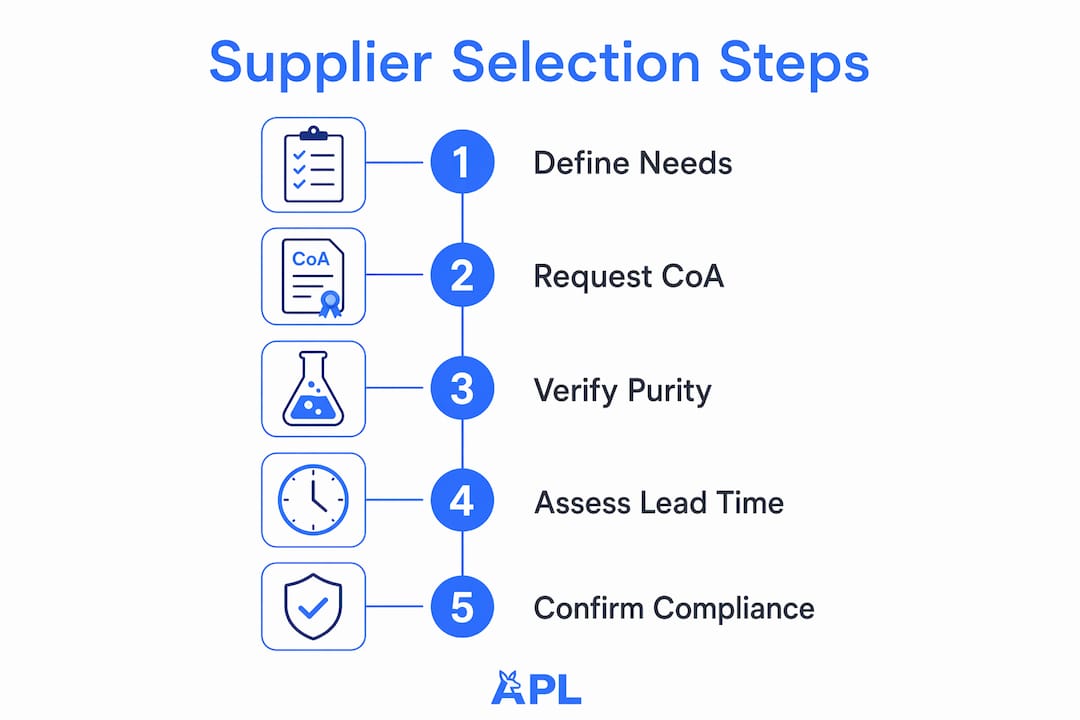
Sequential procurement steps:
- Define end use and documentation requirements. Determine whether the project requires research-grade CoA documentation or GMP-certified batch records with audit trails. This single decision determines which supplier category is appropriate.
- Request the CoA and accreditation evidence. Obtain a sample CoA for a comparable product and, where GMP capability is claimed, request the facility accreditation certificate and most recent audit summary.
- Order a pilot or sample batch. Before committing to a large order, procure a small quantity and verify purity independently if the application is critical. Supplier testing documentation should match your in-house or third-party verification results.
- Scale with batch traceability. Once a supplier is qualified, establish a procurement process that records batch numbers against experimental records to maintain traceability across the project lifecycle.
Checklist items to verify before ordering:
- CoA completeness: HPLC chromatogram, MS spectrum, batch number, analyst sign-off
- Facility accreditation claims: documentary evidence, not marketing language
- MOQ and pricing structure: pilot-batch availability before large-scale commitment
- Lead times: confirmed dispatch dates, not estimated ranges
- Cold-chain and hazardous goods policy: documented procedures, not verbal assurances
- Technical consultation: pre-synthesis feasibility for custom sequences
- IP and confidentiality terms: NDA availability for proprietary sequences
Red flags: vague CoAs with purity percentages but no analytical data; no batch number or traceability; refusal to provide accreditation documentation; ambiguous or undocumented shipping practices; unverifiable GMP claims.
Template questions for vendor evaluation: "Can you provide the CoA and HPLC chromatogram for a current batch of [sequence]?" / "What is your facility accreditation status and can you provide the certificate?" / "What is your cold-chain protocol for [destination postcode]?" / "Do you offer a pilot batch before full-scale ordering?"

Why Aupeptidelabs is recommended for Australian research labs
Aupeptidelabs meets the research-grade supplier checklist across the criteria that matter most to laboratory procurement.
- Purity: all products are tested to purity levels exceeding 99%, supported by third-party analytical documentation rather than in-house claims alone.
- Dispatch speed: shipments leave Australia within one business day, the fastest domestic fulfilment window available for research peptides in Australia and a direct solution to the customs delay problem that affects international orders.
- CoA provision: batch-specific Certificates of Analysis accompany every order, with documentation sufficient for laboratory records and experimental traceability.
- Purchaser verification: Aupeptidelabs applies standard purchaser vetting consistent with research-use-only compliance requirements.
- Customer satisfaction: Aupeptidelabs holds a 4.6/5 rating based on verified customer reviews, reflecting consistent performance on product quality and delivery reliability.
- Ancillary supplies: the product range extends to bacteriostatic water, insulin syringes, and alcohol wipes, consolidating common laboratory consumables into a single domestic order.
Dispatch callout: Dispatch within one business day from Australia with purity above 99% and third-party CoA documentation. Aupeptidelabs's 4.6/5 verified customer rating reflects consistent delivery on both product quality and fulfilment speed.
For procurement teams evaluating supplier trust signals, the combination of third-party purity verification, domestic dispatch, and documented traceability positions Aupeptidelabs as a reliable first-choice research supplier for Australian laboratories.
The procurement habits that actually protect your research
The most common procurement failure in peptide research is not choosing the wrong supplier outright. It is skipping the pilot batch because the project timeline is tight, then discovering a purity or identity issue mid-experiment when the cost of repeating the work is far higher than the cost of the verification step would have been.
Local fulfilment resolves one category of risk entirely: customs delays, temperature excursions during international transit, and import documentation errors disappear when the supplier dispatches from within Australia. That is not a minor convenience; for time-sensitive assays or experiments with narrow reconstitution windows, a predictable one-business-day dispatch is a material experimental variable.
Pre-synthesis feasibility calls are equally underutilised. A supplier willing to assess solubility, cleavage profile, and synthetic yield before accepting a custom order is protecting both parties from a failed batch. Treat a supplier that skips this step as a risk indicator, not a sign of efficiency.
The practical recommendation for ongoing supplier relationships: schedule a sample re-verification before any large-scale order, even with a qualified supplier. Synthesis batches vary, and a single independent HPLC or MS check before committing significant budget is straightforward risk management.
Order from Aupeptidelabs: research-grade peptides, dispatched today
Australian labs that need high-purity research peptides without the lead times and customs uncertainty of international supply have a direct domestic option. Aupeptidelabs stocks an extensive range of pharmaceutical-grade research peptides at purity above 99%, dispatches within one business day from Australia, and provides third-party CoA documentation with every order.
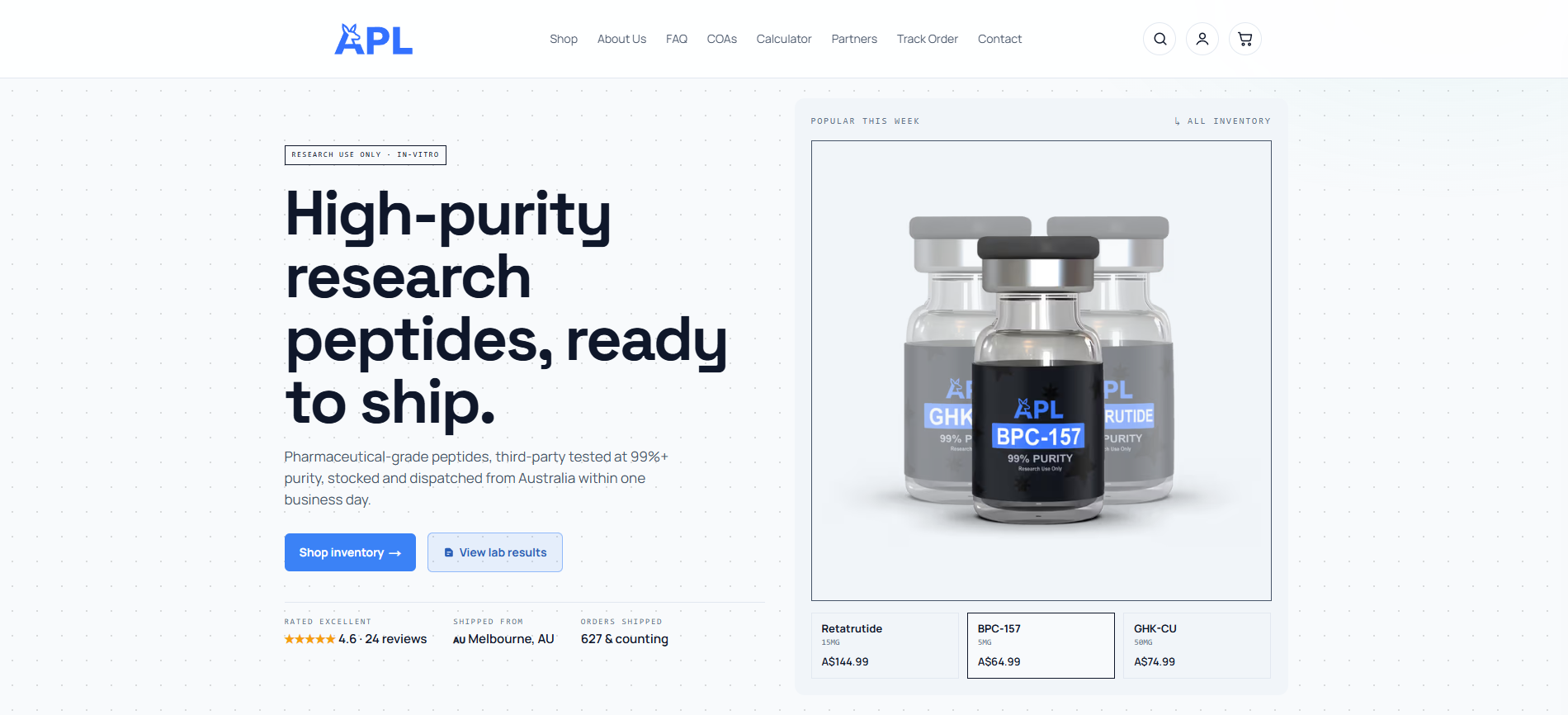
To place an order or request a custom synthesis quote, visit the Aupeptidelabs product page and select your peptide from the catalogue or submit a custom sequence enquiry. CoAs are available on request prior to ordering for procurement teams that require pre-purchase analytical review. All products are supplied for research use only; purchaser verification is required at checkout. For bulk orders or custom synthesis discussions, contact the Aupeptidelabs team directly through the website to initiate a feasibility consultation.
Primary sources and further reading
Official and primary sources:
- Auspep GMP Manufacturing — facility accreditation details and cleanroom classification for clinical peptide API manufacture in Australia.
- Auspep Peptide Synthesis — pre-synthesis feasibility assessment methodology and custom synthesis capabilities.
- The Guardian: Not approved for human use — investigative reporting on online peptide sales risks and the importance of purchaser verification in Australia.
Aupeptidelabs further reading:
- Buy peptides Australia: top suppliers compared — procurement comparison and supplier selection criteria for Australian laboratories.
- Are peptides legal in Australia? — detailed walkthrough of legal restrictions, scheduling status, and compliant procurement practices.
- Pharmaceutical-grade peptide sources in Australia — manufacturing grades, sourcing options, and GMP versus research-grade distinctions.
- Peptide testing Australia: six alternatives — independent verification options for critical batch confirmation.