
Concentration (mcg/mL) equals vial mass (mg) multiplied by 1,000, divided by the volume of bacteriostatic water added (mL). From there, mcg per syringe unit equals that concentration divided by 100, since a standard insulin syringe reads 100 units to 1 mL.
Take a 5 mg vial reconstituted with 2 mL of bacteriostatic water: 5 × 1,000 ÷ 2 = 2,500 mcg/mL, or 25 mcg per unit. A 250 mcg dose therefore draws to 10 units.
- Concentration formula: (vial mg × 1,000) ÷ bac water mL = mcg/mL
- Units formula: mcg/mL ÷ 100 = mcg per unit (100U syringe)
- Rule of thumb: choose a reconstitution volume that places common doses somewhere between 10 and 50 units
Quick check: for the example above, doubling the bac water to 4 mL halves the concentration to 12.5 mcg per unit, pushing the same 250 mcg dose to 20 units — still comfortably inside the accurate reading range on a standard syringe.
Step-by-step peptide reconstitution for laboratory preparations
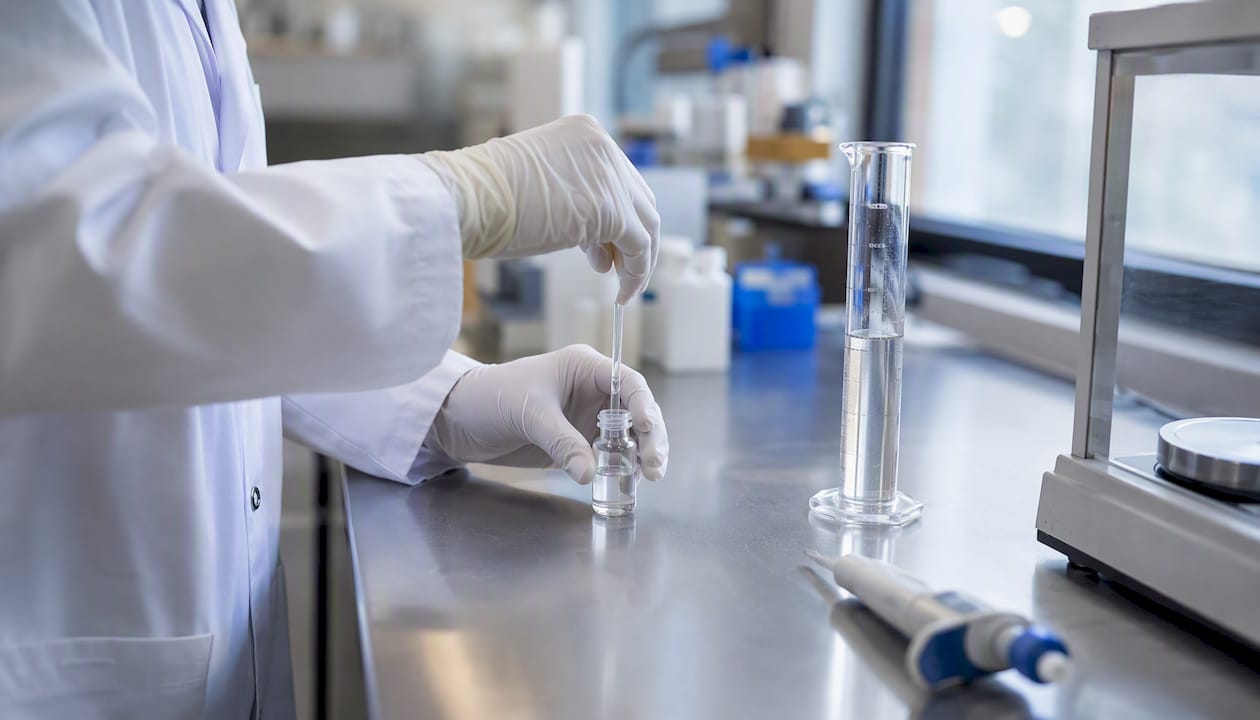
Consistent technique matters as much as the arithmetic. A correct concentration calculation is worthless if the reconstitution itself introduces contamination or measurement drift.
Set up on a clean, uncluttered bench, ideally under a laminar flow hood if your lab has one, and wear gloves. Wipe the vial's rubber stopper and the bacteriostatic water stopper with an alcohol swab before every draw, not just the first one.
- Select your solvent. Bacteriostatic water is the default for most peptides intended for short-term refrigerated storage, since the added benzyl alcohol suppresses bacterial growth across repeated punctures. Some peptides are sensitive to that preservative and call for sterile water instead. A technical comparison of bacteriostatic and sterile water is worth reading before you settle on one for a new peptide.
- Draw the calculated volume of solvent into a syringe fitted with an appropriate reconstitution needle.
- Insert the needle at an angle and let the water run slowly down the inside wall of the vial rather than firing it directly onto the lyophilised powder.
- Swirl gently to dissolve. Never shake. Agitation of that kind can denature the peptide's secondary structure and skew your actual concentration versus your calculated one.
- Label the vial immediately with the reconstitution date, the solvent volume used, and the resulting mcg/mL or units-per-dose figure.
- Refrigerate at 2 to 8°C. Most reconstituted peptides hold reasonable stability for around 28 days under refrigeration, though this varies by peptide chemistry and handling, so treat that figure as a general guide rather than a fixed rule for every compound.
Pro Tip: Aliquot a reconstituted vial into several smaller volumes if it will be accessed repeatedly over its shelf life. Fewer stopper punctures mean less risk of contamination and less concentration drift from evaporation.
Research use only. These preparations and calculations are not intended for clinical or veterinary administration.
Peptide molarity calculation and unit conversions explained
Two separate calculation chains matter in a peptide lab, and they serve different purposes. The mass-to-syringe-units chain tells you how much volume to draw for a target dose. The mass-to-molarity chain tells you what concentration you're actually delivering to cells or an assay well, and it's the one most researchers get wrong first time.
Mass to syringe units: Concentration (mcg/mL) = (vial mg × 1,000) ÷ bac water (mL) Units per dose = desired dose (mcg) ÷ mcg per unit
Mass to molarity: Moles = mass (g) ÷ molecular weight (g/mol) Molarity (M) = moles ÷ volume (L)
This second pathway is the one cell-based and biochemical assays rely on almost exclusively, since dose-response and receptor-binding work is expressed in molar units, not mcg. Getting the peptide's exact molecular weight right is the single biggest source of error here. A molecular weight calculator removes the guesswork, particularly for modified or branched peptides where the MW isn't obvious from the sequence alone.
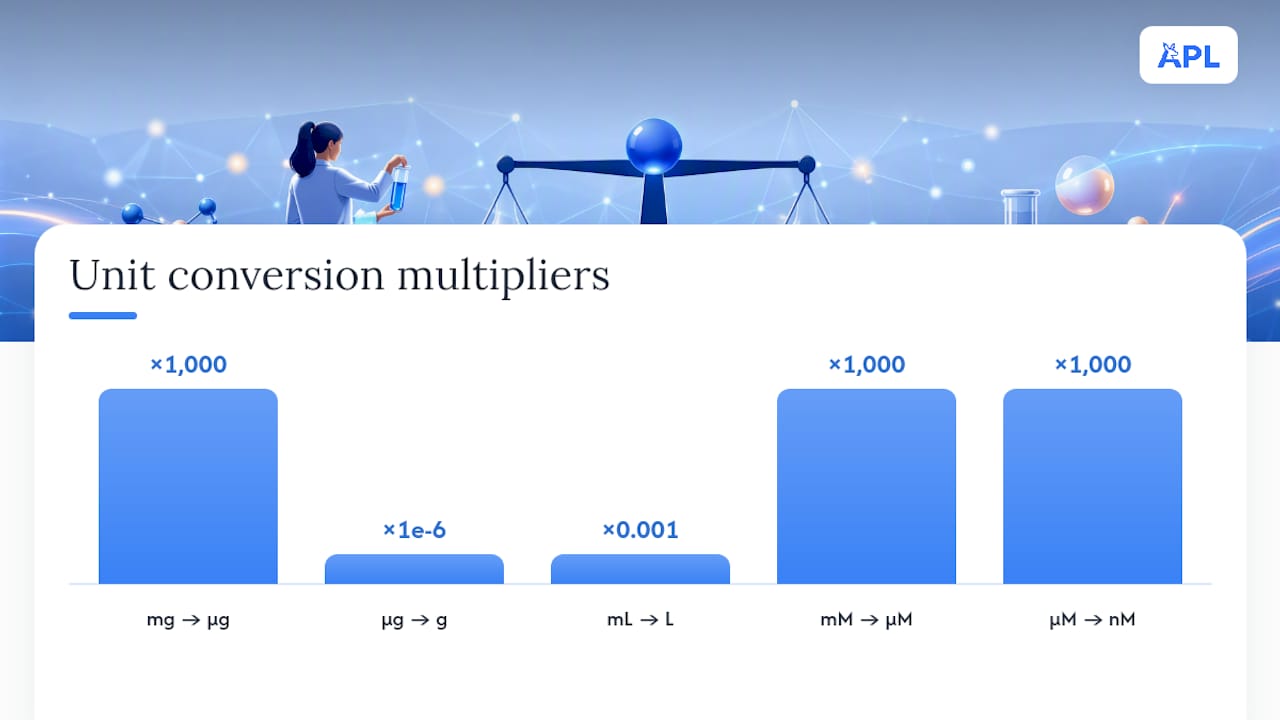
| Convert from | Convert to | Multiply by |
|---|---|---|
| mg | µg | 1,000 |
| µg | g | 1 × 10⁻⁶ |
| mL | L | 0.001 |
| mM | µM | 1,000 |
| µM | nM | 1,000 |
Worked molarity example: A peptide with a molecular weight of 1,000 g/mol, dissolved as 1 mg in 1 mL, gives 0.001 g ÷ 1,000 g/mol = 1 × 10⁻⁶ mol, in a volume of 0.001 L. That's 1 × 10⁻³ M, or 1 mM. Typical working concentrations for in-vitro assays sit in the 0.1 to 100 µM range, so a 1 mM stock like this one needs a further dilution step before it reaches the bench.
- Always confirm MW from the peptide's certificate of analysis, not a generic estimate
- Convert mg to g before applying the moles formula. Misplaced decimals here are the most common calculation error in the lab
Choosing a reconstitution volume: the trade-offs
More bac water means a lower concentration, which makes small doses easier to measure accurately but pushes injection or pipetting volumes higher. Less bac water concentrates the peptide, keeping volumes small but leaving less room for error if your syringe or pipette isn't finely graduated.
The working compromise most labs settle on is targeting a reconstitution volume that lands typical doses between roughly 10 and 50 units on a standard 100U syringe. Below 10 units, small misreads translate into large percentage errors in the actual dose delivered. Above 50 units, you're using more of the vial's total volume per dose than necessary, and injection volume becomes the limiting factor.
- Assay work: plan around molar concentrations and serial dilutions, not syringe units
- Volumetric dosing: plan around the 10 to 50 unit window on a 100U syringe
- Once you settle on a bac water volume for a given vial, keep it fixed for that vial's entire life. Changing it mid-use makes every subsequent draw a fresh calculation
Pro Tip: If your target dose consistently falls near 5 units or under 100 units, it's simpler to adjust your bac water volume upfront than to compensate with awkward syringe reading later.
Three worked peptide dilution calculations
- 5 mg vial, 2 mL bac water, 250 mcg dose. Concentration: (5 × 1,000) ÷ 2 = 2,500 mcg/mL, or 25 mcg per unit. Dose in units: 250 ÷ 25 = 10 units.
- 2 mg vial, 1 mL bac water, molarity conversion. Concentration: (2 × 1,000) ÷ 1 = 2,000 mcg/mL, or 2 mg/mL. If the peptide's molecular weight is 2,000 g/mol, that's 0.002 g ÷ 2,000 g/mol = 1 × 10⁻⁶ mol in 0.001 L, giving 1 mM, or 1,000 µM.
- 1 mM stock with a serial dilution plan. A peptide with MW 1,000 g/mol dissolved as 1 mg in 1 mL yields exactly 1 mM. Diluting 1 in 10 (10 µL stock into 90 µL diluent) three times in succession brings that down to 1 µM, a typical in-vitro working concentration.
Pipetting error compounds across each dilution step, so a 2 percent inaccuracy at step one becomes a meaningfully larger deviation by step three. Use calibrated pipettes and round MW figures to at least one decimal place rather than the nearest whole number, particularly for smaller peptides where a rounding error shifts the molarity noticeably.
Calculators and templates for peptide dilution
Manual arithmetic works, but a dedicated calculator removes the two most common failure points: mixed-up decimal places and unit confusion between mg, mcg, and moles. Reconstitution calculators solve for solvent volume given a target concentration, molarity calculators handle the mass-to-molar conversion, and serial dilution planners lay out multi-step dilutions in one pass.
The Aupeptidelabs peptide dilution calculator covers reconstitution volume, concentration, and syringe units in one tool built specifically around the vial-to-syringe workflow described above.
Whichever calculator you use, the same four fields drive every result:
- Vial mass (mg)
- Desired dose (µg)
- Bacteriostatic water volume (mL)
- Molecular weight (g/mol), if converting to µM or nM
Balancing accuracy and lab workflow
Repeatability matters more than any single calculation. A correct number written on a label is only useful if the next person handling that vial can trust it without redoing the maths themselves.
Pro Tip: Run the calculation once per vial, record the mcg-per-unit figure directly on the label, and treat that vial as fixed for its working life. Reconcentrated stocks reduce pipetting error on small working volumes, so lean toward higher stock concentrations when the assay allows it.
Where to source calculators and research-grade peptides
Getting the maths right only matters if the peptide behind it is what the certificate says it is. Aupeptidelabs ships pharmaceutical-grade research peptides tested above 99% purity, dispatched from Australia within one business day, so labs aren't stuck waiting on customs while a reconstitution schedule sits idle.

Alongside the peptide dilution calculator covered above, Aupeptidelabs stocks the bacteriostatic water, insulin syringes, and alcohol wipes needed to run the reconstitution steps in this guide, plus a full peptide catalogue for procurement, including LL-37. All products are supplied strictly for laboratory research, not for clinical or veterinary use. If your next step is sourcing a vial and confirming your dilution numbers before it arrives, start with the Aupeptidelabs product range and run your figures through the calculator first.
Sources
- Reconstitution 101: Turning a Powder Vial Into a Working Dose | PepAtlas
- Calculate peptide and protein molecular weight (MW) | AAT Bio
This article is general information, not a substitute for advice from a qualified doctor. Consult a qualified healthcare professional about your own circumstances before acting on anything here.