
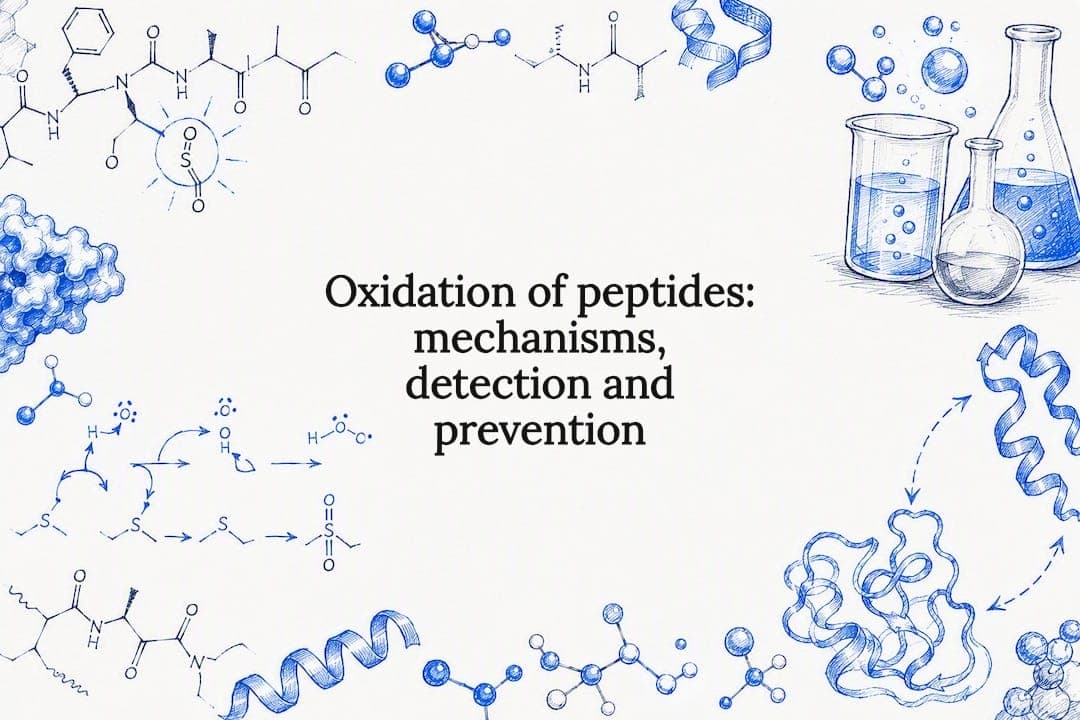
Oxidation of peptides is the covalent modification of oxidation‑prone side chains, most commonly methionine, cysteine, histidine, tryptophan, tyrosine and phenylalanine, altering conformation, bioactivity and analytical behaviour. This matters for every lab handling synthetic or recombinant peptides: an oxidised sample can produce false negatives in a bioassay, unexplained aggregation in a formulation study, or a peak shift in your ICH-aligned forced degradation run that nobody flags until the batch is unusable. Detection relies on established analytical standards, with LC-MS/MS and UHPLC-MS/MS the accepted tools for spotting the characteristic mass shifts, and the literature on forced hydrogen peroxide stress in peptides like somatostatin gives a working template for what to expect.
Three actions matter immediately:
- Store peptides lyophilised wherever possible, since dissolved peptides oxidise faster.
- Exclude light and headspace oxygen from storage vials, particularly for Trp and Tyr‑rich sequences.
- Run periodic LC-MS/MS checks on stock peptides rather than assuming stability from a certificate issued months earlier.
Oxidative damage is cumulative and rarely reversible once advanced, which is why prevention gets more attention in this guide than remediation.
What causes oxidation of peptides at the chemical level?
Oxidation happens through a handful of well‑characterised pathways, and knowing which one applies to your sample tells you what to control. Reactive oxygen species, chiefly the hydroxyl radical (•OH), hydrogen peroxide (H2O2) and singlet oxygen (1O2), drive most of the damage seen in stored or stressed peptides. Metal‑catalysed one‑electron (Fenton‑type) reactions generate •OH from trace iron or copper contamination in buffers, while two‑electron oxidations (typically from H2O2 or peroxide‑contaminated excipients like polysorbates) act more selectively on sulfur and aromatic side chains.
Mechanistically, radical pathways abstract a hydrogen atom or add directly to aromatic rings, whereas sulfur oxidation proceeds stepwise from sulfoxide through to sulfone. Hydroxyl radical studies on leucine‑enkephalin show hydroxylation, hydroperoxide formation and backbone fragmentation occurring together, not in isolation.
Several conditions push a peptide toward one pathway or another:
- Low pH and trace transition metals accelerate Fenton‑type radical generation.
- Light exposure, especially UV, drives singlet oxygen formation around Trp and Tyr residues.
- Buffer components and residual peroxides from polysorbate degradation act as latent oxidant reservoirs.
- Radical‑radical coupling under sustained oxidative stress produces backbone cleavage and crosslinks such as di‑tyrosine, both hallmarks of advanced oxidative damage.
Which residues oxidise and what mass shifts do they leave?
Methionine and cysteine are the most reactive residues under nearly every oxidative condition, but the aromatic residues carry equally diagnostic signatures once you know what to search for. Davies and Truscott's review identifies Met, Cys, His, Trp, Tyr and Phe as the six residues carrying the bulk of oxidation risk across natural peptides and proteins.
Typical products by residue:
- Methionine: sulfoxide (+16 Da), progressing to sulfone (+32 Da) under sustained stress.
- Cysteine: sulfenic, sulfinic and sulfonic acid intermediates, plus disulfide scrambling that changes tertiary structure.
- Tryptophan: hydroxytryptophan and N‑formylkynurenine, both detectable by characteristic mass and retention‑time shifts.
- Tyrosine: dityrosine crosslinks and quinone‑type products, often the first sign of radical‑mediated coupling.
- Histidine: 2‑oxo‑histidine and ring‑opened derivatives, frequently a marker of metal‑catalysed oxidation because His coordinates metal ions directly.
- Phenylalanine: ring‑hydroxylated products, less common but detectable under forced conditions.
Sequence context changes the picture substantially. A histidine positioned near a methionine can bind trace metal ions and accelerate oxidation of that neighbouring Met well beyond what isolated kinetics would predict, and solvent‑exposed residues on flexible loops oxidise faster than buried ones in folded regions. Forced degradation work on somatostatin and cetrorelix found trace oxidised isomers on Trp, Tyr and even proline positions not usually flagged as oxidation‑prone, a reminder that "resistant" residues aren't immune under harsh enough conditions.
How do you detect and quantify peptide oxidation?
UHPLC-MS/MS remains the practical standard for both screening and quantification. High‑resolution MS confirms exact mass shifts, MS/MS fragmentation localises the modification to a specific residue, and targeted MRM or SRM assays give you quantitative tracking once you know which oxidised species to watch for. Hydroxyl radical oxidation studies demonstrate how MS/MS mapping distinguishes genuine oxidation products from co‑eluting impurities, which matters when a peak looks suspicious but isn't actually degradation.
Sample preparation introduces its own risks. Peroxide‑contaminated solvents and plasticware are a common source of artefactual oxidation that has nothing to do with your actual sample history. Adding EDTA to chelate trace metals, minimising light exposure during handling, and using isotopically labelled internal standards where budget allows all reduce the chance of chasing an artefact instead of a real degradant.
When interpreting data, watch for:
- Mass shifts of +16 Da (single oxidation) or +32 Da (double oxidation), the two most common signatures.
- Earlier elution of oxidised species on reversed‑phase columns, since oxidation typically reduces hydrophobicity.
- Unexpected peaks that may represent crosslinked or truncated fragments rather than simple oxidation.
- Peak shape changes suggesting a mixture of oxidised isomers co‑eluting under standard gradients.
A solid method development package includes forced degradation controls, spiked oxidised reference standards, and a defined peptide mapping workflow with clear acceptance criteria before you trust a result.
What happens functionally when a peptide oxidises?
The literature offers concrete cases that illustrate the stakes better than abstract kinetics. Hydroxyl‑radical oxidation of leucine‑enkephalin produces oxygen‑insertion products and backbone cleavage that a naive HPLC purity check would miss entirely, since fragments can co‑elute or fall below detection thresholds on a standard UV trace. Forced H2O2 stress on somatostatin and cetrorelix generated trace oxidised isomers that only appeared under UHPLC-MS/MS resolution, not conventional HPLC.
A separate but related problem is peptide contamination rather than oxidation itself: contaminating peptides at low levels have caused false‑positive results in T‑cell assays, a finding that argues strongly for biological QA/QC alongside biochemical testing.
Functional consequences worth tracking:
- Loss of receptor‑binding potency, sometimes without any visible change on standard HPLC.
- Increased aggregation propensity, since oxidation frequently acts as the trigger for downstream physical instability.
- Altered immunogenicity in peptides used for immunological research.
- False positives in sensitive cellular assays from trace contaminants that mimic real signal.
The practical lesson from each case is the same: don't rely on a single analytical readout. Purity by HPLC area, mass confirmation, and a functional assay control together catch problems that any one method alone would miss.
How can you prevent peptide oxidation in the lab?
Prevention beats remediation because oxidative damage, once advanced into aggregation or backbone cleavage, is rarely reversible without degrading the native structure further. Formulation choices make a measurable difference: antioxidants like L‑methionine or ascorbate act as sacrificial scavengers, metal chelators such as EDTA remove the trace transition metals that drive Fenton chemistry, and polyol or sugar excipients can stabilise structure enough to reduce solvent‑exposed oxidation sites.
Storage guidance that holds up across most peptide classes:
- Lyophilise wherever the application allows it, since dissolved peptides oxidise measurably faster than dry powder.
- Flush storage vials with inert gas (nitrogen or argon) to displace headspace oxygen.
- Store at −20°C or −80°C, protected from light, and avoid repeated freeze‑thaw cycles.
- Prepare single‑use aliquots immediately after reconstitution rather than refreezing a partially used stock.
On the manufacturing side, removing residual transition metals during purification, minimising exposure to peroxide‑contaminated excipients like polysorbates, and selecting buffers that don't themselves accelerate oxidation all reduce baseline risk before the peptide ever reaches your bench.
Pro Tip: Run a forced degradation study, even a small one, whenever you validate a new peptide method. Including an oxidised reference standard (deliberately stressed with dilute H2O2) tells you exactly what an oxidation event looks like on your specific column and gradient before you need that knowledge in a real investigation.
How do you check whether a peptide has degraded?
When a peptide's behaviour doesn't match its certificate, work through a defined sequence rather than guessing:
- Visual inspection for discolouration, precipitate or turbidity in reconstituted solution.
- Solubility test at the expected concentration and buffer.
- Analytical HPLC profile compared against the original chromatogram.
- High‑resolution MS for exact mass confirmation.
- MS/MS mapping if mass discrepancies appear, to localise the modification.
- Endotoxin and residual solvent checks before use in biological assays.
Flags that point specifically to oxidation include new peaks at +16 or +32 Da relative to the parent mass, earlier HPLC elution of a secondary peak, visible aggregation or precipitate that wasn't present initially, and unexplained loss of activity in a functional assay that biochemical purity data doesn't account for.
A minimum QC panel for peptides destined for cell‑based work combines biochemical testing (HPLC, MS) with a biological control, since contamination and oxidation can both produce false readouts that purity data alone won't catch. If two or more flags appear together, re‑order fresh stock, request third‑party retesting, or consider re‑synthesis before continuing time‑sensitive work.
What should you ask a peptide supplier to prove quality?
A credible vendor documentation package should include an HPLC chromatogram, an MS spectrum with exact mass confirmation, counterion specification, and water content data, since net peptide content differs meaningfully from chromatographic purity once you account for salts, residual solvent and bound water.
Ask specifically for:
- Third‑party certificates of analysis, not just in‑house testing.
- Biological QA/QC recommendations or functional assay controls where relevant to your application.
- Endotoxin certificates for anything destined for cell culture.
- Packaging detail: lyophilised format, inert headspace, temperature‑controlled shipping, and single‑use vial options.
Vendors that document third‑party testing transparently make it considerably easier to rule out oxidation and contamination as variables before you even open the vial.
Where can you source properly documented research peptides?
Every listing specifies net content alongside chromatographic purity, and lyophilised formats are the default wherever the peptide's chemistry allows it, consistent with the storage principles covered above.
For labs building out a broader research panel, browsing the full peptide range alongside individual product pages such as LL-37 or SS-31 shows the documentation standard in practice, including certificate access and storage instructions specific to each compound. Bulk and custom orders are available for labs running larger forced degradation or stability programs.
An Australian lab's take on routine oxidation checks
Most oxidation problems get caught late because nobody re‑checks stock between the certificate date and the assay date. Run LC-MS/MS on stored peptides periodically, demand vendor transparency, and treat prevention as the only reliable lever. Reversing advanced oxidation isn't realistic once aggregation sets in.
Sources
- Susceptibility of protein therapeutics to spontaneous chemical modifications by oxidation, cyclization, and elimination reactions | Amino Acids
- Mechanisms of peptide oxidation by hydroxyl radicals (ACS JPCC)
- Forced oxidative stress on small synthetic peptides — case studies (somatostatin, cetrorelix)
- Contaminating peptides in synthetic peptide sets cause false‑positive cellular immune assays (PMC)