

Peptide hygroscopicity describes the tendency of a peptide powder or solid formulation to absorb water vapour from its surroundings, and the immediate practical consequence is that even modest increases in ambient relative humidity can alter potency, microstructure, and handling requirements. Three actions should precede any formulation decision:
- Measure residual moisture by Karl Fischer titration or thermogravimetric analysis (TGA) before characterising any new batch.
- Store all peptide solids in moisture-barrier packaging with an appropriate desiccant, sealed under dry nitrogen or argon where feasible.
- Run a dynamic vapour sorption (DVS) isotherm on any new sequence before committing to a formulation strategy.
Pro Tip: Hygroscopic properties of peptides are highly sequence-dependent, and counter-ion identity compounds the effect. Acetate and trifluoroacetate (TFA) salts — the most common HPLC purification by-products — carry substantially higher water affinity than the neutral free-acid or hydrochloride forms. Always confirm counter-ion identity from the certificate of analysis (COA) before interpreting moisture data.
Why does hygroscopicity matter for pharmaceutical and biochemical peptide work?
Sorbed water participates directly in hydrolysis and oxidation reactions, accelerating the chemical degradation pathways that reduce potency. At higher relative humidity (RH), deliquescence and agglomeration can render a powder unprocessable, while subtler moisture uptake shifts glass transition temperature (Tg), altering flow and compressibility.
The biological consequences are equally significant. The pentapeptide SHECN (Ser-His-Glu-Cys-Asn) absorbed moisture substantially and formed a trihydrate, with measurable oxidation of reductive groups alongside a statistically significant reduction in antioxidant activity — structural changes confirmed by mid-infrared spectroscopy and gas chromatography-mass spectrometry, as reported in Food Chemistry. Separately, the hexapeptide MPDAHL (Met-Pro-Asp-Ala-His-Leu) demonstrated that absorbed water substantially altered proton distribution and microstructure, with DVS, DSC, and LF-NMR together identifying four distinct water populations governing hygroscopic behaviour.
"Amorphous peptides and proteins sorb significant water under ambient conditions, and this sorption can profoundly affect both chemical and physical stability." Water vapor sorption by peptides, proteins and their formulations
From a regulatory standpoint, moisture control is a stability-indicating parameter under ICH Q1A(R2) and is expected in stability protocols submitted to the Therapeutic Goods Administration (TGA) for pharmaceutical peptide products in Australia.
What sequence, chemistry, and solid-state factors determine a peptide's hygroscopic tendency?
Hygroscopic behaviour is not a fixed property of peptide solids in general — it is sequence-specific, salt-form-dependent, and strongly influenced by physical state.
Residue-level effects:
- Polar and charged residues (Asp, Glu, Lys, Arg, Ser, Thr, His) increase water affinity through hydrogen bonding and electrostatic interactions.
- Aromatic and hydrophobic residues (Phe, Trp, Ile, Val, Leu) reduce surface water binding, though they do not eliminate bulk sorption in amorphous matrices.
- Cysteine introduces redox sensitivity that moisture can activate, compounding chemical instability beyond simple water uptake.
Sequence dependence is not always predictable from composition alone. Among three egg-white derived peptides exposed to 75% RH for 30 hours, DHTKE deliquesced readily, MPDAHL reached intermediate dampness, and FFGFN showed only weak uptake — a direct demonstration that sequence governs hygroscopic capacity even within a structurally related family.
| Residue category | Representative residues | Expected effect on hygroscopicity |
|---|---|---|
| Charged (acidic) | Asp, Glu | High increase |
| Charged (basic) | Lys, Arg, His | High increase |
| Polar uncharged | Ser, Thr, Asn, Gln | Moderate increase |
| Aromatic | Phe, Trp, Tyr | Moderate decrease |
| Hydrophobic/aliphatic | Ile, Val, Leu, Ala | Low to moderate decrease |
| Sulfur-containing | Cys, Met | Variable; Cys adds oxidation risk |
Salt and counter-ion effects: TFA and acetate salts are more hygroscopic than hydrochloride or free-acid forms. Specifying counter-ion in synthesis requests and confirming it on the COA is a prerequisite for reproducible moisture data. Purity versus net peptide content explains how residual salts affect the effective peptide mass and moisture behaviour.
Solid-state effects: Amorphous powders — the predominant output of lyophilisation and spray-drying — sorb water into their bulk structure in a manner qualitatively similar to synthetic amorphous polymers, as the water vapour sorption review documents. Crystalline materials limit uptake to surface sites and are generally less hygroscopic, though hydrate formation at defined RH thresholds can produce stoichiometric water incorporation that is difficult to reverse.
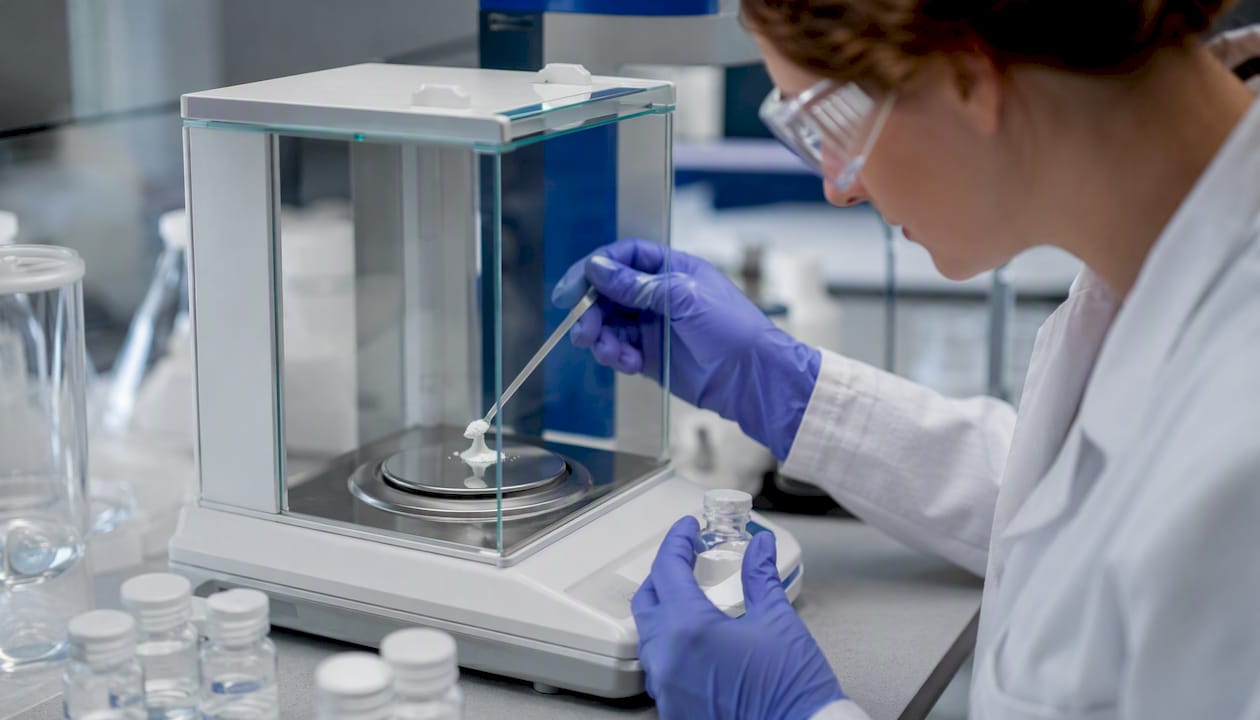
How do you measure and quantify peptide moisture absorption in the laboratory?
| Method | Primary output | Typical application |
|---|---|---|
| DVS (dynamic vapour sorption) | Sorption isotherm, kinetics, mass change vs RH | Isotherm profiling, deliquescence point, hysteresis |
| LF-NMR (low-field NMR) | Water mobility, population fractions | Distinguishing bound, intermediate, and bulk water |
| DSC (differential scanning calorimetry) | Tg, melting events, bound water enthalpy | Glass transition shifts, hydrate characterisation |
| Karl Fischer titration | Absolute water content (% w/w) | Batch release, residual moisture specification |
| TGA (thermogravimetric analysis) | Mass loss vs temperature | Total volatile content, dehydration profile |
Recommended DVS parameters for peptide powders:
- Sample mass: 5–15 mg in a platinum or aluminium pan; avoid packing to minimise diffusion artefacts.
- RH step sequence: 0% → 10% → 20% → ... → 90% → 0% (adsorption then desorption), with 5% steps in the 60–90% range where deliquescence is likely.
- Equilibration criterion: dm/dt ≤ 0.002% min⁻¹ over a 10-minute window, or a maximum hold of 120 minutes per step.
- Temperature: 25 ± 0.1°C; temperature stability is critical because a 1°C drift shifts equilibrium RH measurably.
- Particle size: grind or sieve to a consistent fraction where possible; polydisperse samples introduce kinetic artefacts that mimic slow equilibration.
DVS combined with LF-NMR provides complementary data: DVS quantifies total uptake and isotherm shape, while LF-NMR resolves water into strongly bound, loosely bound, and bulk fractions. Add Karl Fischer when an absolute moisture figure is needed for batch release or regulatory submission, since DVS reports relative mass change rather than absolute water content.
How do you interpret sorption isotherms and identify formulation risk?
A low-slope, near-linear isotherm across the full RH range indicates weak hygroscopicity and low formulation risk. A steep uptake above a threshold RH, particularly with a visible inflection, signals either strong water binding at specific sites or the onset of deliquescence — the point at which the solid dissolves into a saturated solution. Hysteresis between the adsorption and desorption curves suggests structural reorganisation, pore effects, or irreversible phase change during water uptake.
Key isotherm features and their interpretation:
- Deliquescence relative humidity (DRH): the RH at which a crystalline solid begins to dissolve; above DRH, moisture uptake accelerates sharply and is often irreversible.
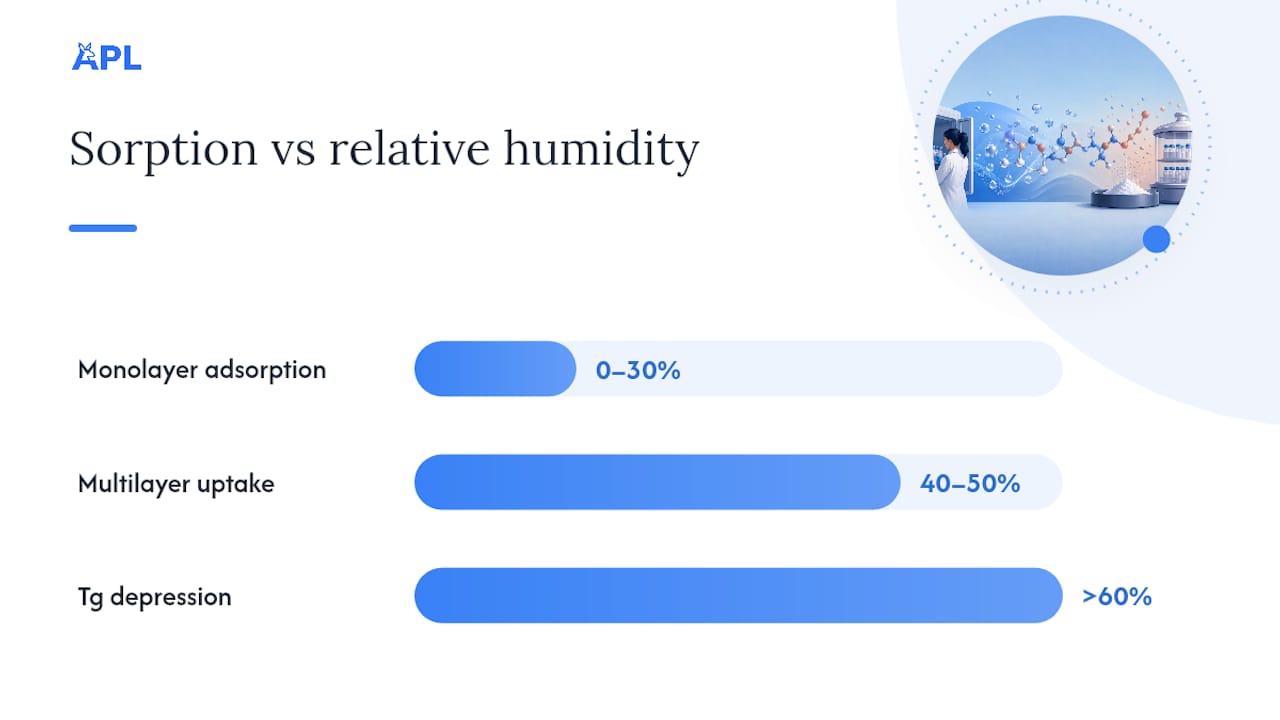
- Glass transition (Tg) depression: absorbed water plasticises amorphous matrices, lowering Tg and increasing molecular mobility — confirm with DSC when the isotherm shows significant uptake above 60% RH.
- Hysteresis: a desorption curve that lies above the adsorption curve indicates water retained in the structure; a desorption curve below suggests collapse or densification.
- Monolayer vs multilayer sorption: the low-RH region (0–30%) typically reflects monolayer adsorption at polar sites; multilayer uptake dominates above 40–50% RH.
Irreversible physicochemical changes — including altered infrared signatures, pH shifts, and reduced biological activity — have been documented in peptide sequences after slow moisture absorption, and re-drying does not always restore original properties.
Pro Tip: Always record sample history, residual solvent identity, and counter-ion in the methods section of any DVS report. Two runs on nominally identical peptides that differ only in TFA versus acetate salt form can produce substantially different isotherms, making counter-ion the single most common source of inter-laboratory discrepancy.
What formulation and mitigation strategies reduce hygroscopic risk?
Excipient and processing choices:
- Select bulking agents with low hygroscopicity (mannitol, glycine) over sucrose or trehalose when the peptide itself is already highly hygroscopic.
- Glass-forming excipients (sucrose, trehalose) stabilise amorphous matrices but add to total water uptake capacity; balance cryoprotection against hygroscopic load.
- Controlled crystallisation during lyophilisation reduces amorphous fraction and lowers bulk sorption, though it requires careful cycle development.
- Counter-ion exchange from TFA to hydrochloride or acetate reduces water affinity for many sequences; confirm by DVS before committing to a new salt form.
Lyophilisation and spray-drying both yield predominantly amorphous solids, with amorphous materials showing higher bulk sorption than crystalline equivalents.
Packaging and desiccation:
- Sealed glass vials with bromobutyl stoppers provide the lowest water vapour transmission rate (WVTR) for parenteral formats.
- Secondary moisture-barrier pouches (foil laminate, WVTR ≤ 0.01 g/m²/day) are standard for bulk peptide storage.
- Molecular sieve desiccants (3Å or 4Å) adsorb water at low RH and are preferred when the target moisture floor is below 10% RH; silica gel is effective across a broader RH range but has a higher equilibrium moisture content at low RH.
- Two-way humidity control materials are appropriate where a residual moisture floor must be maintained to prevent over-drying of formulations sensitive to very low RH.
Pro Tip: Include moisture control rationale explicitly in stability protocols submitted to the TGA. Reviewers expect a justification for the chosen desiccant type, packaging WVTR specification, and the RH range the packaging system is designed to maintain.
Storage, packaging, and transport best practice for Australian laboratories
Australia's climate introduces specific challenges. Temperature transitions during cold-chain transport — from a 2–8°C refrigerated shipper to a 25°C receiving dock — drive condensation on cold surfaces, and lyophilised peptides will pull moisture from headspace or permeable packaging during these excursions.
Operational storage checklist:
- Short-term (up to 4 weeks): −20°C, RH < 30%, sealed vial inside a secondary foil pouch with molecular sieve desiccant.
- Long-term (beyond 4 weeks): −80°C preferred; allow vials to equilibrate to room temperature inside the sealed pouch before opening to prevent condensation.
- Headspace desiccant sizing: calculate desiccant mass based on headspace volume, pouch WVTR, expected storage duration, and number of anticipated temperature excursions — not simply desiccant presence.
- Labelling: include batch number, counter-ion, residual moisture (if measured), and storage RH/temperature specification on the primary container.
Dispatch checklist from Australia:
- Secondary sealed foil pouch with validated WVTR.
- Molecular sieve or silica gel desiccant sized for headspace and transit duration.
- COA included inside the outer packaging, not inside the moisture-barrier pouch.
- Cold-pack configuration validated for the longest expected transit time to the destination state or territory.
Sourcing from an Australian pharmaceutical-grade peptide supplier eliminates the customs delays and extended transit times that compound moisture ingress risk for imported material.
Reporting checklist and example DVS protocol for reproducible results
Essential reporting items:
- Peptide sequence, molecular weight, and counter-ion identity (confirmed by COA).
- Synthesis batch number and purification method (HPLC, ion-exchange).
- Pre-conditioning protocol: temperature, RH, and duration before DVS loading.
- Residual solvent identity and estimated content (from TGA or headspace GC).
- Particle size distribution or sieve fraction used.
- DVS instrument model, calibration date, and software version.
- RH step sequence, equilibration criterion (dm/dt threshold and maximum hold time), and temperature.
- Mass change at each RH step (adsorption and desorption), plotted as isotherm.
- Hysteresis area or qualitative description of desorption behaviour.
- Any anomalies: baseline drift, sample loss, condensation events.
Example DVS protocol (adapt as required):
- Sample mass: 10 mg ± 0.5 mg, loaded into a platinum mesh pan.
- Pre-conditioning: 0% RH, 25°C, hold until dm/dt ≤ 0.002% min⁻¹ (typically 60–90 minutes).
- RH sequence: 0, 10, 20, 30, 40, 50, 60, 70, 80, 90, 80, 70, 60, 50, 40, 30, 20, 10, 0%.
- Equilibration criterion: dm/dt ≤ 0.002% min⁻¹ over 10 minutes, maximum 120 minutes per step.
- Temperature: 25.0 ± 0.1°C throughout.
- Report: mass change (%) at each RH step, full isotherm plot, and hysteresis area.
Common pitfalls, measurement artefacts, and troubleshooting
Typical pitfalls and fixes:
- Inadequate pre-conditioning: loading a sample without drying to a stable baseline inflates apparent uptake at low RH. Fix: hold at 0% RH until dm/dt is stable before starting the isotherm.
- Instrument baseline drift: a slow mass increase or decrease at constant RH with no sample loaded indicates a balance or temperature control issue. Fix: run a blank pan correction and recalibrate the RH sensor before the run.
- Condensation artefacts after temperature cycling: a sudden mass spike followed by gradual loss indicates condensation on the sample pan or balance housing. Fix: verify that the instrument enclosure temperature is stable and that the sample is fully equilibrated to instrument temperature before loading.
- Particle-size-induced kinetic confusion: coarse particles equilibrate slowly, producing apparent non-equilibrium at each RH step and a falsely low isotherm. Fix: grind or sieve to a consistent fraction and extend the maximum hold time per step.
- Counter-ion misidentification: assuming a TFA salt behaves like a hydrochloride form leads to incorrect hygroscopicity classification. Fix: confirm counter-ion by ion chromatography or NMR before DVS.
Pro Tip: Validate DVS results with at least one orthogonal method before reporting. Karl Fischer titration provides an absolute moisture figure that anchors the DVS mass-change scale; LF-NMR identifies whether absorbed water is mobile or tightly bound, which DVS alone cannot resolve. This combination is particularly informative for sequences showing hysteresis or Tg depression.
Why routine hygroscopicity screening is worth the instrument time
Researchers who treat hygroscopicity testing as an optional characterisation step rather than a standard part of sequence qualification tend to encounter reproducibility failures late in a project, when reformulation is costly. A DVS run on a new sequence takes less than 24 hours and immediately flags whether the material requires specialised packaging, counter-ion exchange, or a modified lyophilisation cycle — decisions that are far cheaper to make at the discovery stage than after stability batches have been prepared.
The practical habits that reduce reproducibility risk are straightforward: pre-condition every sample to a defined baseline before any analytical measurement, run a DVS spot check on each new sequence, and include counter-ion identity in every synthesis report as a mandatory field. The Peptide Dilution Calculator from Aupeptidelabs supports accurate dosing by accounting for net peptide content, which is directly affected by residual salt and moisture load — a detail that matters when translating in vitro concentrations to experimental conditions.
Aupeptidelabs supports hygroscopicity-aware peptide research
Researchers managing moisture-sensitive peptides need material that is characterised, documented, and dispatched without delays that introduce additional moisture risk. Aupeptidelabs supplies pharmaceutical-grade research peptides with purity exceeding 99%, each accompanied by a third-party COA that includes counter-ion identity and net peptide content — the two parameters most directly relevant to hygroscopicity interpretation.
- High-purity peptides with batch-specific COAs available on request.
- Dispatch from Australia within one business day, eliminating extended transit times that compound moisture ingress.
- Moisture-barrier secondary packaging included as standard for cold-chain orders.
- Technical support available for researchers requiring guidance on stability testing or batch specification.
All products are supplied strictly for laboratory research use only. To request batch COA documentation or discuss specification requirements for moisture-sensitive sequences, visit the Aupeptidelabs product page.
Sources
The following peer-reviewed sources and application notes underpin the guidance in this article and are recommended for inclusion in stability reports and manuscripts:
- Water vapor sorption by peptides, proteins and their formulations
- Water dynamics of Ser-His-Glu-Cys-Asn powder and effects of moisture absorption on its chemical properties
- Desiccant for Lyophilized and Peptide Cold-Chain Packs