

The difference between Australian-supplied and overseas peptides lies in supply-chain control, border exposure, documentation and delivery time. It does not lie in regulatory status. Under Australian law, a domestic seller does not turn an unapproved product into an approved one, and an overseas origin does not by itself make a product unsafe. What a domestic supply chain can offer a laboratory is shorter transit, no import clearance step, and batch documentation that can be checked against a stocked lot. This article sets out the regulatory baseline first, then compares the two sourcing routes on the criteria that matter to a laboratory: legal exposure, product identity, verification, logistics and traceability.
All products discussed here are research materials for laboratory use only. They are not for human or veterinary use.
The regulatory baseline applies to both routes
Any comparison has to begin with a point that is often missed. The Therapeutic Goods Administration (TGA) states that therapeutic peptide products must be included in the Australian Register of Therapeutic Goods (ARTG) before they can be imported, manufactured, supplied, exported or advertised, subject to limited exceptions. Products not on the ARTG are generally treated as unapproved, meaning the TGA has not assessed them for quality, safety or effectiveness. The same page states that "research use only" and "not for human use" disclaimers do not change whether a product is regulated as a therapeutic good.
Two consequences follow:
- Buying from an Australian business does not make a peptide approved, tested by the regulator or suitable for human use. The TGA's peptide products overview notes that some peptide products are approved, while many promoted online are unapproved and may be unlawful to import, supply or advertise.
- Overseas sourcing is not inherently a different legal category. It adds an import event, and the import event is where most of the enforcement activity occurs.
For a wider summary of the rules, see our guide to TGA peptide regulations in Australia and the question of whether peptides are legal in Australia.
Side-by-side comparison
The table summarises the practical differences between the two sourcing routes for a laboratory buyer. Regulatory status of the compound is the same in both rows and is therefore not listed as a differentiator.
| Criterion | Stocked in Australia | Shipped from overseas |
|---|---|---|
| Import step for the buyer | None for the buyer, as stock is already in the country | The buyer is the importer and carries the import obligations |
| Customs and border exposure | No border clearance on the consignment | Goods may be held, seized and destroyed if the import appears unlawful |
| Transit time | Domestic, typically days | International, plus any clearance time |
| Labelling | Can be inspected against the lot before use | Unmarked or code-only vials are a recurring TGA concern |
| Batch documentation | Certificate of analysis (COA) can be matched to a stocked batch | COA may be generic, undated or not tied to the shipped lot |
| Recourse | Domestic seller, domestic consumer and returns processes | Cross-border dispute, often impractical |
| Cold-chain exposure | Shorter, more predictable | Longer, with multiple handovers |
The sections below explain each row with its evidence.
Border enforcement and import exposure
The TGA says it works with the Australian Border Force to identify and stop unlawful imports of unapproved peptide products. Where an import appears unlawful, the goods may be seized and destroyed, and the importer may lose both the products and the money paid.
The agency has also described what it is looking for. In a May 2026 alert, the TGA reported imported products suspected to be peptides that were not on the ARTG, arrived as powders or injectables in unmarked vials, and were labelled only with codes or abbreviations, or lacked the name and concentration of the active ingredient or dosing instructions. Its guidance on importer responsibilities adds that products which are not clearly labelled cannot be assessed for lawful importation under the Personal Importation Scheme.
What the Personal Importation Scheme does and does not cover
The Scheme allows individuals to import certain goods for personal use if every condition is met, but it does not permit commercial supply or public advertising. For prescription medicines, the TGA states that an Australian doctor's prescription is required, and recommends sending the seller a copy so Border Force can be shown that a valid prescription exists. A single importation cannot exceed a three-month supply at the maximum dose recommended by the manufacturer. The Law Society Journal reports that the Scheme sits in Schedule 5 of the Therapeutic Goods Regulations 1990 (Cth) and that, for peptides classed as prescribed restricted substances, total quantity must not exceed 15 months' supply within a 12-month period.
The Scheme concerns personal therapeutic use. It is not a pathway for bulk laboratory purchasing, which is one reason institutions and research groups tend to look at local stock. Detail on the customs side is covered in peptide seizures in Australia and the lawful path, peptide customs delays and the import permit timeline for researchers.

Penalties are real
In August 2026 the TGA announced it had seized more than $120,000 of illicit peptide and anabolic steroid products from two New South Wales residential premises. The release stated that it is unlawful to import, advertise, manufacture and supply unapproved peptide products in Australia, and that unlawful activity can lead to infringement notices and civil or criminal action, with criminal penalties under the Therapeutic Goods Act 1989 of up to seven years' imprisonment. Any buyer, domestic or overseas-sourcing, should read the regulator's position on its own pages before acting.
Product identity: what the testing evidence shows
The strongest argument for scrutinising any peptide source, whatever its origin, comes from the regulator's own laboratory results. On 5 November 2026 the TGA reported that tested products from one supplier did not contain what their labels claimed. Some contained no detectable TB-500, and tested retatrutide 10 mg products contained less retatrutide than stated, with significant variation between samples. The TGA's conclusion was that labels cannot be relied on to establish the substance or the amount.
This finding is the reason documentation matters more than geography. A label is an assertion. Identity and purity are established analytically, and the result has to be tied to the specific lot in the vial.
Methods that establish identity and purity
In the therapeutic peptide literature, identity is typically confirmed by liquid chromatography-mass spectrometry (LC-MS), and purity is assessed by reversed-phase ultra-high-performance liquid chromatography (RP-UPLC) on C18, C8 or phenyl columns. The methods are validated for specificity, accuracy, precision and robustness under the ICH validation lifecycle, as described in an analytical method strategy for therapeutic peptides. A laboratory reading a COA can ask whether it reports both a mass-spectrometric identity result and a chromatographic purity figure, and whether the batch number matches the vial.
A practical way to read a certificate is covered in this explanation of COA tests for peptide researchers, which sets out how analytical results relate to purity claims. Additional guidance on spotting inconsistencies is in five checks labs use to spot counterfeit peptides.
Why a domestic lot is easier to verify
When the product is stocked in Australia, the lot received is the lot listed, and a certificate for that batch can be matched to the vial label before any work begins. With an overseas consignment, the chain between the analysed batch and the vial in the parcel is longer and harder to confirm. Our guidance on local peptide sourcing lists what to verify before ordering.
Safety information that accompanies unapproved products
The TGA states that unapproved peptide products have not been assessed for safety, quality or effectiveness, and that information on manufacturing, sterility, side effects and actual contents remains unknown. It reports adverse events including severe allergic reactions requiring adrenaline and hospitalisation, systemic inflammatory response syndrome and poor product quality such as unsealed packaging. healthdirect adds that counterfeit products may mimic genuine medicines, making a safe product difficult to distinguish from a harmful one.
For this reason, products sold by Au Peptide Labs are supplied strictly for laboratory research and are not intended for human or veterinary administration. Anyone considering a peptide for personal health reasons should speak to an Australian doctor, who can advise on approved options and prescription pathways.
Logistics: transit, handling and storage
Lyophilised peptides are generally shipped as powders, and the practical risks in transit are time, temperature and handling. A domestic consignment avoids international legs, customs holds and the variable delays that accompany them. For a laboratory, that translates into predictable receipt dates, which matter when a study timeline or a stability protocol depends on the material arriving in a defined state.

Our own dispatch practice is that orders ship from Australia within one business day, from Melbourne, with discreet packaging. Express Post is available for a one-off $10. Further operational detail is in peptide shipping in Australia: what labs need to know.
On receipt, a laboratory should record the date, inspect the seal, compare the label and batch number with the COA, and store according to the supplier's instructions for lyophilised or reconstituted material. Reconstitution calculations can be done with the peptide dilution calculator.
A selection checklist for laboratories
The following criteria apply whichever route is chosen:
- Clear labelling. The vial states the compound name, quantity per vial and batch number, not a code alone.
- Batch-specific COA. The certificate is dated, names the lot, and reports identity (mass spectrometry) and purity (HPLC or UPLC).
- Independent testing. The analysis was performed by a third-party laboratory, not only the seller.
- Consistent documentation. The purity figure, the compound and the strength agree across the COA, the product page and the vial.
- Transparent regulatory position. The seller states that products are for laboratory research only and does not make therapeutic claims.
- Domestic contact and dispatch. Returns, queries and traceability can be resolved within Australia.
- Intended use matches the product. Material for research is used for research, never administered.
A broader supplier comparison is available in buying peptides in Australia: suppliers compared.
Our perspective on Australian supply
At Au Peptide Labs we hold that the most meaningful distinction between Australian and overseas supply is verifiability. A research programme depends on the compound in the vial being the compound on the certificate, and a domestic, stocked lot allows that to be confirmed before work starts.
Our products are independently third-party tested to a purity above 99%, with a COA available for every batch. Stock is held and dispatched in Australia within one business day, which removes the import step and the customs delays that accompany it. Packaging is discreet.
We supply these materials strictly for laboratory research. They are not for human or veterinary use, and we state this plainly because a supplier's location does not alter the regulatory status of a compound. Our customer satisfaction rating of 4.6/5 reflects verified reviews and the emphasis we place on dependable fulfilment for research groups.
Dr. Authur
Research peptides stocked in Australia
Au Peptide Labs supplies research peptides and laboratory consumables from Australian stock, with third-party purity certificates, custom orders and bulk procurement on request. Categories include Metabolic and GLP-1, Recovery and Repair, GH Secretagogues, Cognitive and Sleep and Longevity and Cellular, together with lab supplies such as bacteriostatic water, alcohol wipes and insulin syringes for laboratory use.
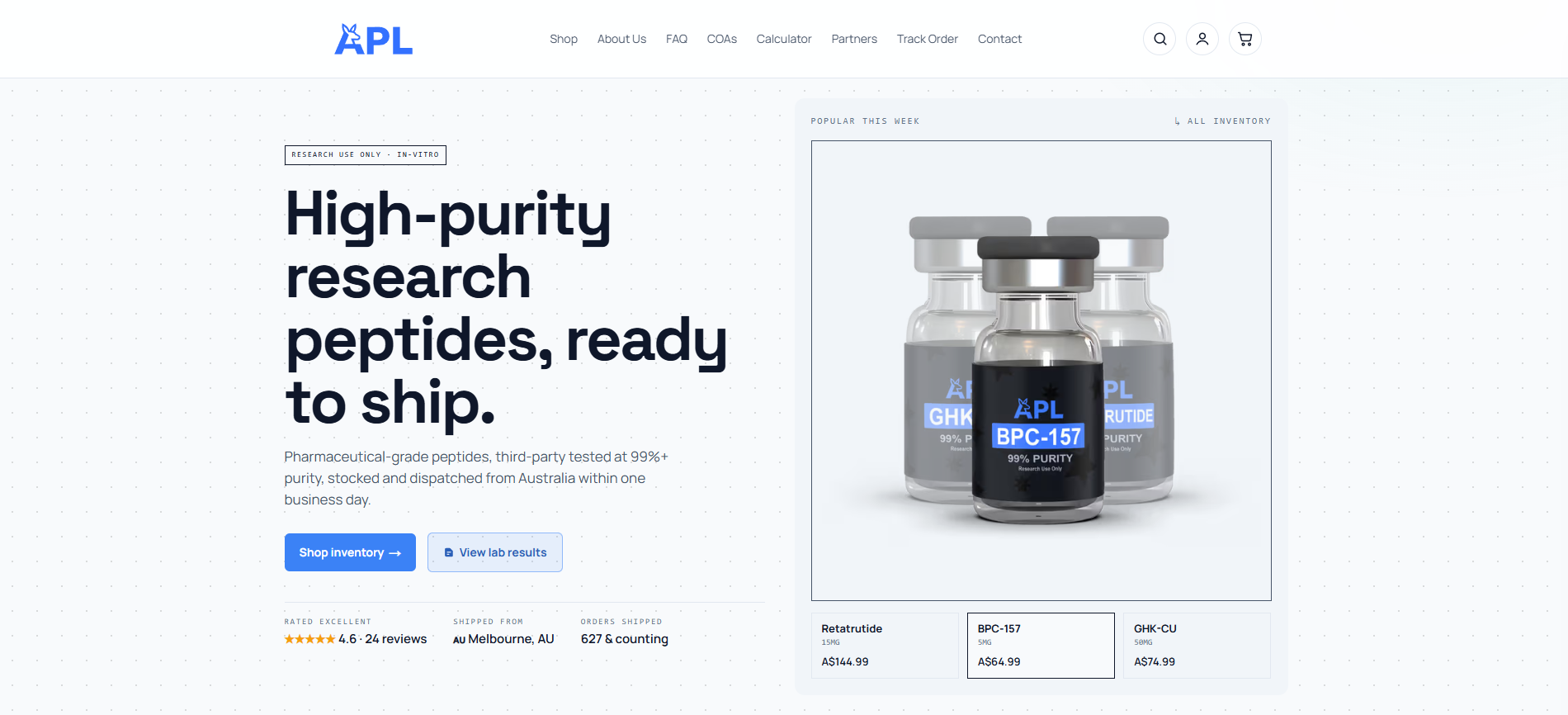
Laboratories ready to order can browse the full range at Au Peptide Labs, where Express Post is offered for $10.
Frequently asked questions
Is a peptide bought from an Australian supplier approved by the TGA?
Not automatically. The TGA states that many peptides promoted online are unapproved therapeutic goods, and that there is no assurance they are safe, effective, correctly labelled or sterile. A domestic seller changes the logistics, not the regulatory status. Research materials remain for laboratory use only.
Can a "research use only" label make a peptide lawful?
No. The TGA says such disclaimers do not alter whether a product is regulated as a therapeutic good, and do not remove import, supply, manufacture or advertising obligations. The label describes the intended use but does not substitute for compliance.
What happens if an overseas peptide order is stopped at the border?
The TGA says the goods may be seized and destroyed if an import appears unlawful, and the importer may lose the products and the money paid. Unclearly labelled products, such as code-only vials, cannot be assessed under the Personal Importation Scheme.
How can a laboratory check that a peptide matches its label?
Compare the vial's batch number with a dated, batch-specific COA reporting identity by mass spectrometry and purity by chromatography, ideally from an independent laboratory. The TGA's November 2026 testing shows why labels alone are insufficient.
Sources
- How we regulate therapeutic peptide products, TGA
- Peptide products, TGA
- TGA warning on the risks of importing unapproved peptide products
- Understanding your responsibilities when importing, compounding and supplying unapproved peptide products, TGA
- Importing a medicine or medical device, TGA
- Injectable peptides: Where does the law stand? Law Society Journal
- TGA flexes its muscle against illegal peptides and steroids
- TGA testing finds unapproved peptides do not contain what their labels claim
- Are peptides safe and lawful in Australia? healthdirect
- Analytical Method Strategy for Therapeutic Peptides, BiologicsGuide