
In Australia, a peptide product is regulated as a therapeutic good when it is promoted, supplied or generally used for a therapeutic purpose, and the Therapeutic Goods Administration (TGA) evaluates such goods for safety, quality and effectiveness. Two separate frameworks apply: entry on the Australian Register of Therapeutic Goods (ARTG), which concerns a specific product, and scheduling under the Poisons Standard, which concerns who may supply or prescribe a substance. A "research use only" label does not replace either. This article sets out how each framework works, what the TGA has said about research-labelled peptides, how state and territory law interacts with federal rules, and what documentation a laboratory should hold.
What the TGA regulates when it comes to peptides
Peptides are short chains of amino acids, and the category is broad. It includes long-established medicines as well as compounds that circulate online with no regulatory evaluation. The TGA does not regulate "peptides" as a chemical class. It regulates therapeutic goods, and the test is how a product is promoted, supplied or generally used.
The TGA states that peptide products regulated as therapeutic goods must be included in the ARTG before they can be imported, manufactured, supplied, exported or advertised, unless a specific approval, authority or exemption applies. That sentence carries most of the regulatory weight for the sector. It means the obligations attach to every step of the supply chain, not only to the final sale.
Examples of TGA-approved peptide medicines named on the same TGA page include insulin and insulin analogues, GLP-1 receptor agonists such as semaglutide, oxytocin, vasopressin analogues and somatostatin analogues. These are prescription medicines with evaluated manufacturing, labelling and clinical evidence. Their approved status does not extend to other compounds that happen to share a pharmacological class or a research literature.
ARTG approval and Poisons Standard scheduling: two different questions
Readers often conflate the two frameworks, so it helps to separate them.
| Framework | What it answers | Applies to |
|---|---|---|
| ARTG entry | Has this specific product been evaluated for quality, safety and effectiveness, and may it be supplied? | A named product and its sponsor |
| Poisons Standard scheduling | Who may supply, prescribe or possess this substance, and under what conditions? | A substance, across all products |
A substance can be scheduled without any product containing it being on the ARTG. In that case the substance has controlled access, yet no approved product exists for it to be supplied lawfully as a medicine. Conversely, an approved product has passed evaluation for its stated indication, and its scheduling then determines whether a prescription is required.
How to check the status of a product
The TGA allows anyone to search the ARTG by product name, sponsor or active ingredient to confirm whether a medicine is approved for supply in Australia. A practical three-step check for any peptide name:
- Search the ARTG for the active ingredient. A listing identifies approved products and their sponsors.
- Check the current Poisons Standard for the substance name, including its schedule and any appendix entries, because both determine access conditions.
- Read the TGA's peptide pages for any compound-specific statements, since the regulator updates its position as enforcement priorities change.
No listing on the ARTG means no approval has been granted for that product. Absence of a scheduling entry does not mean a product is outside therapeutic goods law, because the therapeutic-good test depends on promotion and use as well as on the substance.
Research-use labelling and what the TGA has said about it
This is the point most often misunderstood by purchasers. The TGA is explicit that disclaimers that a product is for research use only or not for human use do not change whether it is regulated as a therapeutic good or remove advertising, manufacture, import, export or supply obligations. The regulator's safety alert repeats the point: such a disclaimer alone does not change a product's regulatory status, permit importation or remove advertising and supply obligations.
For a laboratory, the consequence is practical. A label is not a compliance position. What matters is the actual purpose of the supply, the way the product is described and promoted, who the buyer is, and what the buyer does with the material. Our own supply is directed at laboratory research, and our products are not for human or veterinary use. For a deeper treatment of how the phrase is used commercially, see our explainer on the meaning of research use only for Australian labs.
Importation and the Personal Importation Scheme
The TGA states that under the Personal Importation Scheme, unapproved peptides that are not clearly labelled or that obscure their active ingredients cannot be assessed for lawful importation and will not be released. Clear labelling of the active ingredient is therefore a minimum condition for any consignment to be assessed at all.
This is one reason domestic stock matters operationally. Consignments held and dispatched within Australia avoid the border step entirely, so there is no customs hold affecting a research schedule. Researchers who do import should read our guides on customs risks and a lawful path and the import permit timeline for Australian researchers.
Enforcement: what the TGA is doing
The TGA reports that it actively enforces compliance against unlawful compounding, importation, supply and advertising of unapproved peptide products, including action against social media promotions. Advertising is therefore as relevant as supply. Product pages, social posts and affiliate content that describe health benefits can bring a product within therapeutic goods law regardless of the label on the vial.
For suppliers and any party referring customers, the working rules are straightforward:
- Describe products by identity, specification and laboratory use, not by health outcome.
- Avoid dosing, administration or body-composition language.
- Keep batch documentation available for every product listed.
- Treat referral and affiliate material as advertising subject to the same rules.
State and territory law alongside the federal framework
The TGA notes that state and territory laws may impose additional controls on the sale, supply and possession of unapproved peptide products. Federal scheduling sets the national baseline, but possession and supply offences are largely enacted by the states and territories through their poisons and medicines legislation. A position that is workable in one jurisdiction cannot be assumed for another, so a laboratory operating across several states should confirm requirements with each relevant health department.
Healthcare practitioners carry a further layer. Those who compound, prescribe or supply unapproved peptides must comply with the professional standards set by bodies such as the Pharmacy Board of Australia and Ahpra. For a plain-language overview of the broader legality question, our article on whether peptides are legal in Australia covers the main distinctions.
Health and quality risks the TGA has identified
The regulator's concern is not abstract. Many peptide products promoted online or through social media are unapproved therapeutic goods that have not been assessed by the TGA for safety, quality or effectiveness. Its public health statement adds that important information may be unknown, including how products are manufactured, whether they are sterile and what substances they contain, and that labelling may not reliably state ingredients, dosage or administration.
Reported adverse effects from use of unapproved peptides, according to the TGA, include severe allergic reactions requiring hospitalisation, liver damage, inflammation, insomnia, blurred vision and musculoskeletal injuries. The Chief Medical Officer, Professor Michael Kidd AO, has said that unapproved peptides pose a growing public health risk because many have not undergone sufficient human clinical trials.
These statements concern use in people. They explain why verifiable identity, purity and batch traceability are the central quality questions in any peptide supply, and why material intended for laboratory work should be handled strictly as such. Anyone who has used an unapproved peptide product and is unwell should see a doctor, or call the Poisons Information Centre on 13 11 26.
Lawful pathways for clinical access
The regulatory system does provide routes for patients. In limited circumstances, health practitioners may access an unapproved therapeutic good for a patient through established pathways, after clinically appropriate ARTG treatment options have been considered. These routes are clinical decisions made by a prescriber, not purchasing options for an individual, and they sit entirely outside laboratory supply.
For individuals asking about the effects of peptides on their own health, the appropriate step is a consultation with a doctor about approved options. Approved peptide medicines exist for several conditions, and a prescriber can advise whether any is relevant.
Documentation a research laboratory should hold
A laboratory buying peptides can reduce regulatory and scientific risk by keeping a consistent record for every purchase. A sound file contains:
- Identity and sequence: the compound name, sequence or CAS reference, and the supplier's specification.
- Certificate of analysis (COA): a batch-specific document with purity data, ideally from an independent third-party laboratory, that can be matched to the vial's batch number.
- Purpose of supply: a record that the material is acquired for in-vitro or other laboratory research, consistent with the label.
- Storage and handling records: receipt date, storage temperature and chain of custody.
- Supply terms: written terms covering specification, delivery and compliance responsibilities. Our guide to peptide supply agreements in Australia covers the clauses to look for.
On purity, our own positioning is that products are independently third-party tested to 99%+ purity, with COAs available for every batch. A COA verifies analytical identity and purity of a batch. It is not a regulatory approval, and it should be read as one part of the file, not as a substitute for the legal questions above.
Our perspective: why traceability and local stock matter
We supply research peptides and laboratory consumables to researchers, and the regulatory picture described above shapes how we work. The TGA's position that a research label does not alter regulatory obligations means a supplier's credibility rests on what can be demonstrated: independent testing, batch-level COAs, clear identification of every product, and an unambiguous statement of intended use. Our products are for laboratory research only, not for human or veterinary use, and our descriptions are written to say that plainly.

Operationally, we dispatch from Melbourne within one business day. Domestic stock means no consignment passes through the Personal Importation Scheme, which removes a recurrent source of delay for projects with fixed schedules, and discreet packaging protects the integrity of shipments in transit. Our independently verified customer rating of 4.6/5 reflects that emphasis on predictable, documented supply.
We consider this approach the correct response to a tightening regulatory climate: the laboratories best placed to continue their work are those that buy from suppliers who publish verifiable batch data and keep their own records in order. For laboratories comparing supply options, our overview of peptide shipping in Australia sets out what dispatch and handling standards to expect.
— Dr. Authur
Research supply from Melbourne stock
Laboratories that need documented research peptides can browse our catalogue by research area: metabolic and GLP-1, recovery and repair, GH secretagogues, cognitive and sleep, and longevity and cellular. Each batch is supported by a third-party COA, orders are dispatched from Australia within one business day, and Express Post is available for $10.
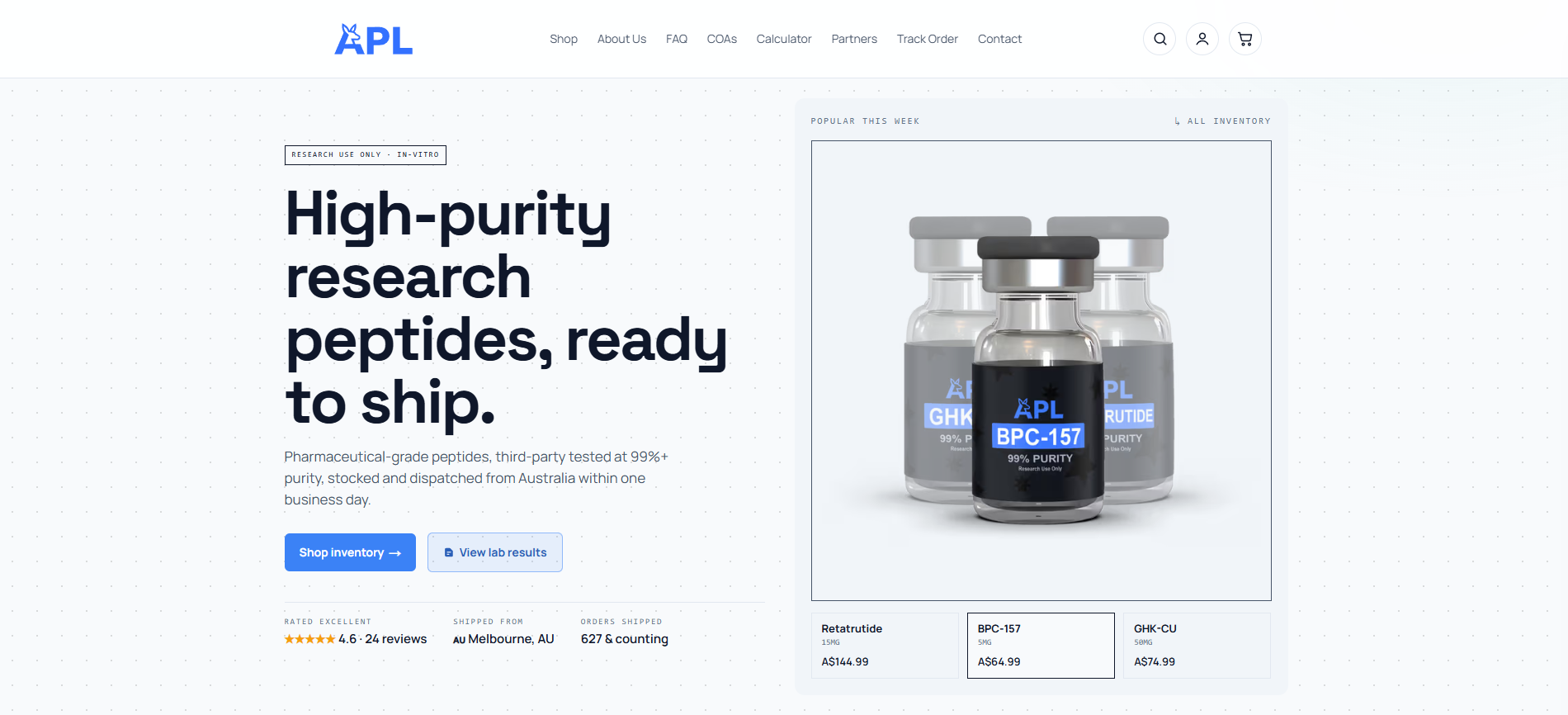
The consumables used alongside peptides, including bacteriostatic water, alcohol wipes and insulin syringes, are listed under laboratory supplies. Bulk and custom orders are available on request from the Au Peptide Labs store. All products are sold strictly for laboratory research.
Frequently asked questions
Does a "research use only" label make a peptide legal to sell in Australia?
No. The TGA states that such disclaimers do not change a product's regulatory status, permit importation or remove advertising and supply obligations. What determines the position is how the product is promoted, supplied and generally used, together with its scheduling and ARTG status.
How can I check whether a peptide is approved in Australia?
Search the ARTG on the TGA website by product name, sponsor or active ingredient. If a product is listed, it has been approved for supply in Australia. If not, it has not been evaluated by the TGA, and the Poisons Standard should be checked for any scheduling of the substance.
Do state laws differ from the TGA rules?
They can. The TGA notes that state and territory laws may impose additional controls on the sale, supply and possession of unapproved peptide products. Confirm the position with the relevant state or territory health department before acquiring or holding any scheduled substance.
Can a doctor prescribe an unapproved peptide?
In limited circumstances, practitioners may access an unapproved therapeutic good for a patient through established pathways, after considering clinically appropriate ARTG options. The prescriber must also meet professional standards set by bodies such as the Pharmacy Board of Australia and Ahpra.
Sources
- Peptide products | Therapeutic Goods Administration (TGA)
- How we regulate therapeutic peptide products | TGA
- Understanding your responsibilities when importing, compounding and supplying unapproved peptide products | TGA
- Concerns regarding the public health risks associated with unapproved peptide products | TGA
- Searching the Australian Register of Therapeutic Goods (ARTG) | TGA