

TL;DR:
- Peptides are only legal in Australia when obtained through a prescription from a registered medical practitioner and dispensed by an accredited pharmacy. Since June 2024, compounds like BPC-157 and TB-500 are classified as Schedule 4 medicines, making unprescribed possession illegal. Approved peptides like insulin and semaglutide are fully authorized, while unapproved ones require special access schemes with strict compliance.
Peptides are legal in Australia when obtained via a valid prescription from a registered medical practitioner and dispensed by an accredited pharmacy. Without that prescription, possession or supply of most peptides is unlawful under the Therapeutic Goods Administration (TGA) Poisons Standard. The regulatory environment shifted significantly in june 2024, when compounds including BPC-157 and TB-500 were reclassified as Schedule 4 Prescription Only Medicines. That change closed a grey area that many suppliers and consumers had relied upon, and enforcement has intensified since. Understanding where the legal boundaries sit is the first step toward compliant and safe peptide use or research.
Are peptides legal in Australia, and which ones are approved?
The short answer is yes, but only for a narrow category of peptides that hold formal TGA approval and are listed on the Australian Register of Therapeutic Goods (ARTG). Outside that category, the legal pathway requires a prescription obtained through the TGA's Special Access Scheme or an Authorised Prescriber arrangement.

The most prominent examples of ARTG-listed peptides are GLP-1 receptor agonists such as semaglutide, which is approved for type 2 diabetes management and weight reduction. Insulin, another peptide-based medicine, has been approved and dispensed through standard pharmacy channels for decades. These products have undergone full clinical evaluation, carry established safety profiles, and are prescribed under standard Schedule 4 conditions.
Peptides not listed on the ARTG occupy a more complex legal position. They are not automatically prohibited, but accessing them legally requires navigating the TGA's special access frameworks. Medical practitioners who prescribe unapproved peptides must comply with rigorous documentation and reporting standards. The TGA and medical boards apply strict scrutiny to prescribers of unapproved peptides, given the limited clinical evidence supporting many of these compounds.
The approved peptides accessible through standard prescription channels include:
- Semaglutide (GLP-1 receptor agonist): approved for diabetes and weight management under ARTG listing
- Insulin analogues: long-standing Schedule 4 medicines dispensed through licensed pharmacies
- Tesamorelin: accessible in Australia through special access pathways for specific clinical indications, not via standard ARTG listing
- Compounded peptides: legally prepared by accredited compounding pharmacies when prescribed by an authorised practitioner
The distinction between ARTG-listed and unapproved peptides matters enormously from a compliance standpoint. ARTG listing means the TGA has evaluated the product's quality, safety, and efficacy. Unapproved peptides lack that evaluation, which is precisely why the prescription and special access requirements exist.
What did the 2024 rescheduling of BPC-157 and TB-500 change?
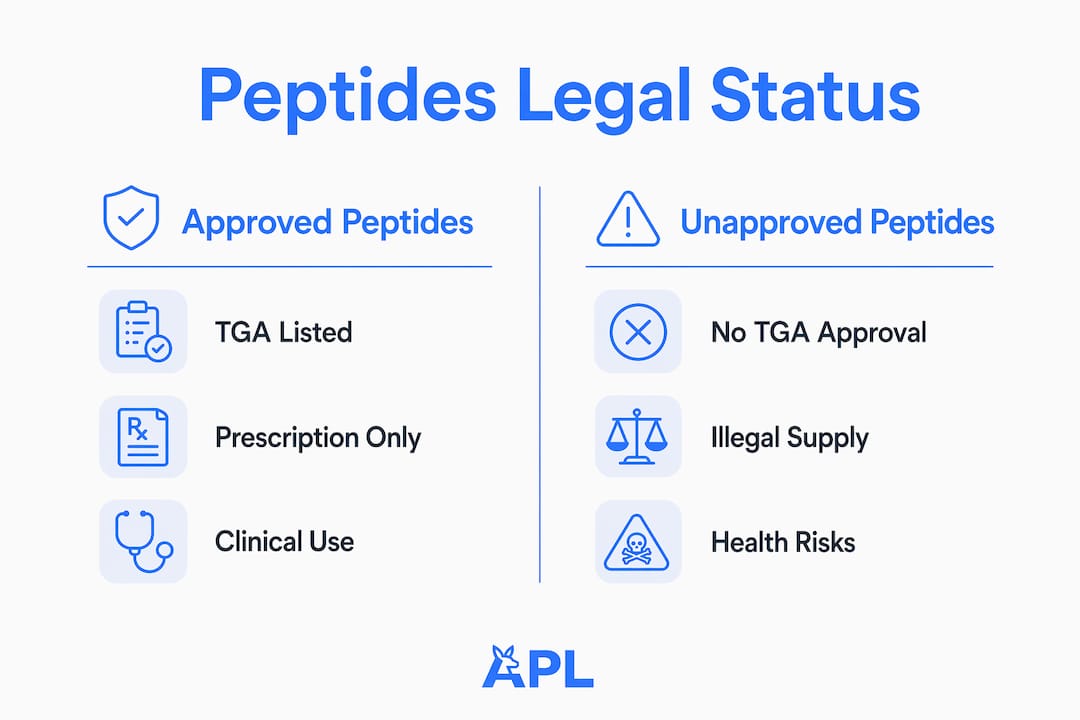
The june 2024 rescheduling of BPC-157 and TB-500 as Schedule 4 Prescription Only Medicines was the most significant regulatory shift for peptides in Australia in recent years. Before this change, these compounds existed in a regulatory grey zone that some suppliers exploited by labelling products as "research use only."
Schedule 4 classification means that supply without a prescription is a criminal offence under the Therapeutic Goods Act 1989. Compounding pharmacies can still prepare BPC-157 and TB-500, but only when a registered medical practitioner issues a valid prescription. Healthcare providers who prescribe these compounds must document clinical justification and comply with TGA reporting obligations.
The practical effect on consumers is direct. Purchasing BPC-157 or TB-500 from an online supplier without a prescription is now unambiguously illegal. Possession without a prescription also carries legal risk, depending on the quantity and circumstances. The rescheduling removed the ambiguity that previously allowed some suppliers to operate with minimal accountability.
Pro Tip: If a practitioner offers to prescribe BPC-157 or TB-500 without a thorough clinical assessment, that is a red flag. Legitimate prescribers document medical necessity and follow TGA Authorised Prescriber or Special Access Scheme B requirements before issuing any script for an unapproved peptide.
Enforcement actions following the rescheduling have targeted both suppliers and advertisers. The TGA has issued warnings and pursued penalties against businesses making unsubstantiated therapeutic claims about peptides. Medical practitioners face scrutiny from AHPRA if they prescribe unapproved peptides without adequate clinical justification.
How does Australian law regulate importing peptides?
Importing peptides into Australia is governed by the TGA's Personal Importation Scheme, which permits individuals to import a limited quantity of therapeutic goods for personal use. The conditions are specific and non-negotiable. Products must carry clear, accurate labelling that includes the active ingredient name, concentration, and dosing instructions. Most peptides sold online by overseas suppliers fail this requirement.
Australian Border Force intercepts non-compliant packages at the border. Products that lack proper labelling or TGA approval documentation are seized and destroyed. This outcome is not a minor inconvenience. It represents a complete financial loss for the importer, with no recourse for recovery.
The key import requirements under the Personal Importation Scheme include:
- Quantity limits: the importation must be for personal therapeutic use, not commercial supply
- Labelling compliance: active ingredient name, concentration, and dosing instructions must appear on the label
- TGA approval or special access: the product must either hold ARTG listing or be imported under a valid special access arrangement
- No "research use only" exemption: labelling peptides as research use only does not exempt them from scheduling requirements under the Poisons Standard
The TGA warns explicitly that many unapproved peptides imported from overseas are seized and destroyed due to regulatory non-compliance and safety risks. That warning reflects the volume of non-compliant products intercepted at the border each year. The financial and legal risks of ordering peptides online from overseas suppliers are substantial.
Beyond the legal risk, there is a product quality concern. Overseas suppliers operating outside Australian regulatory oversight have no obligation to meet TGA manufacturing standards. Products may be contaminated, mislabelled, or incorrectly dosed. There is no mechanism for quality verification once a product enters the country through unofficial channels.
The practical guidance is straightforward. If you are a researcher or clinician seeking access to specific peptides for legitimate purposes, the correct pathway is through the TGA's Special Access Scheme or an Authorised Prescriber arrangement, with products sourced from a supplier operating within Australian regulatory frameworks.
What are the health and legal risks of unapproved peptides?
Unapproved peptides carry both health and legal risks that are frequently underestimated by consumers who encounter them through wellness marketing or online forums. The RACGP and TGA have both issued formal warnings that many online peptide products are unregulated and pose significant public health risks.
The health risks associated with unregulated peptides include:
- Contamination: products manufactured outside GMP-certified facilities may contain bacterial endotoxins, heavy metals, or residual solvents that cause serious adverse reactions
- Inaccurate dosing: without analytical testing, the stated concentration may differ substantially from the actual content, leading to under-dosing or overdose
- Sterility failure: injectable peptides that are not manufactured under sterile conditions carry a direct risk of infection, including sepsis
- Unknown long-term effects: most unapproved peptides lack long-term human safety data, meaning the risk profile over extended use is genuinely unknown
The legal risks are equally serious. Supply of a Schedule 4 medicine without a prescription is a criminal offence under the Therapeutic Goods Act 1989, with penalties that include substantial fines and imprisonment. Advertising therapeutic benefits of unapproved medicines is also prohibited, and the TGA has pursued enforcement action against businesses making unsubstantiated claims. Consumers who purchase from non-compliant suppliers may also face scrutiny, particularly if quantities suggest supply rather than personal use.
The TGA and RACGP both urge consumers to rely on regulated medical guidance rather than wellness marketing when considering peptide use. That guidance reflects a genuine public health concern, not regulatory overreach.
My perspective on navigating peptide legality in Australia
The regulatory complexity around peptides in Australia is real, and I have seen researchers and clinicians struggle with it. The 2024 rescheduling was necessary and overdue, but it has created friction for practitioners who have legitimate clinical reasons to access compounds like BPC-157.
The most common mistake I observe is researchers assuming that a "research use only" label provides legal cover. It does not. The TGA's position is unambiguous: scheduling status determines legality, not the label printed on the vial. Any researcher or clinician operating under that assumption is exposed to serious legal risk.
My practical advice is to consult a medical practitioner who is familiar with TGA special access pathways before pursuing any unapproved peptide. The Authorised Prescriber scheme exists precisely for situations where a clinician has a well-founded reason to use a compound outside standard ARTG listing. The process requires documentation, but it provides genuine legal protection. Sourcing from suppliers who operate within Australian regulatory frameworks, test products to verified purity standards, and dispatch from within Australia is the only approach that manages both legal and quality risk simultaneously.
The regulatory trend is toward stricter enforcement, not relaxation. Practitioners and researchers who establish compliant procurement pathways now will be better positioned as the TGA continues to tighten oversight of the peptide sector.
— Dr. Authur
Aupeptidelabs and legal peptide access in Australia
Researchers and clinicians who need access to high-purity research peptides within Australian regulatory frameworks have a reliable option in Aupeptidelabs. The company supplies pharmaceutical-grade peptides tested to purity levels exceeding 99%, dispatched from within Australia within one business day.
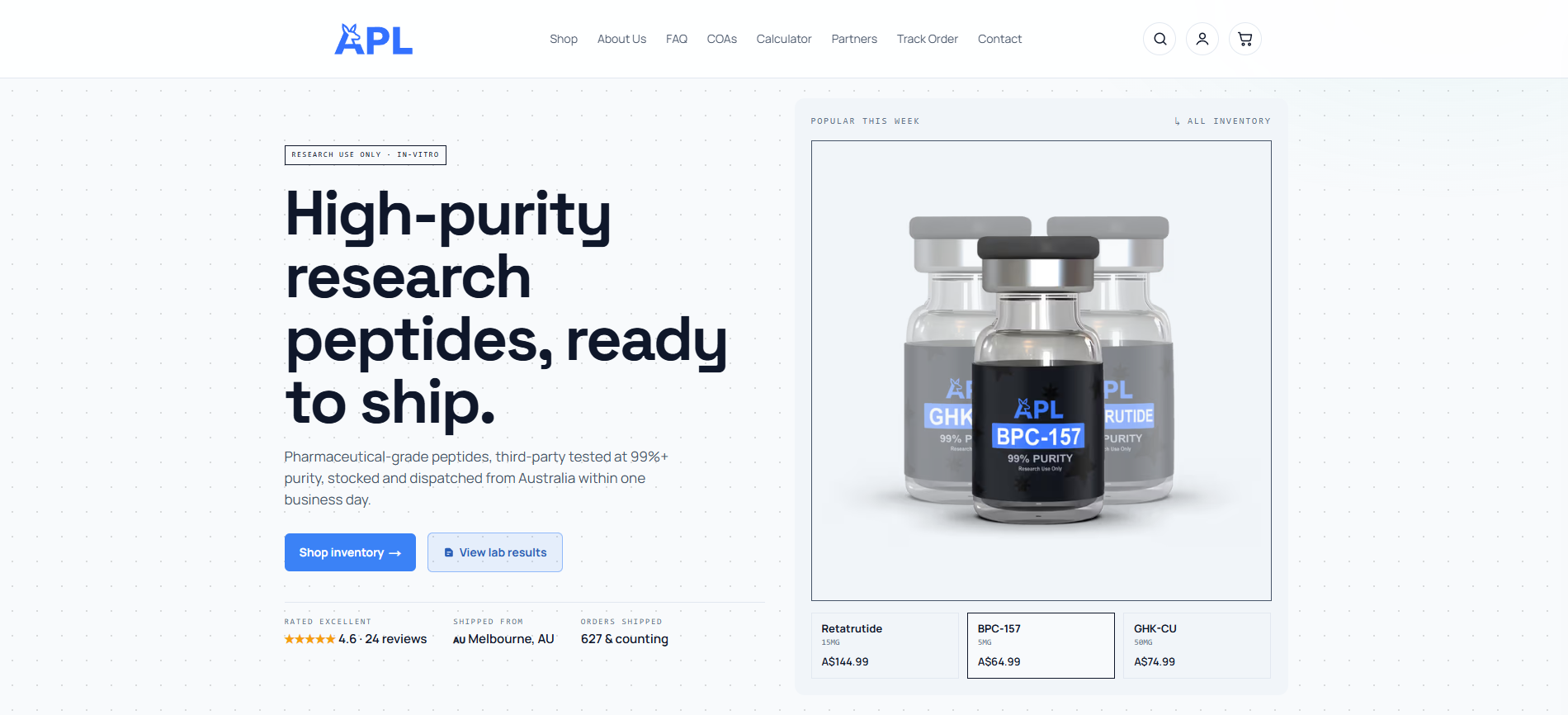
Aupeptidelabs maintains a catalogue aligned with TGA regulatory requirements, including peptides accessible through compounding pharmacy and special access pathways. All products are dispatched domestically, which eliminates the customs interception risk that accompanies overseas orders. Researchers can also use the peptide dilution calculator to support accurate dosing consistent with clinical and research protocols. With a verified customer satisfaction rating of 4.6/5, Aupeptidelabs is a trusted source for the Australian research community.
FAQ
Are peptides legal in Australia without a prescription?
Most peptides are not legal to possess or supply in Australia without a valid prescription from a registered medical practitioner. Since the june 2024 rescheduling, compounds including BPC-157 and TB-500 are classified as Schedule 4 Prescription Only Medicines.
Is BPC-157 legal in Australia?
BPC-157 is legal in Australia only when prescribed by an authorised medical practitioner and dispensed by an accredited compounding pharmacy. Purchasing or importing it without a prescription is a criminal offence under the Therapeutic Goods Act 1989.
What peptides are legal in Australia without special access?
Peptides listed on the ARTG, such as semaglutide and insulin analogues, are accessible through standard prescription channels. All other peptides require access through the TGA's Special Access Scheme or an Authorised Prescriber arrangement.
Is it legal to buy peptides online in Australia?
Buying peptides online is legal only when the supplier is operating within Australian regulatory frameworks and the purchase is supported by a valid prescription. Ordering unapproved peptides from overseas suppliers carries significant legal and health risks, including seizure of the product at the border.
Does a "research use only" label make peptides legal to import?
No. The TGA's position is that scheduling determines legality, not the label on the product. A "research use only" designation provides no exemption from Australian scheduling and prescription requirements under the Poisons Standard.