

Domestic Australian suppliers remain the fastest and most compliant way to source research peptides, because cross-border parcels face routine Australian Border Force screening and TGA referral once flagged. A shipment dispatched from an Australian warehouse with a batch-specific certificate of analysis avoids that exposure entirely. If your lab is still importing from overseas, the single most important action is verifying domestic stock and CoA documentation before you place an order.
How do TGA and Border Force rules affect peptide imports?
The Therapeutic Goods Administration treats most research peptides as unapproved therapeutic goods unless they are listed on the Australian Register of Therapeutic Goods, and importers rarely appreciate how quickly that classification becomes a problem at the border. The TGA warns that packages containing unapproved peptide products are increasingly identified by Australian Border Force screening, referred to the TGA, and can be seized and destroyed. Writing "research use only" on the vial changes nothing legally. The TGA has explicitly clarified that such disclaimers don't alter a product's regulatory status and don't make importation lawful if the goods themselves are unapproved.
Enforcement is intensifying rather than easing. The regulator has escalated compliance action against sellers and advertisers of unapproved peptides, with penalties extending to prosecution in serious cases. A handful of narrow pathways still exist:
- A valid prescription tied to a genuine clinical indication, processed through recognised medical channels.
- Institutional import arrangements negotiated directly with an approved supplier and supported by full TGA documentation.
- Fully labelled, correctly declared batches accompanied by manufacturer certification, which is rare in practice among consumer-facing overseas sellers.
For most laboratories, none of these apply, which is precisely why domestic fulfilment has become the default procurement strategy.
What domestic shipping options exist for research peptides?
Australian-based suppliers can move product far faster than any international route because there's no customs queue to clear. A well-run operation dispatches same-day when orders land before a defined cutoff, typically early-to-mid afternoon on business days.
- Same-day dispatch from an Australian warehouse, provided the order is confirmed before the supplier's daily cutoff.
- Australia Post Express, generally arriving next business day for metro addresses and one to three days for regional postcodes.
- Private metro couriers, often same-day or next-day within capital cities, with live tracking down to the delivery window.
- Signature-on-delivery and insurance, protecting high-value or temperature-sensitive consignments in transit.
Metro labs in Sydney, Melbourne, and Brisbane should expect delivery within one to two business days from a compliant domestic supplier. Regional and remote addresses typically add one to three days depending on the courier network's coverage. Every leg should carry a tracking number, and the paperwork on arrival should match what was quoted at checkout: no surprise customs forms, no import declarations, nothing beyond a standard domestic consignment note. That absence of paperwork is itself a signal the shipment never left Australian soil.
How should peptides be packaged and temperature-controlled?

Not every peptide needs cold chain handling, but many do, and getting this wrong compromises the research before the vial is even opened. Lyophilised peptides are generally more stable at ambient temperature for short transit windows, while reconstituted or more fragile sequences typically demand consistent refrigeration from dispatch to doorstep.
A supplier worth trusting should be able to demonstrate:
- Insulated shipping boxes rated for the transit duration, not just generic polystyrene.
- Gel packs sized to the route and season, not a fixed quantity regardless of distance.
- Temperature indicators visible on the outer packaging or inside the parcel.
- Sealed, tamper-evident vials packed to prevent movement and breakage.
- Discreet outer packaging that doesn't advertise contents to couriers or third parties.
Pro Tip: Check the temperature indicator strip the moment the parcel arrives, before you even open the box. A tripped indicator doesn't automatically mean the peptide is compromised, but it tells you to test purity before relying on that batch for sensitive work.
Suppliers should also be willing to share shipping SOPs and temperature logs on request. That transparency, paired with our packaging guide for Australian labs, gives receiving staff a clear benchmark for what a properly handled shipment looks like.

What documentation should accompany every peptide shipment?
A certificate of analysis is non-negotiable, and a vague one is barely better than none. Insist on documentation that includes:
- Purity percentage backed by HPLC and mass spectrometry results, not a single unverified figure.
- A lot or batch number that ties the CoA directly to the vial in hand.
- A material safety data sheet covering storage conditions and stability windows.
- Clear labelling stating product name, concentration, manufacturer, and batch, since the TGA has identified missing identity and concentration details as a primary reason vials are refused release at the border.
Third-party, independent testing matters more than a supplier's in-house claims. ABC reporting has cited TGA officials warning that online-purchased peptides are frequently poorly labelled and of unknown origin, a pattern directly linked to documented adverse events. A batch-linked CoA with an independent lab signature is the clearest defence against that risk.
How do you choose a reliable Australian peptide supplier?
Run every prospective supplier through the same short checklist before payment, not after.
- Confirm stock is held in Australia, not drop-shipped from overseas on demand.
- Request a CoA for the specific batch you're buying, not a generic product-page PDF.
- Ask about same-day dispatch cutoffs and courier options for your postcode.
- Confirm cold-chain protocols for temperature-sensitive lines.
- Check the returns and refund policy in writing.
- Ask whether institutional invoicing and purchase orders are supported.
Pro Tip: If a supplier can't produce a batch-specific CoA on request within a day, treat that as a hard stop. A legitimate lab supplier has this documentation ready before you ask, not weeks later.
Red flags are easy to spot once you know what to look for: no CoA offered upfront, fulfilment centres based overseas despite an Australian-facing website, or marketing language pitched at consumers rather than researchers. Our supplier comparison guide and the technical standards reference from Herbi Labs both offer useful benchmarks for evaluating handling practices beyond price alone.

What proof should an Australian supplier offer researchers?
Aupeptidelabs ships from an Australian warehouse within one business day of order confirmation, which removes the customs exposure that derails so many cross-border orders.
Aupeptidelabs holds a high customer satisfaction rating based on verified reviews, a factor procurement teams can weigh against a supplier's own marketing promises.
What that combination buys a lab is straightforward:
- No ABF interception risk, because nothing crosses an international border.
- No reliance on personal importation exemptions that rarely apply to institutional buyers anyway.
- Discreet packaging that protects shipment contents without misrepresenting what's inside.
- Documentation ready at the point of sale, not chased down after the fact.
Why domestic-first procurement beats the conventional import playbook
The conventional advice floating around research forums still treats overseas suppliers as a cost-saving shortcut, provided you label the parcel carefully and hope for the best. That advice was shaky five years ago and it's worse now. TGA enforcement has moved from occasional spot checks to a stated priority focus on unapproved peptide imports, and Border Force screening has scaled to match it. Betting a research timeline on a parcel clearing customs is no longer a reasonable risk calculation for a lab with deadlines.
What gets underrated in most procurement discussions is documentation discipline, not price. A cheaper peptide with a vague CoA costs more once you factor in the retesting, the delays, and the risk of building results on an uncertain batch. The labs that get this right treat domestic sourcing and batch-linked certification as the baseline, not an upgrade. If your current supplier can't produce that paperwork on request, the shipping speed doesn't matter, because the parcel that never gets seized can still deliver an unreliable peptide. Fix the documentation question first. Everything else about shipping reliability follows from that.
— Dr. Authur
Ordering from Aupeptidelabs: cutoffs, documentation and support
Aupeptidelabs exists precisely because Australian labs got tired of gambling on cross-border shipping timelines and customs outcomes. Orders confirmed before the daily cutoff, dispatch same business day from our Australian warehouse, arriving through Australia Post Express or metro courier depending on your postcode.
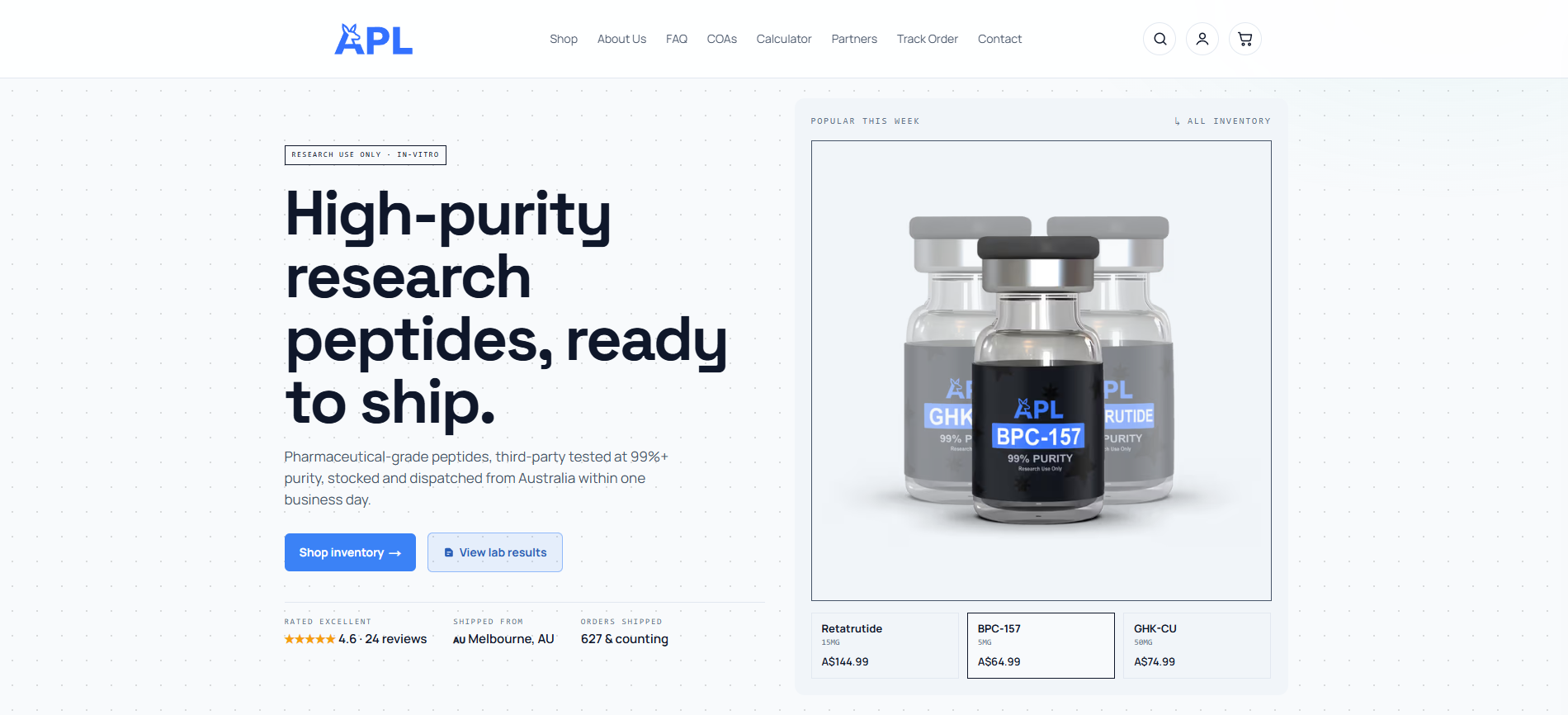
Every order ships with its batch-specific certificate of analysis and material safety data sheet attached, so your receiving team has everything needed for internal records the moment the parcel lands. Procurement officers handling institutional or bulk orders can reach our support team directly to arrange invoicing and custom volumes. If you're reconstituting on arrival, the peptide dilution calculator takes the guesswork out of concentration maths. Browse research peptides available now, including SS-31 and Selank, and place your order before today's cutoff to have it moving within the hour.
This article is general information, not a substitute for advice from a qualified doctor. Consult a qualified healthcare professional about your own circumstances before acting on anything here.
Sources
- TGA warning on the risks of importing unapproved peptide products
- TGA cracks down on unregulated peptides, says increased imports are posing a risk to consumer safety - ABC News