
For Australian laboratories, the dominant research peptide cost factors are synthesis complexity, quality documentation, and landed logistics including cold-chain freight. The single most effective way to reduce total cost is to source from an on-shore supplier with batch-specific Certificates of Analysis (COA), eliminating customs delays, quarantine risk, and cold-chain freight premiums in a single procurement decision.
Landed cost equation for Australian labs:
- Unit price: synthesis complexity, sequence length, modification type, and fill volume
- Freight and insurance: air freight plus cold-chain packaging, typically adding 5–15% to landed cost for temperature-controlled imports
- Customs and duties: import tariff classification, broker fees, and GST
- Quarantine handling: around 10% of oligonucleotide shipments experience extended customs or quarantine delays
- Local warehousing and expiry risk: stockholding costs offset against spoilage and replenishment lead times
- Testing and COA costs: third-party HPLC, mass spectrometry, and endotoxin screening per batch
Two immediate actions: order larger lyophilised fills to reduce per-mg packaging overhead, and prefer suppliers with on-shore stock and verified COAs to avoid the documentation overhead the Therapeutic Goods Administration (TGA) and Australian Border Force require at import. ABS data show Australia imported a substantial amount in laboratory reagents in 2021, confirming the scale of import dependence that drives these tail costs. Aupeptidelabs addresses this directly with domestically stocked, same-business-day dispatch.
How do pricing tiers affect peptide costs in Australia?
Research peptides span a wide cost range depending on purity grade, synthesis method, and documentation depth. Premium molecular and cell-culture reagents carry a 30–50% premium over commodity equivalents, and custom peptides with modifications such as PEGylation, fluorescent labelling, or cyclisation attract further synthesis surcharges.

Purity reporting itself drives cost stratification. Research-grade peptide purity ranges from roughly 70% up to very high purity levels, with high-purity batches requiring additional HPLC purification cycles and lot-specific ISO 17025-accredited testing. Lyophilisation and high-quality vial packaging add shelf stability but increase per-vial cost; small fills cost more per milligram because packaging and vial overheads are fixed regardless of fill weight.
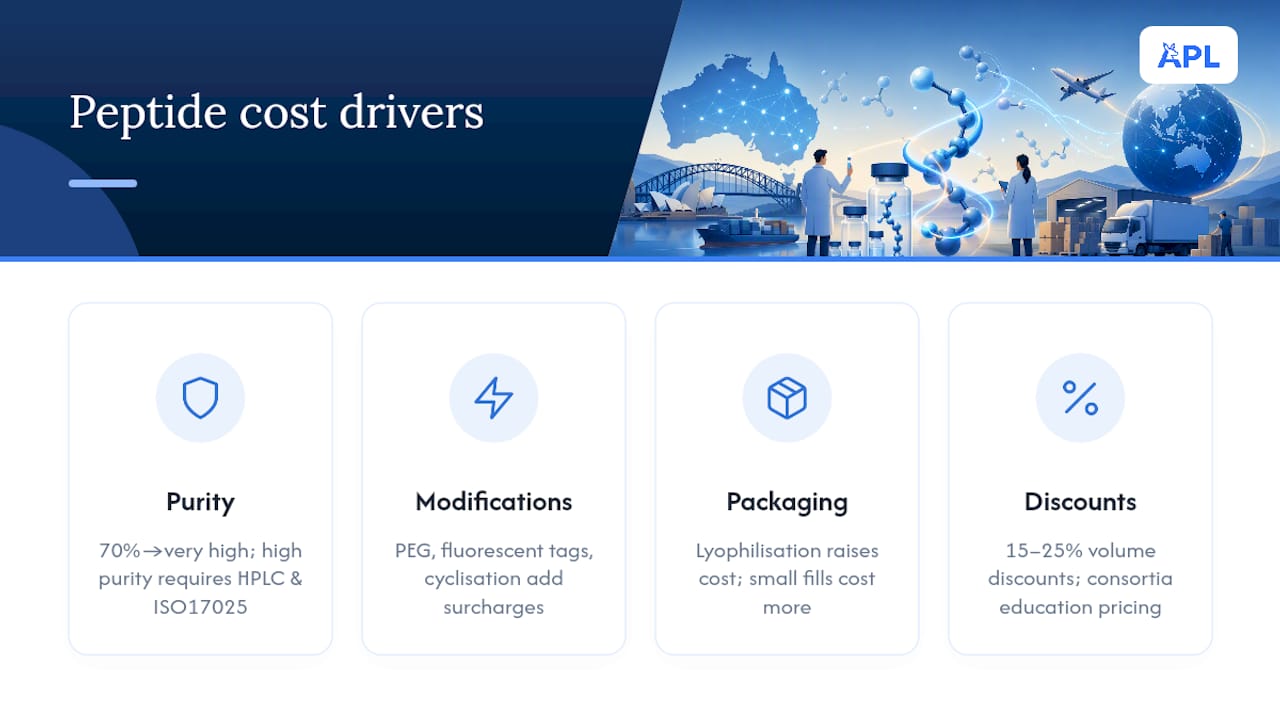
Contract buyers can offset tier premiums. Volume agreements typically yield 15–25% discounts off catalogue prices, and academic or public-sector labs representing 30–40% of procurement can access education pricing and bundled offers through centralised consortia arrangements.
How do currency fluctuations and freight insurance affect peptide pricing?
Most research peptides imported into Australia are invoiced in USD or EUR. AUD/USD volatility directly affects the landed AUD cost of any catalogue-priced import, and procurement officers who lock in forward contracts or purchase from domestic stock avoid this exposure entirely.
Freight insurance for temperature-controlled shipments adds a further variable. Cold-chain air freight from Europe or the United States carries both a logistics premium and an insurance component that fluctuates with carrier rates and declared value. When a shipment fails temperature excursion monitoring, the insurance claim process introduces additional lead time, meaning the true cost of a failed cold-chain shipment includes both the replacement order and the research delay.
What are the TGA regulatory compliance costs for research peptides?
The TGA regulates research peptides under the Therapeutic Goods Act 1989 and associated schedules. Peptides intended strictly for in-vitro laboratory research and not for human or veterinary administration generally do not require TGA registration as therapeutic goods, but import permits, correct tariff classification, and compliant labelling remain mandatory. Misclassification at the border triggers quarantine holds and potential destruction of the shipment.
Compliance costs include broker fees for correct HS code classification, documentation preparation (Safety Data Sheets, import declarations), and, where applicable, permit fees. Suppliers who maintain pre-cleared import documentation and established broker relationships reduce this overhead for the purchasing laboratory.
What does the full landed cost breakdown look like, including hidden fees?
Beyond the catalogue unit price, Australian procurement teams routinely encounter fees that inflate the effective per-milligram cost:
- Customs clearance broker fees: typically AUD $80–$200 per shipment entry
- Quarantine inspection charges: levied per consignment when biosecurity screening is triggered
- Cold-chain surcharges: carrier-applied fees for dry-ice or gel-pack packaging and temperature-monitoring devices
- Re-testing costs: when a supplier COA is not batch-specific, in-house HPLC or mass spectrometry verification adds internal labour and consumable costs
- Expedite premiums: urgent orders from offshore suppliers attract air-freight surcharges that can exceed the unit cost for small fills
A cost-per-verified-mg metric normalises these variables: divide the total landed cost by the COA-verified mass and purity-adjusted yield.
The case for local fulfilment in Australian peptide procurement
The conventional procurement instinct is to chase the lowest catalogue price. For Australian research peptide buyers, this approach consistently underestimates tail risk.
ABS import data show Australia's laboratory reagent imports grew from US$569m in 2019 to US$1,074m in 2021, a trajectory that reflects structural import dependence rather than a temporary supply condition. Specialised reagents can carry lead times of 6–10 weeks, and when a customs or quarantine hold extends that timeline, the downstream cost to a running experiment is rarely captured in the procurement budget but is very real to the research team.
Cold-chain failure is the most underpriced risk in imported peptide procurement. A single temperature excursion during a 30-hour air-freight transit invalidates the batch. The replacement order restarts the lead-time clock, and the spoilage cost falls on the laboratory, not the offshore supplier. Domestic stockholding eliminates this exposure.
Pro Tip: Build a COA-normalised cost-per-verified-mg column into your procurement spreadsheet. For each supplier quote, divide total landed cost (unit price + freight + broker fees + estimated re-testing if COA is non-batch-specific) by the COA-stated purity-adjusted mass. This single metric surfaces the true comparative cost and flags suspiciously low-priced offers as the risk indicators they are.
Dual-sourcing critical peptide lines across one domestic and one offshore supplier balances unit price against supply continuity. Framework agreements with domestic suppliers who hold bonded on-shore stock allow procurement to aggregate demand across research groups, capturing volume discounts while maintaining same-week availability. Centralised procurement through university or institutional consortia can extend these discounts further, particularly for academic labs where price sensitivity is highest.
Aupeptidelabs: on-shore stock that addresses your cost drivers directly
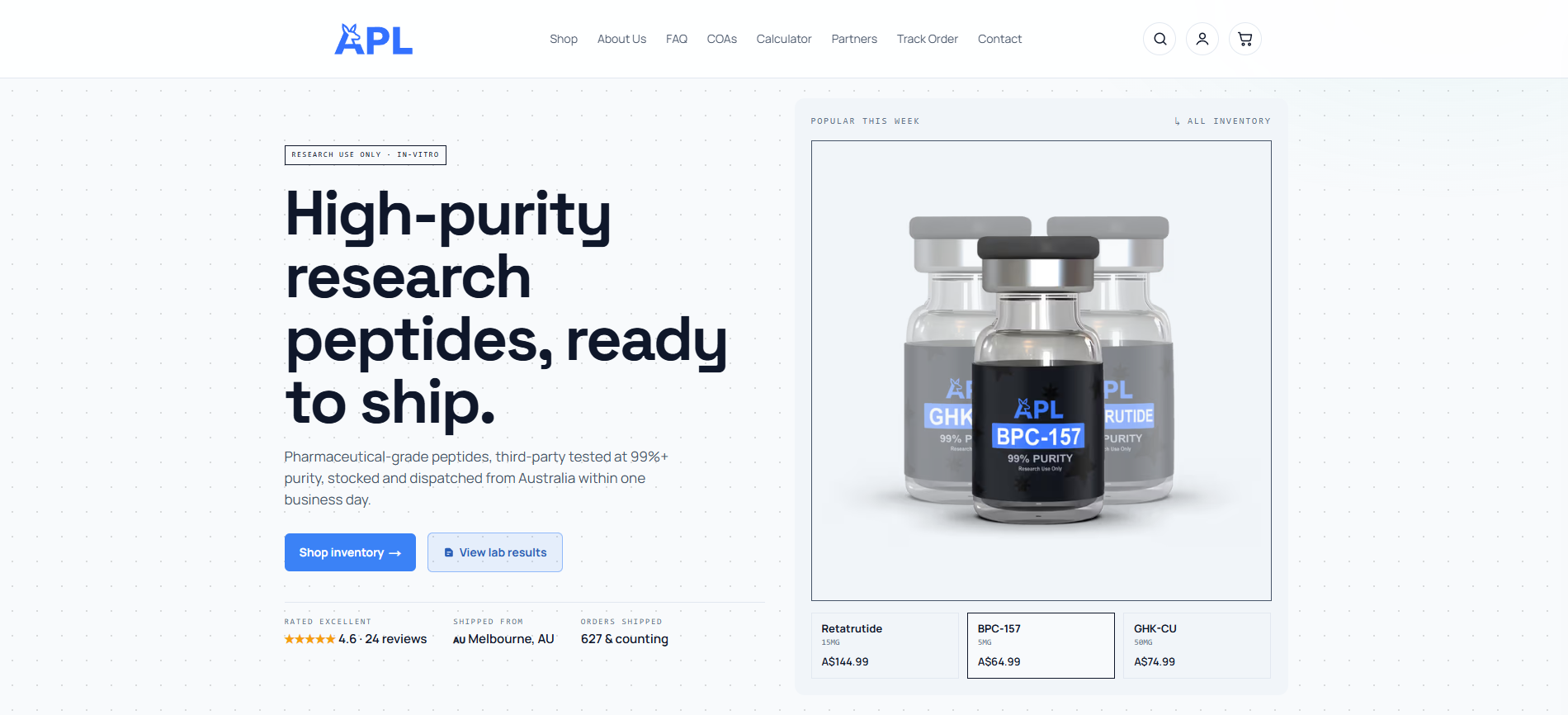
For Australian labs that have worked through the landed-cost equation above, the arithmetic of domestic fulfilment is clear. All orders are dispatched within one business day, removing the 6–10 week import lead time and the cold-chain freight premium from your cost model entirely.
| Feature | Cost driver mitigated | Procurement benefit |
|---|---|---|
| On-shore warehousing with temperature-controlled dispatch | Cold-chain spoilage and freight insurance premium | Eliminates 5–15% logistics surcharge and spoilage replacement risk |
| Batch-specific third-party COA (HPLC + MS) | In-house re-testing labour and consumable costs | Reduces validation time; supports reproducibility documentation |
| One-business-day dispatch | Import lead times and expedite surcharges | Predictable replenishment; no air-freight urgency premium |
| High-purity guarantee | Purity-adjusted yield loss | Higher cost-per-verified-mg efficiency versus lower-purity imports |
| verified customer satisfaction rating | Supplier qualification overhead | Reduces due-diligence time for procurement officers |
To request a procurement quote, review a sample COA, or discuss a framework agreement for your institution, visit Aupeptidelabs directly. For a practical overview of sourcing pharmaceutical-grade peptides in Australia, the internal resource library covers supplier qualification criteria and logistical trade-offs in detail.
Sources
- Australia genetic testing reagents market analysis — IndexBox
- Peptide quality control: essential tests for research‑use peptides | ILS Laboratories
- Peptides