

Treat every research peptide as potentially bioactive until its behaviour is characterised in your own system. Powdered peptide is an inhalation hazard, so engineering controls and PPE come first, not last. Reconstitute promptly, aliquot before first use, and hold lyophilised stock cold. Everything else in this article builds on that single rule.
Peptide handling safety starts with PPE and engineering controls
Powder handling carries the highest exposure risk in any peptide workflow. Aerosolised peptide dust can reach the lower respiratory tract during weighing, and manufacturer lab guidance treats this as a genuine inhalation hazard, not a theoretical one.
For powder work, use nitrile gloves, an N95 or FFP2 respirator, splash goggles, and a closed-front lab coat. Solution work permits lighter PPE (gloves and eye protection) once the peptide is dissolved and the vial is sealed.
- Weigh and transfer lyophilised peptide inside a biosafety cabinet or laminar flow hood where one is available.
- No cabinet on hand? Use a fume hood with sash lowered, or work inside a sealed glovebag on a HEPA-filtered bench.
- Pre-weigh a tare vial, minimise the time the powder sits open to air, and cap immediately after transfer.
- Wipe down the balance and surrounding bench with 70% isopropanol after every session.
Pro Tip: Keep a dedicated "powder only" corner of the bench, away from pipetting stations. It stops loose dust settling on tips, filters, or open vials nearby.
Receiving, storage and cold-chain verification
Every shipment needs a quick inspection before it goes anywhere near storage. Check the certificate of analysis (COA), confirm the lot number matches the packing slip, and photograph any temperature indicator before you open the box.
- Cross-reference the COA's stated purity and lot against the vial label; flag mismatches before opening anything.
- Log arrival temperature and condition, then move stock to appropriate storage within the hour.
- For short-term needs, ambient storage is acceptable for days and 4°C for a few weeks, but long-term storage of lyophilised peptide should sit below a cold temperature threshold, ideally well below −15°C.
- Equilibrate hygroscopic vials to room temperature inside a desiccator before opening, a step peer-reviewed drug storage guidance flags specifically to prevent moisture uptake.
- Keep oxygen-sensitive sequences in sealed vials, purged with inert gas where practical.
Peptides containing Cys, Met, or Trp residues are more oxidation-prone and benefit from storage at the lower end of the recommended temperature range. If you're deciding between lyophilised and liquid formats for a new order, factor in how much bench-side storage discipline your team can realistically sustain.
Reconstitution and solubilisation by peptide chemistry
Solvent choice depends on the peptide's sequence, not habit. Basic peptides generally dissolve better in slightly acidic solvents, acidic peptides prefer mild base, and hydrophobic sequences often need a small volume of DMSO or acetonitrile before you can bring them into aqueous buffer. Supplier reconstitution protocols build this decision tree around sequence polarity rather than a one-size-fits-all approach.
Add solvent slowly down the vial wall and swirl gently. Vortexing shears some peptide backbones and generates foam that traps material against the cap. If the peptide resists, a brief low-power sonication helps, but keep the bath cool. Heat accelerates hydrolysis in exactly the sequences you're trying to preserve.
- Confirm peptide class from the sequence before selecting a solvent, not after the first attempt fails.
- Filter aliquots through a low-protein-binding syringe filter where sterility matters for downstream assays.
- Aliquot immediately into single-use volumes rather than repeatedly freezing and thawing one working vial.
- Rinse the vial wall during solvent addition instead of dropping solvent directly onto the pellet.
Pro Tip: Run your dilution maths before you open the vial, not after. A quick check with a peptide dilution calculator avoids the classic error of under or over diluting a peptide you can't easily replace. For persistently stubborn hydrophobic sequences, a DMSO co-solvent protocol is worth working through before you assume the stock is bad.
Contamination prevention and aseptic vial access
Cross-contamination usually comes from rushed vial access, not exotic sources. Manufacturer training materials consistently point to the same fix: swab the stopper with 70% isopropanol and let it air-dry fully before the needle goes in. Puncturing a wet stopper drags alcohol into the vial and does nothing for sterility.
- Swab, air-dry, then access with a single-use sterile needle and syringe every time. Never reuse a needle across vials, even the same peptide.
- Run one peptide per session where the workflow allows it. A dedicated pipette set or syringe box per project measurably cuts tracking errors and cross-contamination in multi-project labs.
- Use bacteriostatic water for multi-use vials accessed repeatedly over days; reserve sterile water for injection for single-use preparations where the benzyl alcohol preservative isn't wanted.
- Cap and refrigerate immediately after each draw. Don't leave an accessed vial sitting on the bench between uses.
Stability, degradation signs and safe disposal
Peptide degradation follows a small number of predictable chemical routes: oxidation, hydrolysis, aggregation, and surface adsorption to plastic. Residues carrying Cys, Met, Trp, or the amide side chains of Asn and Gln are disproportionately responsible for instability, and manufacturer guidance recommends oxygen-free buffers or a reducing agent for sequences carrying them.
Discard stock the moment you see any of these signs, rather than trying to use it up:
- Visible cloudiness or particulate that wasn't there at reconstitution.
- A colour shift, even subtle yellowing, in a solution that was clear.
- An unusual odour on opening the vial.
- Storage time exceeding the window you logged at reconstitution, regardless of how the vial looks.
Dispose of sharps in a rigid, puncture-resistant container per your institution's biohazard pathway. Solutions that need inactivation before disposal should follow your site's chemical waste protocol, and expired stock goes through the same documented route, never down the sink.
Transport and shipping best practice
Cold-chain peptide shipments should arrive with validated cold packs, a temperature indicator, and a COA. If any of those three is missing or the indicator shows an excursion, quarantine the shipment and photograph it before you do anything else.
- Notify the supplier immediately on any suspected temperature excursion and hold the stock in quarantine pending advice.
- Log the excursion (time, indicator reading, packaging condition) rather than relying on memory later.
- For internal transfers between labs, use an insulated carrier and cap the time out of cold storage to the same limits you'd apply on receipt.
- Confirm cold-chain integrity on arrival before signing off delivery, not after the peptide's already in the freezer.
Documentation, SOPs and training requirements
A usable log needs six fields at minimum: peptide identity, lot number and COA reference, storage location and date, reconstitution solvent and date, the user's initials, and disposal date. Miss one of these and traceability breaks the first time something goes wrong.
Your SOP should specify who is authorised to handle powder, when PPE is mandatory versus optional, exact reconstitution steps, and acceptable storage tolerances. Australian lab guidance recommends written SOPs paired with documented competency checks, not just a one-off induction.
- Refresh training annually or whenever a new peptide class enters the lab's inventory.
- Report any spill or accidental exposure the same day, even minor ones, so patterns across the team surface early.
Pro Tip: A one-page SOP that staff actually read beats a thirty-page document nobody opens. Keep the tolerances and PPE requirements on page one.
What Dr Authur's bench notes reveal about avoidable errors
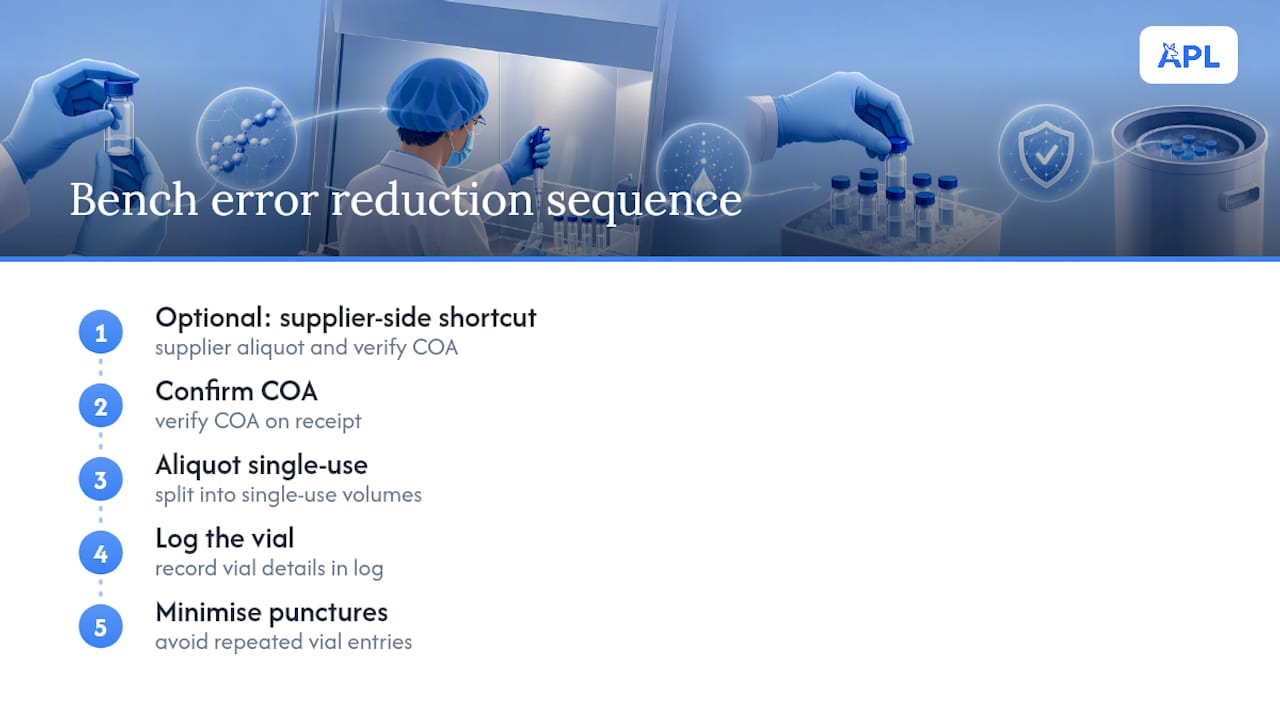
The most common failure isn't exotic chemistry, it's repeated vial entry. Teams that aliquot on receipt and verify the COA before the first draw report far fewer discard events later. A short checklist works: confirm COA, aliquot into single-use volumes, log the vial, minimise punctures. Where the workload justifies it, supplier-side aliquoting and COA verification remove several of these steps from the bench entirely.
Why strict handling protocols save time, not just risk
Aliquoting on day one and running a single-peptide workflow cut the incidents I've seen traced back to cross-contamination almost to zero. The habit that pays off fastest is boring: label every vial the moment it's made, log it before you walk away from the bench.
— Dr. Authur
Operationalising safe peptide handling with Au Peptide Labs
Every protocol in this article assumes you're starting from a peptide you can trust, and that's where sourcing decisions matter as much as bench technique. Au Peptide Labs supplies third-party certificates of analysis for every batch, so purity and identity are verified before the vial reaches your fridge, not assumed from a label.
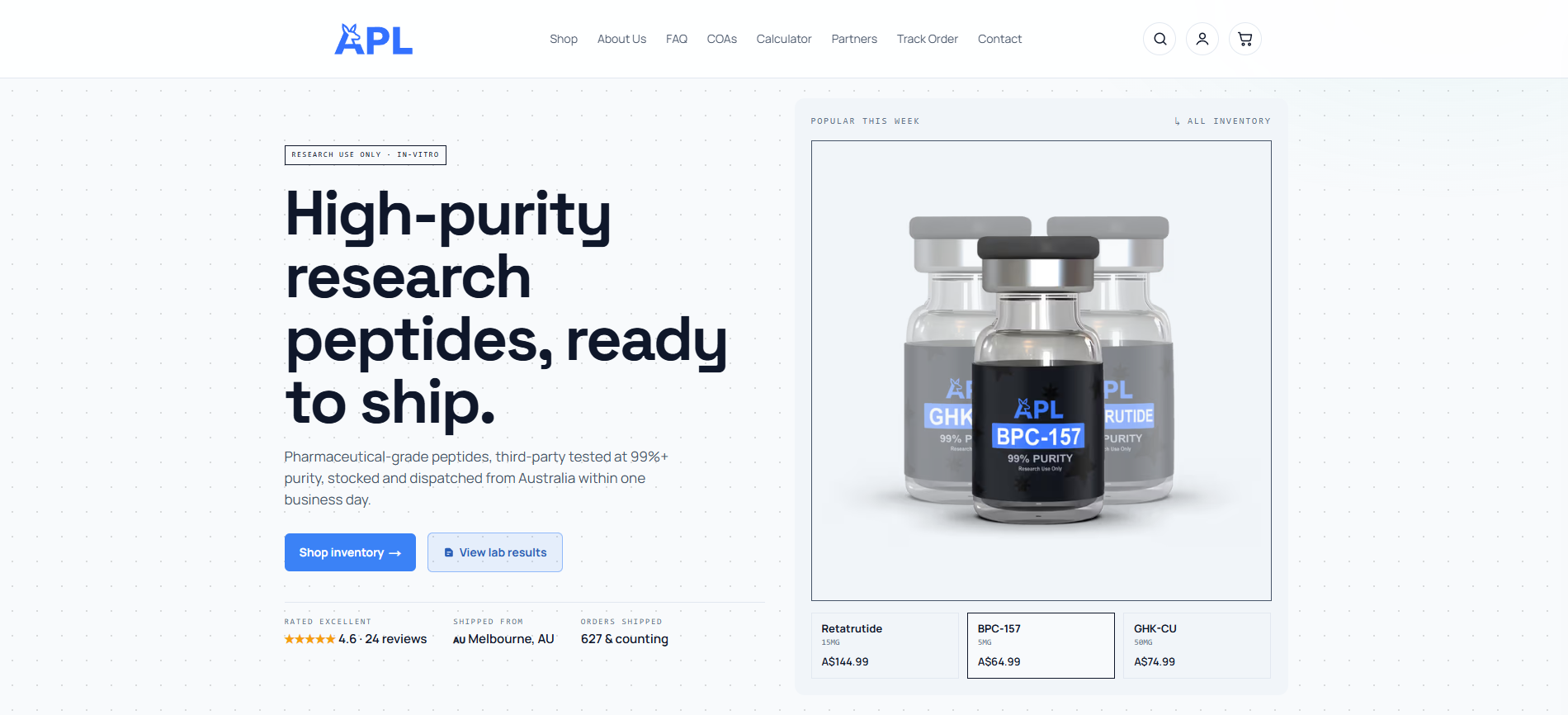
Aliquoting services reduce the number of times any one vial gets punctured, directly addressing the contamination risk covered above, and local dispatch means research stock reaches labs without customs delays that leave temperature-sensitive peptides sitting in transit. Express Post shipping fees and turnaround times can be found on the client’s website. For the consumables side of the protocol, low-adsorption tubes, syringes, and PPE are stocked in the lab supplies range, and current peptide categories including recovery and repair and GH secretagogues are listed with batch documentation attached. Check the current range and place an order through the Au Peptide Labs storefront.
Where to verify these protocols yourself
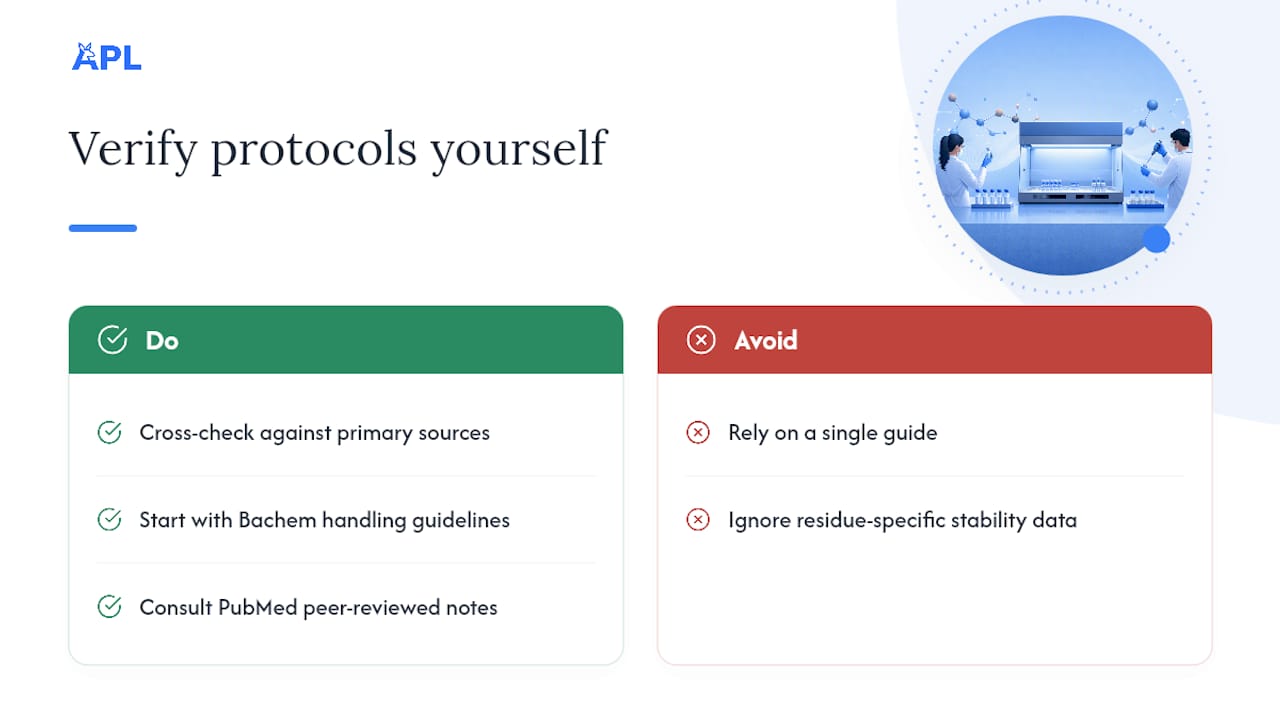
Cross-check any storage or handling decision against primary sources rather than relying on a single guide. Start with Bachem's handling and storage guidelines and the peer-reviewed drug storage notes on PubMed for residue-specific stability data.
Sources
- Handling and Storage Guidelines for Peptides | Bachem
- Drug storage guidance (John Wiley & Sons unit cited via PubMed)
- Peptide Storage and Handling Guidelines | GenScript
FAQ
Are there safety concerns with peptides?
Yes. Research peptides are treated as potentially bioactive, and powder handling specifically carries an inhalation risk that engineering controls and PPE are designed to manage. The main concerns are dust exposure during weighing, microbial contamination during reconstitution, and degradation from poor storage.
How fragile are reconstituted peptides?
Once dissolved, peptides are more vulnerable to bacterial growth, oxidation, and hydrolysis than they are as lyophilised powder. Supplier guidance recommends aliquoting immediately and freezing at ≤ −15°C rather than keeping one working vial and repeatedly freezing and thawing it.
Is it safe to store peptides at room temperature?
Briefly, yes, for lyophilised stock over a matter of days, but it's not a long-term option. Reconstituted solutions degrade faster at room temperature, and long-term storage guidance points firmly toward −15°C or colder for both powder and solution stability.
How do I transport peptides that need to be refrigerated?
Use validated cold packs with a temperature indicator, and confirm the indicator on arrival before signing for the delivery. If you suspect a temperature excursion during transit, quarantine the shipment, photograph the packaging, and contact the supplier before using any of the stock.
Does Au Peptide Labs provide documentation to verify peptide safety before use?
Au Peptide Labs supplies third-party certificates of analysis for its research peptide batches, covering purity and lot identity ahead of reconstitution. Current product categories and their documentation are listed on the Au Peptide Labs site.