

Peptides in cell culture act through three distinct mechanisms: as extracellular matrix (ECM) mimetics that drive adhesion via integrin binding, as nutrient supplements that supply amino acids in stable, absorbable forms, and as bioactive signalling fragments that modulate survival and proliferation pathways. Defined synthetic peptides suit experiments requiring reproducibility and mechanistic clarity, while hydrolysates and peptones boost growth at the cost of batch variability. Correct handling, dilution and sterility practice determine whether these effects are seen consistently or lost to contamination and lot drift.
What peptides do in cell culture: modes of action
Peptides earn their place on the bench through three separate biological routes, and confusing them is the most common design error in a peptide-supplemented protocol.
The first is ECM mimicry. Short sequences containing integrin-binding motifs, most famously the RGD tripeptide, attach cells to a surface by engaging integrin receptors directly, bypassing the need for full-length collagen or fibronectin coatings. The angiopoietin-1-derived peptide QHREDGS demonstrates this mechanism clearly: it binds β1-integrins on human pluripotent stem cells, activating ILK and ERK1/2 survival signalling, reducing apoptosis during passaging and increasing colony number and size.
The second route is nutritional. Dipeptides and hydrolysates deliver amino acids, particularly ones prone to degradation or poor solubility in free form, in a chemically stable carrier that cells cleave enzymatically on uptake.
The third is signalling modulation, where short bioactive fragments trigger specific receptor pathways without the immunogenicity or cost burden of a recombinant protein.
In practice, a single culture system might use:
- An ECM-mimetic peptide coating for initial attachment
- A soluble bioactive fragment to sustain survival signalling during expansion
- A dipeptide or hydrolysate feed to support proliferation once density increases
Each mechanism responds to a different variable, so troubleshooting adhesion failure with a nutrient fix (or vice versa) wastes a run.
Common peptide types used in culture and their trade-offs
Choosing the right peptide class starts with matching the biological problem to the chemistry on offer, and the four main categories rarely overlap in function.
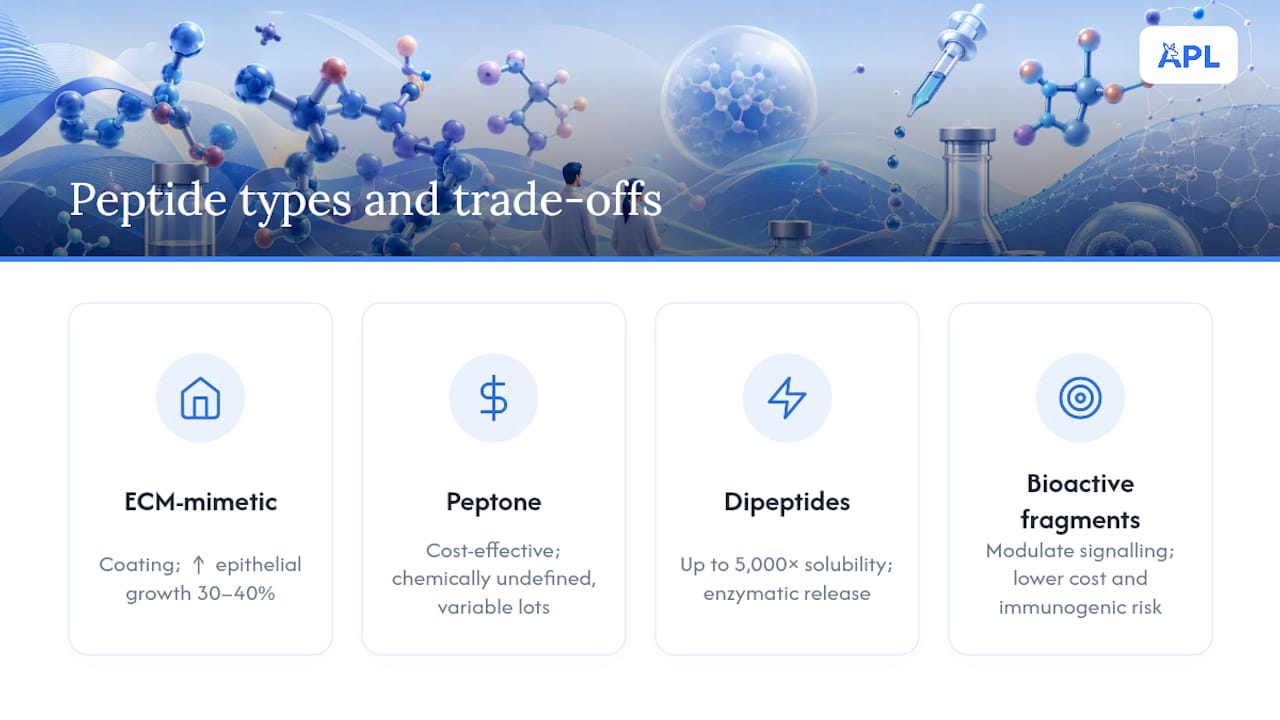
ECM-mimetic short peptides cover sequences such as FNIN2 and FNIN3, derived from fibronectin, and various RGD variants. The FNIN2 and FNIN3 study found that coating surfaces with these peptides after a polydopamine or tannic acid pre-treatment increased primary epithelial cell proliferation by roughly 30 to 40%, alongside improved mesenchymal stem cell proliferation and osteogenic differentiation. These peptides work as coatings or, less commonly, as soluble additives for adhesion and differentiation assays.
Peptone (hydrolysate) supplements are protein digests, often derived from soy, casein or yeast, and remain the workhorse growth promoter in fed-batch bioprocessing. They are cost-effective but chemically undefined, meaning their exact peptide composition varies between suppliers and even between production lots from the same supplier.
Dipeptides solve a narrower but persistent problem: the poor solubility or instability of specific amino acids, particularly glutamine and cysteine, in free form. A dipeptide media formulation review reports solubility gains of up to 5,000-fold for some cysteine-conjugated dipeptides, delivered through controlled enzymatic release rather than bulk free-amino-acid dosing.
Bioactive fragments derived from growth factors, such as QHREDGS, modulate specific signalling pathways without the manufacturing cost or immunogenic risk of a full-length recombinant protein.
Practical handling: solubility, storage and sterile technique
Peptide integrity is lost more often in the freezer and the fume hood than in the incubator, so handling discipline matters as much as peptide selection.
For dissolution, follow a stepwise approach:
- Check the peptide's solubility profile before opening the vial, since hydrophobic or highly charged sequences often need a DMSO-based dissolution protocol rather than direct aqueous dilution.
- Dissolve in a small volume of DMSO first, using brief sonication if the peptide resists going into solution.
- Dilute stepwise into buffer or medium, adding the DMSO stock slowly to avoid localised precipitation.
- Confirm the final working concentration against a dilution calculation reference before adding to culture.
Storage practice is equally unforgiving. Lyophilised peptide stock generally tolerates freezer storage well, but reconstituted working stocks degrade faster and should be aliquoted immediately to avoid repeated freeze-thaw cycles, which fragment peptide bonds and introduce degradation products that confound results.
Sterile preparation deserves its own checklist rather than an afterthought bolted onto a general cell culture protocol.
Filter working stocks through a low-protein-binding membrane, maintain aseptic technique throughout, and validate the batch against a 14-day peptide sterility checklist aligned to USP and WHO release criteria before trusting results generated from it.
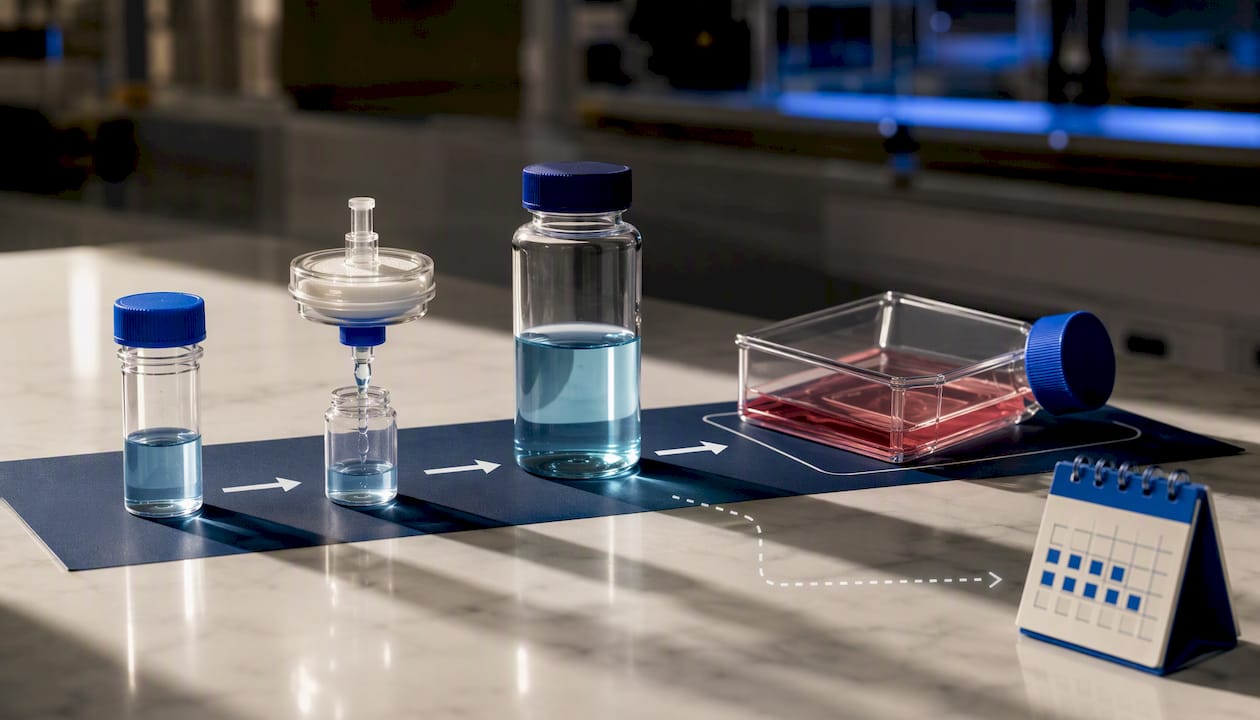
Pro Tip: Run a small 24-well matrix testing peptide concentration, DMSO carrier volume, and time-of-addition together before committing to a full-scale run. Isolating one variable at a time in a peptide-supplemented protocol almost always misses interaction effects between solvent load and peptide dose.
Coating versus soluble addition: dosing and timing
Whether to immobilise a peptide on a surface or add it directly to medium depends on what the experiment is asking of the cell.
Immobilisation suits situations demanding a defined, reproducible substrate, such as single-cell passaging of pluripotent stem cells or standardised differentiation assays. The recombinant collagen-based peptide study found that RCP performed comparably as a coating or as a soluble medium additive for mesenchymal stromal cell adhesion and proliferation, at effective concentrations in the low microgram-per-millilitre range, giving researchers flexibility depending on downstream processing needs.
Soluble addition suits scale-up work where coating every vessel surface becomes impractical, and where convenience matters more than substrate uniformity.
For dosing, treat published concentrations as a starting point, not a fixed protocol:
- FNIN2/FNIN3 coatings were effective in the low micromolar range in the original study, but optimal concentration varies by cell type
- Peptone feeds are typically effective around 2 g/L, with higher concentrations often inhibiting growth rather than boosting it
- Titrate every new peptide, cell line and passage number combination rather than assuming a published concentration transfers directly
Timing carries its own risk. Feeding too early can overwhelm cells before they establish baseline metabolism, while feeding too late misses the proliferation window entirely, so match feed timing to the culture's actual growth phase rather than a fixed calendar day.
Benefits, limitations and common pitfalls
The single biggest failure mode with hydrolysate-based peptide supplements is lot-to-lot variability, since two peptone batches from the same supplier can differ meaningfully in their peptide fraction and growth-promoting activity depending on the raw material and hydrolysis process used.
Optimised peptone feeding can lift CHO cell volumetric productivity by up to 100% and cell numbers by around 40%, but the same study found this effect depends heavily on peptone origin, concentration and feed timing, not a fixed dose that works everywhere.
Fractionation research backs this up: growth-promoting activity in hydrolysates often concentrates in low molecular weight fractions around 1.5 to 1.7 kDa, meaning two peptones with identical protein content can perform very differently depending on how much of that active fraction survives processing.
Metabolic side effects compound the problem. Rapid early growth from a nutrient boost can deplete key substrates faster than expected and allow toxic by-products, lactate and ammonia among them, to accumulate before the next feed.
Mitigations worth building into any protocol:
- Screen incoming hydrolysate lots against amino acid profiling before committing a full run to them
- Stage feeding across multiple smaller additions rather than one large bolus
- Prefer chemically defined peptides over hydrolysates when downstream consistency, not just yield, is the priority
- Request a certificate of analysis for every peptide batch and verify sterility before use
Authoritative laboratory practices behind this guidance
This guidance draws on peer-reviewed peptide research spanning ECM-mimetic coatings, CHO cell feeding strategies and dipeptide media design, cross-checked against practical laboratory workflow, and reflects the editorial view of Dr. Authur.
Reproducibility in peptide-supplemented culture rests less on the peptide itself and more on the surrounding workflow. A certificate of analysis confirms purity, but it means little without a documented sterility process behind the peptide once it reaches the bench. Au Peptide Labs supplies research peptides with third-party COAs verifying purity above 99%, dispatches from within Australia within one business day, and publishes practical lab resources including a 14-day peptide sterility checklist and a net peptide content glossary explaining how purity figures translate into actual usable peptide mass. Cross-referencing a COA against net peptide content before calculating a working dose avoids one of the more common sources of concentration error in peptide-supplemented protocols.
Deciding between defined synthetic peptides and hydrolysates
The choice between a defined synthetic peptide and a hydrolysate is not really a quality question. It is a risk allocation question.
Defined peptides earn their higher cost when reproducibility, mechanistic clarity or regulatory traceability matter, because a fixed sequence means a fixed mechanism, and that mechanism can be defended in a paper or an audit. Peptides also compare favourably to full-length recombinant proteins on stability and cost, which strengthens the case for defined sequences even outside strict reproducibility requirements.
Hydrolysates earn their place in development-phase work where raw yield matters more than mechanistic clarity, provided the variability is actively managed through lot screening rather than assumed away. Skipping that screening step is the single most avoidable cause of failed scale-up in labs that adopted a hydrolysate feed based on someone else's published concentration.
Cost, downstream processing burden and how much project risk the team can absorb should drive the decision, not habit or whichever peptide sat in the freezer already.
— Dr. Authur
Sourcing research peptides for your culture work
Getting the mechanism right means nothing if the peptide itself is inconsistent between orders, which is the practical problem Au Peptide Labs was built to solve.
Before ordering from any supplier, check four things: whether a COA accompanies the specific batch, whether sterility documentation is available on request, whether the supplier can trace the peptide back to its manufacturing lot, and how quickly it actually reaches the bench once ordered. Au Peptide Labs publishes its sterility and solubility protocols openly rather than gatekeeping them behind a sales call, which is worth checking against whichever supplier is currently in consideration.
Researchers working across metabolic, recovery or longevity and cellular research categories can browse current stock and certificates directly, and Express Post is available for $10 one off when a project timeline cannot absorb standard shipping delays. Start by checking current COAs against the batch you need before it goes into your next feed.
Primary studies and reviews to consult next
For direct evidence behind the claims above, the FNIN2/FNIN3 fibronectin peptide study covers ECM-mimetic coating effects on primary and stem cells. The CHO peptone feeding study details productivity gains and variability drivers in hydrolysate supplementation. The dipeptide media formulation review explains solubility and stability engineering for process intensification. For hands-on protocols, the publisher's DMSO solubility guide and sterility checklist cover the handling side directly.
Sources
- Peptides as alternatives to recombinant proteins in stem cell and regenerative applications (review)
- Characterization and design of dipeptide media formulation for scalable therapeutic production
FAQ
Do peptides improve cell viability in culture?
Peptides can improve viability indirectly by reducing apoptosis during stressful steps like passaging, as shown with the integrin-binding peptide QHREDGS, though the effect depends on the specific peptide and cell type used.
Should I use hydrolysates or defined peptides for a new cell line?
Use defined synthetic peptides when the goal is reproducible, mechanistically clear results; use hydrolysates for early-stage yield optimisation only if you screen each lot for variability first.
What concentration of peptide should I start with?
Treat published concentrations as a starting reference only. Peptone feeds are often effective near 2 g/L, while ECM-mimetic peptide coatings tend to work in low micromolar ranges, but every cell line needs its own titration.
Can peptides cause contamination or toxicity in culture?
Peptides themselves are not typically toxic at research concentrations, but poor sterile technique during dissolution and storage introduces contamination risk, which is why a documented sterility workflow matters as much as peptide choice.