
Peptide quality standards are the documented combination of identity, purity, content, and appropriate safety testing that together determine whether a batch is fit for research use. On receipt, verify three things immediately: the certificate of analysis (COA), including test methods and dates; an HPLC purity snapshot alongside LC‑MS identity confirmation; and net peptide content or amino acid analysis, plus endotoxin or sterility data where the application demands it. Pharmacopeial references such as USP and ICH guidance define the deeper requirements behind each check.
Core quality attributes every COA should report
A certificate of analysis is only useful if it answers five specific questions, and most commercial COAs answer fewer than researchers assume. Identity confirms the peptide is the intended sequence, established through LC‑MS mass matching and, ideally, co‑elution with a reference standard. Purity describes how clean the chromatographic profile is, almost always expressed as HPLC area percent. Assay or net peptide content tells you how much of the vial's mass is actually peptide, as distinct from counter‑ions, moisture, and residual solvent. Related substances (impurities) covers truncated sequences, oxidised variants, and synthesis by‑products that HPLC and MS together should resolve and quantify. Potency or bioidentity applies mainly where a biological assay is relevant, though for most synthetic research peptides this attribute is replaced by structural confirmation via mass spec peptide verification.
A COA that lists a single purity number and nothing else is not a quality document. It is a marketing artefact.
What separates a usable COA from a decorative one is the metadata attached to each result. A lab-grade certificate should include:
- The specific method used for each test (e.g., RP‑HPLC with named column and gradient, not just "HPLC")
- Instrument model and, where relevant, the analyst's initials or the testing lab's accreditation
- The date the test was performed, not just the date the certificate was issued
- Lot number and vial number, cross‑referenced to the shipped product
- Storage conditions the results were generated under, particularly for stability‑sensitive peptides
Consistent peptide labelling standards matter here because a lot number that does not match the vial in hand makes every other result meaningless.
For a practical triage rule: accept material when the COA shows orthogonal identity confirmation (LC‑MS mass match plus a co‑elution or retention‑time check against a known standard), an HPLC main peak consistent with the stated purity, and a net peptide content figure that is either reported outright or calculable from the mass balance data provided. Reject or query anything missing method dates, instrument details, or a clear separation between chromatographic purity and actual peptide mass. This is not pedantry. It is the difference between a reproducible dataset and a batch‑to‑batch guessing game.
Purity claims: HPLC area% versus net peptide content
RP‑HPLC area percent measures the proportion of UV‑absorbing peak area attributable to the main peptide peak, relative to all detected peaks in the chromatogram. It says nothing about what fraction of the vial's actual weight is peptide. That number comes from mass balance, which accounts for everything the peptide is not: residual trifluoroacetic acid (TFA) or other counter‑ions from purification, water absorbed during lyophilisation, leftover organic solvents, and inorganic salts. A synthetic peptide purified by standard RP‑HPLC using TFA‑based buffers can carry a meaningful counter‑ion load, and reviews of purity reporting note that a peptide labelled 98% by HPLC area% can, in practice, contain substantially less peptide by mass once counter‑ions and moisture are subtracted.
Mass balance in practice: HPLC area% purity minus (counter‑ion mass % + water content % + residual solvent % + inorganic residue %) approximates net peptide content by mass. None of these subtractions appear on a standard HPLC trace.
For labs running dose‑response work or anything where mass accuracy matters, request:
- Amino acid analysis (AAA) or a validated corrected assay for absolute peptide content
- Explicit counter‑ion quantification, particularly for TFA salt forms
- Water content at time of assay, not an assumed or historical figure
The field a supplier's COA should carry, and rarely does, reads something like: "net peptide content (mg peptide per mg powder), method X, tested on [date]." Ask for it by name. It is the only figure that tells you how much peptide you are actually weighing out, and the distinction is explained in more detail in Aupeptidelabs's purity versus peptide content resource.
Analytical methods: what each test actually proves
No single analytical method proves peptide quality on its own. Pharmacopeial and regulatory frameworks converge on this point: orthogonal testing, meaning multiple independent methods confirming the same conclusion, is what separates a defensible QC package from a single reassuring number. Recent regulatory reviews covering ICH, EMA, and Ph. Eur. expectations are explicit that identity and impurity data should not rest on one technique alone.
RP‑HPLC remains the workhorse for purity assessment and impurity detection. It separates the main peptide from truncated sequences, deamidated variants, and synthesis by‑products based on hydrophobicity. Its reliability depends entirely on system suitability: column condition, gradient reproducibility, and resolution between the main peak and its nearest neighbour. A poorly resolved chromatogram can hide a 3–5% impurity inside what looks like a clean single peak.
LC‑MS/MS confirms identity by matching observed mass to the theoretical mass of the intended sequence, typically within a few parts per million on a well‑calibrated instrument, and MS/MS fragmentation sequencing can pinpoint exactly where a synthesis error or truncation occurred. This is the method that catches substitution errors HPLC alone would miss entirely, since a wrong amino acid with similar hydrophobicity can co‑elute with the correct peptide.
NMR provides orthogonal structural confirmation and, for peptides where higher‑order structure (HOS) is relevant, conformational information that MS cannot supply. Its practical limitation is size and complexity: full structural assignment becomes increasingly difficult beyond roughly 15 amino acids, where signal overlap makes unambiguous interpretation slow and resource‑intensive. MS and NMR are genuinely complementary rather than interchangeable, with MS excelling at sequence confirmation and impurity profiling while NMR contributes structural orthogonality.
Beyond these three, a fuller panel includes:
- Amino acid analysis (AAA) or quantitative NMR (qNMR) for absolute peptide content
- LAL (Limulus amoebocyte lysate) testing for bacterial endotoxin
- ICP‑MS for elemental and heavy metal impurities
- GC‑MS for residual synthesis solvents.
Pro Tip: Do not assume a supplier's LC‑MS confirmation used the same lot you received. Ask for the lot number tied to the mass spec run, not just the lot number on the shipping label. These occasionally diverge when suppliers batch‑test upstream and assume homogeneity across a production run.
Method validation expectations scale with intended use. Full validation, covering accuracy, precision, specificity, and stability‑indicating performance, aligns with ICH Q2 and the newer Q14 guidance on analytical procedure development, and is expected for anything heading toward regulatory submission. For routine research‑use material, partial validation or documented cross‑validation against a compendial method is generally sufficient, provided the method's stability‑indicating capacity, meaning its ability to detect degradation products, has been demonstrated at some point.
How peptide reference standards are built and assigned
Every purity claim a lab receives is only as reliable as the reference standard it was measured against, which makes the preparation of that standard a quality issue in its own right, not a background detail.
A certified reference standard serves three functions: it provides a co‑elution check to confirm identity on HPLC, it calibrates assay and potency determinations, and it verifies that a lab's in‑house method is performing as expected over time.
The USP describes a two‑step process for building these standards. First, bulk material purity is established by mass balance, accounting for peptide‑related impurities, counter‑ions, water, residual solvents, and inorganic residues, the same components discussed above. Second, that characterised bulk is used to assign a specific mg‑per‑vial value to individual lyophilised reference vials, using a compendial HPLC assay and typically involving multi‑laboratory collaborative testing to confirm the assigned value holds up across independent analysts.
This is also why lyophilised reference standards have become the preferred format. A lyophilised vial removes the end user's burden of independently determining counter‑ion content and moisture, since those variables have already been accounted for during value assignment. A liquid or powder reference standard shifts that determination back onto the user's own lab, introducing exactly the kind of inter‑lab variability the standard exists to eliminate.
Documenting reference standard use properly means recording:
- Lot number and expiry date of the reference material
- Storage conditions between receipt and use
- Traceability to the certifying body or supplier
- The specific assay or method the reference standard was used to calibrate
A reference standard past its expiry, or stored outside its specified conditions, does not silently degrade into irrelevance. It quietly corrupts every result calibrated against it.
Impurity thresholds and when a result demands escalation
Not every impurity peak on a chromatogram is a problem, but the point at which it becomes one is defined, not guessed. Pharmacopeial guidance sets tiered thresholds that scale the response to the size of the impurity, and understanding these bands is what stops a lab from either over‑reacting to noise or under‑reacting to a genuine contaminant.
A commonly applied framework, consistent with Ph. Eur. guidance, sets three action points:
- Report any impurity above 0.1%, regardless of whether it is identified
- Identify the specific impurity structurally once it exceeds 0.5%
- Qualify the impurity, meaning assess its biological or toxicological relevance, once it exceeds 1.0%
The rationale scales with risk. A 0.15% unidentified peak in a research‑use peptide destined for an in vitro binding assay carries a different risk profile than the same peak in material headed for in vivo dosing, where an unqualified impurity could introduce dose‑dependent or immunogenic effects that confound results entirely.
Detecting and assigning an impurity properly follows the same orthogonal logic as identity confirmation: LC‑MS locates the mass discrepancy, MS/MS fragmentation narrows down where in the sequence it occurred, and NMR can confirm structural assignment when the impurity level and peptide size allow. All of this should be documented on the COA, not held back as internal-only data, because a lab that receives an unexplained peak has no way to judge its significance without knowing what it is.
When an impurity crosses the qualification threshold, or when it recurs across multiple lots from the same source, the appropriate response is rarely "accept and move on." It typically means requesting repeat synthesis, additional purification, or, for anything approaching in vivo or sensitive biological work, a formal qualification study before the material is used at all.
Storage, stability and handling to protect declared content
A peptide that passed every quality check on the day it was tested can drift out of specification within weeks if storage conditions are wrong, which makes handling practice an extension of quality control, not a separate concern.
Lyophilised vials should be stored per the supplier's stated temperature (commonly frozen, at or below negative 20 degrees Celsius, for long‑term storage of many synthetic peptides) and protected from light and repeated freeze‑thaw cycling. Once reconstituted, most peptide solutions are considerably less stable and should be handled with a shorter usable window in mind, refrigerated rather than frozen for short‑term use, and protected from repeated headspace exposure that introduces moisture and oxygen with every open‑close cycle.
Water content is not a fixed property of a lyophilised peptide. It changes with ambient humidity and handling, which is exactly why mass balance calculations should use water content measured at the time of assay preparation rather than a figure from the original manufacturing certificate. A vial opened and partially resealed six months ago will not have the same moisture content it left the factory with.
A practical reconstitution and handling sequence:
- Confirm net peptide content and counter‑ion form before calculating reconstitution volumes, since counter‑ion mass affects the true peptide concentration of any solution prepared.
- Reconstitute using the diluent and technique specified for that peptide, avoiding vigorous agitation that can promote aggregation.
- Aliquot immediately into single‑use volumes rather than repeatedly accessing one working vial.
- Label each aliquot with lot number, reconstitution date, and concentration, maintaining traceability back to the original COA.
- Store aliquots per the peptide's stability profile and discard per the supplier's stated usable window.
Pro Tip: If a supplier offers a choice of counter‑ion salt form, acetate salts generally introduce less mass discrepancy between HPLC purity and net peptide content than TFA salts, which is worth requesting when precise dosing calculations matter more than purification cost.
A recommended QC panel for research and preclinical peptides
The right test panel depends on downstream use, but a defensible baseline exists regardless of application, and skipping it to save on testing costs almost always costs more later in unexplained data variability.
| Test category | Method | Applies to | Suggested target |
|---|---|---|---|
| Chromatographic purity | RP‑HPLC | All research peptides | > 90% area for dosing‑grade material |
| Identity confirmation | LC‑MS | All research peptides | Mass match within instrument accuracy, plus co‑elution |
| Net peptide content | AAA or validated corrected assay | All research peptides, essential for in vivo dosing | Reported explicitly, not assumed from HPLC purity |
| Endotoxin | LAL assay | In vivo and cell‑sensitive applications | Below 1 EU/mg, a commonly cited research‑use target |
| Sterility | Rapid sterility screen | In vivo and cell culture work | No growth detected |
| Elemental impurities | ICP‑MS | Sensitive assays, regulatory‑adjacent work | Within pharmacopeial elemental limits |
| Residual solvents | GC‑MS | Where synthesis solvent carryover is a concern | Within ICH Q3C limits |
The essential trio, HPLC purity, LC‑MS identity, and net peptide content, should never be optional regardless of application, because without all three you cannot confirm what you have, how much of it you have, or how clean it is. Endotoxin, sterility, and elemental screening move from optional to essential once material is headed into in vivo work or any assay sensitive to biological contamination.
For traceability, a documentation checklist worth building into any lab SOP includes:
- COA on file, cross‑referenced to lot and vial number
- Raw chromatogram and mass spec data retained, not just the summary values
- Reconstitution and aliquot log linked back to the original lot
- Any deviations or repeat testing recorded against the same lot number
A 14 day sterility checklist aligned to USP and WHO release criteria is a useful template for labs building this into a formal SOP rather than an ad hoc habit.
Which regulatory documents actually apply to your material
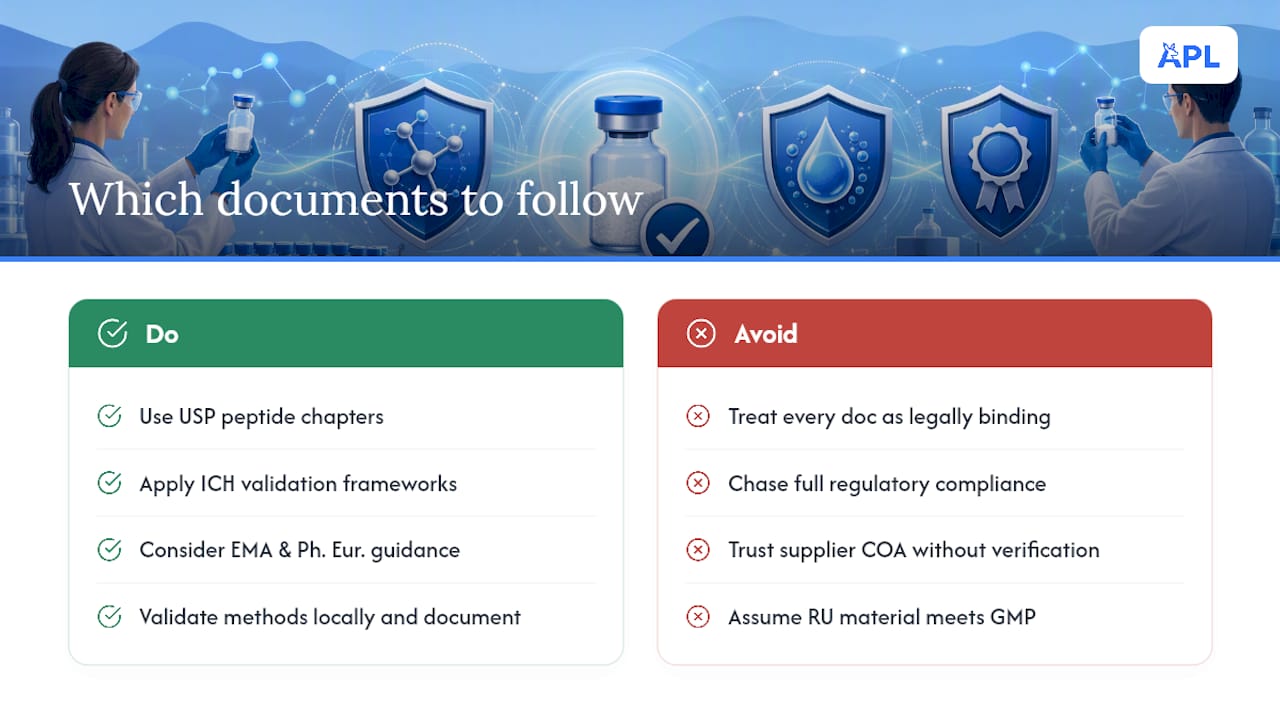
Not every pharmacopeial or regulatory document is relevant to research‑use material, and treating all of them as equally binding leads to either wasted effort or false confidence.
The core references worth knowing: USP general chapters addressing peptide quality attributes, including chapters covering synthetic peptide impurities and reference standard practices; the ICH Q6B specification framework alongside the newer ICH Q2 and Q14 guidance on analytical method validation and development, plus ICH M10 for bioanalytical method validation where pharmacokinetic work is involved; and the EMA's guideline on synthetic peptide quality, alongside Ph. Eur. monograph practice for identification and impurity thresholds. Recent pharmacopeial activity has expanded coverage of peptide-specific quality attributes, reflecting how much this area has matured over the past decade.
The distinction that matters practically: USP monograph methods, ICH validation frameworks, and EMA submission guidelines are written primarily for drug development, ANDA filings, and GMP manufacturing. Research‑use material is not held to these as legal requirements, but the methods themselves remain the best available benchmark for what "well‑characterised" looks like. A lab evaluating a supplier's COA against ICH‑aligned expectations, even informally, is applying a higher standard than most research suppliers are obligated to meet, and that gap is precisely where quality problems hide.
The practical next step is not to chase full regulatory compliance for research material. It is to adopt pharmacopeial methods where feasible, validate them locally against your own instruments and reference standards, and document why a given method is fit for purpose. For assay validation more broadly, the same logic that governs reagent and antibody datasheet checks applies here: verify what a document claims before trusting it, rather than after a failed experiment.
Turning these standards into a working lab checklist
Reading pharmacopeial guidance is one thing. Building it into a repeatable receiving procedure is another, and this is where most labs quietly fall short, not because they disagree with the standards but because nobody translated them into a checklist anyone can run in ten minutes.
An on‑receipt SOP worth copying directly into a lab's documentation:
- Confirm the COA lists method, date, instrument, and lot number for every reported result
- Cross‑check the HPLC purity snapshot against the COA's stated main peak retention time
- Confirm LC‑MS identity shows a mass match and, where possible, co‑elution against a known standard
- Verify net peptide content is reported or calculable, not silently substituted with HPLC area% alone
- Request endotoxin and sterility data where the peptide is destined for in vivo or cell‑based work
Aupeptidelabs supports this workflow with practical resources built for exactly this purpose: a purity versus net peptide content guide explaining how to read a COA properly, peptide labelling standards for maintaining traceability once material is in the lab, a mass spec verification guide for interpreting LC‑MS results, and a peptide dilution calculator for converting confirmed net peptide content into working solution concentrations. Every Aupeptidelabs order ships with a COA covering these attributes, and material dispatches from Australian stock within one business day, which matters when a delayed shipment means a delayed experiment.
Where to go for primary documents
For the compendial detail this guide summarises, go directly to the source. USP's report on reference standards for synthetic peptide therapeutics covers mass balance and value assignment in full. The PMC review of reference standard practices details mass balance components and water content timing. For regulatory context spanning ICH, EMA, and Ph. Eur. expectations, the Springer review of peptide quality assessment is the most current summary available. For lab‑ready templates, the sterility testing checklist and dilution calculator turn these documents into daily practice.
An editorial view on where labs actually go wrong
The conventional advice on peptide quality treats "purity" as a single number worth chasing higher, when the more useful question is almost always: purity of what, measured how, against which standard?
What is genuinely overrated is the assumption that a supplier's single-line purity claim substitutes for a proper COA. What is underrated is amino acid analysis, which most researchers treat as optional and most suppliers rarely offer without being asked directly. If this guide argues for one change in practice, it is this: stop accepting HPLC area% as a proxy for how much peptide is actually in the vial, and start asking for net peptide content by name, every time, regardless of how routine the order feels.
— Dr. Authur
Sourcing research peptides that meet these standards
Some suppliers provide peptides that ship with a certificate of analysis covering identity, HPLC purity, and net peptide content, dispatched promptly to reduce shipment delays that could impact experiments. Suppliers differ in how transparently and promptly they provide method dates and purity details; good documentation should be considered a baseline for research peptides.
That matters most for labs running dose‑dependent or time‑sensitive protocols, where a vague purity claim is not just an inconvenience but a genuine confound in the data. Some suppliers also stock supporting research materials such as bacteriostatic water, insulin syringes, and alcohol wipes, and may offer custom and bulk order fulfilment for larger research protocols. If you are ready to order against the checklist covered here, browse the current peptide inventory and check net peptide content against your own dosing calculations using the peptide dilution calculator before your next batch order goes in.
Sources
- Reference standards to support quality of synthetic peptide therapeutics (USP report)
- Regulatory and analytical considerations for the quality assessment of peptide drugs (Springer review, 2026)