
Peptide sterility testing is performed mainly by membrane filtration or direct inoculation, with a valid result defined as no growth after the compendial 14 day incubation set out in USP <71> and WHO sterility guidance. That outcome tells you the tested sample showed no viable microorganisms under the conditions applied, not that every unit in the batch is absolutely sterile. Evaluating which method fits your peptide matrix, reading a certificate of analysis critically, and setting up proper validation are what separate a defensible release decision from a rubber stamp.
Sterility testing peptides: choosing membrane filtration or direct inoculation
Membrane filtration is the preferred method for most peptide solutions because it removes any inherent antimicrobial activity in the sample by physically separating microorganisms onto a filter membrane, then culturing that membrane in growth media. USP <71> sets out this method alongside direct inoculation as the two accepted compendial routes for testing peptides for sterility, and both remain the backbone of peptide sterility validation across contract labs.
The membrane filtration workflow runs in a defined sequence. A measured sample volume passes through a sterile 0.45 micron (or finer) membrane filter under negative pressure, the filter is rinsed with a sterile diluent to clear residual antimicrobial activity, and the membrane is then transferred aseptically into both thioglycollate and soybean casein digest media for incubation. Rinsing matters more with peptides than with many small molecule drugs, because peptide formulations sometimes carry preservatives, buffers, or bacteriostatic agents that can otherwise suppress microbial growth on the membrane and produce a false negative.
Direct inoculation, by contrast, involves adding the sample straight into the growth media without a filtration step. It becomes necessary when a peptide solution is too viscous to filter cleanly, when sample volume is too small to justify filtration setup, or when the peptide is suspended in a solvent that isn't compatible with standard filter membranes. The trade off is real: direct inoculation dilutes the sample less effectively into a defined volume, so any inherent antimicrobial property in the peptide formulation is more likely to mask low level contamination.
Lyophilised peptides need reconstitution in sterile diluent (typically water for injection or bacteriostatic water) before either method proceeds, and that reconstitution step itself must occur under aseptic conditions to avoid introducing contamination the test would then wrongly attribute to the original batch.
Method selection generally comes down to a short list of practical factors:
- Filterability: clear, low viscosity aqueous peptide solutions almost always go through membrane filtration.
- Sample volume: very small research batches may not yield enough material to justify filtration apparatus.
- Formulation components: high concentrations of surfactants, oils, or viscosity modifiers can clog filters and push testing toward direct inoculation.
- Antimicrobial carryover: filtration's rinsing step gives it an edge whenever a formulation contains any inhibitory agent.
Growth media and incubation conditions under USP and WHO standards
Two media cover the accepted spectrum of contaminating organisms in compendial sterility testing, and getting both right is non negotiable for a defensible result.
- Fluid Thioglycollate Medium supports anaerobic and aerobic bacteria and is incubated at approximately 30 to 35 °C.
- Soybean Casein Digest Medium supports aerobic bacteria and fungi, incubated at approximately 20 to 25 °C.
- Both media are held for the entire incubation period specified under USP <71>, with daily visual checks for turbidity, sediment, or other signs of microbial growth.
- Where a peptide formulation contains penicillins, cephalosporins, or other antibiotic residues, sterile beta lactamase or an equivalent neutraliser is added to the media to stop antibiotic activity from suppressing growth and generating a false pass, a requirement detailed in compendial guidance on media supplementation.
- Before either medium is used on a client sample, it must pass its own sterility check (an uninoculated control incubated in parallel) and a growth promotion test confirming it actually supports the growth of known challenge organisms.
Skipping growth promotion testing on a fresh batch of media is one of the more common shortcuts that undermines an otherwise correctly run assay. Media that has degraded in storage, or that was prepared with a compounding error, can sit clear for 14 days regardless of what's actually in the sample, and that failure mode is invisible unless growth promotion was verified beforehand.
Sample preparation and method suitability for peptide matrices
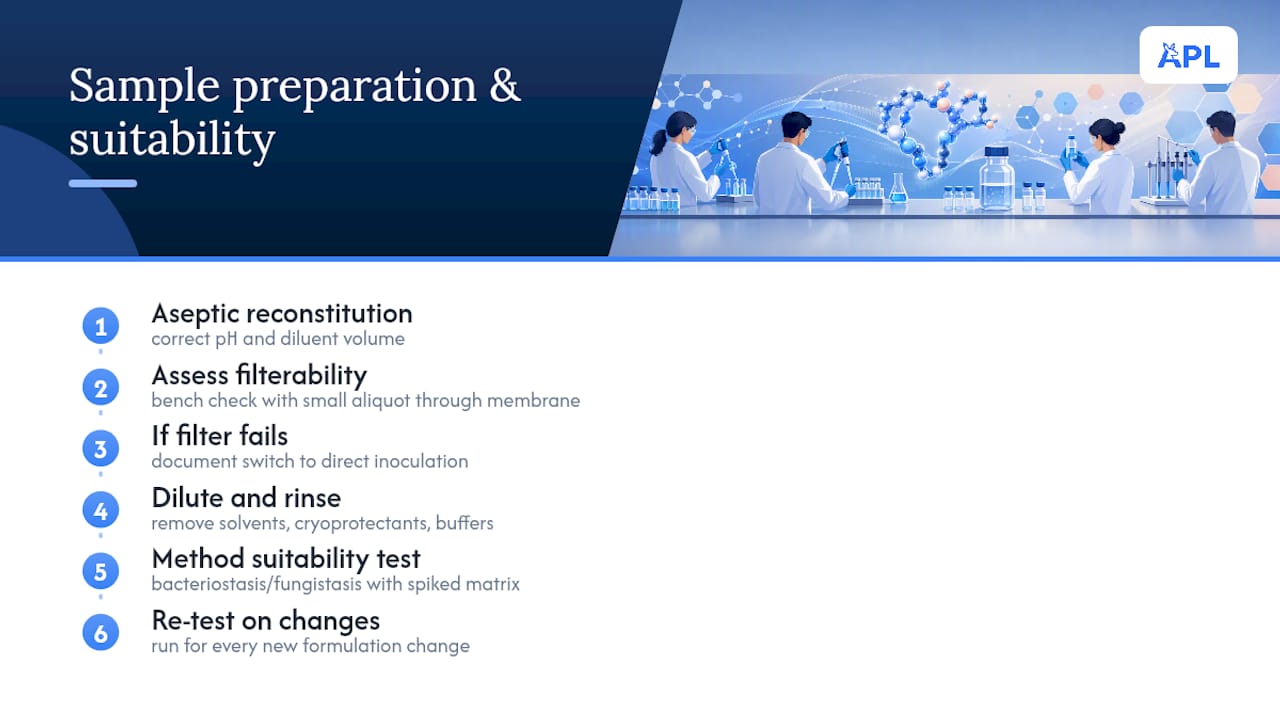
Sample preparation is where most avoidable sterility testing peptides errors occur, because peptides behave differently from small molecule drugs in solution. Lyophilised peptide powders must be reconstituted aseptically, at the correct pH and diluent volume, before either filtration or inoculation begins, and any deviation in reconstitution technique can introduce contamination that has nothing to do with the original manufacturing process.
Filterability needs to be assessed early. A quick bench check, passing a small aliquot through the intended membrane pore size, reveals whether a peptide solution will clog the filter, foul the membrane with visible residue, or pass cleanly. Solutions that fail this check justify a documented switch to direct inoculation rather than forcing filtration and risking an incomplete or invalid run.
Residual solvents, cryoprotectants, and buffer components common in peptide formulations (glycerol, mannitol, acetate buffers) can inhibit microbial growth if carried into the media at high concentration, which is why dilution and rinsing steps are specified rather than optional.
Method suitability testing, sometimes called a bacteriostasis and fungistasis test, confirms the chosen method actually recovers challenge organisms when they're deliberately spiked into the peptide matrix at low levels. This step, run once per new product formulation, is what proves your method isn't quietly suppressing the very growth it's meant to detect.
Pro Tip: Run method suitability testing on every new peptide formulation before relying on it for batch release, not just once per product family. A change in buffer, concentration, or preservative can shift bacteriostatic activity enough to mask contamination that an earlier validation missed.
Validation, controls and acceptance criteria for a defensible result
A sterility test is only as trustworthy as the controls run alongside it, and compendial standards are specific about what those controls need to show.
- Growth promotion testing confirms the media supports growth of defined challenge organisms, typically Staphylococcus aureus, Pseudomonas aeruginosa, Bacillus subtilis, and Candida albicans, inoculated at low levels of no more than 100 cfu, as specified in compendial guidance.
- Positive controls (media deliberately inoculated with a known organism) must show visible growth within the incubation window, confirming the media and conditions are capable of supporting microbial life.
- Negative controls (uninoculated media handled identically to test samples) must remain clear, ruling out contamination introduced by the testing environment itself rather than the product.
- A test is considered invalid, not simply a fail, when growth is attributable to a flaw in the testing process itself, such as environmental contamination during handling or equipment failure, and compendial guidance permits a documented investigation and retest under these circumstances rather than an automatic batch rejection.
- Documentation retained for batch release should include the growth promotion results, control outcomes, incubation logs with daily observations, and any investigation records tied to an invalid run.
What a sterile result actually means and where it falls short
A "no growth observed" result means the sample tested, under the specific conditions applied, showed no viable microorganisms during the incubation period. It doesn't mean the entire batch is sterile in an absolute sense. WHO frames this through the sterility assurance level concept, a probability model rather than a certainty, because testing every single unit in a batch is physically impossible and representative sampling is the only workable alternative.
Sterility testing is also distinct from bioburden and endotoxin testing, and confusing the three is a common error. Bioburden quantifies the total microbial load present before any sterilisation step, endotoxin testing detects bacterial toxins that survive even after organisms are killed, and sterility testing confirms the absence of viable organisms after processing is complete. Peptide release programs generally need all three, not one in place of the others.
- Bioburden: measures load pre sterilisation, informs process control.
- Endotoxin: detects toxin residues, relevant even when no live organisms remain.
- Sterility: confirms absence of viable organisms in the final tested sample.
Sample size and representative sampling directly affect how much confidence a batch's result deserves, and a pass on a small sample fraction never converts to a guarantee about units never tested. Handling after the test, reconstitution technique, storage conditions, and how a vial is opened for use, can all introduce contamination that the original sterility test never had the chance to catch.
Rapid screening tools: where ATP, PCR and flow cytometry fit
ATP bioluminescence detects microbial metabolic activity within roughly 24 to 48 hours by measuring light output from an enzymatic reaction, making it useful as an early warning during in process monitoring or troubleshooting a suspected contamination event. PCR based methods identify specific microbial DNA sequences, useful when a lab needs to confirm the identity of an organism rather than simply detect its presence, while flow cytometry can enumerate cells rapidly in a liquid sample.
- ATP bioluminescence: fast go/no go signal, not organism specific.
- PCR: confirms identity of a detected organism, needs species specific primers.
- Flow cytometry: rapid cell counts, useful for process monitoring rather than final release.
None of these rapid methods currently replace the compendial 14 day incubation for final batch release under USP or WHO frameworks. They speed up troubleshooting and give earlier visibility into a possible problem, but regulatory expectations for release testing still point to the traditional method as the standard labs are held to, and any rapid method used in that role needs its own validation against the compendial result first.
How to read a peptide certificate of analysis without missing red flags
A sterility certificate of analysis worth trusting shows the batch ID, test method used (membrane filtration or direct inoculation), both media names, incubation start and end dates covering the full 14 days, the testing laboratory's accreditation, and evidence that growth promotion was verified on that media lot.
- Confirm the test date sits reasonably close to the manufacture date, not months apart.
- Check both media show negative results, not just one.
- Look for the accredited lab's name, not a generic "in house tested" claim.
- Treat a document showing only a rapid screen result, with no compendial data, as incomplete for release purposes.
Author perspective: three priorities before batch release
Given how much of this hinges on process rather than a single test result, our editorial view weighs method validity, control documentation, and certificate currency above everything else. A pass on a stale certificate, or one missing growth promotion evidence, tells you very little. Sterility testing complements clean manufacture and aseptic handling. It never substitutes for either.
— Dr. Authur
Sourcing pre-tested peptides versus running your own sterility validation
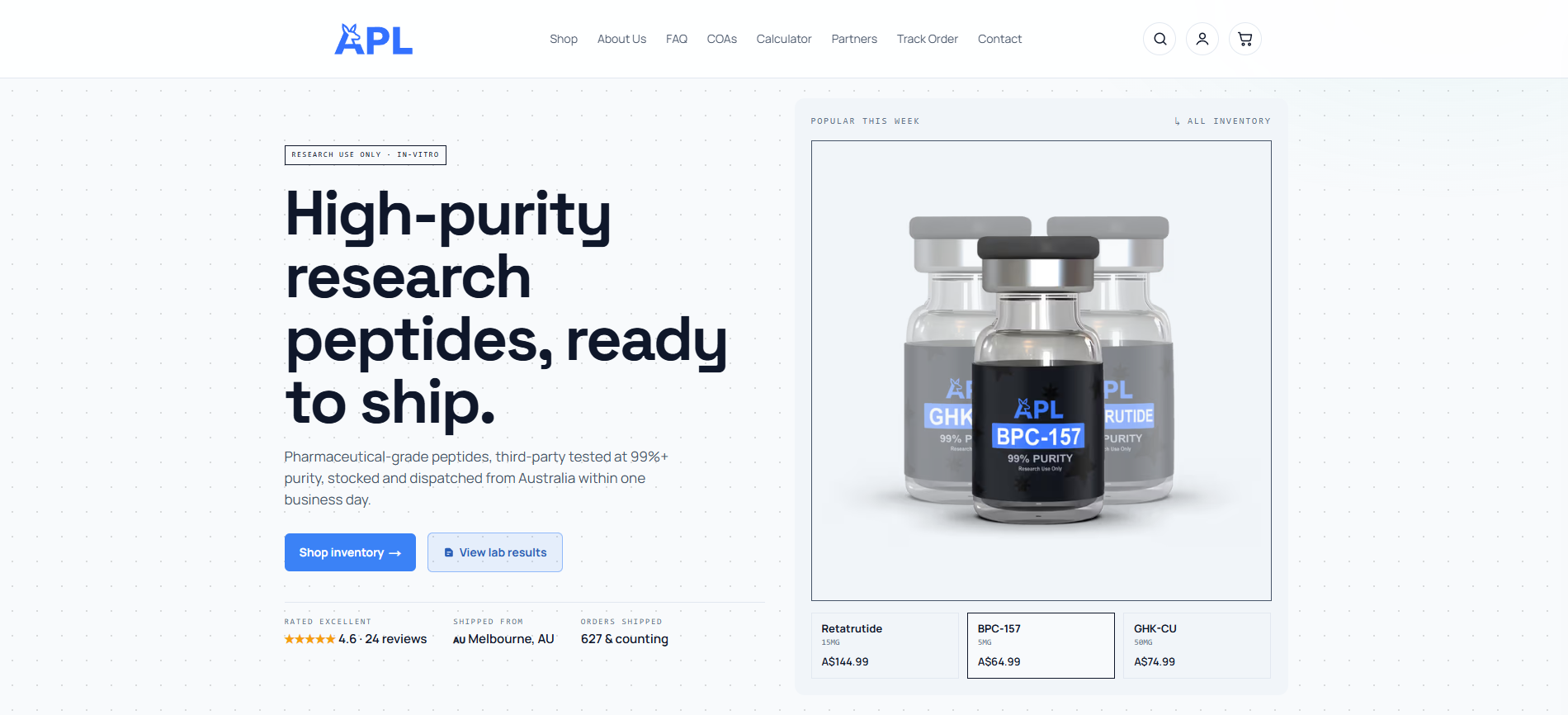
Running full sterility validation in house makes sense when your lab has the incubators, accredited testing partners, and staff time to manage a 14 day cycle for every batch. For many research programs, that overhead competes directly with the actual research. Aupeptidelabs stocks high purity research peptides with third party purity certificates and dispatches from Australia within one business day, which matters when a delayed shipment means a delayed experiment rather than a delayed dinner.
Buying pre-tested inventory is the sensible route when your project timeline can't absorb weeks of independent validation on every incoming batch. Independent testing still earns its place when you're formulating a novel peptide combination, working with materials from an unfamiliar source, or need documentation specific to a study protocol that stock certificates don't cover. For standard research peptide procurement, check Aupeptidelabs's current inventory and get your next batch moving without adding a testing bottleneck to your own schedule.
Sources
- Sterility testing
- General Chapters: <71> STERILITY TESTS
- USP <71> (extracts)
- Sterility testing: Methods and standards in 2026