
Reconstituted peptides need refrigerated (2–8°C) transport. Lyophilised peptides can often tolerate brief ambient excursions, but the specific stability data for that formulation, not a general rule, should govern the final decision. Because degradation is cumulative and often invisible, every shipment needs a validated pack-out matched to its lane, plus a mandatory verification step on arrival before the peptide goes anywhere near a bench.
What temperature band does peptide cold chain shipping actually require?
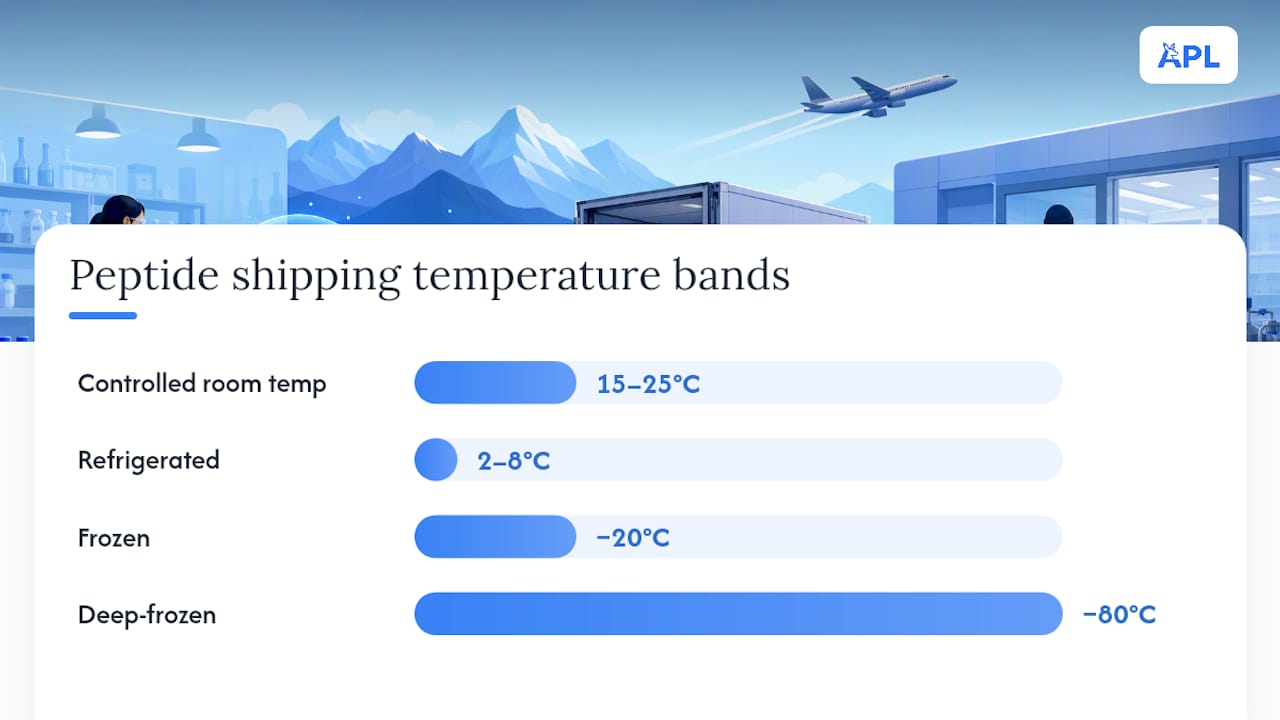
Four temperature bands cover almost every research peptide moving through the supply chain: controlled room temperature (CRT, typically 15–25°C), refrigerated (2–8°C), frozen (−20°C), and deep-frozen (−80°C). Which band applies depends on the specific formulation's stability data, not a blanket industry rule.
Lyophilised (freeze-dried) peptides are more forgiving because the amorphous solid matrix limits molecular mobility. That matrix holds its structure below its Glass Transition Temperature (Tg), the point where a freeze-dried solid starts behaving more like a viscous liquid, with far higher rates of degradation. Keep a lyophilised peptide below its Tg and the powder stays stable for extended periods. Push it above Tg, even briefly, and hydrolysis and aggregation accelerate. Reconstituted peptides have no such buffer. Dissolved in liquid, they behave like most protein solutions: heat-sensitive, prone to aggregation, and unforgiving of ambient excursions.
Transit duration should dictate the pack-out:
- Overnight (12–24 hours): standard gel-pack refrigeration is often sufficient for lyophilised formulations.
- 2–3 day domestic lanes: require more refrigerant mass and better insulation to hold the band through longer dwell times.
- International lanes: typically demand validated pack-outs or active cooling, given customs delays and unpredictable handling.
Pro Tip: Never assume a lyophilised peptide's ambient tolerance without checking its specific stability data. Tg varies by peptide sequence, salt form, and residual moisture, so what holds for one product can fail for another.
Choosing insulation, refrigerants and pack-out configuration
Packaging choice is not cosmetic. It is the difference between a peptide that arrives intact and one that arrives degraded with no visible sign of the problem. Three insulation types dominate peptide logistics, each with a different cost-to-performance profile.
- Expanded polystyrene (EPS) foam — the cheapest option, adequate for short domestic lanes but prone to losing its cold reserve faster in temperature extremes.
- Polyurethane foam — denser and better insulated than EPS, suited to 2–3 day lanes where thermal mass needs to last longer.
- Vacuum insulated panels (VIPs) — the strongest thermal performance of the three, generally reserved for international lanes or high-value shipments where failure is not an option.
Refrigerant selection has to match the band, not just the box. Gel packs are the default for 2–8°C shipments. Phase-change materials (PCMs) hold a narrower engineered range and suit lanes where temperature swings are common. Dry ice is standard for frozen shipments but needs venting considerations, since it sublimates to carbon dioxide gas.
Conditioning refrigerant to the correct starting temperature before packing, positioning it around rather than beneath the payload, and using void-fill to stop internal movement all matter more than the brand of cooler used. Small payloads lose thermal buffer faster during handoffs, so smaller shipments often need proportionally more refrigerant than their size suggests.
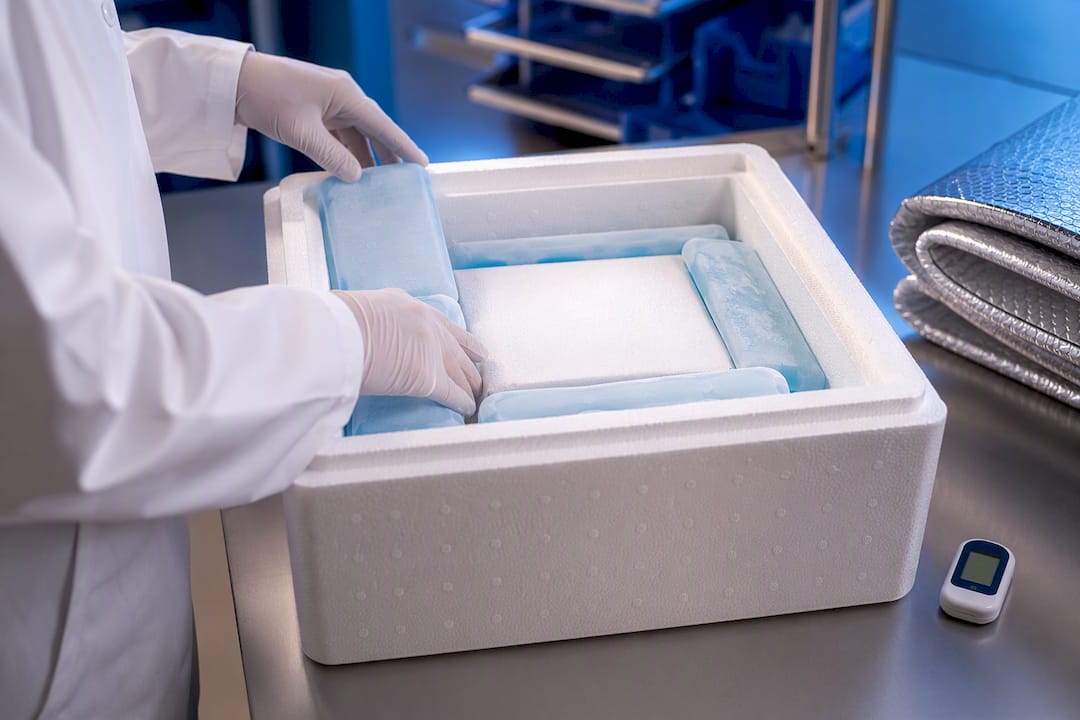
Pro Tip: Adjust refrigerant mass seasonally. A pack-out validated in winter can fail in summer heat on the same lane, because ambient exposure during last-mile delivery is the variable that changes, not the carrier's transit time.
Staging, pick/pack workflow and carrier selection
Most thermal excursions happen at handoffs, not during transport. A refrigerated van holding 4°C for six hours does nothing to protect a peptide sitting on an ambient loading dock for forty minutes beforehand.
Effective operational control starts with time-out-of-environment limits: a hard cap on how long any peptide sits outside its target band during picking, packing, and staging. Refrigerant should be conditioned on a schedule, not pulled from the freezer the moment an order comes in, and cutoff times need to be strict enough that late orders roll to the next dispatch window rather than get rushed through with under-conditioned packaging.
Carrier selection carries real weight here. Dedicated cold-chain services with predictable transit windows and documented temperature-controlled handling outperform generic couriers, particularly on weekend or holiday-adjacent lanes where a parcel can sit in an unconditioned depot for days.
- Weekend holds are one of the most common and preventable excursion causes; avoid dispatching into a lane where a weekend transit gap is likely.
- Ambient staging areas, even for ten minutes, undo hours of correct refrigeration upstream.
- Staff training on cutoff discipline matters more than any single piece of packaging.
Pro Tip: Treat cutoff times as non-negotiable. A peptide packed correctly but rushed past its conditioning window is functionally the same risk as one packed with the wrong refrigerant.
How should labs monitor and document shipments?
Monitoring choice should scale with the value and sensitivity of what is being shipped. Single-use time–temperature indicators (TTIs) are the cheapest option and tell you only whether a threshold was crossed at some point, not when, for how long, or by how much. Continuous data loggers record the full temperature curve, which is what actually supports a defensible disposition decision when something goes wrong.
- Single-use indicators suit low-risk, low-value shipments where a simple pass/fail flag is enough.
- TTIs add a time dimension but still lack the granularity to distinguish a five-minute spike from a two-hour excursion.
- Continuous data loggers are the appropriate standard for high-value or lab-sensitive peptides, and documented SOPs with continuous logging measurably reduce undetected excursions.
Calibration matters as much as the device itself. A logger that has not been calibrated in twelve months is producing numbers nobody should trust. Retain logger records, calibration certificates, and pack/staging SOPs together for each shipment lot, so an audit or an internal investigation can reconstruct exactly what happened without guesswork.
Checking a peptide shipment the moment it arrives
Verification on receipt is not optional. It is the last checkpoint before a peptide enters someone's research workflow, and it takes minutes.
- Check the temperature indicator or logger reading first, before opening the vial packaging itself.
- Inspect the refrigerant condition: gel packs should still feel cold, dry ice should show reasonable remaining mass, and any sign of full thaw or complete sublimation is a red flag.
- Examine vial seals and look for condensation inside the packaging, both signs of a compromised environment during transit.
- If anything looks off, quarantine the shipment immediately rather than placing it into standard storage.
- Escalate to analytical testing, typically HPLC or mass spectrometry, when the indicator data or physical signs suggest a real excursion occurred.
Pro Tip: Log the receipt check with a timestamp and photo before touching the vial. That record is often the only evidence available if a disposition dispute comes up later.
Deciding whether to use, test or destroy after an excursion
Not every excursion is a write-off, but guessing is not an acceptable substitute for a decision framework. Document the excursion's duration, peak temperature, and the specific formulation involved, since lyophilised and reconstituted peptides tolerate excursions very differently.
- A brief excursion (minutes, not hours) on a lyophilised peptide below its Tg threshold is usually low risk.
- A prolonged excursion, or any excursion on a reconstituted peptide, warrants quarantine pending analytical testing.
- Where testing is impractical, the conservative disposition is reship or destroy rather than use.
- Feed every excursion back into the SOP: if staging or a specific carrier lane keeps causing the same failure, the workflow needs to change, not just the individual shipment.
Labs building this process from scratch can start with a decision guide for handling suspected temperature excursions.
What operational proof should you expect from a peptide supplier?
Au Peptide Labs dispatches all orders from Australia within one business day, which removes the customs-delay variable that turns a validated domestic pack-out into an unpredictable international one.
Two pack-out configurations illustrate the practical range most labs will encounter:
- A typical 24–48 hour domestic lane uses gel-pack refrigeration held at 2–8°C, with insulation sized to the payload and conditioning completed before pick/pack begins.
- A frozen shipment uses a dry-ice protocol with venting allowance built into the container, reserved for peptides whose stability data calls for −20°C or below.
Labs comparing lyophilised against liquid peptide handling or wanting local dispatch specifics can review what Australian labs need to know about peptide shipping. Requests for validation data or SOP documentation can be directed to Au Peptide Labs directly.
The one habit that fixes most cold chain failures
The biggest preventable failure is not packaging or refrigerant choice. It is ambient staging: a parcel sitting on a bench between picking and packing while nobody watches the clock. Pre-condition refrigerant on a fixed schedule and enforce strict cutoff times. That single habit closes more gaps than any premium cooler ever will. Labs formalising this should pair it with a stockout-prevention forecasting approach so pack/pack pressure never forces a rushed shipment.
— Dr. Authur
Ordering peptides with the cold chain already handled
Researchers seeking reliable cold chain peptide shipments without customs delays can consider suppliers that dispatch orders promptly from within Australia.
For labs wanting to see purity documentation before ordering, product pages such as LL-37, SS-31, and Selank list storage recommendations alongside CoA availability. If your lab needs validated pack-out data or SOP references to support internal quality documentation, request that information directly through the Au Peptide Labs ordering page and place your next peptide order with same-day Australian dispatch already built in.
Sources
- Peptide Cold Chain: Temperature Requirements & Best Practices | 3PLGuys
- Peptide Cold Chain Packaging | Temperature-Controlled Shipping Solutions | Nordic Cold Chain
- PMCID article on temperature‑sensitive product logistics
- Peptide stability topics on ScienceDirect