
A TGA research exemption does allow lawful supply of unapproved therapeutic goods in Australia, but only through two defined mechanisms: the Clinical Trial Notification (CTN) scheme and the Clinical Trial Approval (CTA) scheme. Notification under CTN creates an automatic exemption once the fee is paid; CTA requires the Therapeutic Goods Administration to formally evaluate and approve the goods first, and this is mandatory for certain high-risk biologicals. Both pathways depend on active Human Research Ethics Committee (HREC) approval and continuing compliance.
What a TGA research exemption actually covers
An "unapproved therapeutic good" is any drug, biological, or device not listed on the Australian Register of Therapeutic Goods (ARTG). Under the Therapeutic Goods Act 1989 and its associated Regulations, supplying such a good in Australia is prohibited unless a specific pathway applies. The CTN and CTA schemes are two of those pathways, built specifically for clinical research rather than general commercial supply.
The exemption does not mean the good is approved, safe, or endorsed by the TGA. It means the supply of that unapproved good for a defined trial has been made lawful, subject to strict conditions. That distinction trips up sponsors constantly, particularly first-time investigator-initiated trials run out of university departments where ethics processes are well understood but TGA obligations are treated as an afterthought.
Several categories of goods routinely fall into "unapproved" status in a trial context, and each one needs its own coverage under an exemption or approval:
- The investigational product itself, whether a novel compound, biological, or device.
- Comparator products, even where the comparator is already registered overseas or used off-label in Australian clinical practice.
- Placebos, which have no ARTG listing of their own and must be captured by the same notification or approval as the active arm.
- Device kits, diagnostic components, or companion software bundled into a device-based trial.
- Any locally manufactured batch of a product that differs from an ARTG-listed formulation, even by dose or excipient.
The Australian clinical trial handbook is explicit that every one of these items must be individually covered before supply occurs. Ethics approval from an HREC is necessary, but it is not sufficient on its own. HREC sign-off addresses the scientific and ethical merit of a trial; it says nothing about whether the goods used in that trial are legally permitted to be supplied. Sponsors who treat ethics approval as a proxy for regulatory clearance are one of the most common sources of compliance failure in Australian research.
CTN versus CTA: how they work and when each applies
CTN is a notification scheme, not an approval scheme. A sponsor lodges the online CTN form, confirms the HREC has reviewed the trial and is satisfied it has the expertise to do so, and pays the prescribed fee. Once that's done, the unapproved goods are exempt from ARTG inclusion for the duration of the trial, without the TGA itself reviewing the scientific data. The regulatory burden sits with the sponsor and the HREC, not with a TGA evaluator.
CTA works differently. The sponsor submits data for the TGA to actually assess before any supply can begin, and the trial cannot proceed until that evaluation is complete. This is mandatory for Class 4 biologicals, unless the product already has meaningful prior human clinical use or an equivalent overseas regulatory approval that the TGA accepts as sufficient. For everything outside that mandatory category, the choice between CTN and CTA is a joint decision between sponsor and HREC, hinging largely on whether the HREC believes it has the scientific expertise to properly assess the trial's risk on its own, as TGA guidance on regulating clinical trials sets out.
Here's how the decision typically plays out in practice:
- Identify the product's risk classification first. Class 4 biologicals trigger mandatory CTA in almost all cases; lower-risk drugs, devices, and biologicals usually have the CTN option available.
- Check for prior human data. A product with a solid overseas clinical safety record, or an equivalent approval from a comparable regulator, can sometimes avoid mandatory CTA even within the Class 4 biological category.
- Assess manufacturing changes. A formulation, dose, or manufacturing process that differs meaningfully from what's been used previously raises the risk profile and often pushes a sponsor toward CTA, even where CTN would otherwise be permitted.
- Confirm HREC expertise. If the ethics committee reviewing the trial doesn't have the specific scientific background to assess a novel mechanism or delivery method, CTA becomes the safer, and sometimes the required, route.
- Weigh timeline against certainty. CTN is faster because there's no TGA evaluation queue. CTA takes longer but removes the risk of a later regulatory challenge to the trial's legal footing.
A first-in-human trial of a novel small-molecule compound with a well-characterised safety profile and a competent specialist HREC is a textbook CTN case. By contrast, a first-in-human trial of a genetically modified cell therapy sits squarely in Class 4 biological territory and will almost certainly require CTA, with the CTA evaluation process often running to multiple rounds of TGA requests for further information.
Pro Tip: Don't assume your HREC's general research ethics experience covers TGA-relevant expertise. Ask the committee directly, in writing, whether it considers itself equipped to assess the specific product class in your trial. That written confirmation becomes part of your compliance record if the pathway choice is ever questioned.
Step by step: securing and maintaining a CTN exemption
Getting a CTN exemption right is less about the form itself and more about what happens before and after it's lodged.
- Confirm ARTG status before you do anything else. Search the ARTG to establish, in writing, that the investigational product, comparator, and placebo are all genuinely unapproved for the intended use. A product registered for one indication but used off-label in your trial still needs to be checked carefully.
- Engage the HREC early and get its position on expertise. The committee's approval, and its confirmation that it's satisfied with reviewing this specific trial, needs to be locked in before the CTN form is lodged, not after.
- Assemble the Investigator's Brochure and supporting documentation. This includes manufacturing information, prior toxicology and clinical data where available, and the trial protocol itself, all of which underpin the sponsor's representation that the trial is appropriate for CTN rather than CTA.
- Complete the online CTN form accurately. Common errors include mismatched product names between the form and the protocol, incorrect site listings, and lodging the notification before HREC approval is finalised rather than after.
- Pay the prescribed fee. Payment is what actually activates the exemption. A notification submitted but unpaid does not create lawful supply status, a detail sponsors sometimes miss when working to tight enrolment timelines.
- Maintain HREC approval and site authorisations for the trial's full duration. A lapsed HREC approval, even briefly, removes the legal basis for supply during that gap, regardless of what the CTN form originally stated.
- Monitor and report adverse events as they occur. This obligation runs independently of the CTN exemption and continues for as long as the trial is active.
- Keep records that map HREC approval dates, site authorisations, and the CTN's effective period against each other. A single compliance register showing all three timelines side by side makes it far easier to catch a lapse before supply happens, rather than after an incident forces the question.
- Notify the TGA when the trial concludes. The exemption is tied to an active trial. Once the trial ends, the TGA needs to be told that supply under CTN is no longer required, and failing to close this out properly can leave open regulatory obligations that outlast the actual research.
Sponsors who build the compliance register described in step eight rarely encounter a nasty surprise at inspection. Those who track HREC dates in one system, site authorisations in another, and the CTN status nowhere at all, are the ones who find a gap only when it's already caused a breach.
What sponsors and manufacturers still owe once a product is exempt
An exemption from ARTG inclusion is not a blanket exemption from regulation. Exempt medical devices, in particular, remain subject to a full set of ongoing obligations that exist entirely independently of ARTG status.
- Adverse-event reporting continues regardless of exemption status. A device or drug that's exempt from ARTG listing still triggers mandatory reporting if it causes or contributes to a serious adverse event during the trial.
- Recall responsibilities sit with the sponsor, not the HREC. If a batch defect or safety signal emerges, the sponsor must act, coordinate with sites, and notify the TGA, exactly as it would for an ARTG-listed product.
- Advertising and labelling restrictions still apply. Promoting an unapproved therapeutic good outside the bounds of the trial protocol, even informally, can breach advertising provisions under the Act.
- Devices must still meet the Essential Principles where applicable. Exemption from ARTG listing does not exempt a device from meeting the safety and performance benchmarks the TGA's guidance on exempt medical devices sets out.
- Manufacturing licences and GMP requirements can still apply. Some categories carry time-limited manufacturing exemptions tied specifically to the trial's scope; manufacturing outside that scope, even for a seemingly minor batch variation, can fall outside the exemption entirely.
- A breach of any condition changes the product's legal status immediately. Supply outside a nominated site, or continued supply after an HREC approval has lapsed, removes lawful supply status the moment the breach occurs, not from when it's discovered.
Pro Tip: Treat your exemption's conditions as a living checklist, not a one-off approval you file away. Review site authorisations, HREC status, and manufacturing scope at every trial milestone, not just at the start.
Import, export, and the customs checks that sit alongside TGA rules
A TGA exemption solves the domestic supply problem. It does not solve customs, quarantine, or controlled-substance issues, which run under entirely separate legislation and separate agencies.
- Biological materials crossing the border usually need Department of Agriculture quarantine clearance. This applies whether the product is entering Australia for the first time or is a comparator being brought in specifically for the trial.
- Importing or exporting unapproved therapeutic goods for experimental purposes generally requires additional clearance under the Customs (Prohibited Imports) Regulations, layered on top of whatever the TGA's import and export guidance already requires for the trial itself.
- Exporting trial goods out of Australia, for instance sending samples to an overseas central laboratory, routes through the TGA's Exports Team and needs its own approval, separate from the CTN or CTA that covers domestic supply.
- Controlled substances trigger a further layer entirely. Anything appearing on the list of drug substances requiring permission to import or export needs a specific permit, regardless of what CTN or CTA status the trial already holds.
- Documentation is the practical difference between a clean customs clearance and a delayed shipment. Certificates of analysis, quarantine declarations, correct Harmonized System coding, and accurate labelling all need to travel with the goods, not be assembled retrospectively when customs asks for them.
Sponsors who've been through a delayed shipment know the frustration: a trial ready to enrol, sites staffed and waiting, and an investigational product sitting in a bonded warehouse because a quarantine declaration was incomplete. Building these checks into procurement planning from day one, rather than treating them as a formality after the TGA exemption is secured, avoids that specific and entirely preventable delay.
Where exemptions actually get lost
Most exemption failures aren't dramatic. They're administrative gaps that quietly remove lawful supply status long before anyone notices.
- Supply outside a nominated trial site. An investigational product sent to a site not listed in the CTN or CTA documentation falls outside the exemption's scope entirely, even if the site is running an otherwise identical arm of the same trial.
- A lapsed HREC approval. Renewal delays happen, particularly for multi-year trials, and the Australian clinical trial handbook is clear that a gap in HREC approval removes lawful supply status for that period, regardless of intent.
- Manufacturing outside the exemption's stated scope. A batch produced under different conditions or at a different facility than what was disclosed in the original notification or approval can fall outside coverage.
- Failure to report adverse events promptly. This isn't just a documentation issue; delayed reporting can itself constitute a breach with enforcement consequences.
- Continuing supply after a trial has effectively ended. Once enrolment closes and follow-up concludes, ongoing supply without notifying the TGA can leave the sponsor without a valid exemption for that continued activity.
The enforcement consequences for these breaches range from suspension of supply and formal revocation of the exemption through to civil and criminal penalties under the Act, alongside product recalls where patient safety is affected. None of these outcomes require deliberate wrongdoing. Most stem from administrative drift: a renewal missed by a few weeks, a site added informally without updating the paperwork, a batch variation nobody flagged as material.
- Run internal compliance audits at fixed trial milestones, not just at initial approval and final closeout.
- Keep HREC liaison active and documented, including written confirmation of ongoing expertise and approval status at each site visit.
- Retain evidence of every condition met, from batch records to site authorisation letters, in a format that can be produced quickly if the TGA requests it.
- Report incidents rapidly rather than investigating fully before disclosure. A prompt, partial report is safer than a delayed, complete one.
Pro Tip: Assign one named person on the trial team as the compliance register owner. When responsibility for tracking HREC dates, site authorisations, and exemption status is shared informally across a team, gaps get missed. When one person owns it, they get caught.
How local sourcing reduces logistics and documentation risk
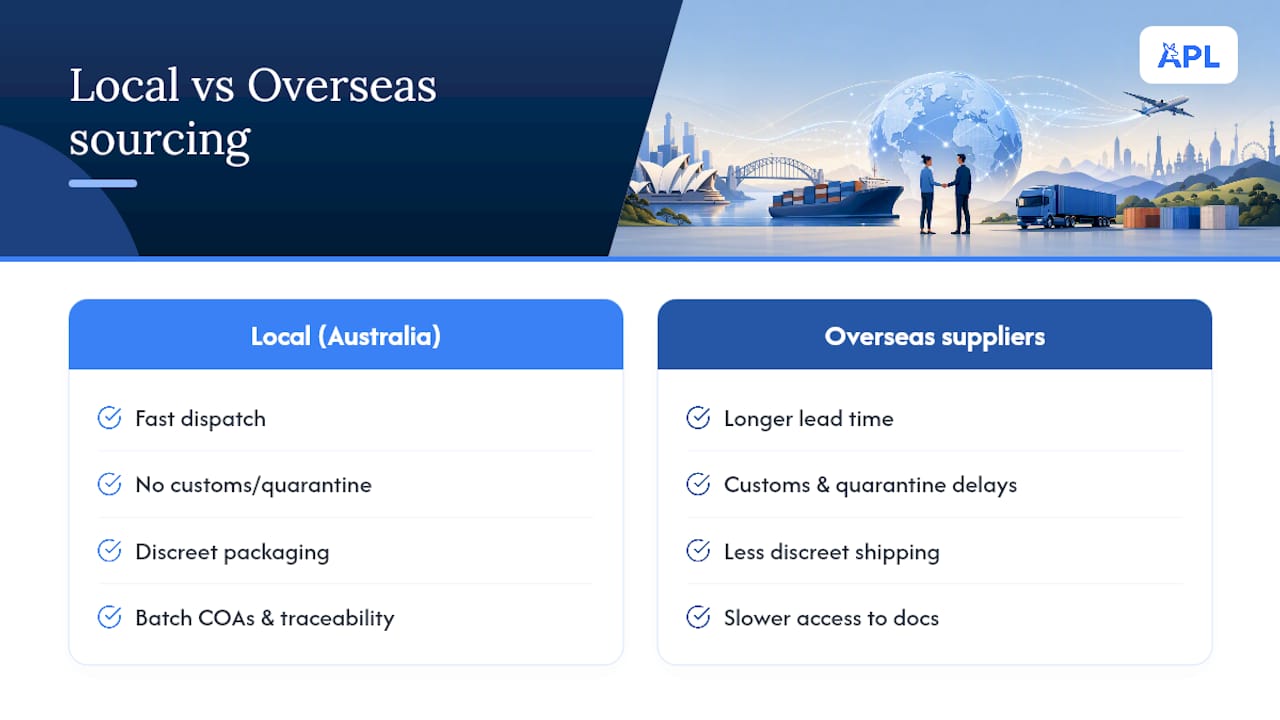
Trial timelines are vulnerable to exactly the kind of customs and quarantine friction described above, and the goods most exposed are usually the investigational product and its comparators, the items with the least regulatory flexibility if a shipment stalls.
- Sourcing from a supplier that dispatches domestically avoids the customs and quarantine clearance steps that apply to overseas imports altogether. A local supplier shipping same-day removes an entire category of delay risk from the procurement timeline.
- Third-party certificates of analysis (COAs) give sponsors independent verification of purity and identity for every batch, which is exactly the kind of documentation an HREC or, in a CTA context, the TGA itself may expect to see referenced in trial records.
- Batch traceability and chain-of-custody documentation support the compliance register sponsors should already be maintaining, linking a specific product batch to the site, the trial arm, and the date of supply.
- Discreet packaging matters for trials where product identity needs to stay blinded, protecting randomisation integrity right through to the point of administration.
Sponsors should ask any supplier for a COA specific to the batch being supplied, not a generic product-level document, along with a clear shipping declaration that supports customs and quarantine paperwork where relevant. Guidance on third-party testing for research peptides covers what a genuinely useful COA should include, and a research reagent partner such as ABMIUM illustrates the standard of batch documentation sponsors should expect across their supply chain, not just from a single vendor.
What sponsors keep getting wrong about exemptions
Working through the CTN and CTA frameworks repeatedly, the same pattern shows up: sponsors treat the regulatory pathway as a one-time decision made at trial setup, rather than a condition that has to be actively maintained for the trial's entire life. That's the single biggest gap between what the exemption promises and what actually protects a trial.

The conventional advice, get the CTN lodged, get the HREC approval, then focus on recruitment, understates how much ongoing discipline the exemption requires. HREC renewal dates, site authorisation lapses, and manufacturing scope creep are unglamorous administrative details, and that's exactly why they cause the most damage. Nobody loses an exemption because they misunderstood the Therapeutic Goods Act. They lose it because a renewal slipped by three weeks and nobody was tracking it.
My practical view: sponsors should treat the pathway decision, CTN or CTA, as the easy part. The hard part, and the part worth investing real operational effort into, is the compliance register that ties HREC dates, site authorisations, and exemption status together in one place. When a trial sits close to a borderline case, particularly around Class 4 biological classification, contacting the TGA directly before lodging anything is far cheaper than guessing and being wrong six months into recruitment.
— Dr. Authur
A local sourcing option for compliant trial supply
Choosing the right exemption pathway solves half the compliance picture. The other half is making sure the goods themselves arrive with documentation that survives scrutiny from an HREC, a TGA request, or an internal audit.
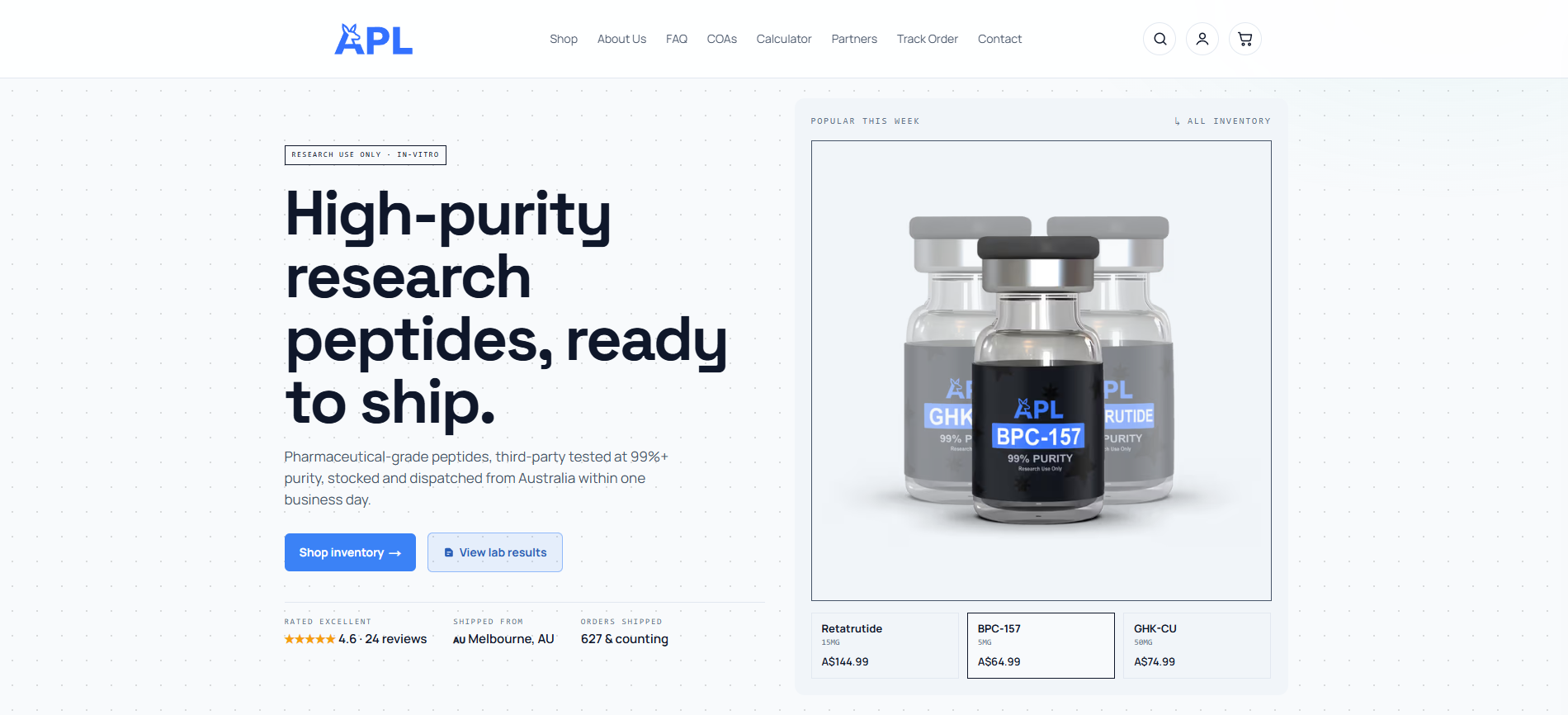
Because shipments dispatch quickly from Australia, sponsors avoid the customs and quarantine clearance steps that slow down overseas orders, a genuine risk factor in the import checklist covered above. Every order includes discreet packaging and the batch-level documentation, COAs, traceability records, and shipping declarations, that a compliance register needs to link supply directly to trial records.
Sponsors and laboratories running metabolic, recovery, or longevity-focused research can browse the Metabolic & GLP-1 range or the broader Lab Supplies category for consumables like insulin syringes and bacteriostatic water. For guidance on what "research use only" labelling actually requires from a compliance standpoint, the research use only meaning breakdown is worth reading before placing a first order. Start procurement through the Aupeptidelabs landing page and request current COAs for your batch before it ships.
Authoritative TGA pages worth bookmarking
Every CTN or CTA submission should be checked against the TGA's own current guidance rather than a secondhand summary. The core pages to keep on hand are the Clinical Trial Notification (CTN) scheme page, the Review of the Clinical Trial Approval (CTA) Scheme, and the Australian clinical trial handbook, which sets out sponsor and HREC obligations in full.
For device-specific trials, the guidance on regulatory obligations for exempt medical devices is essential reading. Anyone importing or exporting trial goods should also check the TGA's import/export guidance for experimental purposes alongside current Department of Agriculture quarantine requirements, since these sit outside the TGA's own jurisdiction entirely.
This article is general information, not a substitute for advice from a qualified doctor. Consult a qualified healthcare professional about your own circumstances before acting on anything here.
FAQ
Does a TGA research exemption mean the product is approved?
No. A research exemption under CTN or CTA makes supply lawful for a specific trial; it does not mean the TGA has approved the product for general use or listed it on the ARTG.
Can a sponsor choose CTN for a Class 4 biological?
Generally no. CTA is mandatory for Class 4 biologicals unless the product has meaningful prior human clinical use or an equivalent overseas approval that satisfies the TGA's CTA criteria.
Does a placebo need its own exemption coverage?
Yes. Placebos have no ARTG listing and must be covered by the same CTN or CTA exemption as the active investigational product, as the Australian clinical trial handbook makes explicit.
What happens if HREC approval lapses during a trial?
Supply becomes unlawful for the period the approval has lapsed, since the exemption is conditional on active HREC oversight throughout the trial's duration, not just at its start.
Where can sponsors source compliant peptide supplies for trials?
Aupeptidelabs supplies pharmaceutical-grade research peptides with third-party COAs, dispatched from Australia within one business day, through its Express Post landing page and category pages including GH Secretagogues and Recovery & Repair.