
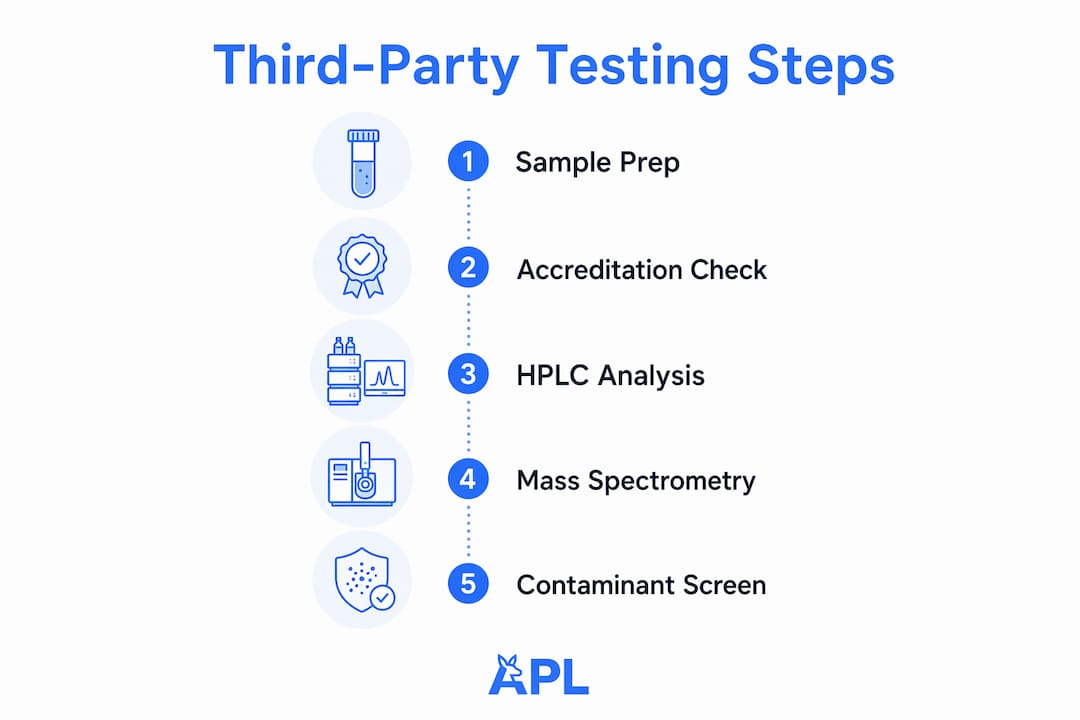
Independent third-party testing of peptides is available to Australian researchers, and the minimum test bundle to order is HPLC (chromatographic purity) combined with mass spectrometry (identity confirmation). These two methods address the most consequential failure modes: a compound with the wrong molecular identity and a compound with insufficient purity. A published lab dataset found that only approximately 27% of supplier Certificates of Analysis matched independent third-party results across more than 1,400 peptide samples, a finding that underscores why supplier self-reporting alone is insufficient for rigorous research. Standard turnaround at professional independent labs is 5–11 business days for purity and identity analyses, with endotoxin or heavy-metal screens adding time and cost when injectable material or safety screening is required.
The minimum verification checklist for Australian researchers:
- Order HPLC + mass spectrometry as the baseline bundle for every new compound or new supplier.
- Add endotoxin (LAL method) testing when the material will be used in injectable or cell-based assays.
- Add ICP-MS (heavy metals) or GC-MS (residual solvents) for preclinical safety assessments or regulatory submissions.
- Request raw instrument files (chromatogram PDFs, mass spectra) alongside the Certificate of Analysis.
- Confirm the laboratory holds NATA accreditation or ISO/IEC 17025 certification before submitting samples.
Pro Tip: When sourcing from Aupeptidelabs, request the supplier COA at the point of purchase and use it as the reference document when commissioning independent verification. Comparing batch numbers and measured molecular weights line-by-line is the fastest way to identify discrepancies.
What does "third-party testing" actually mean for peptide verification?
Third-party testing, in the analytical chemistry context, refers to verification conducted by a laboratory that has no financial or operational relationship with the peptide supplier. The lab receives a sample, runs its own instrumentation, and issues an independent Certificate of Analysis (COA) based solely on the data it generates. That operational independence is what distinguishes an independent COA from a supplier COA: the supplier has a commercial incentive to report favourable results, whereas an independent lab reports instrument outputs without that conflict.
A properly constituted independent COA includes the following elements:
- Raw chromatogram data showing the main peak, impurity peaks, and baseline noise, with retention times and area percentages stated explicitly.
- Mass spectra confirming molecular weight, isotope pattern, and mass accuracy relative to the theoretical value.
- Quantified purity percentage with the analytical method described (column type, mobile phase gradient, detection wavelength, instrument model).
- Limit of detection (LOD) and limit of quantitation (LOQ) for each reported parameter.
- Chain-of-custody documentation linking the submitted sample to the issued report.
Pro Tip: Before submitting samples to any laboratory, request confirmation of the lab's accreditation status (NATA or ISO/IEC 17025) and ask whether raw instrument files are provided as attachments to the COA. A lab that declines either request warrants scrutiny.

Why independent verification matters for research integrity
Supplier COAs are generated by the same organisation that has a financial interest in selling the product. That structural conflict does not mean supplier COAs are always inaccurate, but it does mean they cannot serve as the sole evidence of quality in research that requires reproducibility. Independent testing breaks the market incentive loop by placing verification in the hands of analysts who have no stake in the outcome.
The practical consequences of relying exclusively on supplier documentation include:
- Wrong identity: A compound with a different molecular structure than labelled will produce experimental results that cannot be attributed to the intended peptide.
- Insufficient purity: Impurities at concentrations above the LOQ can act as confounders, particularly in receptor-binding or cell-viability assays.
- Incorrect concentration: Net peptide content frequently differs from labelled weight when water, counter-ions, or residual solvents are not accounted for.
- Undetected contaminants: Endotoxin, heavy metals, and residual synthesis solvents are not visible on a standard HPLC trace and require dedicated assays.
Independent verification is most critical when working with a new supplier, a new compound, injectable material, preclinical safety studies, or any dataset destined for regulatory submission.
A discrepant COA does not merely affect one experiment. If a peptide is mislabelled at 98% purity when independent analysis returns 84%, every dose calculation, every dose-response curve, and every comparison with published literature is systematically skewed. The error compounds across the entire study.
What parameters does a third-party lab report on a peptide COA?
Purity percentage (HPLC)
HPLC purity is reported as the area percentage of the main peak relative to all detected peaks in the chromatogram. A result of 98.5% area purity means 98.5% of the UV-absorbing material eluting from the column corresponds to the main compound. Small differences of 0.5–1.5% between a supplier COA and an independent result are within normal instrument-to-instrument variability; discrepancies exceeding 3–5% warrant investigation.
Identity confirmation (MS or LC-MS)
Mass spectrometry confirms molecular identity by measuring the molecular weight of the compound and comparing it to the theoretical monoisotopic or average mass. Typical mass accuracy tolerances are ±0.5 Da for low-resolution instruments and sub-5 ppm for high-resolution instruments (Orbitrap, Q-TOF). LC-MS/MS fragmentation patterns provide additional structural confirmation for complex or modified peptides.
Quantitation and net peptide content
Chromatographic purity does not equal net peptide content. Purity versus net peptide content are distinct parameters: a vial labelled as 5 mg may contain 5 mg of total lyophilised material, of which only 3.8 mg is actual peptide after accounting for water, trifluoroacetate counter-ions, and residual solvents. Labs report net peptide content using UV quantitation at 280 nm (for Trp/Tyr-containing sequences) or amino acid analysis (AAA) for sequences lacking UV-active residues.
Contaminant screens
| Contaminant screen | Method | When to order |
|---|---|---|
| Endotoxin | LAL (limulus amebocyte lysate) | Injectable use, cell-based assays |
| Heavy metals | ICP-MS | Preclinical safety, regulatory submissions |
| Residual solvents | GC-MS | Regulatory submissions, high-dose studies |
| Bacterial contamination | Sterility / bioburden | Injectable or sterile-fill applications |
COA glossary for researchers
- Retention time: The time at which a compound elutes from the HPLC column; used to confirm compound identity against a reference standard.
- Area %: The proportion of total UV signal attributed to a given peak; the basis for purity reporting.
- Mass accuracy: The difference between measured and theoretical molecular mass, expressed in Da or ppm.
- LOD / LOQ: The lowest concentration detectable (LOD) or reliably quantifiable (LOQ) by the instrument under stated conditions.
Which analytical methods do third-party labs use, and what does each one prove?
HPLC and UHPLC
High-performance liquid chromatography separates peptide components by their differential affinity for a stationary phase, generating a chromatogram that quantifies purity and impurity profiles. UHPLC (ultra-high-performance) uses sub-2-micron particles for faster run times and improved resolution. HPLC is the standard method for purity reporting, but it does not confirm molecular identity: a structurally different compound with similar hydrophobicity can co-elute at the same retention time and appear as a single clean peak.
Mass spectrometry (ESI-MS, LC-MS/MS, MALDI-TOF)
Mass spectrometry confirms molecular identity by measuring the mass-to-charge ratio of ionised molecules. Electrospray ionisation (ESI-MS) is the most common method for peptides and is readily coupled to HPLC (LC-MS) for simultaneous purity and identity analysis. MALDI-TOF (matrix-assisted laser desorption/ionisation time-of-flight) is faster and well-suited to larger peptides but provides lower mass accuracy than high-resolution ESI instruments. LC-MS/MS fragmentation adds sequence-level confirmation for modified or complex sequences.
Amino acid analysis and quantitative UV
Amino acid analysis (AAA) hydrolyses the peptide to its constituent amino acids and quantifies each by chromatography, providing an accurate net peptide content independent of counter-ions or water. Quantitative UV at 280 nm is faster and lower cost for sequences containing tryptophan or tyrosine residues.
Endotoxin and contaminant screens
LAL endotoxin testing detects lipopolysaccharide contamination at sub-nanogram-per-millilitre concentrations. ICP-MS quantifies trace heavy metals (lead, arsenic, cadmium, mercury) at parts-per-billion levels. GC-MS identifies and quantifies residual synthesis solvents such as acetonitrile, DMF, and TFA.
| Method | What it proves | Typical turnaround | Indicative cost (EUR) |
|---|---|---|---|
| HPLC / UHPLC | Chromatographic purity, impurity profile | 3–5 business days | — |
| ESI-MS / LC-MS | Molecular identity, mass accuracy | 3–5 business days | — |
| HPLC + MS bundle | Purity and identity (minimum bundle) | 5–11 business days | ~€60–80 |
| LAL endotoxin | Endotoxin contamination | 2–3 business days | — |
| ICP-MS / GC-MS | Heavy metals / residual solvents | 5–11 business days | Included in full profile |
| Full QC panel | All of the above | 5–11 business days | ~€140–180 |
Note: costs above are indicative European market figures from published lab pricing. Australian laboratory pricing will differ; contact NATA-accredited providers directly for current AUD rates.
Pro Tip: Order combined HPLC + MS as the baseline for every verification submission. HPLC alone cannot detect a substituted compound; MS alone does not quantify impurities. Together, they address both failure modes with a single submission.
How to read a peptide COA: a five-step checklist
A COA is only as useful as the researcher's ability to interpret it critically. The following numbered checklist applies whether you are reviewing a supplier COA or an independent result.
-
Confirm sample identifiers. Verify that the batch number, vial ID, and compound name on the COA match the supplier's documentation and your submission form exactly. A mismatch at this step invalidates the comparison before any analytical data is considered.
-
Check HPLC purity and chromatogram shape. Review the main peak area percentage and examine the chromatogram for secondary peaks, shoulder peaks, and baseline noise. A purity claim of 99% accompanied by a chromatogram showing multiple unresolved shoulders is inconsistent and requires clarification from the lab.
-
Verify MS identity. Confirm that the measured molecular weight matches the theoretical value within the instrument's stated mass accuracy tolerance. For ESI instruments, check that the charge-state envelope and isotope pattern are consistent with the expected peptide sequence. A mass shift exceeding ±0.5 Da on a low-resolution instrument, or ±5 ppm on a high-resolution instrument, indicates a structural discrepancy.
-
Review quantitation results and units. Confirm whether the reported value is chromatographic purity (area %) or net peptide content (mg or µg per vial). These are different parameters and should not be conflated. Check that the method used for quantitation (UV, AAA, or gravimetric) is stated explicitly and that units are consistent with the labelled amount.
-
Check contaminant results and chain-of-custody documentation. If endotoxin, heavy metals, or solvent screens were requested, confirm that each result is reported with its LOQ and a pass/fail designation. Verify that the COA includes the submission date, analysis date, analyst signature or laboratory stamp, and any raw data attachments.
A COA without a chromatogram attachment is not a complete analytical record. The purity number alone, without the underlying raw data, cannot be independently verified and should not be accepted as sufficient documentation for research purposes.
How to choose a third-party testing laboratory for Australian research
Accreditation and technical capability
The primary selection criterion for any analytical laboratory is accreditation. In Australia, the National Association of Testing Authorities (NATA) administers laboratory accreditation against ISO/IEC 17025, the international standard for testing and calibration laboratories. A NATA-accredited laboratory has demonstrated competence in its stated scope of testing through independent technical assessment. When evaluating a laboratory, request its NATA accreditation number and verify the scope of accreditation on the NATA website to confirm that peptide analysis falls within the accredited scope.
Beyond accreditation, confirm that the laboratory operates LC-MS or high-resolution MS instrumentation (Orbitrap, Q-TOF, or equivalent) and has documented experience with synthetic peptide analysis. Peptide-specialist independent labs typically accept single-vial submissions and offer faster turnaround than large contract research organisations (CROs), which are often structured for multi-sample pharmaceutical projects and priced accordingly.
Operational criteria
- Chain-of-custody documentation: The lab must provide a documented chain of custody from sample receipt to report issuance.
- Sample handling policy: Confirm the lab's requirements for dry lyophilised powder versus reconstituted samples, and whether cold-chain handling is available.
- Raw data provision: The lab must provide chromatograms and mass spectra as attachments to the COA, not merely a summary table.
- Blind or anonymised submissions: A reputable lab accepts samples without supplier identity information, removing any residual bias.
- Sample retention policy: Confirm how long the lab retains residual sample material in case re-analysis is required.
For Australian researchers, domestic NATA-accredited laboratories are preferable to offshore providers because they eliminate customs delays and cross-border shipping complications. Where a domestic lab does not offer a specific assay (e.g. MALDI-TOF or AAA), an offshore lab with ISO/IEC 17025 accreditation and documented international shipping experience is a reasonable alternative. For peptide testing alternatives in Australia, a comparison of available verification workflows is a useful starting point.
Cost and turnaround expectations
Standard HPLC + MS analyses at professional independent labs run 5–11 business days for domestic submissions. Indicative European market pricing (in EUR, as published by independent labs) runs approximately €60–80 for a combined HPLC + MS bundle, with full QC panels (purity, identity, endotoxin, heavy metals, sterility) reaching €140–180. Australian laboratory pricing in AUD will differ; contact NATA-accredited providers directly for current rates.
Red flags
- A lab that provides only a pass/fail statement without raw chromatogram and mass spectra attachments.
- Unwillingness to accept blind or anonymised samples.
- No documented quality management system or refusal to provide accreditation documentation.
- Turnaround times quoted under two business days for full HPLC + MS analysis (indicative of insufficient analytical rigour or pre-generated results).
Pro Tip: Aupeptidelabs ships domestically from Australia and provides supplier COAs with each order. Use the supplier COA as your reference document when briefing an independent lab, and request that the lab compare batch numbers explicitly in its report.
Sampling, storage, and shipping best practices
Collecting a submission sample
Specialist labs accept 1–3 mg of dry lyophilised powder as a sufficient sample for standard HPLC + MS analysis. Collect the sample directly from the original vial using a clean, dry spatula or by transferring a portion of the lyophilised cake without reconstituting it. Label the submission vial with the compound name, batch number, and your internal sample ID. Document the collection date, storage conditions up to that point, and the amount transferred.
Dry powder submissions are preferred over reconstituted solutions because reconstitution introduces variables (solvent type, concentration, pH) that can affect measured purity and stability. If the material has already been reconstituted, note the solvent, concentration, and reconstitution date on the submission form.
Storage best practice
- Store lyophilised peptides at -20°C in a sealed, desiccated container until the submission sample is collected.
- Avoid repeated freeze-thaw cycles; each cycle can introduce oxidation, aggregation, or hydrolysis artefacts that reduce measured purity.
- For peptides containing cysteine, methionine, or tryptophan residues, minimise exposure to light and oxygen during handling.
- Refer to peptide recovery and stability guidance for compound-specific storage recommendations.
Shipping within Australia
- Package the submission vial in a sealed, labelled primary container (e.g. 1.5 mL microcentrifuge tube) with desiccant.
- Place the primary container in a padded secondary container with sufficient cushioning to prevent breakage.
- Label the outer package clearly as "Laboratory Analysis Sample — Not for Human Use."
- Include a completed submission form inside the package with: sample ID, compound name, batch number, supplier COA copy, storage history, requested tests, and contact details.
- Use a tracked courier service and retain the tracking number.
- For temperature-sensitive peptides, include a cold pack and notify the receiving lab of the shipping conditions.
Pro Tip: When using a domestic NATA-accredited laboratory, confirm the lab's preferred sample format (dry powder vs solution) and any special handling instructions before dispatching. A brief email exchange before shipping prevents rejected submissions and avoids delays.
Interpreting results and limitations: what one tested vial actually proves
A COA, whether from a supplier or an independent laboratory, represents the analytical result for one specific sample from one specific batch. Manufacturing drift and intra-batch variability mean that other vials from the same batch, or vials from a subsequent batch, may differ measurably from the tested sample. A single passing result is a positive data point, not a guarantee of uniformity across an entire shipment.
Situations that warrant re-testing or expanded verification include:
- Results that are borderline (e.g. purity at 95–96% when 98%+ is required for the intended assay).
- Critical safety applications, including any injectable use in animal studies.
- Chronic dosing studies where cumulative impurity exposure is a concern.
- Regulatory submissions requiring batch-level documentation.
- Any result that conflicts materially with the supplier COA (>3–5% purity discrepancy or mass mismatch).
Recommended verification strategies for routine laboratory procurement include periodic spot checks on the first batch from any new supplier, followed by quarterly re-testing for compounds used in ongoing chronic studies. When results from two independent labs conflict, blind testing across a third laboratory is the most reliable method for resolving the discrepancy.
Small percentage differences between a supplier COA and an independent result (0.5–1.5%) are within normal instrument-to-instrument variability and do not necessarily indicate supplier misrepresentation. Differences exceeding 3–5%, or any mass mismatch, require investigation before the material is used in research.
Research findings and practical recommendations for Australian lab buyers
Turnaround and cost benchmarks
Standard purity and identity analyses at professional independent laboratories run 5–11 business days for domestic submissions. Indicative European pricing for a combined HPLC + MS bundle is approximately €60–80; full QC panels covering purity, identity, endotoxin, heavy metals, and sterility reach approximately €140–180. These figures are published European market rates; Australian AUD pricing from NATA-accredited providers will vary.
The supplier COA mismatch finding
The most consequential empirical finding in this space is a low match rate between supplier COAs and independent results across many samples. That implies that a substantial proportion of supplier COAs, when independently verified, show material discrepancies in purity, identity, or concentration. For researchers making dosing or safety decisions based on supplier documentation alone, that mismatch rate represents a substantial source of uncontrolled experimental error.
Statistical callout: Independent analysis of over 1,400 peptide samples found that only approximately 27% of supplier COAs matched independent third-party results. The implication for research reproducibility is direct: supplier documentation alone is insufficient as the sole quality control checkpoint.
Practical recommendations
- Minimum test bundle: HPLC + MS for every new compound and every new supplier.
- Add endotoxin (LAL) when material will be used in injectable or cell-based assays.
- Add ICP-MS or GC-MS for preclinical safety studies or regulatory submissions.
- Request raw instrument files (chromatogram and mass spectra PDFs) with every COA.
- Use a public COA database (where available from the independent lab) as an additional confidence signal.
- Commission blind testing when results are borderline or when two COAs conflict materially.
- Prefer domestic NATA-accredited labs to avoid customs delays and chain-of-custody complications.
A note on independent verification from Aupeptidelabs
The case for independent verification is not a critique of any single supplier. It is a structural observation about how analytical quality assurance works: no organisation should be the sole judge of its own product quality, and that principle applies universally across the peptide supply chain. Aupeptidelabs recommends independent third-party testing precisely because the research community's confidence in its own results depends on it.
From a logistics standpoint, Australian researchers are better served by a domestic supplier that ships within one business day and provides supplier COAs at the point of purchase. That documentation gives researchers a reference baseline before they commission independent analysis, reducing the back-and-forth with laboratories and accelerating the verification workflow. Aupeptidelabs stocks pharmaceutical-grade research peptides with purity levels exceeding 99% and ships from Australia, which means researchers can receive material, review the supplier COA, and dispatch a submission sample to a NATA-accredited laboratory without the customs delays associated with offshore procurement.
Aupeptidelabs: research peptides with local support for verification workflows
Australian researchers who need pharmaceutical-grade peptides with supplier COAs and same-day domestic dispatch have a direct path through Aupeptidelabs. The practical advantage over offshore procurement is straightforward: material arrives faster, supplier documentation is included with each order, and the local customer support team can assist with pre-submission checks and sample tracking when you are preparing for independent laboratory analysis.
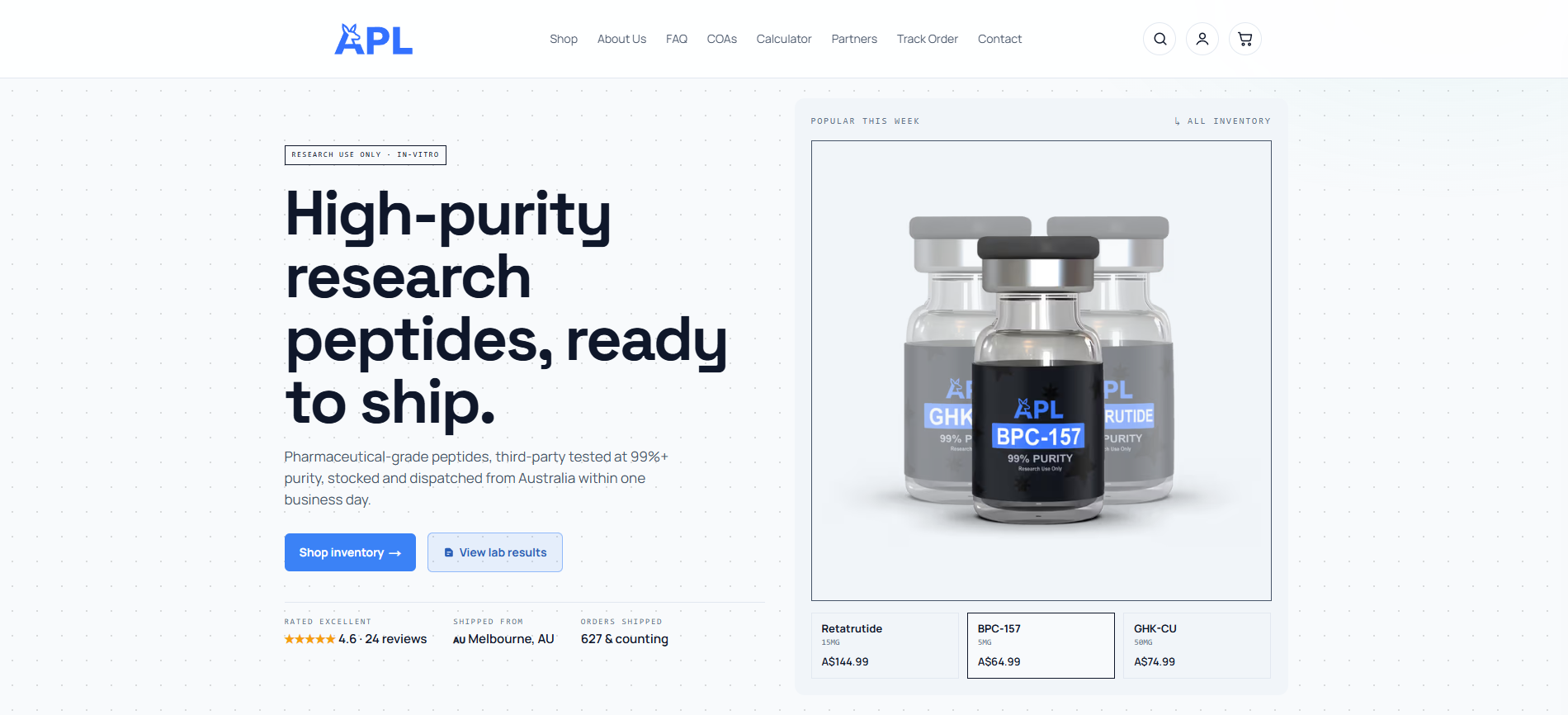
Aupeptidelabs stocks an extensive range of research peptides with purity levels exceeding 99%, all dispatched from Australia within one business day. Each product ships with a supplier COA that includes purity and identity data, giving you the reference document you need before commissioning independent verification. For researchers requiring specific compounds with full documentation, product pages for LL-37 and other catalogue items include COA details and storage specifications. Contact the Aupeptidelabs support team directly to discuss pre-submission documentation requirements or to arrange a custom or bulk order tailored to your laboratory's verification workflow.
Useful sources and accreditation bodies for Australian researchers
Key accreditation bodies and standards
- NATA (National Association of Testing Authorities, Australia): The primary accreditation body for Australian testing laboratories. Accreditation against ISO/IEC 17025 is the standard to request when selecting a domestic lab. Verify a laboratory's accreditation scope at nata.com.au.
- ISO/IEC 17025: The international standard for the competence of testing and calibration laboratories. A lab accredited to this standard has demonstrated technical competence and a documented quality management system.
- TGA (Therapeutic Goods Administration): Relevant for researchers working with peptides in a regulatory context; TGA guidelines reference GMP and analytical standards applicable to therapeutic peptide development.
What to look for on a lab data package
A complete analytical data package from a NATA-accredited laboratory includes: the accreditation number and scope reference, the analyst's signature or laboratory stamp, raw chromatogram and mass spectra files, LOD/LOQ values for each reported parameter, and chain-of-custody documentation. Absence of any of these elements reduces the evidentiary weight of the COA for research purposes.
Suggested further reading and resources
| Resource | Focus | URL |
|---|---|---|
| ACS Peptide Testing Labs | Third-party peptide verification, COA interpretation | acslabtest.com |
| Peptide Calc — Verifying Peptide Purity | Method selection, cost bands, submission guidance | peptide-calc.app |
| Finnrick product testing knowledge base | Independent rankings, HPLC + MS methodology | finnrick.com |
| ILS Laboratories — Peptide Testing Services | Full QC panel, individual test options, client portal | ils-lab.com |
| PeptideVerify (UK) | HPLC + LC-MS with QR-verified digital certificates | peptideverify.co.uk |
| Aupeptidelabs — Purity vs Net Peptide Content | COA interpretation, quantitation methods | aupeptidelabs.com/resources |
| Aupeptidelabs — Peptide Testing Australia Alternatives | Verification workflow comparison, lab selection | blog.aupeptidelabs.com |
This article is general information for research purposes and does not constitute professional analytical, regulatory, or legal advice. Researchers should confirm current accreditation status and testing requirements with NATA-accredited providers and relevant regulatory bodies for their specific applications.