
Choose an in-market peptide supplier that issues lot-specific certificates of analysis with mass spectrometry identity confirmation, offers temperature-appropriate shipping, and answers questions before and after purchase. One reputable example meeting that profile for Australian laboratories stocks domestically with rapid dispatch and provides high-purity documentation. Before ordering from any vendor, request the lot-specific COA and confirm pre-sales support responds promptly.
How do you choose a peptide supplier in Australia?
Selecting a peptide supplier in Australia comes down to verifiable documentation, not marketing copy. A 6-point quality framework gives labs a structured way to score any vendor before committing budget, and it converts cleanly into a tiering system your procurement officer can apply in minutes.
Work through these six criteria in order:
- HPLC documentation quality. Look for a chromatogram image with a clearly labelled peak, integration values, and a numeric purity result, not just a percentage claim in a product description.
- Mass spectrometry identity confirmation. A mass table or spectrum proving the molecule matches its expected weight is what separates identity from guesswork.
- Sterility and endotoxin testing, where relevant to the peptide's intended research application.
- COA completeness, including lot number, testing date, and the name of the testing laboratory.
- Shipping and cold-chain capability suited to the specific peptide's stability profile.
- Customer service and accountability, meaning a supplier answers technical questions and stands behind lot-matching if something goes wrong.
Score each criterion as pass or fail, then group suppliers into tiers. A Tier 1 suppliers generally pass all six, publish MS data as standard rather than on request, and dispatch domestically within a short timeframe. Tier 2 suppliers might satisfy HPLC and COA basics but lack routine mass spec verification, according to Peptides.so's decision matrix. That gap matters more than most buyers realise. Mass spectrometry availability is the single most common differentiator between Tier 1 and Tier 2 vendors, so treat its absence as a hard disqualifier for publication-quality work and, at best, a caution flag for preliminary screening.
What documents should you request before you buy?
Ask for the lot-specific COA before you place an order, not after the package arrives. A complete COA states the lot or batch number, the analytical testing date, the name and identity of the testing laboratory, a chromatogram image with numeric HPLC purity, a mass spectrometry table or spectrum, and the net peptide content with salt form disclosed separately from gross weight.
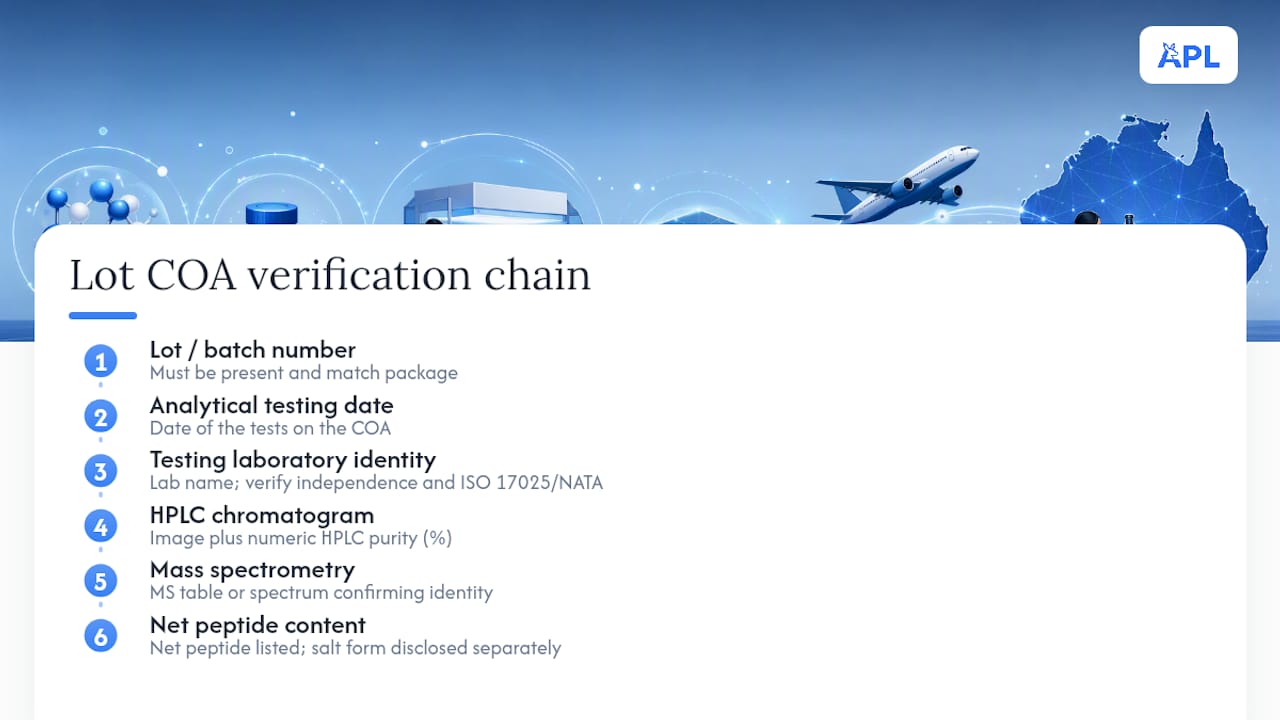
Verify the testing lab is real and, ideally, holds ISO 17025 accreditation or operates independently of the supplier itself. A quick search of the lab's name alongside "accreditation" or "NATA" usually confirms whether it's a genuine third-party operation or an in-house rebrand. OXpeptides' sourcing guide treats anything below 98% purity as unsuitable for serious research use, with 99% or higher the working standard once mass spec identity is confirmed alongside the HPLC figure.
Red flags are usually obvious once you know what to look for: a COA with no lot number, a purity percentage with no chromatogram behind it, or MS data offered only "on request" and never actually supplied. Vendors selling material labelled research grade without lot-specific paperwork are a documented problem across the industry, and chasing missing data after the fact wastes far more time than checking it upfront, as HonestPeptide's vendor guide notes.
Pro Tip: Keep every COA in a shared lab folder indexed by lot number, even for peptides you've ordered before. Suppliers occasionally reformulate or resource a product without renaming it, and a mismatched lot number is often the first sign something changed.
What shipping and storage should you expect for domestic orders?
Cold chain matters most for peptides sensitive to temperature fluctuation during transit. Insulated packaging with gel ice packs handles most domestic Australian routes; dry ice is reserved for longer transits or particularly unstable compounds. Domestic dispatch shortens the window where a parcel sits in an uncontrolled environment, which is precisely why sourcing from a supplier stocked and shipped within Australia reduces risk compared with overseas orders that clear customs and travel for days. Package audits from Peptide Hub Australia confirm that many local suppliers dispatch same-day or next-day, a meaningful advantage over international sourcing.
On receipt, run through this quick sequence:
- Inspect the outer seal and packaging integrity before opening.
- Match the lot number on the vial against the COA you were sent.
- Photograph and file the COA alongside your internal order record.
- Move the peptide into recommended storage conditions immediately, rather than leaving it on a bench.
Pro Tip: If a delivery arrives visibly warm or the ice pack has fully melted on a route that should have taken it cold, log the delivery time and temperature before you even open the box. That record is what makes a replacement claim straightforward instead of a dispute.
How do you balance price against documented quality?
The cheapest listing rarely correlates with the best documentation, and the most expensive one doesn't guarantee it either. Mid-range suppliers that publish third-party HPLC and mass spec data as standard practice typically deliver the strongest value, because you're not paying a premium for a brand name, nor gambling on a discount vendor with no verifiable paperwork.
- Run a small pilot order first when trialling a new supplier, then verify the COA against the physical vial before scaling up.
- Send a portion of the pilot batch to an independent testing service if documentation looks thin but the price is tempting.
- Keep purchase orders, invoices, and correspondence in one retrievable file per supplier for audit purposes.
- Negotiate bulk pricing only after documentation standards are agreed in writing, not as a verbal assurance.
Independent verification on a pilot order is a defensible, low-cost way to de-risk a new vendor relationship before committing to larger institutional orders.
What compliance steps apply to Australian institutions?
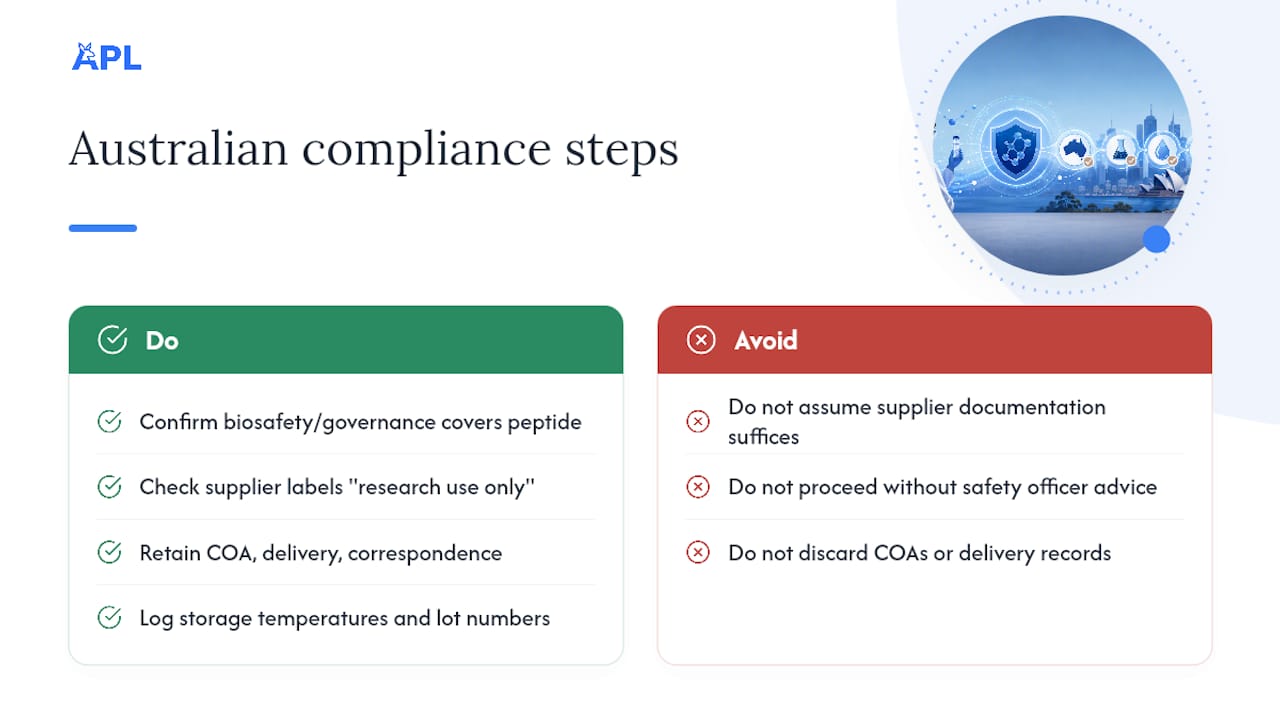
Research-use-only peptides are lawfully procured in Australia for laboratory research, but that doesn't remove your institution's own obligations. Confirm your organisation's biosafety committee or research governance policy covers the specific peptide and intended use, and check that the supplier labels products clearly as research use only rather than implying any clinical application.
Recordkeeping matters as much as the purchase itself. Retain every COA, delivery record, and piece of supplier correspondence, and log storage temperatures and lot numbers alongside your experimental records. Where sterility or endotoxin risk is relevant to your protocol, consult your institution's safety or compliance officer before proceeding rather than assuming the supplier's documentation covers your specific regulatory obligation.
Does Au Peptide Labs meet the checklist?
Au Peptide Labs is stocked and dispatched within Australia, with orders leaving within one business day, avoiding the customs delays that plague overseas sourcing.
- Request a lot-specific COA before ordering, and expect pre-sales support to respond with testing details for the exact batch you'd receive.
- Cross-check the testing laboratory named on the COA independently, the same due diligence you'd apply to any supplier.
- Ask about dispatch timing for your postcode if you're on a tight research timeline.
Pro Tip: Save every COA you receive with its order confirmation. If you ever need to demonstrate reproducibility to a reviewer or an institutional auditor, matched lot numbers and dated COAs are the fastest way to prove your material was consistent across a study.
What procurement mistakes do labs actually make?
Piloting a new supplier always comes with a trade-off between speed and verification, and the labs that get burned are usually the ones that skip the second half of that equation because a deadline is close. One recurring pattern is trusting a purity percentage on a product page without ever seeing the underlying chromatogram. It looks convincing until you ask for the raw data and nothing arrives.
Three questions cut through most of the noise fast: Can you send the lot-specific COA for the exact batch I'd receive? Who performed the testing, and can I verify them independently? What happens if the lot number on delivery doesn't match the COA? A supplier that answers all three without hesitation is telling you more than any marketing page ever will.
— Dr. Authur
Ready to order from an Australian-stocked supplier?
Once you've run a vendor through the six-point checklist, the next step is straightforward: request the paperwork before you request the invoice. Au Peptide Labs supplies research-grade peptides stocked in Australia, with lot-specific COAs available on request and dispatch within one business day of order confirmation, cutting out the customs uncertainty that overseas orders carry.
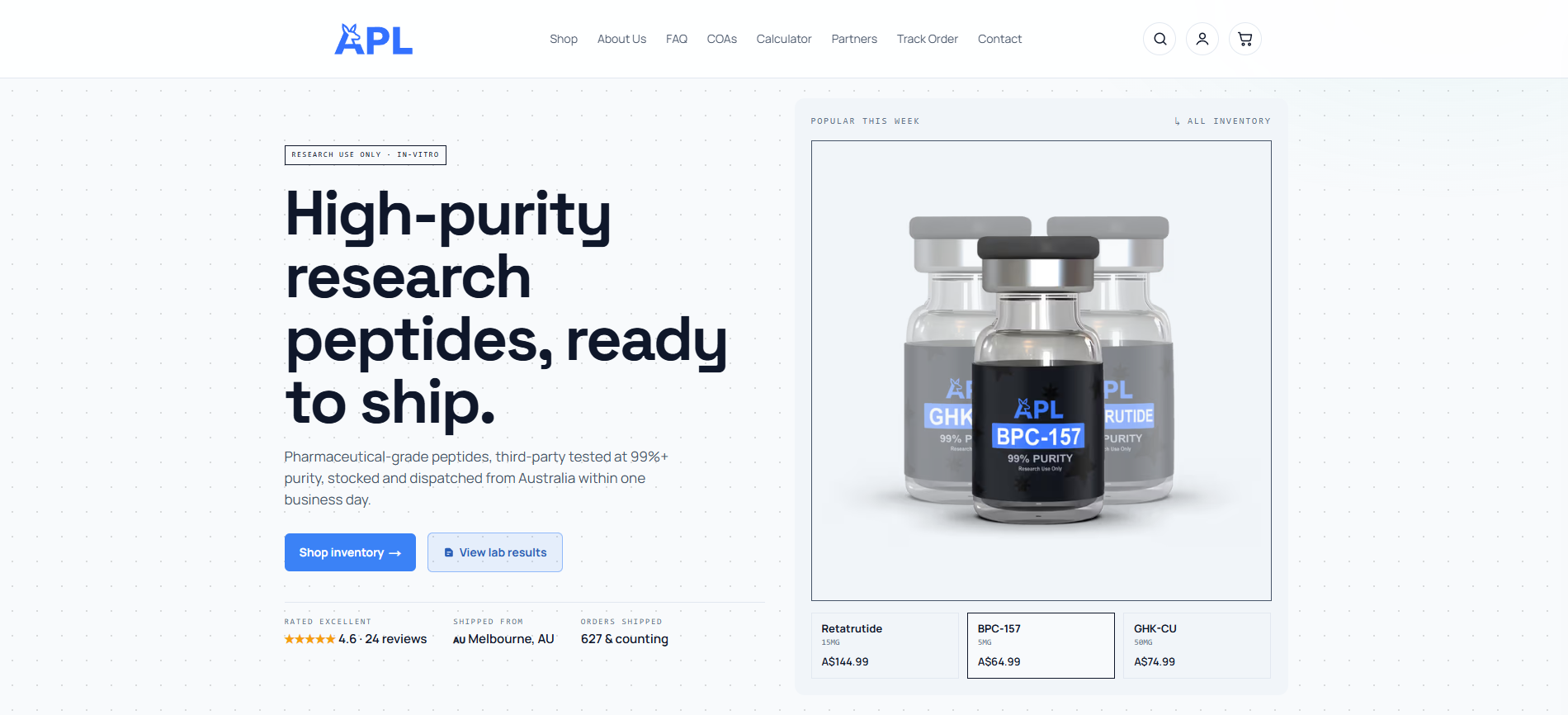
For labs building a standing order, start small. Request a COA for a commonly used research peptide such as LL-37 or SS-31, verify it against your checklist, and place a purchase order once you're satisfied. Institutional buyers placing bulk or custom orders can contact the team directly for technical support and lead times, and once your peptide arrives, the dilution calculator helps confirm reconstitution volumes before you start work. Head to the Au Peptide Labs store page to request a sample COA or place your first order today.
Sources
Cross-check any vendor's claims against Peptide Hub Australia's package audits and the 6-point quality checklist. For Australia-specific shipping and verification guidance, see peptide shipping requirements and local sourcing checks.
- How to Choose a Research Peptide Supplier: 6‑Point Quality Checklist
- How to Source Research Peptides: A Researcher’s Playbook (2026) | OXpeptides
- Peptide Hub Australia | Compare Trusted Peptide Vendors