

In Australia, Schedule 4 is the Poisons Standard category for prescription-only medicines, and several peptides sit in it, including the growth hormone secretagogues CJC-1295 and ipamorelin. Scheduling is decided substance by substance, so "peptide" is not a legal category in itself. A Schedule 4 peptide may be supplied only on a prescription from an authorised health professional, and many peptide products promoted online are unapproved therapeutic goods that carry additional legal and safety consequences. This article sets out what the listing means, which peptides have been placed in it, how supply and possession are regulated, and what research purchasers should verify before ordering.
What Schedule 4 means under the Poisons Standard
The Poisons Standard (formally the Standard for the Uniform Scheduling of Medicines and Poisons, or SUSMP) groups medicines and chemicals by the level of regulatory control considered necessary to protect public health and safety. The TGA's scheduling overview explains that the schedules are a national classification, and that they obtain legal effect through state and territory legislation rather than through a single federal statute.
That last point has practical consequences. The national scheduling decision is uniform, but the offences, penalties and enforcement agencies that attach to it are set by each jurisdiction. A researcher working in Victoria and one working in New South Wales therefore apply the same schedule but may encounter different statutory wording and different maximum penalties.
Under this system, Schedule 4 medicines are prescription-only. They must be prescribed by an authorised healthcare professional, such as a doctor, and are supplied in hospitals or dispensed by a pharmacy against a prescription. Some Schedule 4 medicines carry additional prescribing requirements where dependence or misuse is a recognised risk, a feature the Poisons Standard uses to tighten control beyond the base category.

Are all peptides Schedule 4?
No. Scheduling attaches to named substances, not to the chemical class. A peptide is a short chain of amino acids, and the class includes endogenous hormones, approved medicines, cosmetic ingredients and experimental compounds. Each is assessed individually, and the Poisons Standard lists those it controls by name or by a defined description.
In practice, peptides in Australia fall into four broad groups:
- Approved medicines on the Australian Register of Therapeutic Goods (ARTG), such as insulin, semaglutide and tirzepatide. These require a prescription and must be purchased from a registered Australian pharmacy.
- Peptides specifically listed in Schedule 4 because of misuse risk, discussed below.
- Unapproved products that are not individually scheduled but are still therapeutic goods when promoted for a therapeutic use, and therefore subject to the TGA's rules on import, supply and advertising.
- Substances used purely as laboratory reagents, which are outside therapeutic-goods regulation only while they remain genuinely supplied and used as research chemicals.
Because scheduling entries are amended over time, the current text of the Poisons Standard is the authority for any individual compound. Our summary of TGA peptide regulations in Australia tracks how the framework applies in 2026, and the official register should be checked for each substance before any purchasing decision.
Which peptides have been placed in Schedule 4
The clearest documented example is the March 2015 scheduling decision. In that decision, a TGA delegate included a group of performance-enhancing peptides in Schedule 4, among them CJC-1295, ipamorelin and the growth hormone releasing peptides (GHRPs). The stated reasons were misuse, particularly by bodybuilders and in sport, together with online sales and promotion of these substances as safer alternatives to anabolic steroids.
The delegate's reasoning is instructive because it shows what Schedule 4 listing is designed to achieve. It places the substances under medical supervision and makes them harder to obtain without a lawful purpose. It does not assert that the compounds are without scientific interest; it controls who may supply them and on what authority.
These compounds belong to the growth hormone secretagogue class. Ghrelin-receptor agonists (GHRPs) and GHRH analogues (CJC-1295) act on distinct receptors in the pituitary axis, which is why the class is frequently studied in endocrine and metabolic research and, separately, why it attracted attention in sport.
Other peptides have since been considered or scheduled individually, and the TGA continues to publish interim and final scheduling decisions. Secondary summaries circulate online listing which compounds are in or out of Schedule 4, but they vary in accuracy and date quickly. The reliable approach is to read the current Poisons Standard entry for each compound and confirm whether any Appendix D or Appendix B notation applies.

What the rules cover: import, supply, advertising and possession
Scheduling is only one layer. The TGA's guidance on peptide products states that, as of 2026, some peptides are approved for use in Australia, while many products promoted online are unapproved therapeutic goods that may be unlawful to import, supply or advertise. It also notes that significant penalties may apply for unlawful dealings with unapproved peptide products.
The obligations differ by role:
| Role | Principal consideration |
|---|---|
| Prescribing practitioner | Prescribing is limited to authorised health professionals, and unapproved peptide products may be compounded, prescribed or supplied only in line with all regulatory requirements and the practice standards set by Ahpra |
| Pharmacy | Dispenses Schedule 4 substances only against a valid prescription |
| Importer | Import of therapeutic goods, scheduled or not, engages TGA and Australian Border Force requirements |
| Online seller or promoter | Advertising and supply of unapproved therapeutic goods can attract civil and criminal penalties |
| Individual | Possession rules for scheduled substances are set by state and territory law, so wording and penalties differ by jurisdiction |
State legislation illustrates the variation. Legal-practice commentary on New South Wales, for example, notes that possessing certain scheduled peptides without a valid prescription can be a criminal offence with a financial penalty, while other states legislate differently. Anyone with a specific legal question should consult a lawyer in their own jurisdiction, and a researcher with institutional oversight should consult the institution's compliance office.
For laboratories that import materials, the logistics are a separate topic from scheduling. Our guides on import permit timelines for Australian researchers and customs seizure risks describe how border processes interact with scheduled and unscheduled material.
Why prescription status and quality are linked
Schedule 4 control is not only a legal matter. The TGA is explicit that unapproved peptide products have not been assessed for safety, quality or effectiveness. There is therefore no assurance that they are safe, effective, correctly labelled, sterile or made to appropriate quality standards.
The TGA lists the associated hazards as contamination, infection, severe allergic reactions and systemic inflammatory response syndrome (SIRS), along with unknown ingredients and uncertain dosage. Its safety alert also urges caution when buying therapeutic goods online, especially prescription-only products supplied without a proper prescription (see the TGA safety alert on importing, compounding and supplying unapproved peptide products).
Anyone considering a peptide for personal use in the body should speak to a registered doctor or pharmacist, who can advise on approved treatments for the condition concerned, such as the approved GLP-1 medicines available on prescription. Products labelled for laboratory research are not a substitute for a prescribed medicine, and research materials are not intended for human or veterinary use.
Verifying a research peptide supplier
For laboratories, the practical question is not whether a compound is interesting but whether the material is what its label states. Quality verification rests on a small number of checkable items:
- A batch-specific certificate of analysis (COA) issued by an independent third-party laboratory, showing the batch number that appears on the vial.
- Reported purity by HPLC and identity confirmation by mass spectrometry, with the method and date stated on the document.
- A clear statement of intended use, which for research materials should be laboratory use only.
- Traceable dispatch and storage conditions, since lyophilised peptides are sensitive to temperature and moisture during transit.
- A domestic dispatch point, which removes border clearance as a source of delay and temperature excursion.
The checklist in five checks labs use to spot counterfeit peptides expands on COA verification, and local peptide sourcing: what to verify before you order covers the questions to put to any Australian supplier. Shipping conditions are covered in peptide shipping in Australia.
Handling scheduled and unscheduled compounds in a research setting
Institutional research involving a Schedule 4 substance generally requires documented authority appropriate to the state or territory and the institution, and records of receipt, storage and use. Compounds that are not scheduled still require standard chemical hygiene, labelled storage, and a clear chain of custody for each batch. Where there is doubt about the status of a compound, the correct course is to confirm with the institution's compliance officer and the relevant state health department before ordering.
Our perspective
Scheduling is frequently misread as a statement about a compound's scientific value. It is a statement about access. Schedule 4 listing, as the delegate's 2015 reasoning shows, aims to place certain substances under medical supervision and to limit supply without a lawful purpose. A responsible research supplier works within that framework: it states plainly that its materials are for laboratory research only, it documents purity with batch-specific, independently tested COAs, and it ships domestically so that the material reaches the laboratory without customs delay or uncontrolled transit conditions.
We design our range around that principle. Our peptides are tested by third parties to 99%+ purity, every batch is accompanied by a verifiable COA, and orders are dispatched from Melbourne, with discreet packaging. For laboratories, this means a documented, traceable supply route and fewer variables between the vial and the bench. We encourage every purchaser to confirm the regulatory status of each compound in their own jurisdiction and to maintain the records their institution requires.
Dr. Authur
Sourcing research peptides from within Australia
Laboratories that need documented material across the main research categories can review our ranges for metabolic and GLP-1 research, growth hormone secretagogues, recovery and repair, cognitive and sleep research and longevity and cellular research. Reconstitution and handling consumables, including bacteriostatic water, are listed under lab supplies.
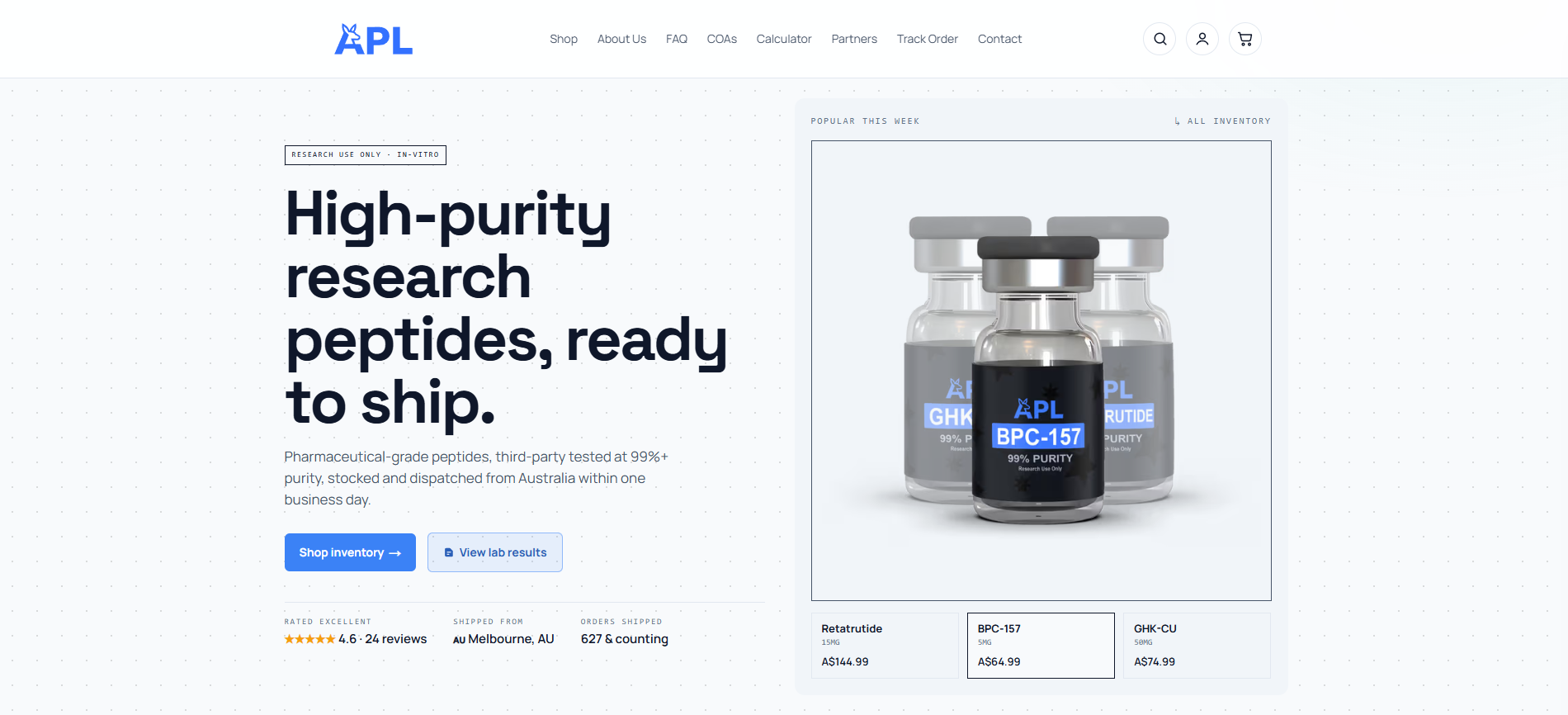
All products are supplied strictly for laboratory research and are not for human or veterinary use. Orders are dispatched from Australia within one business day, and Express Post is available for 10 $ one-off. Custom and bulk orders can be arranged through the Au Peptide Labs store.
Frequently asked questions
Are peptides legal in Australia?
Peptides as a class are not banned. Approved peptide medicines such as insulin are lawfully available on prescription, while unapproved products promoted online may be unlawful to import, supply or advertise, according to the TGA. Legality depends on the specific compound, its approval and scheduling status, and the purpose of supply. Our overview, are peptides legal in Australia, covers the distinctions in more detail.
Can I buy a Schedule 4 peptide without a prescription?
Not for use as a medicine. Schedule 4 medicines are prescription-only and are dispensed by a pharmacy against a valid prescription. Research materials are supplied only for laboratory use and carry no therapeutic authorisation. A person seeking treatment should see a registered doctor.
Who can prescribe a Schedule 4 peptide?
An authorised healthcare professional, such as a doctor, must prescribe Schedule 4 medicines. Practitioners who compound, prescribe or supply unapproved peptide products must also meet all regulatory requirements and the Ahpra professional practice standards. Approved peptides such as semaglutide and tirzepatide are dispensed through registered Australian pharmacies.
Do penalties for unlawful peptide dealings vary by state?
Yes. The TGA states that significant penalties may apply to unlawful dealings with unapproved peptide products, and because schedules take legal effect through state and territory legislation, possession offences and maximum penalties differ by jurisdiction. For a specific situation, seek advice from a lawyer in your own state or territory.
Where can I check whether a peptide is Schedule 4?
The Poisons Standard published by the TGA is the authoritative source, and it should be consulted for each compound by name. Secondary lists online can be outdated, since scheduling decisions are amended over time. Institutional compliance staff can also confirm what authority a research project requires.
Sources
- Scheduling of medicines and poisons, healthdirect
- Scheduling basics of medicines and chemicals in Australia, TGA
- Are peptides safe and lawful in Australia? healthdirect
- Reasons for scheduling delegate's final decisions, March 2015, TGA
- Peptide products, TGA
- Understanding your responsibilities when importing, compounding and supplying unapproved peptide products, TGA