
Peptide batch traceability is the documented, unbroken link between a vial's label and the batch-specific analytical records that prove what is actually inside it. The immediate action for any researcher on receipt of a shipment is simple: confirm the batch ID printed on the vial matches, character for character, a batch-linked certificate of analysis or a verification portal entry. That single check protects reproducibility, because an assay run against the wrong or unverifiable batch record cannot be defended during peer review or audit.
What does peptide batch traceability actually mean?
Peptide batch traceability refers to the chain of custody linking a specific manufacturing lot to every document generated about it, from synthesis through to the moment a researcher pipettes it into an assay. A batch or lot number identifies one discrete production run; a product SKU or catalogue number identifies the peptide itself, regardless of which run produced it. Confusing the two is the most common documentation error in laboratory procurement, because a SKU tells you what you bought, not which specific production of it you received.
A complete chain covers six stages: manufacture, analytical testing, labelling, shipping, receipt, and storage through to use in an experiment, as detailed in this guida operativa per PMI on production traceability. Each stage needs to reference the same batch identifier without variation. If the synthesis log says "Batch 24A091" but the certificate of analysis says "24A91" or the shipping manifest omits the batch entirely, the chain is broken, even if the peptide itself is perfectly fine.
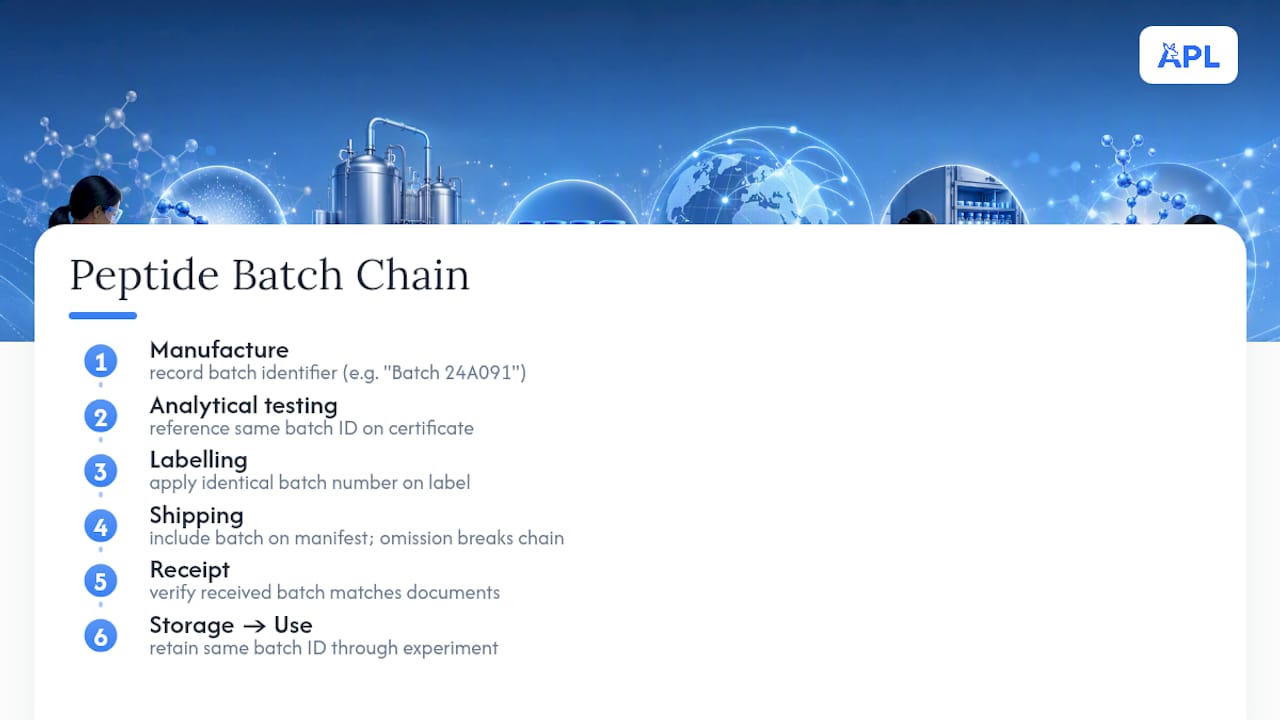
Consistent identifiers matter because International Council for Harmonisation guidance under ICH Q6B and ICH Q7 requires written procedures linking batch production records to laboratory control records before a lot can be released for sale. That requirement exists precisely because identity and purity data are only meaningful when tied to the batch that generated them. A batch number floating without a linked analytical record is not evidence. It is a claim.
What are the parts of a traceable batch record?
A genuinely traceable batch record has four distinct components, and researchers should be able to locate all four before trusting a peptide for use in a published experiment.
- The physical label. It must carry a batch or lot number, net peptide content or fill weight, storage conditions, and a manufacture or expiry reference. Ambiguous labelling, such as a batch number that changes format between the vial and the outer packaging, is a warning sign rather than a clerical quirk.
- The verification record. A QR code or online portal entry should return metadata tied to that exact batch, including shipment date and a link to the relevant certificate of analysis. This confirms the batch exists in the supplier's system, nothing more.
- The analytical report, or COA. This document should state the assay result, purity by RP-HPLC, related substances or impurity profile, the analytical method identifier, the testing laboratory's name, and the date of testing.
- The supplier or manufacturing record. This is the deeper layer most researchers never ask for: synthesis log entries, raw material lot numbers, fill-finish notes, and any stability data generated during lyophilisation.
Analytical confidence in peptides typically rests on orthogonal techniques such as RP-HPLC, mass spectrometry, and peptide mapping, paired with stability studies that track degradation over time, as outlined in regulatory guidelines for therapeutic peptide analysis. If a COA cites none of these methods by name, it is not describing a validated analytical process. It is describing a summary with nothing underneath it. Fill and lyophilisation quality also matter more than most researchers assume. Vial-to-vial homogeneity depends on tight fill-weight control, and reference standard programs typically target a fill-weight coefficient of variation under 0.5 percent when assigning certified vial content through multi-lab testing.
How do you verify a peptide batch on arrival?
Verification should happen the moment a shipment lands on the bench, not after the freezer door closes. Treat it as a fixed procedure, not an occasional courtesy check.
- Inspect on arrival. Check the seal is intact, the vial is undamaged, and if the product required cold-chain shipping, note the packaging condition and any temperature indicator. Peptides that arrive visibly compromised or that show signs of a temperature excursion need a documented decision before use, not a guess.
- Compare identifiers exactly. Match the batch number on the vial label against the batch number stated on the COA, field by field, including leading zeros and punctuation.
- Check the analytical fields. Confirm the assay value, RP-HPLC purity result, and method identifier are present and specific to that batch, not a generic template shared across multiple lots.
- Confirm laboratory accreditation. Note the testing lab's name and, where stated, its accreditation scope, so the result can be traced back to a real, checkable source if questioned later.
- Escalate mismatches. If the label and COA disagree, or the COA is missing entirely, request the batch-specific COA from the supplier before use. If none is available, isolate the material and consider independent analysis.
- Log everything. Record the batch ID, COA reference, and verification date directly in the lab notebook or electronic lab record, in the same place the experimental protocol is documented.
Pro Tip: Keep a simple spreadsheet mapping batch ID to COA file name and receipt date across every peptide in your freezer. When an assay behaves unexpectedly six months later, you want to find the exact analytical record in under a minute, not reconstruct it from memory.
Publication reviewers increasingly expect batch traceability to be stated, not implied. A methods section that names a peptide but omits its batch reference, gives reviewers nothing to interrogate if a replication attempt fails.
Why isn't a generic COA good enough?
A generic certificate of analysis, one that describes "typical" purity for a peptide product rather than the specific batch shipped to you, creates a false sense of security. It looks like documentation. It functions as marketing copy.
Several signs mark a COA as weak rather than robust:
- No batch or lot number printed anywhere on the document.
- No named testing laboratory, or a laboratory with no stated accreditation.
- No method identifier or version number for the analytical technique used.
- Purity or assay figures that appear identical across multiple different batches, suggesting the same report has been reissued.
- No date of testing, or a testing date that predates the batch's own manufacture date.
A robust COA, by contrast, links directly to the batch in question, states which method and version were used, and comes from a laboratory operating under a recognised quality system such as ISO 17025 accreditation. USP monographs and ICH guidance set the floor for what a valid analytical report should demonstrate, but manufacturers still need to show they have controlled for process-specific impurities that a generic monograph does not anticipate. When a researcher's work depends on precise quantification, such as calibration curves or dosing studies, independent testing is justified whenever fill-weight data, water content correction, or mass-balance value assignment are not disclosed.
Vial label versus COA: what should actually match?
Line up the physical vial against the certificate of analysis before either goes anywhere near the bench. Discrepancies here are rarely dramatic; they are usually small enough to miss on a quick glance, which is exactly why they cause problems later.
- Identifier match. The batch or lot number must be identical, including punctuation, leading zeros, and letter case.
- Assay and purity. Check the assay percentage and RP-HPLC purity figure, and confirm mass spectrometry identity data is referenced if the peptide's molecular weight matters to your work.
- Related substances and water content. Impurity profiles and residual moisture affect both potency and stability, particularly for lyophilised peptides.
- Method and laboratory details. The COA should name the analytical method identifier, the testing laboratory, and the test date, with a signature or electronic seal confirming authenticity.
- Storage and handling. Cross-check the label's storage temperature against any handling notes in the COA, especially for peptides sensitive to moisture or repeated freeze-thaw cycles.
Multi-laboratory reference standard programs commonly target a fill-weight coefficient of variation under 0.5 percent to guarantee vial-to-vial consistency. If a supplier can state a comparable homogeneity figure for its own batches, treat that as a genuine positive signal rather than a routine disclosure, because most consumer-facing COAs never mention it at all.
Does scanning a QR code prove a peptide is genuine?
A QR code or verification portal proves that a batch exists in the supplier's system and links to a document, nothing more. It confirms shipment metadata and gives quick access to a PDF. It does not confirm the analytical data inside that PDF is accurate, nor does it validate the testing method or the laboratory's identity.
What a scan typically shows:
- A serialised entry confirming the batch was registered and shipped.
- A downloadable link to the associated COA document.
- Basic shipment metadata, such as dispatch date.
What it does not show:
- Raw analytical data, chromatograms, or spectra behind the stated purity figure.
- Evidence the testing method was validated for that specific peptide's impurity profile.
- Independent confirmation of the testing laboratory's accreditation status.
Pro Tip: Download and archive the COA PDF and a screenshot of the portal verification the day the shipment arrives. Portals get restructured, links expire, and a batch record you can't retrieve eighteen months later is functionally the same as no record at all.
Treat a portal as an index that points you toward evidence, not as the evidence itself. When quantitative precision matters, escalate to requesting raw chromatography data or commissioning independent analysis.

How does traceability support reproducible research?
Reproducibility depends on other researchers being able to identify exactly what material produced a given result, and batch traceability is the mechanism that makes that possible. An assay result tied to an unverifiable or generic batch reference cannot be meaningfully repeated, because nobody, including the original researcher a year later, can confirm which material actually generated it.
Methods sections benefit from citing batch information plainly and without turning into vendor advertising. A workable format states the peptide name, batch or lot number, and the fact that a batch-specific COA confirmed purity and identity, without naming supplier marketing language.
- Cite the batch number alongside the peptide name in the methods section, not just in supplementary material.
- Note the analytical method used to confirm purity, particularly if it differs from a standard reference method.
- If results shift unexpectedly between experiments, batch mismatch is one of the first variables to rule out, ahead of reagent degradation or procedural drift.
- In multi-centre collaborations, shared batch records reduce the risk that two sites are unknowingly working with materials of different purity or impurity profiles.
Traceability, in this sense, is a control variable as much as an administrative habit. Skipping it does not save time. It defers the cost to whichever point in the project a result stops making sense.
How Au Peptide Labs documents batch traceability
Dr. Authur, reviewing the minimum traceability deliverables a research-grade supplier should provide, notes that a batch-linked certificate of analysis is not optional documentation. It is the baseline evidence a researcher needs before a peptide enters any experimental protocol.
Au Peptide Labs structures its documentation around that expectation. Every batch ships with a batch-linked COA reflecting third-party purity testing above 99%, tied specifically to the lot dispatched. Shipments leave Australia within one business day, which shortens the window in which cold-chain integrity could otherwise be questioned, and packaging is discreet for laboratories managing sensitive procurement.
- Batch-specific certificates of analysis, not generic product-level summaries.
- Third-party testing claims of high purity, stated per batch rather than as a blanket product claim.
- Prompt dispatch from a local base, reducing customs delay and the associated documentation gaps that long transit times can introduce.
- A direct channel for researchers to request additional batch data or discuss independent sample testing.
Researchers wanting more detail on how batch documentation should be structured can review Au Peptide Labs' guidance on peptide labelling standards and on local sourcing verification before placing an order.
The gap between traceability theory and lab practice
Most guidance on peptide quality assurance treats traceability as a compliance checkbox, something to glance at once and file away. That framing gets the priority backwards. The research on batch documentation, from ICH's batch-record linkage requirements to the mass-balance methods used in reference standard programs, points to traceability as an active control researchers should be running continuously, not a one-time procurement check.
The conventional advice, "check the COA when it arrives," falls short because it treats verification as a single event rather than a recurring discipline. Batches change. Suppliers reissue documentation. A COA that was valid and specific in January says nothing about the batch sitting in your freezer in November unless someone rechecked it.
If there is one place to put effort first, it's the exact-match comparison between vial label and COA on receipt, logged immediately in the lab notebook. That habit costs minutes. Its absence costs entire experiments, and sometimes entire manuscripts, when a reviewer asks a question about material provenance that nobody can answer six months after the fact.
— Dr. Authur
Where to source batches with traceable documentation
That matters most when a project timeline can't absorb delays. Shipments dispatch promptly, arriving in discreet packaging without the customs holdups that come with overseas suppliers, so the batch you order is the batch on your bench days later, with documentation intact. For researchers who want a concrete look at what batch-specific documentation should include, the LL-37 product listing shows the format in practice, and the full research peptide catalogue covers everything from TB-500 to SS-31. If your lab is setting up a verification workflow for the first time, start by pulling a current COA from your next order and running it against the checklist above.