
Peptide prices are set primarily by sequence complexity, purity tier, analytical verification, batch scale and distribution channel, with shipping and cold chain layered on top. Before comparing any two vendor quotes, convert both to a purity-adjusted cost per milligram, calculated as price divided by (labelled mg multiplied by purity). Every other comparison metric is secondary to this one. The worked example and full checklist follow below.
What determines peptide pricing factors in a vendor quote?
A vendor's headline price reflects several stacked cost inputs, not one. Understanding which line items are fixed manufacturing realities and which are commercial margin lets a buyer judge whether a quote is fair or inflated.
Sequence length is the most predictable driver. Solid-phase peptide synthesis (SPPS) builds a chain one residue at a time, and each additional coupling cycle introduces a chance of incomplete reaction. Longer sequences accumulate more of these losses, so overall yield drops as chain length grows, and the manufacturer needs more raw material and more purification runs to deliver the same final mass. A 10-mer and a 40-mer are not linearly different in cost; the 40-mer's price premium compounds with every added residue.
Structural complexity pushes cost further. Cyclisation, D-amino acid substitutions, phosphorylation and lipidation each demand extra synthetic steps, specialised reagents or protecting-group chemistry that standard linear synthesis does not need. A lipidated analogue used for extended half-life, for instance, requires a conjugation step and often a dedicated purification method, which is one reason modification-heavy sequences carry disproportionate premiums compared with unmodified peptides of similar length.
Purity tier is where costs escalate sharply rather than gradually. This is why pricing tables across purity bands and scales show cost curves that bend upward, not straight lines, as the purity target climbs. Whether that expense is justified depends on the experiment: a binding assay sensitive to trace impurities warrants the higher spec, while a preliminary screening assay may not.
Analytical verification adds a real per-batch cost that is easy to underestimate. HPLC purity confirmation, mass spectrometry for identity, and endotoxin testing for anything destined for cell culture or in vivo work each carry laboratory fees, and background literature on analytical standards for peptides treats this verification as standard practice rather than an optional extra. A vendor skipping third-party testing can quote a lower price precisely because that cost has been removed, not because their synthesis is cheaper.
Beyond synthesis, several commercial factors move price independently of the molecule itself:
- Scale and lot size: a 100mg batch typically costs less per milligram than five separate 20mg batches, since fixed setup and purification costs spread across more product, though buyers trade this against storage stability and shelf life for material they cannot use quickly.
- Format and fill-finish: lyophilisation and sterile vial filling carry a near-fixed cost per vial regardless of fill weight, so a 1mg vial and a 5mg vial from the same lot rarely differ five-fold in price. This is the mechanic behind why buying larger vials usually improves $/mg.
- Distribution channel: research-grade material sold directly by a manufacturer sits at the low end of the price range, compounding-pharmacy product costs more due to formulation and dispensing overhead, and branded pharmaceutical product costs substantially more again because of the regulatory burden behind it. Channel alone can create price gaps of 50-fold or more for chemically comparable material, which is the single largest multiplier in this entire cost structure.
- Shipping and cold chain: many peptides require refrigerated or frozen transit, and that adds courier surcharges, insulated packaging and, for international orders, customs handling and duties on top of the base freight cost.
Pro Tip: *Ask any vendor for the specific analytical method used for their COA, not just the purity number.
Sequence and modification choices are usually the buyer's own decision, so it is worth understanding how custom peptide cost scales per residue before finalising an experimental design that locks in an expensive synthesis pathway.
How do you calculate purity-adjusted cost per milligram?
Three formulas turn a confusing set of vendor quotes into one comparable number:
- Price per labelled mg = price ÷ labelled mg. This is the number most vendors advertise, and it is the least useful one on its own.
- Effective mg = labelled mg × purity (as a decimal). A 10mg vial at 95% purity contains 9.5mg of actual peptide, not 10mg.
- Purity-adjusted $/mg = price ÷ effective mg. This is the figure to actually compare across vendors.
- Landed cost = price + shipping + payment processing fees + any independent testing you commission. This is the true cost of getting verified material into your freezer.
Normalising headline prices this way routinely flips vendor rankings that look obvious at first glance.
Consider two vials of the same peptide:
On sticker price, Vendor A looks better value and Vendor B looks expensive per unit. Once purity is factored in, the gap narrows but Vendor A still wins on raw cost per effective milligram; the calculation matters most when the purity gap is larger, or when a low sticker price hides a lower fill weight than a competitor's. The number that should decide the purchase is the bottom row, not the top one, and a spreadsheet with these four formulas built in takes the guesswork out of every quote comparison going forward, something also useful when assessing bulk peptide pricing across multiple vials.
Before paying for any vial, request this information from the vendor:
- A lot-specific certificate of analysis (COA), not a generic product-page COA.
- The name of the third-party lab that ran the analysis.
- Labelled mass and its stated tolerance range.
- Current lot availability, so the COA you receive matches the vial you receive.
- Shipping method and expected lead time, particularly for cold-chain items.
- Return or replacement policy if the delivered lot fails independent verification.
Label mass and net peptide content are not the same figure. Under-filled vials happen, and only a lot-specific COA or your own amino-acid analysis confirms the real effective mg you are paying for, which is why understanding purity versus net peptide content matters before any $/mg comparison is trusted.
How should procurement teams budget for peptide purchases?
The decision to accept a cheaper vial or pay for a verified one comes down to assay risk. A screening assay with generous tolerance for impurities can usually run on lower-cost, lower-purity material. A dose-response study, an in vivo protocol, or anything where trace contaminants could confound the result needs verified purity even at a higher unit cost, because a validation buffer built into the budget is cheaper than repeating a failed experiment.
Independent HPLC and mass spectrometry re-testing carries its own line-item cost, and it is not trivial. Testing every single lot is rarely practical for a working lab, but testing on a sampling basis, and always testing a new vendor's first shipment, catches problems before they contaminate months of data. The maths on this is straightforward: a $30 saving on a vial means nothing if the re-test needed to confirm quality costs more than that.
A vendor scorecard turns supplier selection from a gut call into a repeatable process. Score each supplier on:
- COA transparency: lot-specific documents supplied without being asked, versus generic marketing PDFs.
- Third-party lab identity: a named, checkable laboratory versus an unnamed "independent lab".
- Batch consistency: purity and mass held stable across multiple lots over time.
- Lead times: quoted dispatch versus actual delivery, tracked over several orders.
- Return policy and technical support speed: how quickly a supplier responds when a lot fails verification.
Pro Tip: *Keep a "Red Flag" contingency line in the annual budget, separate from routine spend.
Consolidating orders into fewer, larger purchases improves $/mg through the fill-finish economics covered earlier, and negotiating for a larger standard vial size from a trusted vendor often beats hunting for a cheaper unverified one. Understanding the broader landscape of research peptide cost factors helps a procurement officer set realistic annual budgets rather than reacting quote by quote.
Why does peptide market pricing shift from year to year?
Raw-material costs move independently of any single vendor's decisions. Precursor amino acid supply, particularly for specialised or protected variants used in modified peptides, is concentrated in a small number of production regions, and disruption there ripples through every downstream manufacturer's pricing. Energy costs factor in too, since preparative HPLC and lyophilisation are both energy-intensive steps run continuously in commercial facilities.
Demand-side pressure compounds this. A compound gaining sudden research interest sees demand spikes that outpace manufacturing capacity, and lead times stretch before prices do, then prices follow. Market consolidation among manufacturers can tighten this further, since fewer independent producers means less competitive pressure on margins.
None of this is fully predictable, but it is monitorable. Aggregator and price-comparison tools let a buyer track price-per-mg across suppliers over time and flag outliers before committing to a large order, though the data behind any aggregator still needs the same purity-adjustment scrutiny as a direct vendor quote.
Practical ways to reduce exposure to this volatility:
- Hold a small stock buffer for frequently used peptides rather than ordering just in time.
- Stagger large purchases across two or three windows instead of one bulk order, to average out short-term price spikes.
- Maintain relationships with at least two verified suppliers so a shortage or price jump at one does not stall the whole research program.
- Set price alerts on aggregator tools for your most-used compounds so a genuine dip does not pass unnoticed.
Who verifies these figures, and what should buyers expect from a transparent supplier?
The framework in this article, price normalisation before comparison, purity-adjusted cost, and budgeted contingency, comes from analysis of procurement data and published pricing benchmarks rather than a single supplier's marketing claims. Applying it consistently protects a research budget more than chasing the lowest sticker price ever could.
Au Peptide Labs illustrates several of the cost-reduction principles covered above in its own operating model:
- Purity levels tested above 99% on catalogue peptides, addressing the purity-tier cost driver directly rather than settling for a cheaper, lower-spec default.
- Dispatch within one business day from within Australia, which removes the international customs delay and associated cold-chain risk that inflates landed cost for overseas orders.
- Discreet packaging on all shipments.
- A verified customer satisfaction rating of 4.6 out of 5, based on customer reviews.
The hidden cost of an overseas order is rarely the freight line on the invoice. It is the week a temperature-sensitive vial sits in a customs holding facility, or the delay while a replacement is arranged after a lot fails independent testing. Local dispatch and lot-specific documentation address exactly that risk before it becomes a line item.
Buyers evaluating any supplier, not only Au Peptide Labs, should ask for the same COA transparency and batch consistency history described in the vendor scorecard above. It is the only way to know whether a quoted price reflects real quality or simply the absence of the testing that would have revealed a problem.
How do regulatory compliance costs affect peptide price variations?
Regulatory overhead is one of the least visible line items in a peptide quote, and it scales sharply with the intended use category. Material sold strictly for laboratory research carries the lightest regulatory burden: no clinical-grade manufacturing certification, no batch release testing against a pharmacopoeial monograph, and no requirement for Good Manufacturing Practice (GMP) facilities. That lighter burden is a major reason research-grade material sits at the bottom of the pricing scale described earlier.
Move up the chain to compounding-pharmacy product, and the manufacturer absorbs costs tied to pharmacy licensing, formulation record-keeping and dispensing controls specific to their jurisdiction. Move further, to a branded pharmaceutical product, and the cost structure changes again: GMP-certified manufacturing, stability studies, clinical trial data supporting the formulation, and ongoing regulatory filing fees all sit behind the price tag before a single vial reaches a shelf. This regulatory gap is precisely what drives the channel-based price multiplier, as covered in the factors section above.
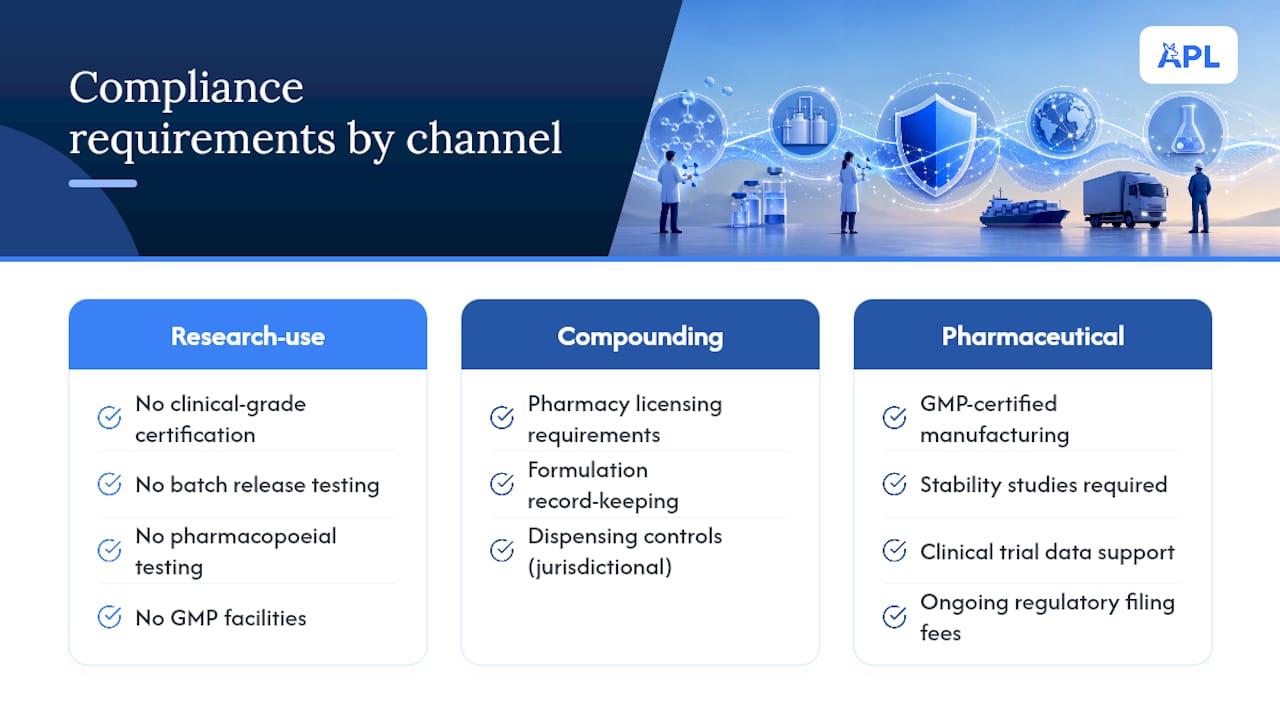
For a research buyer, the practical takeaway is straightforward: paying pharmaceutical-grade prices for research-use material buys nothing extra in regulatory assurance, since that material was never manufactured under the same compliance framework in the first place. The right question is not "which channel is cheapest" but "which channel's compliance framework actually matches what my experiment needs."
Where to source verified peptides with transparent pricing
Once a purity-adjusted $/mg figure is in hand, the next step is finding a supplier whose documentation actually supports that number rather than undermining it.
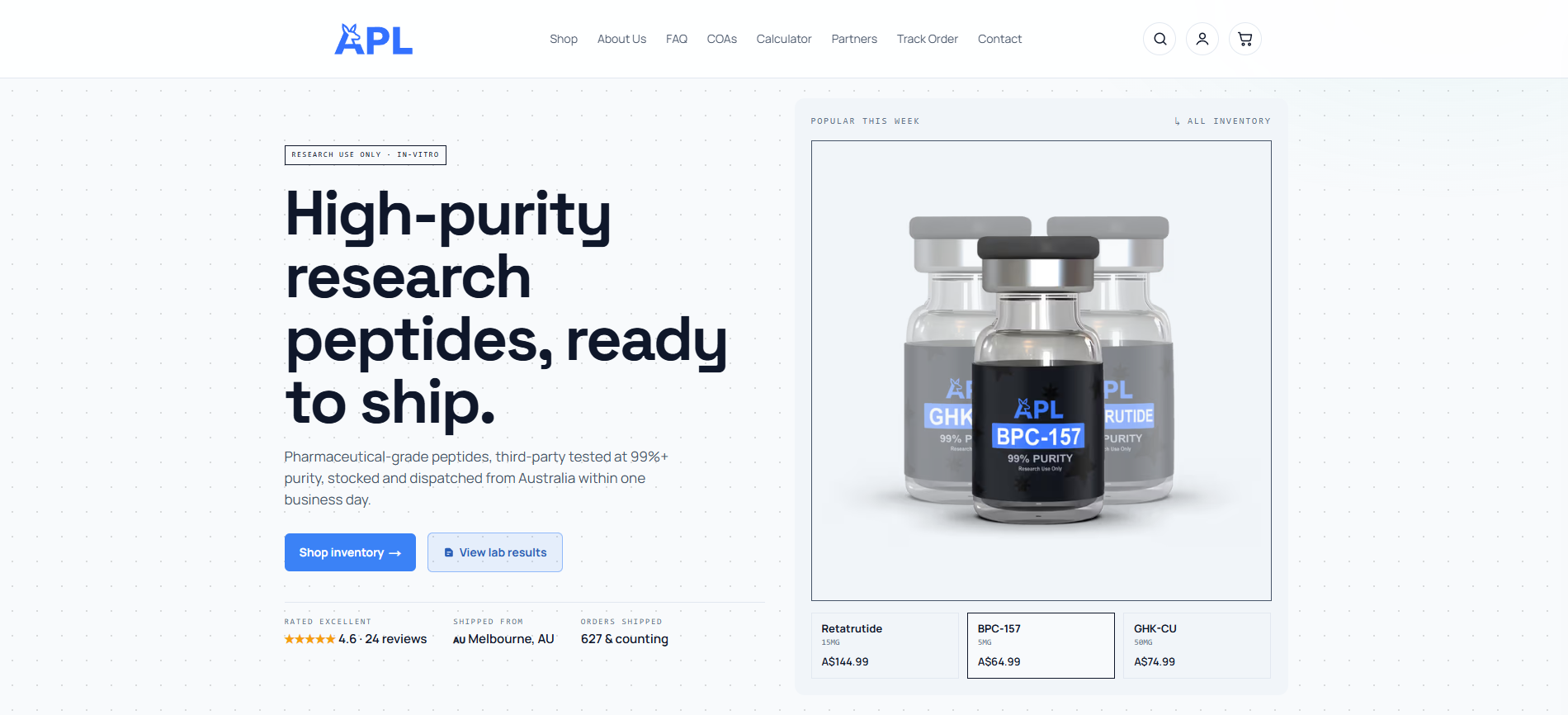
Orders typically dispatch quickly from local warehouses, reducing customs delay and cold-chain uncertainty that can inflate landed costs on overseas orders; shipments also arrive in discreet packaging. For researchers who have just worked through the price-per-mg calculations above, the practical next step is comparing those figures against real product listings rather than theoretical examples. You can view current stock and request a quote on specific peptides, including catalogue items like LL-37 and SS-31, or reach out directly for bulk and custom order pricing tailored to a specific research program.
A procurement officer's rules of thumb
Never compare sticker prices. Convert every quote to purity-adjusted $/mg before deciding anything. Match purity tier to actual assay sensitivity rather than defaulting to the highest spec available, and budget independent testing costs into any order where vendor trust is unproven. Keep a Red Flag contingency fund separate from routine spend, because it is cheaper than repeating a failed experiment. The real skill in this field is not finding the lowest price. It is knowing which price actually reflects the risk you are willing to accept.
— Dr. Authur
Sources
- Peptide Prices Compared: Cost per mg Adjusted for Purity
- How Much Do Peptides Cost? Research, Compounded, Branded
- The Definitive Guide to the Peptide Synthesis Price in 2026_KMD Bioscience