
Choose domestic suppliers for time-critical, low volume or compliance-sensitive peptide work; consider importing only when you can absorb independent testing costs and long lead times. The decision hinges on four factors: speed, quality assurance, regulatory burden and total landed cost. For most laboratories, a domestic supplier such as Aupeptidelabs removes the variables that turn a simple order into a compliance headache.
Domestic vs imported peptides: the stability versus price trade-off
The core trade-off is straightforward: domestic sourcing buys stability, importing buys price, and rarely does one route deliver both.
A domestic supplier holding validated Australian stock typically ships within 2 to 5 business days in metro areas, with no customs inspection standing between order and bench. Pricing is quoted in AUD with no currency conversion risk, and technical support is available in your own time zone rather than across a 12-hour gap. For a laboratory running a grant-funded assay against a deadline, that predictability is worth more than a marginal saving per milligram.
Importing has its place. Overseas manufacturers can offer lower per-unit synthesis costs and access to custom sequences that smaller domestic catalogues don't stock. But those savings come bundled with risk:
- Customs inspections and Australian Border Force holds that can add days or weeks with no notice.
- Cold-chain failures during transit, particularly across long-haul routes exposed to tarmac heat or unheated cargo holds.
- A near-total reliance on independent verification, since a manufacturer's COA often diverges from independent testing results.
- No local recourse if a shipment is seized, degraded, or simply never arrives.
Climate matters more than most procurement teams expect. Australian summers and long transit legs make climate-aware packaging and timing a genuine variable, not a footnote, particularly for lyophilised peptides sensitive to heat cycling.
Pro Tip: If you're importing, order in the largest volume your storage and shelf life allow. Independent HPLC and LC‑MS testing costs roughly the same whether you're verifying 5mg or 500mg, so amortising that fee across a bigger batch is the only way importing stays cost-competitive.
What should procurement verify before placing an order?
Before any purchase order gets signed, run the supplier through a fixed sequence rather than relying on a sales page's claims.
- Request a batch-specific Certificate of Analysis showing HPLC and mass spectrometry results, not a generic product-level document, and cross-check the report ID with the issuing lab where that's possible.
- Confirm third-party testing status. Ask whether the testing laboratory holds ISO/IEC 17025 accreditation, which signals the lab's methods have been independently assessed for competence.
- Check the dispatch SLA in writing. A domestic stocking statement, a same-day or next-business-day dispatch commitment, and discreet packaging are all things a legitimate supplier will confirm without hedging.
- Verify temperature control and lot traceability, including how the product was packed for transit and whether the lot number ties back to a specific COA.
- Calculate total landed cost, not just unit price, before comparing quotes across suppliers.
A tiered evaluation framework helps here: Tier 1 is the paperwork review (COA, orthogonal data), Tier 2 is independent re-testing, and Tier 3 is the supplier's regulatory standing and disclosure practices. A supplier that stalls at Tier 1, refusing to produce batch-specific documentation on request, is a red flag regardless of price. Inconsistent labelling, marketing that drifts from research-use-only framing, or vague answers about testing methodology should halt the purchase outright.
What Australian import rules affect your timeline?
Two regulatory processes shape how long an imported order actually takes to land, and both are worth understanding before you commit to a purchase date.
The Office of Drug Control aims to process import permit applications within 20 business days, with many cleared faster, often inside 10 business days. That target sits on top of manufacturing and shipping time, so a permit-dependent import can realistically stretch to four to six weeks once every step is accounted for.
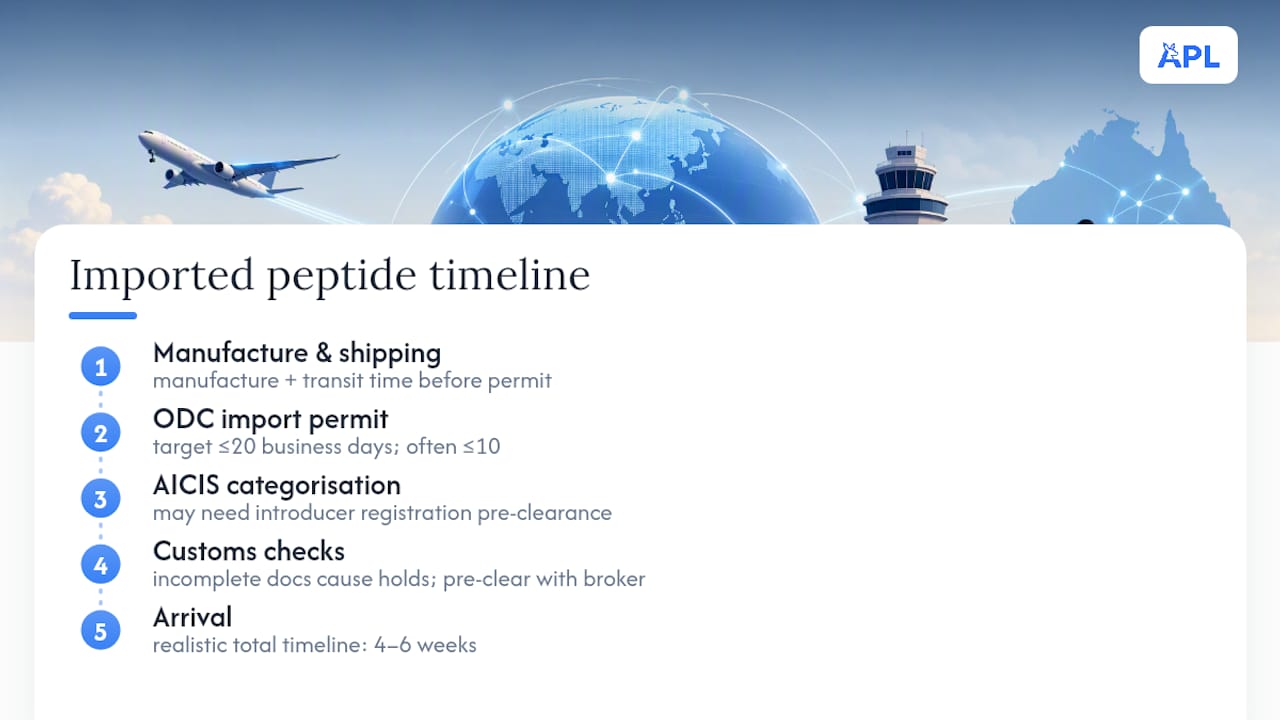
Separately, the Australian Industrial Chemicals Introduction Scheme (AICIS) governs the categorisation of any industrial chemical introduction, including some research peptides depending on volume and use. Categories run from exempted through to assessed, and each carries different registration and record-keeping obligations. A laboratory introducing chemicals commercially or above research-use exemption thresholds needs to register as an introducer before goods clear the border.
Documents that commonly trigger customs queries include incomplete commercial invoices, missing or vague product descriptions, and shipments lacking a research-use-only declaration. Pre-clearing paperwork with a customs broker before dispatch avoids most of these holds.
How do you calculate the true cost of procurement?
Unit price is the least useful number in a peptide quote once you account for everything sitting behind it.
A realistic comparison should include independent testing fees, freight and insurance, customs broker charges, cold-chain surcharges for temperature-controlled transit, the administrative hours spent chasing permits or COAs, and the risk cost of a shipment that needs replacing. Total cost of procurement should be modelled rather than assumed, because testing and shipping fees routinely erase the apparent saving on a low unit price.
Break-even for international sourcing generally requires volume large enough to spread fixed costs, mainly independent verification, across many units. Below that threshold, domestic sourcing is almost always cheaper on a landed-cost basis, even when the domestic quote per milligram looks higher on paper.
- Independent HPLC/LC‑MS retesting per shipment.
- Freight, insurance and customs broker fees.
- Cold-chain packaging surcharges.
- Staff hours spent on permit applications and customs correspondence.
- Contingency cost for reshipment or seizure.
Pro Tip: Build a simple landed-cost spreadsheet before you compare quotes; a supplier's headline price means little until testing and freight are added back in.
Why domestic fulfilment reduces hidden procurement risk
Aupeptidelabs stocks pharmaceutical-grade research peptides tested to exceed 99% purity, with every shipment dispatched from Australian stock within one business day. That single fact removes the two biggest variables in the comparison above: customs delay and cold-chain uncertainty.
- Purity verified above 99%, with batch-specific documentation available on request.
- Next-business-day dispatch from Australian-held stock, not an overseas warehouse.
- Discreet packaging designed for laboratory delivery without drawing attention.
- A 4.6/5 customer satisfaction rating based on verified reviews.
A domestic vendor that imports in bulk, tests thoroughly, and sells only validated lots effectively absorbs the QA burden that would otherwise fall on the purchasing laboratory. Technical documentation and procurement-ready order forms are available through Aupeptidelabs' product catalogue for teams preparing an approval memo.
Which sourcing route actually fits your project?
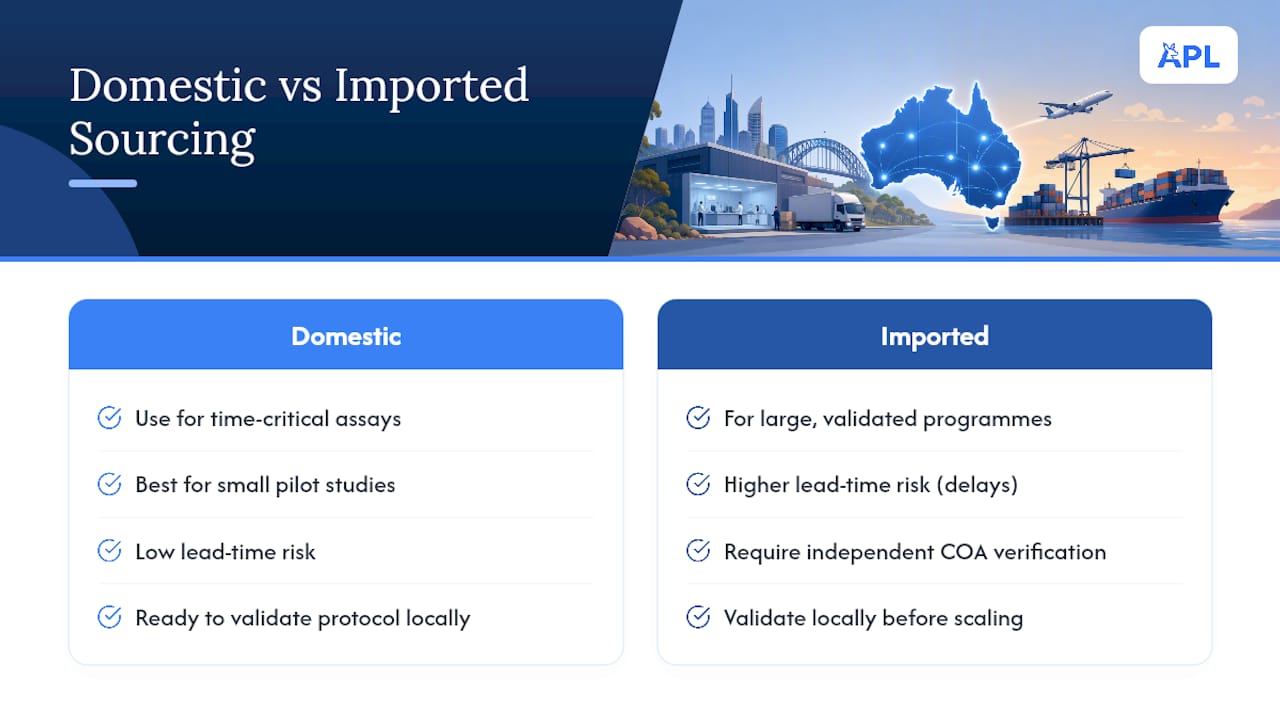
Time-critical assays and small pilot studies belong with a domestic supplier every time. The lead time risk of importing simply isn't worth it when a single delayed shipment can stall a whole experimental timeline.
Large, validated research programmes with dedicated procurement and QA staff can reasonably consider importing, but only after independent verification confirms the supplier's COAs hold up. The conservative workflow is to validate locally first, prove out your protocol on domestic stock, then scale into imported volume only once the economics and the supplier's reliability are genuinely established.
— Dr. Authur
Order domestic stock and request your COA today
Aupeptidelabs exists precisely because Australian laboratories shouldn't have to choose between purity and speed.
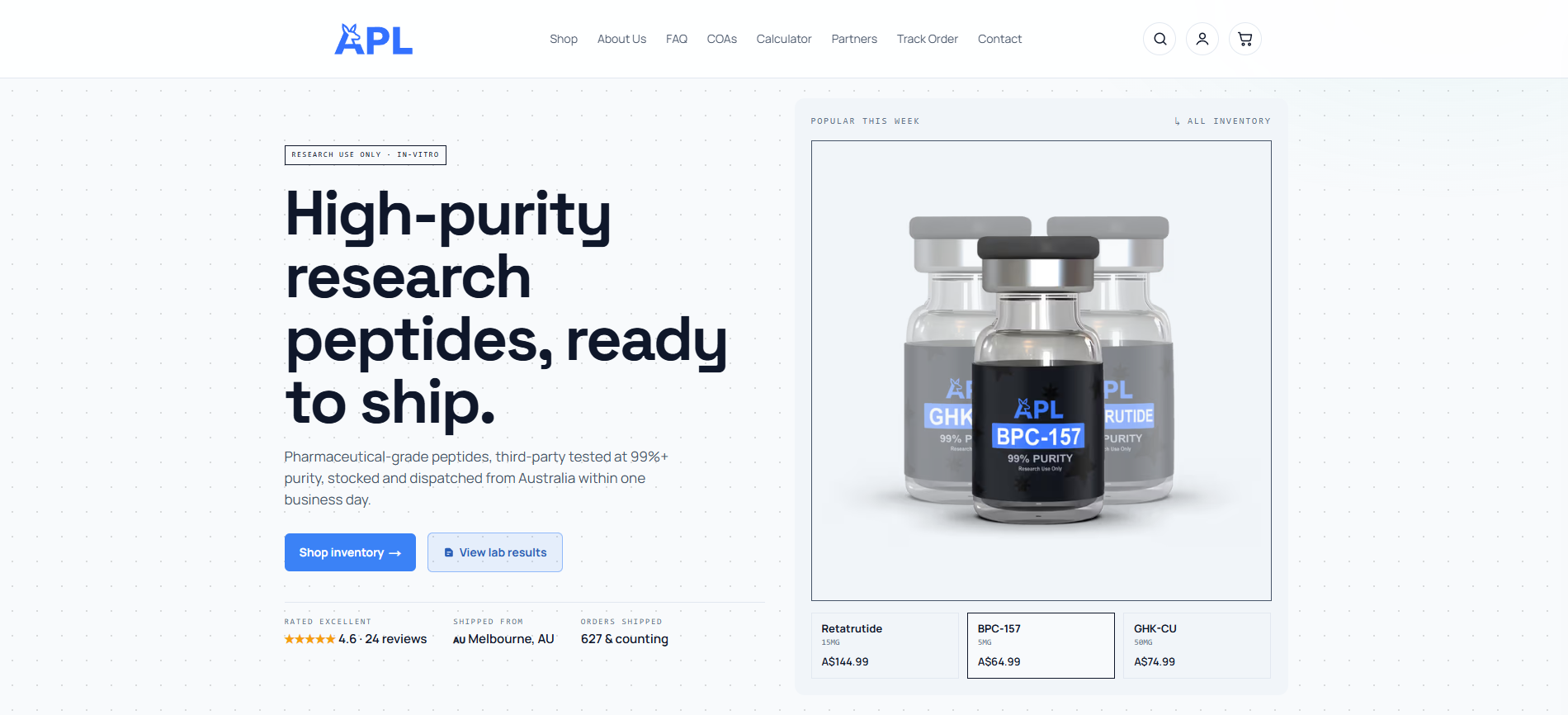
Batch-specific COAs are available on request for any product, and technical questions can be directed to our team for procurement approval documentation. If you're comparing a domestic quote against an overseas offer, start with the full peptide catalogue to see current stock, pricing in AUD, and dispatch timing before you commit to an import order. For sequence-specific ordering, product pages such as Selank and ARA 290 list purity data and COA request options directly. Request your COA now and have documentation in hand before your next procurement meeting.
Sources
- Guidance: completing import permit applications — Office of Drug Control
- Getting started: registration, importing and manufacturing basics — AICIS
- Evaluating research-peptide suppliers: COA verification, third-party testing, transparency — Compound Review
- Research peptide suppliers Australia: domestic vs international — Biovera
- Peptides