
The fastest route is to submit a bulk quote request listing compounds, quantities and institutional billing details. From there, expect volume pricing tiers, a per-batch Certificate of Analysis, and lead times that vary depending on whether the peptides are catalogue stock or custom synthesis.
Quick checklist: what procurement must confirm before a bulk order
Before a purchase order goes anywhere, procurement should lock down a handful of details that prevent delays later. Bulk peptide procurement runs smoother when these are settled upfront rather than negotiated mid-shipment.
- Confirm whether the supplier works on fixed minimum order tiers or quote-based wholesale pricing for larger volumes.
- Require a per-batch COA showing HPLC purity and LC‑MS identity, and match vial lot numbers to that COA on arrival.
- Confirm packaging format, cold-chain requirements, and the verified shipping method being used.
- Agree payment terms, invoicing structure, and any net-terms arrangement before the order is accepted.
Skipping any of these usually surfaces as a problem weeks later, typically when an auditor asks for a document nobody thought to request.
How does bulk peptide ordering actually work?
The process for bulk peptide purchase follows a fairly consistent structure across suppliers, even when the specifics of pricing and lead time differ.
- Enquiry. The buyer submits compound names, target quantities, and institutional details.
- Personalised quote. The supplier returns pricing based on volume, purity requirement, and vial format.
- Purchase order and invoice. Once terms are accepted, a PO is raised and invoiced according to agreed payment terms.
- Batch confirmation. The supplier confirms which lot will fulfil the order and issues the corresponding COA.
- Dispatch. Vials are packed to cold-chain standard and shipped, with tracking issued to the buyer.
Catalogue bulk tiers cover standard, already-synthesised compounds and move fastest through this pipeline. Custom synthesis, needed for novel sequences or gram-scale quantities, adds a production step before batch confirmation and extends the timeline accordingly. Volume buyers placing recurring orders often qualify for account services: a named account manager, net payment terms, and scheduled deliveries that sync with a lab's research calendar rather than one-off purchasing.
Pricing and volume discounts: what actually moves the unit cost
Wholesale peptide pricing is rarely a flat rate per vial. Most suppliers structure it in bands, and tiered volume pricing with institutional and enterprise brackets is common across the sector, with discounts widening as order size increases. Catalogue suppliers often apply the same logic to multi-vial purchases of a single product, where bulk discounts scale with the number of vials ordered rather than requiring a separate custom quote.
Purity requirements and format also shift the number. Procurement has genuine leverage here:
- Committing to a recurring contract rather than a single purchase often unlocks a better rate.
- Splitting one large order into phased deliveries can reduce warehousing pressure without losing the volume discount.
- Requesting larger vial formats instead of many small vials lowers packaging and handling cost per milligram.
Pro Tip: Ask for pricing broken down by vial count and by purity tier separately. A supplier that can show you both lines proves the quote isn't a single arbitrary number.
Comparing quotes properly means normalising for all of this rather than eyeballing the bottom line, which is exactly where a structured comparison approach, such as this guide to comparing bulk peptide quotes, earns its place in a procurement workflow.
What documentation should arrive with a bulk shipment?
Quality assurance for research peptides isn't a formality, it's the difference between a reproducible result and a wasted study. A proper Certificate of Analysis includes the lot number, an HPLC chromatogram, the reported purity percentage, mass spectrometry identity confirmation, and endotoxin data where the application requires it.
Wholesale suppliers commonly issue a per-batch COA covering HPLC purity and LC‑MS identity, and some go further by publishing batch lab results publicly. That visibility matters more than it might seem: institutional buyers checking a supplier for the first time can verify purity claims before a vial is even opened.
The detail that catches most labs out is consolidated reporting. A single COA covering an entire order is far less useful than one that maps every individual vial's lot number against its own analysis. Without that mapping, a quality system can't trace a specific vial back to its exact batch data, which becomes a real problem the moment an auditor or a reviewer asks for it.
- Match vial labels against the COA before reconstitution, not after.
- Log the COA in the lab's quality management system on receipt, not when it's convenient.
- Flag any mismatch between labelled lot number and COA lot number immediately, before the vial enters a protocol.
Consolidated COAs that map lot numbers to individual vials are the detail procurement leads most often cite as the difference between a smooth audit and a scramble.
Shipping, cold chain and lead times for bulk orders
Lead time expectations should be set at the enquiry stage, not discovered after payment clears. In-stock catalogue peptides generally move through dispatch far faster than anything requiring custom synthesis, where production scheduling adds real time to the front end of the order.
- Lyophilised peptides need packaging that maintains stability in transit, typically insulated shipping with appropriate temperature control for the compound.
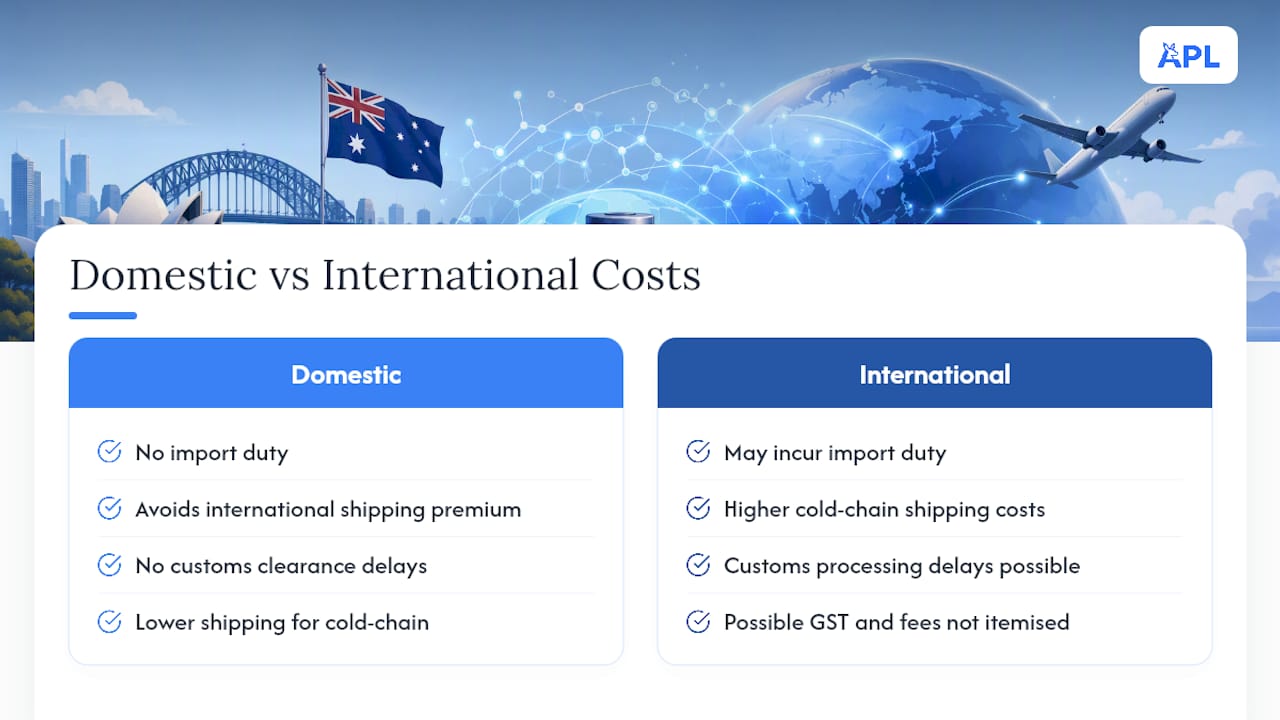
- Local, Australia-dispatched stock avoids the customs clearance step that international shipments face, which is one of the more common causes of unexplained delay.
- Custom synthesis orders should carry an explicit production timeline separate from the shipping timeline, so procurement isn't left guessing which stage caused a delay.
Specialist courier handling matters here too. The same principles that govern medical courier logistics, secure handling, temperature integrity, and verified chain of custody, apply directly to research peptide shipments moving between supplier and laboratory. A supplier holding local stock and dispatching same-day removes an entire layer of risk that international suppliers can't avoid.
What should a bulk enquiry actually include?
A vague enquiry gets a vague quote. Suppliers respond faster and more accurately when the first email contains everything they need to price the order properly.
- Institution name, billing contact, and PO number if one already exists.
- Full compound names or sequences, with CAS number or sequence identifier.
- Target vial sizes and total quantities required.
- Required purity threshold and documentation (COA, HPLC, MS).
- Required lead time and any hard delivery deadline.
Worth adding if relevant: forecasted monthly volumes for recurring orders, any NDA or white-label packaging requirements, and packaging preferences for internal handling. A short, numbered list like this pasted straight into an email cuts back-and-forth considerably and lets a supplier return a quote in one pass rather than three.
Publisher note: how Aupeptidelabs supports bulk research procurement
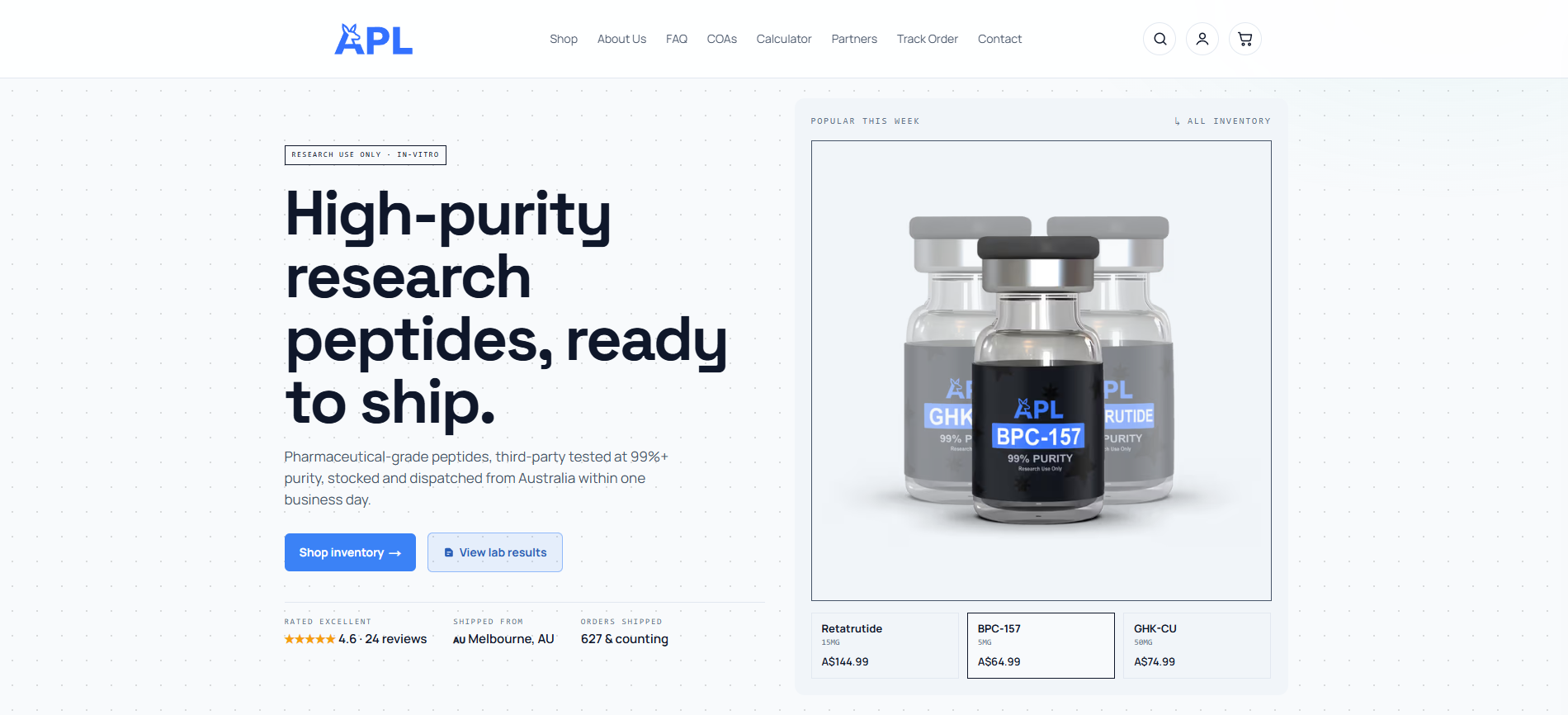
Aupeptidelabs supplies research peptides above 99% purity with same-day dispatch from Australia, and reports a customer satisfaction rating of 4.6/5 based on verified reviews. Local dispatch removes the customs step that can slow down international orders, and consolidated documentation practices, matching lot numbers across every vial in a shipment, reduce the traceability friction that audits usually surface.
For labs weighing supplier reliability more broadly, checking verified reviews on Trustpilot alongside a supplier's published COA practices gives a reasonably complete picture before committing to a first bulk order.
Contract terms for bulk purchases: returns and liability
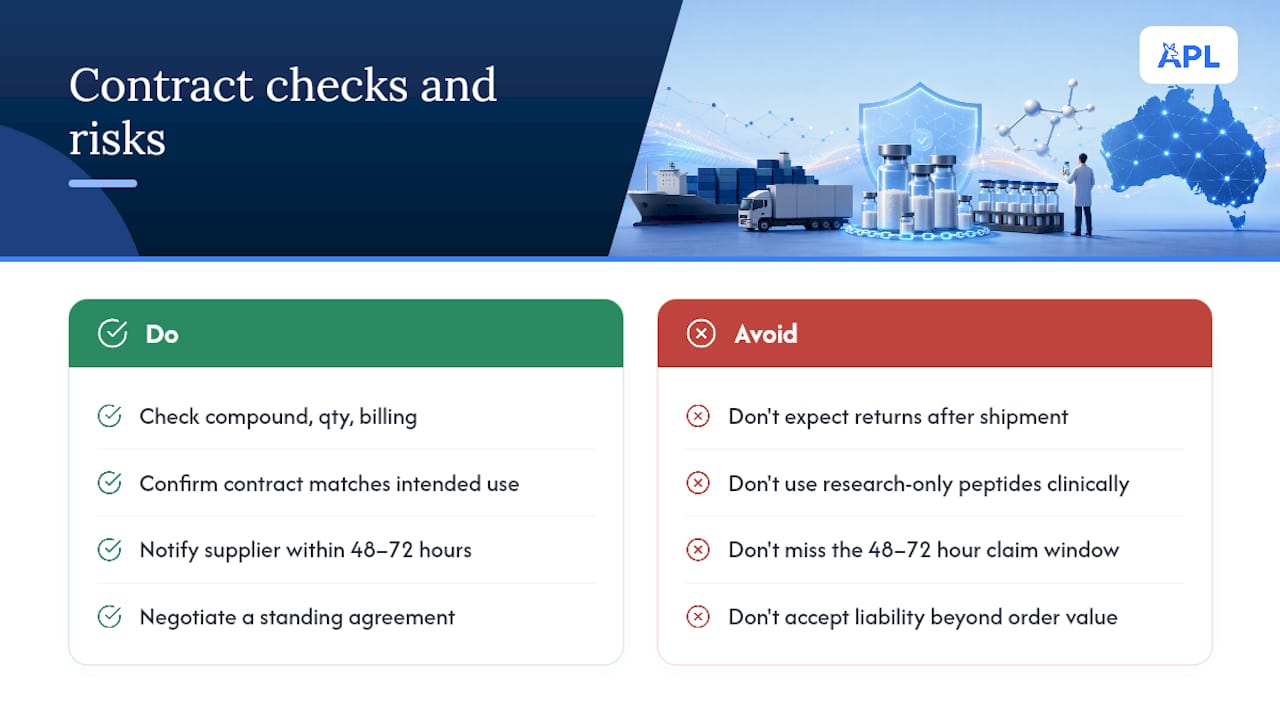
Bulk peptide contracts differ from a single retail purchase in ways procurement should read closely before signing. Research-grade peptides are typically sold on a no-return basis once shipped, given that cold-chain integrity can't be verified retroactively after a vial leaves the supplier's custody. That makes the pre-shipment checks, correct compound, correct quantity, correct billing details, the effective point of no return in most contracts.
Liability terms usually cap the supplier's exposure at the value of the order itself, and explicitly exclude any use beyond laboratory research. This isn't a technicality: peptides sold for research use only carry contractual language that shifts responsibility to the buyer the moment the product leaves for any application outside a lab setting. Procurement should confirm this clause matches how the compound will actually be used internally.
Where contracts do allow for adjustment, it's usually limited to documented discrepancies, wrong compound shipped, purity below the stated threshold on independent verification, or damage in transit, and typically require notification within a defined window, often 48 to 72 hours of receipt. Missing that window can void the claim entirely.
For recurring bulk buyers, it's worth negotiating these terms once into a standing agreement rather than re-reading fine print on every order. A named account manager can usually confirm liability and return terms verbally before a PO is raised, which saves a round of legal review on repeat purchases.
Should you request a sample before ordering in bulk?
Yes, and most experienced procurement teams do this as standard practice, not as an exception. Requesting a small sample vial before committing to a bulk peptide purchase lets a lab verify purity, reconstitution behaviour, and COA accuracy against the supplier's own claims, at a fraction of the cost of finding a problem after a full order arrives.
The sample request process typically mirrors the bulk enquiry: specify the exact compound, required purity, and confirm that the sample will ship with its own COA rather than a placeholder document. A supplier unwilling to provide a documented sample vial is worth treating with caution, since that same reluctance often extends to the full order's documentation.
Where sample requests genuinely earn their cost is in multi-month studies. Running a sample through internal verification first, then requesting lot-locking so that the full bulk order draws from that exact same batch, removes batch-to-batch variability as a confounding factor in longer protocols. This is a service worth asking about directly, since not every supplier offers it and not every supplier advertises it.
Budget a short lead time for the sample stage itself, generally a few days to a week depending on stock status, and factor that into the overall project timeline rather than treating it as a delay. It's cheaper time to lose than the time lost re-running a study on a bad batch.
What does a bulk peptide order really cost?
The quoted unit price is rarely the full number procurement ends up paying. A realistic total cost breakdown separates the peptide cost itself from a handful of line items that are easy to overlook at the quote stage.
Shipping is the most variable of these. Cold-chain packaging, insulated containers, and courier services capable of maintaining temperature integrity all add cost beyond a standard parcel rate, and that cost scales with distance and urgency. Orders dispatched from within Australia sidestep the international shipping premium entirely, along with the customs clearance fees and delays that cross-border research shipments routinely incur.
Taxes and duties are the second variable, and they depend heavily on where the order originates. Domestic Australian orders avoid import duty altogether, while international orders can carry GST and customs processing charges that aren't always itemised in the initial quote. Procurement should ask explicitly whether a quoted price is landed cost or ex-works, since the gap between the two can be substantial on larger orders.
Documentation is occasionally a hidden line item too. Some suppliers charge extra for expedited or additional third-party verification beyond the standard COA, particularly when a lab needs independent lab confirmation rather than the manufacturer's own results. Guidance on what to look for in third-party peptide testing is worth reviewing before assuming a standard COA covers every audit requirement a study might face.
Asking a supplier for an itemised quote, product, packaging, shipping, and any applicable tax listed separately, before signing off is the simplest way to avoid an invoice that doesn't match expectations.
A procurement lead's short perspective on validating a new bulk supplier
The suppliers that hold up under audit aren't necessarily the cheapest. They're the ones offering sample vials and lot-locking before you commit to volume, and a named account rep instead of a generic order form. Consolidated invoicing and traceable documentation aren't extras. They're what separates a defensible study from one you're explaining to a reviewer months later.
— Dr. Authur
Request a bulk quote from Aupeptidelabs
For laboratories ready to move past comparison and into procurement, Aupeptidelabs offers same-day dispatch from Australian stock, which means no customs wait and a shorter gap between purchase order and vials on the bench.
To get a quote, send compound names, target quantities, required purity, and institutional billing details in one enquiry. Procurement teams checking supplier options first can review how to verify a manufacturer before ordering for a fuller comparison framework. When the checklist is settled, request your bulk quote directly through the Aupeptidelabs ordering page and get a lead time confirmed the same day.
Selected resources and internal guides
For deeper detail on any step covered here, see the guide to comparing bulk peptide pricing, the checklist for Australia-based peptide sourcing, and the supplier verification shortlist for evaluating documentation and dispatch practices before committing to a bulk order.