

Normalise every quote to price per milligram and adjust for net peptide content before comparing suppliers. Once headline price gets converted into price per effective milligram, the "cheaper" quote can flip.
A valid quote must show a Certificate of Analysis (CoA), third-party HPLC or mass spectrometry verification, stated purity or net peptide content, and dispatch terms. Cost lines to demand: unit cost per mg, testing fees per batch or per CoA, shipping and handling, and any minimum order quantity (MOQ) discount structure.
- Sequence name, vial size (mg), and stated purity
- CoA with lab name and batch/lot number
- Unit price, testing fees, shipping, and MOQ tiers listed separately
Pro Tip: Always request price per effective milligram, calculated as price ÷ (vial mg × purity fraction). This single number strips out the marketing trick of quoting a bigger vial at a slightly lower purity to look competitive.
Step-by-step procurement checklist for comparing bulk peptide quotes
Procurement teams juggling multiple supplier quotes need a repeatable sequence, not a gut feeling. Here's the process that turns five incompatible PDFs into one clean comparison table.
- Capture headline data. Record sequence name, vial size in mg, concentration, stated purity, batch or lot number, and whether a CoA is supplied at no extra cost.
- Normalise to price per mg, then price per effective mg. Divide the quoted price by vial mg, then divide again by the purity fraction to get the true cost of usable peptide. This method mirrors the approach detailed in peptide pricing comparisons adjusted for purity, which treats purity adjustment as the baseline for any honest comparison.
- Add per-batch costs. Layer in CoA/testing fees, standard shipping, any cold-chain surcharge, import duties, and payment processing surcharges to reach a landed cost.
- Compare MOQs and volume breaks. Some suppliers offer stepped discounts tied to multi-vial purchases, but check whether the discount applies only within a single batch or can be aggregated across multiple lots over time.
- Verify the verification. Confirm the CoA names an identifiable lab, includes HPLC or MS traces, and states clearly whether testing was performed in-house or by an independent third party.
- Assess supply risk. Check lead time, whether dispatch happens locally or offshore, lot-to-lot consistency history, expiry dating, and required storage conditions.
The deliverable from this process is a simple spreadsheet with columns for sequence, vial mg, purity, price per effective mg, CoA status, testing fees, shipping cost, MOQ tier, and total landed cost per project. Paste every incoming quote into the same template and the comparison writes itself.
- Sequence + batch/lot number
- Price per effective mg (calculated field)
- CoA verified (yes/no) + lab name
- Total landed cost for the required order volume
Pro Tip: Ask every supplier to quote against the same sample lot size and request a batch-matched CoA in the proposal itself, not after the invoice. Treat a missing CoA as a quantifiable risk. Price in the cost of independent retesting before you decide the "cheaper" quote is actually cheaper.
What actually makes up the price of bulk peptides
Six cost components drive the number on a supplier's invoice, and understanding which ones are fixed versus negotiable changes how procurement should push back on a quote.
- Synthesis complexity. Longer sequences, difficult residues, and structural modifications add coupling steps and reduce overall yield, which raises cost per mg regardless of supplier margin.
- Purification depth. Moving purity from around 95% to above 99% often raises cost disproportionately, because the final purification steps remove the most stubborn impurities at the lowest yield return. Per-scale pricing tables show this cost curve clearly across peptide length and purity bands.
- Analytical verification. Batch HPLC and mass spectrometry testing cost real money per batch. Some suppliers absorb it into the unit price; others itemise it separately.
- Formulation and fill. Lyophilisation, vial filling, capping, crimping, and cold-chain packaging each add a per-vial cost that scales with order size.
- Scale and MOQs. Larger volumes usually reduce per-mg cost, but locking into single-batch purchases can add inventory carrying costs that offset the saving.
- Quality grade differences. Research-grade and certified-standard peptides carry different pricing profiles reflecting the documentation and testing behind them.
How to calculate price per effective milligram
The formula procurement needs is straightforward: price per effective mg = quoted vial price ÷ (vial mg × purity fraction). This calculation is the industry-standard way to strip vial-size and purity variation out of a comparison, a method also outlined in Au Peptide Labs' guide to purity versus net peptide content.
Take two sample quotes. Supplier A's price per effective mg is $180 ÷ (5 × 0.97) = $37.11. Supplier B's works out to $340 ÷ (10 × 0.985) = $34.52. The larger vial wins on effective cost despite the higher sticker price.
- Confirm whether mg figures refer to peptide content or total vial mass including salts and counter-ions
- Convert currencies to a single reference currency before running any comparison
- If a supplier charges CoA testing separately, divide that fee by total batch mg and add it as a per-mg surcharge
Pro Tip: A CoA fee of $120 on a 500mg batch adds $0.24 to every milligram. That's rarely enough to change a supplier ranking on its own, but it matters when margins between quotes are tight.
What to expect: timelines, MOQs and discount patterns
Lead times vary sharply depending on whether you're ordering sample vials or a full production run. Sample-sized orders from suppliers holding local stock can dispatch same day; custom bulk batches requiring a booked production slot and fresh testing often take considerably longer, and retesting after a failed CoA check adds further delay.
- MOQ shapes vary by business model. Some suppliers run zero-MOQ or white-label arrangements suited to smaller labs; others use traditional volume tiers that reward larger single orders.
- Discount bands commonly sit in the 10 to 20% range across volume breaks, with membership or subscription-style arrangements sometimes altering the effective per-unit price further.
- Local dispatch removes a major variable. Domestic same-day dispatch avoids the customs delays and unpredictable transit windows that come with international shipments.
- Build in buffer time for CoA generation. Third-party testing and any required retesting can add days to a timeline that otherwise looks tight on paper.
Trust signals and red flags in bulk peptide quotes
A batch-matched Certificate of Analysis naming an identifiable lab, complete with HPLC or MS traces, lot number, expiry date, and storage instructions, is the single most important document a supplier can provide. Beyond that, look for verified customer reviews, confirmed same-day dispatch from local stock, and a documented complaint or return process.
- Red flag: a CoA that's vague, unsigned, or missing entirely
- Red flag: refusal to name the third-party lab that performed testing
- Red flag: vial weights that shift between quotes with no explanation
- Red flag: a quoted price dramatically below market with no CoA option at all
Ask directly whether CoA testing is bundled into the unit price or billed as an add-on, and get the add-on figure in writing if it applies.
Pro Tip: When a quote looks too good to verify, price in the cost of independent retesting through your own lab or a third-party analytical service. If that added cost erases the saving, the "cheap" quote was never actually cheap.
Author perspective: procurement practices that work on the lab bench
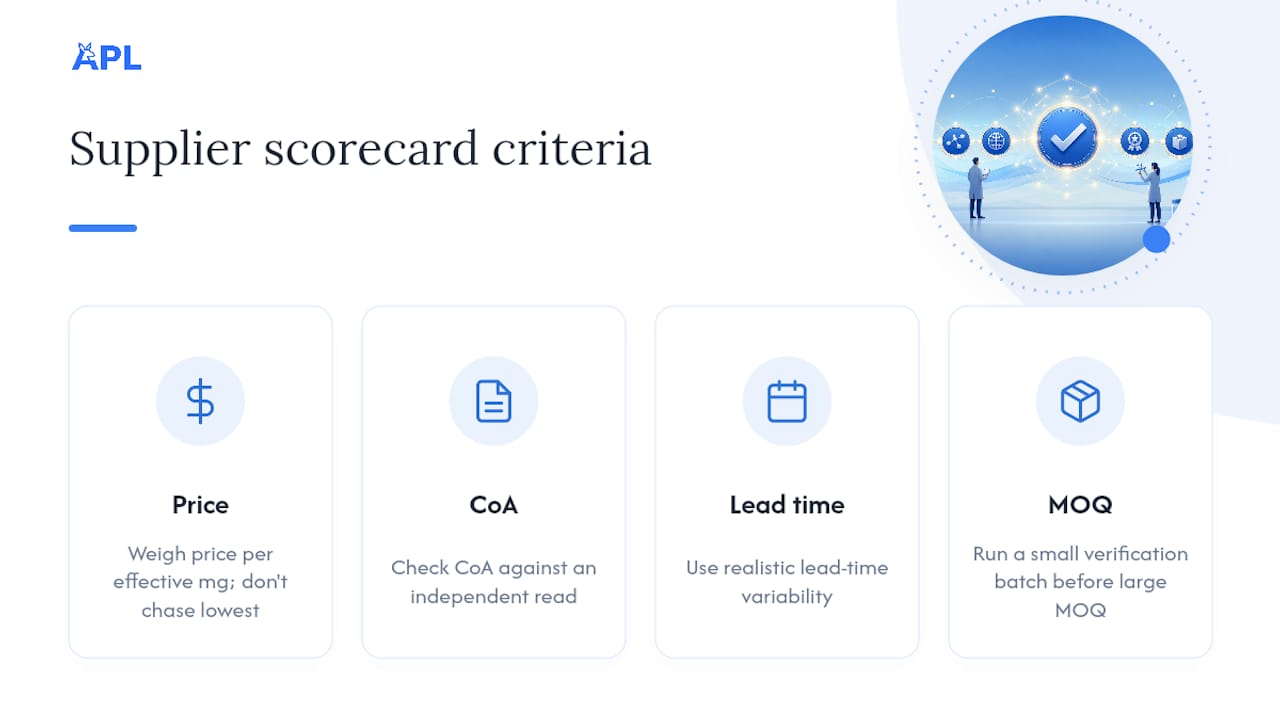
The instinct to chase the lowest price per mg is understandable, but it's the wrong optimisation target. A small saving on unit cost means nothing if a batch fails verification three weeks into a project and the lab loses that time entirely. Reorder points should reflect realistic lead time variability, not the best-case dispatch window a sales rep quoted verbally.

Before committing to a large-volume MOQ with a new supplier, run a small verification batch first. Check the CoA against an independent read where possible, confirm handling and packaging quality, and only then scale the order. A simple supplier scorecard weighing price per effective mg, CoA verifiability, lead time reliability, and MOQ flexibility, weighted according to your lab's own risk tolerance, beats any single-number comparison.
How Au Peptide Labs delivers on these procurement standards
Every checklist item in this guide maps directly to how Au Peptide Labs structures its bulk supply process. Orders dispatch from Australian stock within one business day, removing the customs uncertainty that plagues offshore bulk orders.
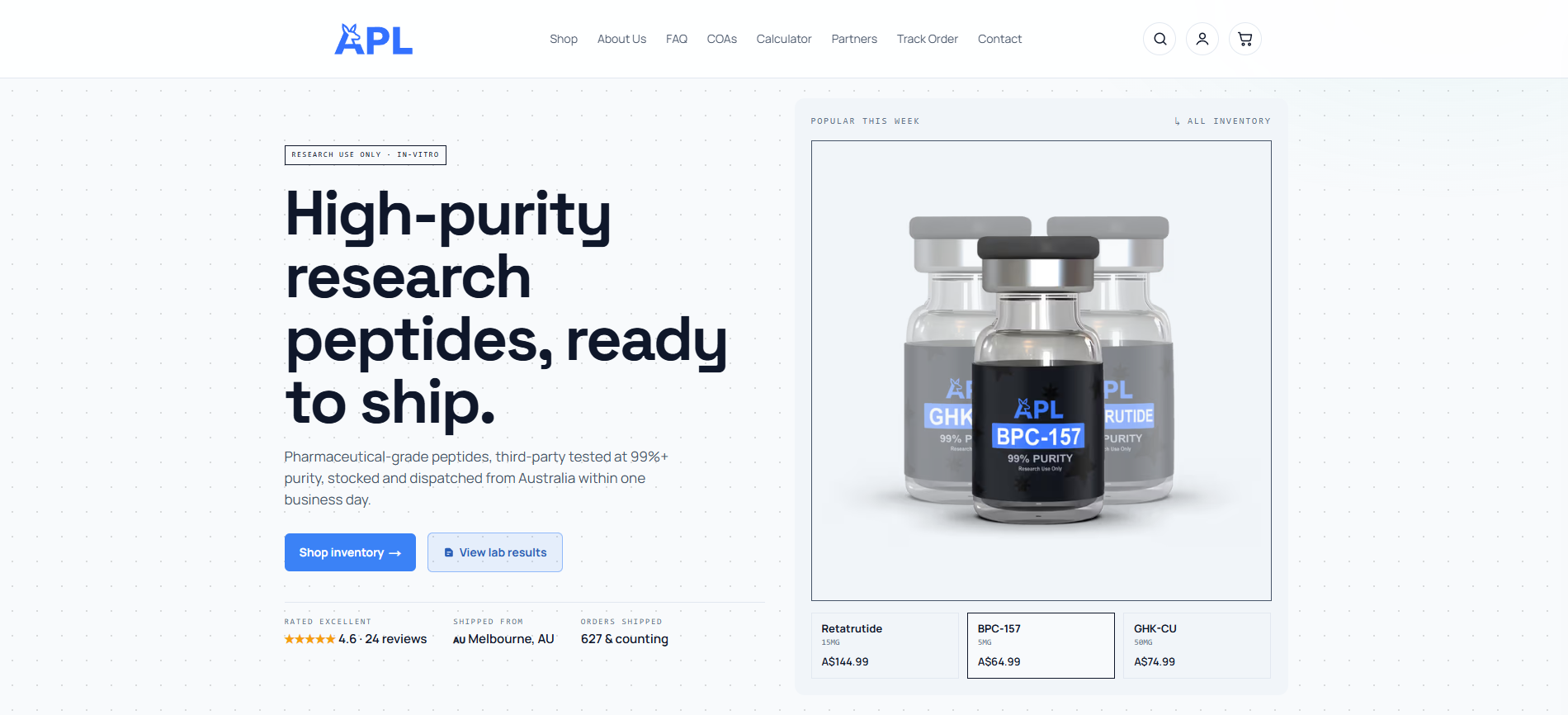
Requesting a comparable quote is straightforward: specify unit price per mg, stated purity, batch size, whether CoA testing is included or billed separately, shipping method, and expected lead time. Au Peptide Labs supplies all of these as standard on product pages, so procurement teams can run the price-per-effective-mg calculation without chasing missing details. Customer satisfaction currently sits at 4.6/5 based on verified reviews, and the net peptide content glossary is available for teams standardising their own internal comparison templates. To start a formal quote or request a verification batch, visit the Au Peptide Labs product catalogue directly.