
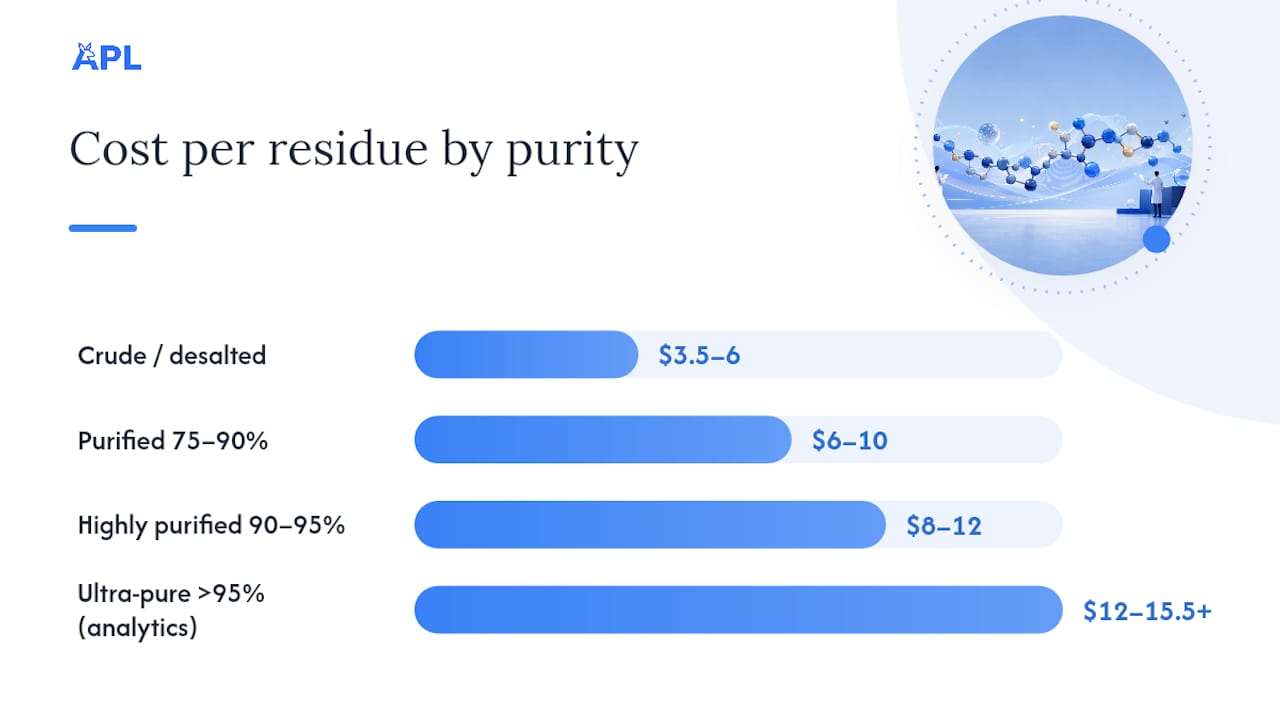
Expect roughly $3.50 to $15.50 per residue depending on purity and synthesis scale, with the low end covering crude, desalted material and the high end reflecting ultra-pure (>95–98%) peptides at small-scale production. A 15-residue research peptide at a typical small scale, purified above 95%, typically costs several hundred dollars once minimum order fees are included. Crude equivalents of the same sequence can cost half that.
- Crude/desalted: $3.50–$6/residue, 3–7 day turnaround
- Purified >90–95%: $8–$12/residue, 1–2 week turnaround
- Ultra-pure >95–98%: $12–$15.50/residue, 2–3 week turnaround
Custom peptide cost callout: A 20-residue peptide at ultra-high purity can cost several hundred dollars before shipping, storage, or rush fees are added.
Most suppliers set minimum order values regardless of sequence length, so short peptides rarely scale down proportionally. Aupeptidelabs supplies Australian-stocked, pharmaceutical-grade peptides with same-day dispatch and full HPLC, MS, and Certificate of Analysis documentation, which shortens the gap between quote and bench work.
What drives custom peptide cost across purity tiers?
Peptide synthesis pricing is not a flat rate. It is built from a base per-residue charge that climbs steeply once you move past standard desalted material into purified and ultra-pure grades. Understanding where your project sits on that curve is the first real step in budgeting.
Crude and desalted peptides sit at the bottom of the cost of peptides spectrum, typically $3.50 to $6 per residue. Some suppliers advertise starting prices as low as $3 per amino acid or roughly $80 per peptide for short, simple sequences at this grade. These are suitable for early screening, not for anything requiring quantitative accuracy.
Purified peptides (>75–90%) move into the $6 to $10 per-residue range. This tier suits most standard in vitro assay work where reproducibility matters but ultra-high specificity does not.
Highly purified peptides (>90–95%) typically run $8 to $12 per residue. Beyond 95%, expect $12 to $15.50+ per residue, with additional analytical charges layered on for peptides requiring extensive HPLC fractionation.
Scale changes the maths in a way many first-time buyers underestimate. Moving from 5mg to 10mg does not double the price. Fixed costs (resin setup, cleavage, initial purification runs) get amortised across more product, so per-residue cost often drops 10–20% at the larger scale. Minimum order fees, however, apply per peptide regardless of length. Ordering three short 8-residue peptides separately usually costs more than ordering one 24-residue peptide of equivalent total synthesis effort.
Turnaround times track purity closely. Crude peptides commonly ship within days, while ultra-pure, heavily fractionated peptides can take two to three weeks or longer.
Why do custom peptide quotes vary so much between suppliers?
The variance rarely comes down to one supplier simply being cheaper. It comes down to how the sequence itself behaves during synthesis.
- Hydrophobic stretches and repeated residues reduce coupling efficiency and final yield, which raises the effective per-residue cost.
- Multiple cysteines or disulfide pairing requirements often demand specialised oxidative folding steps and extra purification runs, a predictable surcharge worth budgeting for early.
- Modifications such as fluorescent labels, PEGylation, D-amino acid substitutions, or head-to-tail cyclisation typically add fixed or per-residue surcharges on top of the base synthesis price.
- Purification and QC choices shift the price depending on whether HPLC chromatograms, mass spectrometry, and a full Certificate of Analysis are bundled into the quote or billed separately for lower-purity orders.
Supplier risk policies also shape final pricing indirectly. A "no peptide, no charge" synthesis guarantee protects you from paying for a failed run, but it is not universal across the industry, so confirming this before you order matters as much as comparing the headline rate.
Pro Tip: Ask upfront whether HPLC and MS data are included at your chosen purity tier or billed as an add-on. Confirming which analytical technique applies to your peptide before you order avoids a recharge surprise when the invoice arrives.
How do you get an accurate custom peptide quote?
Suppliers cannot price a peptide accurately from a sequence length alone. A usable quote request needs enough detail that the reply reflects your actual project, not a generic estimate.
- Sequence in standard one-letter amino acid code, including any non-standard residues.
- Target scale in milligrams (5mg and 10mg are the most common research quantities).
- Target purity (crude, >85%, >95%, or >98%).
- Modification list, including labels, cyclisation, or D-amino acid substitutions.
- Required analytics — HPLC, MS, and whether a formal Certificate of Analysis is needed.
Most suppliers run your sequence through an automated pricing engine first. Anything flagged as difficult, long hydrophobic runs, multiple cysteines, unusual modifications, gets pulled for manual review before a final number comes back.
Query these commonly overlooked costs before committing:
- Additional HPLC runs beyond the standard purification pass
- Resynthesis attempts if the first batch fails QC
- Shipping, customs handling, and storage fees for temperature-sensitive peptides
How can labs reduce total peptide project cost?
Crude or desalted peptides are perfectly adequate for early screening work where you are testing binding or activity rather than generating publication-grade data. Reserve purified and ultra-pure grades for confirmed hits.
- Combine multiple peptides into a single order to spread fixed handling fees across more product.
- Order a slightly larger scale than you need immediately. Aliquoting in-lab is often cheaper than running two separate small syntheses later.
- Use a staged approach: screen with crude material first, then scale up and purify only the sequences that show real activity.
- Ask about volume discounts. Suppliers commonly offer 10–25% off for orders exceeding certain milligram thresholds, which changes the maths for multi-peptide panels.
- Negotiate turnaround against price. If your timeline has flexibility, standard lead time almost always beats rush production on cost.
Where does Aupeptidelabs fit in the custom peptide pricing picture?
Stock ships from Australian warehousing within one business day, which removes the customs delay that often adds a week or more to international orders.
Same-day dispatch from local stock does more than save time on paper. For a lab running a tight experimental window, a week saved on customs clearance can be the difference between hitting a grant milestone and missing it.
| Proof point | Detail |
|---|---|
| Purity capability | >95–98% |
| Dispatch | Same business day, Australian stock |
| Customer satisfaction | verified positive reviews |
| Packaging | Discreet |
| QC documentation | HPLC, MS, Certificate of Analysis |
Pro Tip: When requesting a quote, send your sequence, target purity, and scale together in one message. This lets the supplier route the request straight to manual review if the sequence needs it, cutting back-and-forth delay.
Compare that fulfilment model against a verified supplier checklist before committing, particularly if lead time is as important to your budget as the per-residue rate itself.
What the price bands actually mean for your budget
The per-residue numbers above are a starting point, not a ceiling. The conventional advice, "just get three quotes and compare," treats peptide synthesis pricing like a commodity purchase, but sequence difficulty means two suppliers quoting the same peptide can differ legitimately, not because one is padding margin, but because their synthesis chemistry handles hydrophobic stretches or cysteine pairing differently.
Where most budgeting goes wrong is assuming purity should be maximised by default. It shouldn't. The staged procurement approach, crude first, purify only what works, is underused precisely because it feels slower upfront.
If there's one thing worth prioritising above the headline rate, it's turnaround reliability. A cheap quote that slips two weeks past a stated lead time costs more in lost bench time than the saving was worth.
— Dr. Authur
Get a straightforward peptide quote from Australian stock
If you've been comparing supplier price lists and wondering why turnaround time and customs risk barely get mentioned alongside the per-residue rate, that gap is where Aupeptidelabs is built to compete.
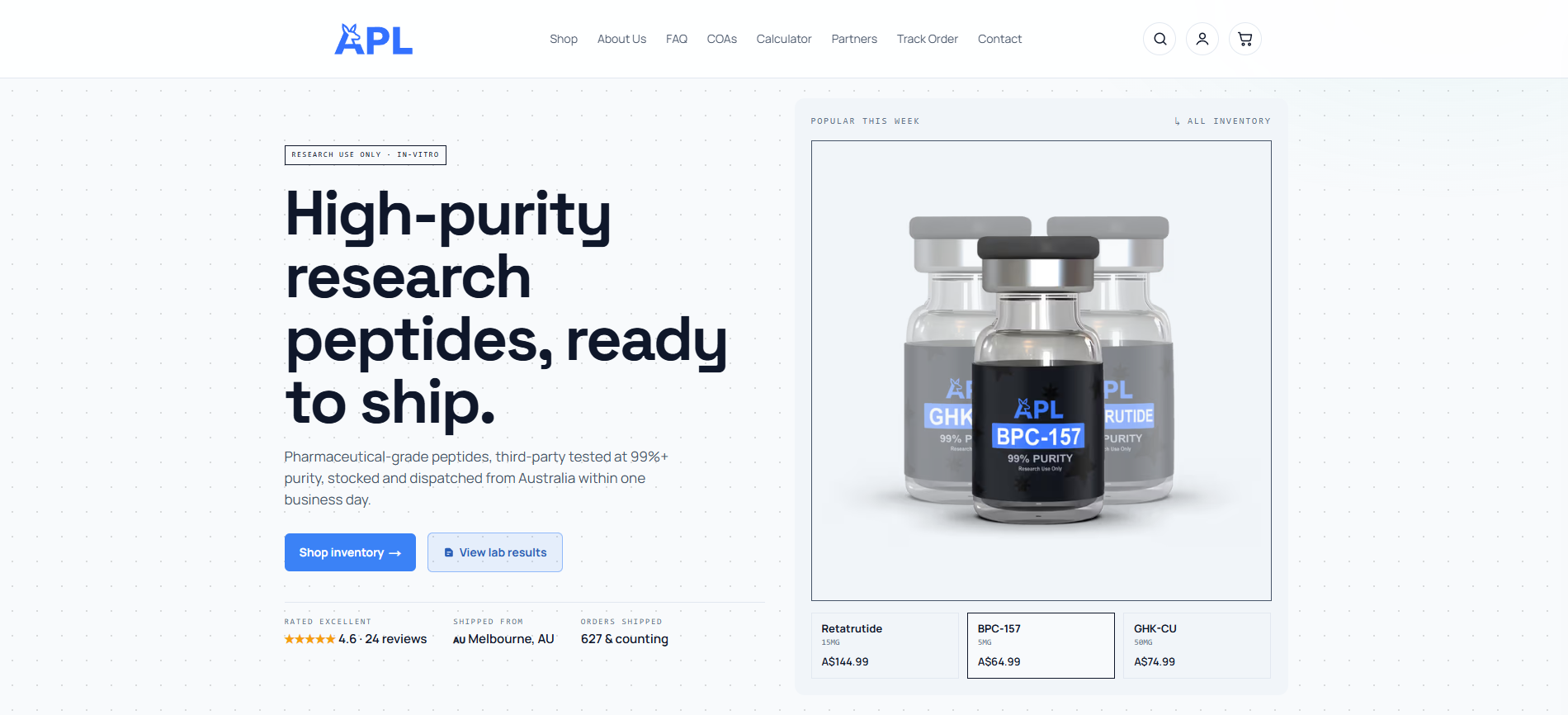
That matters most for labs running time-sensitive protocols where a customs hold can derail a week of scheduled work. Every order ships with HPLC, MS, and Certificate of Analysis documentation included, so purity claims arrive verified, not asserted. Aupeptidelabs also stocks supporting research supplies, insulin syringes, alcohol wipes, and bacteriostatic water, alongside custom and bulk peptide orders.
To get a comparable quote, send your sequence, target scale, and purity requirement through the Aupeptidelabs peptide ordering page and request HPLC and MS documentation upfront.