
Quarantine the affected lot immediately, preserve the time-stamped logger data, and compute mean kinetic temperature (MKT) before making any disposition decision. That sequence, grounded in USP General Chapter <1079.2> and ICH Q1A(R2) stability principles, is the minimum defensible response to any peptide temperature excursion in an Australian research laboratory. The Therapeutic Goods Administration (TGA) expects quality systems to capture and resolve such events with documented evidence. Aupeptidelabs is an available technical resource for Australian labs requiring COA access or lot-specific shipping records during investigations.
First-hour action checklist:
- Secure the affected product; do not distribute or consume any vials from the lot.
- Photograph packaging, coolant state, and any visible temperature indicators.
- Attach the logger file (or carrier temperature record) to the event file immediately.
- Label the lot "Quarantined — temperature excursion under investigation."
- Notify the quality lead or responsible researcher within the hour.
Orientation thresholds from USP <1079.2>:
- For controlled room temperature (CRT) excursions, use up to 30 days of prior temperature data when calculating MKT.
- For controlled cold temperature (CCT) excursions, use up to 24 hours of data for MKT evaluation.
- If the product label prohibits freezing and freeze evidence is present, proceed directly to discard consideration without calculating MKT.
What counts as a peptide temperature excursion?
A temperature excursion occurs when a product is exposed to conditions outside its labelled storage range for any duration, whether during transit, receiving, or in-facility storage. USP <659> and <1079.2> distinguish two primary storage categories relevant to research peptides:
- Controlled room temperature (CRT): typically 20–25°C, with excursions tolerated up to 15–30°C under defined conditions.
- Controlled cold temperature (CCT): typically 2–8°C refrigeration; excursions above 8°C or below 2°C both qualify.
- Freeze-thaw events: exposure below 0°C for products labelled "do not freeze." For many refrigerated peptides, a confirmed freeze event is a discard criterion, because ice-crystal formation can irreversibly alter tertiary structure and aggregation state.
This guide applies to research-use-only (RUO) and in-laboratory reference peptide lots in Australian laboratory settings. It is not clinical dispensing guidance. Common evidence types that establish an excursion include: continuous data logger records, chemical temperature indicators (e.g., colour-change strips), coolant pack state at receipt, carrier delay documentation, and visual inspection of packaging integrity.
Why temperature excursions alter peptide stability and assay outcomes
Even a short or modest warming event can accelerate chemical degradation pathways that directly affect measurable peptide attributes. Small temperature fluctuations can materially change degradation rates during stability studies, which means an excursion that appears minor on a timeline can translate to a meaningful purity loss by the time the lot reaches the assay.
The principal degradation pathways associated with temperature excursions and their analytical signatures include:
- Deamidation (asparagine and glutamine residues): produces mass shifts of +0.984 Da detectable by LC-MS and reduces HPLC purity.
- Oxidation (methionine, tryptophan, cysteine): adds +16 Da per oxidation event; alters receptor-binding selectivity and functional potency.
- Aggregation: soluble oligomers pass visual inspection but are detected by size-exclusion chromatography (SEC) or dynamic light scattering (DLS); aggregates reduce effective concentration and can confound dose-response curves.
- Hydrolysis of peptide bonds: generates truncated fragments visible as new peaks in HPLC and peptide mapping.
The risk is compounded for reconstituted material. The commonly cited 30-day refrigerated shelf life for reconstituted peptides is conditional on six factors: temperature, diluent or preservative, light exposure, concentration, pH or buffer, and container headspace. An excursion disrupts the temperature assumption and can compress that window substantially. Lyophilised product is more thermally resilient but is not immune, particularly to repeated or prolonged excursions above 25°C.
Stepwise evaluation workflow after a temperature excursion
The workflow moves from evidence preservation through MKT calculation to a documented disposition decision. No step should be skipped, because each creates the audit trail required by TGA-aligned quality systems.
- Preserve evidence. Secure the logger export, photographs, carrier records, and packaging in a dedicated event file before any further handling.
- Compute MKT. Use the formula in USP <1079.2> with the recorded time-temperature data (see the MKT section below for the worked example).
- Compare MKT with labelled storage conditions and available stability data. If MKT remains within the labelled range and duration is within the manufacturer's stated excursion allowance, document and proceed.
- Consult the manufacturer or COA. Contact the supplier for lot-specific stability data or written excursion allowances. Record the supplier's response verbatim in the event file.
- Decide on analytical testing. If MKT exceeds the labelled range, or if no lot-specific allowance is available, initiate the recommended test panel (HPLC, LC-MS, SEC/DLS, potency where applicable).
- Record the final disposition. Accept with notation, accept for non-critical assays only, maintain quarantine pending results, or discard. The responsible researcher or quality lead signs off.
Decision criteria at key nodes:
- Accept without testing only when a manufacturer-issued, lot-specific written allowance covers the recorded excursion duration and MKT.
- Discard immediately when freeze evidence is present on a "do not freeze" product, or when the excursion duration exceeds any documented stability allowance.
- Initiate testing when MKT is borderline, stability data are absent, or the lot is destined for a potency-sensitive assay.
How to calculate mean kinetic temperature (MKT)
MKT is the single calculated temperature that summarises cumulative thermal stress across a time-temperature history. USP <1079.2> accepts MKT for excursion evaluation when the product's degradation follows zero- or first-order kinetics over the encountered temperature range.
The MKT formula:
$$T_{MKT} = \frac{\Delta H / R}{-\ln\left(\frac{\sum_{i=1}^{n} e^{-\Delta H / R T_i}}{n}\right)}$$
Where:
- ΔH = heat of activation; USP default = 83,144 J·mol⁻¹ (83.144 kJ·mol⁻¹) USP General Chapter <1079.2> when product-specific data are unavailable.
- R = universal gas constant = 8.314 J·mol⁻¹·K⁻¹
- Tᵢ = each recorded temperature in Kelvin (°C + 273.15)
- n = number of equal time intervals
Kelvin conversion reminder: 5°C = 278.15 K; 25°C = 298.15 K.
Worked example (simplified, four intervals):
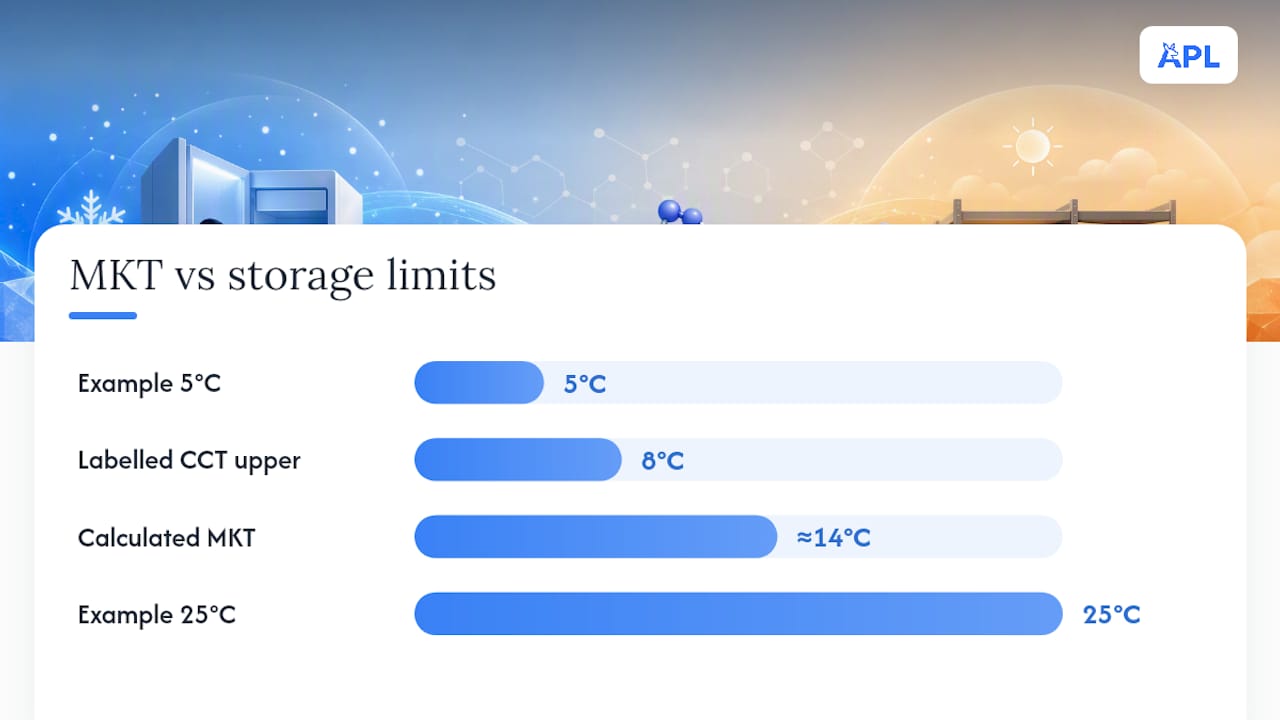
Mean of the four exponential terms ≈ 1.20 × 10⁻¹⁵. Applying the formula yields T_MKT ≈ 287 K (approximately 14°C). For a product labelled 2–8°C CCT, this MKT exceeds the upper limit, triggering analytical testing or discard consideration.
USP cautions that MKT must not be used to justify systems with repeated excursions; repeated events indicate a system out of control and require corrective action independent of any single MKT result.
Pro Tip: Before relying on MKT for a disposition decision, confirm that the peptide's degradation follows zero- or first-order kinetics across the temperature range encountered. If the product has no published kinetic data, treat MKT as indicative only and weight analytical test results more heavily.
Which analytical tests confirm peptide integrity after an excursion?
A targeted panel covering purity, mass integrity, aggregation state, and functional potency will detect most excursion-driven damage. The recommended analytical panel maps each technique to the integrity attribute it reveals:
| Test | Attribute measured | Excursion-relevant finding |
|---|---|---|
| HPLC (RP-HPLC) | Purity, degradation products | New peaks, reduced main peak area |
| LC-MS / peptide mapping | Mass shifts, modifications | Deamidation (+0.984 Da), oxidation (+16 Da) |
| SEC / DLS | Aggregation, oligomers | Elevated high-molecular-weight species |
| UV / amino acid analysis | Concentration | Confirms effective dose per vial |
| Potency / functional assay | Biological activity | Receptor binding or downstream signalling loss |
Sampling and chain-of-custody guidance:
- Retain a minimum of three vials from the affected lot for testing; hold additional vials in quarantine until results are received.
- Label each sample vial with lot number, excursion event reference, date, and analyst initials before transfer.
- Request the lot-specific COA and any available stability data from the supplier at the time of sampling.
- For third-party testing, document the chain of custody from quarantine storage to the external laboratory, including shipping conditions for the test samples themselves.
When the lot is destined for a potency-sensitive or selectivity-dependent assay, include a functional potency test even if HPLC purity appears acceptable. Invisible modifications such as methionine oxidation can preserve chromatographic purity while substantially reducing receptor-binding affinity. Interpreting purity versus net peptide content correctly is important when reviewing HPLC outputs after an excursion.
Monitoring, storage, and transport controls that prevent excursions

Continuous, time-stamped temperature monitoring combined with validated packaging is the minimum requirement for an auditable cold chain for peptides. An auditable cold chain comprises five documented processes: qualified packaging, validated refrigerant, continuous data-logger monitoring, written excursion handling procedures, and last-mile receiving control.
Core laboratory practices:
- Deploy calibrated data loggers recording temperature at intervals consistent with CDC monitoring practices, typically at least every 30 minutes.
- Conduct temperature mapping of all storage units at installation and after any significant maintenance or relocation.
- Maintain calibration records for all monitoring equipment with documented intervals.
- Require validated shippers with pre-conditioned coolant for all CCT shipments; request validation test reports from suppliers as part of procurement.
- Implement a documented receiving SOP that requires inspection of logger data and packaging condition before any product is moved to storage.
Supplier requirements to specify at procurement:
- Per-shipment logger file provided with each delivery.
- Written excursion SOP and defined response timeframes.
- Validated shipper qualification reports available on request.
Pro Tip: Treat last-mile receiving as a formal control point. Inspect the logger record and photograph the packaging before placing any vial into storage. Quarantine the entire shipment on any discrepancy and initiate the excursion workflow before the product enters the active inventory.
Corrective actions, disposition, and documentation after an excursion
Document the event completely, preserve all raw data, and follow a written disposition path. A structured excursion log with ranked evidence fields supports defensible accept, quarantine, or reject decisions when lot-specific stability data are unavailable.
Mandatory event file contents:
- Logger export (raw file, not a screenshot).
- Photographs of packaging, coolant state, and temperature indicators.
- COA for the affected lot.
- Carrier tracking timeline and any delay notifications.
- Supplier communication record (verbatim responses, dated).
- Analytical test results with laboratory report reference.
- Final disposition form with authorising signature and date.
- CAPA record if the event triggers corrective action.
Disposition categories and sign-off:
- Accept with notation: MKT within labelled range; manufacturer allowance confirmed in writing; no analytical anomalies.
- Accept for non-critical assays only: minor excursion; HPLC purity acceptable; potency assay not required for intended use.
- Quarantine pending testing: MKT borderline or no manufacturer allowance; awaiting analytical results.
- Discard: freeze event on "do not freeze" product; MKT exceeds any documented allowance; analytical results confirm degradation beyond specification.
Pro Tip: Initiate a CAPA whenever the same shipper, route, or supplier generates a second excursion event within any 90-day period. Repeated excursions indicate a systemic failure, and USP <1079.2> explicitly states MKT cannot be used to justify a system exhibiting repeated excursions.
Typical investigation timeline and cost drivers in Australia
A basic documentation review, covering logger data, COA, and supplier communication, typically resolves within 2–7 business days. When third-party analytical testing is required, the full investigation extends to 2–3 weeks, depending on laboratory turnaround and the complexity of the test panel requested.
Primary cost drivers:
- Analytical panel scope: HPLC alone is lower cost; adding LC-MS, SEC, and a potency assay increases both cost and turnaround time.
- Third-party laboratory turnaround: standard service versus expedited service carries a meaningful price differential at most Australian contract laboratories. Reviewing testing options available in Australia before committing to a single provider can reduce both cost and delay.
- Emergency replacement procurement: if the affected lot must be discarded, expedited re-supply from a local Australian supplier eliminates customs delays and reduces downtime.
- Validated shipper retesting: if the excursion is attributed to packaging failure, requalification of the shipper configuration adds cost and time.
- Staff hours for CAPA: systemic events requiring root-cause analysis and procedure revision represent a non-trivial internal cost.
Before committing to a full analytical panel, review the supplier's terms and conditions for excursion allowances and replacement policies. Some suppliers provide written lot-specific allowances that eliminate the need for third-party testing when the excursion is within defined parameters.
Australian regulatory and compliance requirements for excursion recordkeeping
Australian research laboratories should align their excursion SOPs to three primary references: ICH Q1A(R2) stability principles, USP <1079.2> for MKT evaluation, and TGA expectations for quality systems and record retention applicable to the laboratory's regulatory context.
Recordkeeping requirements:
- Retain raw logger files, COAs, shipment records, and disposition decisions for the duration of the study plus any institutional or regulatory retention period (commonly a minimum of five years for GLP-adjacent work; confirm with your institution's quality assurance policy).
- Supplier communication records and analytical reports form part of the event file and must be retained alongside the primary data.
- USP MKT is acceptable for excursion evaluation when kinetics assumptions hold; the manufacturer retains ultimate responsibility for labelled product disposition.
Practical compliance actions:
- Involve quality assurance in any disposition decision that deviates from the standard accept pathway.
- Notify the supplier in writing for any event where lot-specific disposition guidance is sought; retain the written response.
- Reference USP <1079.2> and ICH Q1A(R2) explicitly in your excursion SOP so auditors can trace the methodology used for MKT calculation and disposition criteria.
- Review TGA guidance on quality management systems for laboratories handling therapeutic goods or reference materials to confirm applicable record retention obligations.
Aupeptidelabs' perspective on supporting Australian labs after excursions
Aupeptidelabs provides Australian research laboratories with direct access to COAs, per-shipment records, and technical support when a temperature excursion requires investigation. The Peptide Dilution Calculator assists laboratories in determining working concentrations and sample volumes quickly, reducing the time required to prepare aliquots for analytical testing after an excursion event.
When an excursion is identified in a lot supplied by Aupeptidelabs, the technical team can provide lot-specific shipping history and available stability documentation to support the disposition decision. All products are dispatched from Australia within one business day, which means replacement procurement, when discard is the outcome, does not carry the customs delays associated with international supply.
Australian laboratories requiring lot documentation, COA access, or technical guidance on excursion evaluation are encouraged to contact Aupeptidelabs directly through Aupeptidelabs.
Sources
The following references underpin the MKT calculations, test panels, and cold-chain controls described in this guide. Attach raw logger files and COAs to every event file to ensure calculations and decisions are reproducible at audit.
- USP General Chapter <1079.2> Mean Kinetic Temperature in the Evaluation of Temperature Excursions During Storage and Transportation of Drug Products
- Peptide stability testing: temperature, humidity and storage requirements explained
- Reconstituted peptide shelf life factors
- Cold Chain Integrity for Peptide Injectables 2026
- Peptide temperature excursion log for Canadian research buyers
- Peptide storage & stability: how to keep your peptides potent | PeptIQ Blog