
You can largely avoid peptide stockouts by combining conservative forecasting, safety stock on critical SKUs, qualified backup suppliers and strict cold-chain controls. That combination costs slightly more in carrying inventory, but it converts a supply disruption into a rounding error instead of a stalled protocol. The checklist and forecasting model below give you the mechanics to put this into practice this week.
What to do this week to avoid peptide stockouts
If a critical peptide is already running low, or you suspect it will be soon, run this sequence before doing anything else.
- Audit on-hand stock, open orders and lead times. Record current units per SKU, quantity on order, expected arrival date and the supplier's quoted versus historical lead time.
- Raise reorder points on critical SKUs temporarily. For anything tied to an active protocol, place an emergency order now rather than waiting for the scheduled cycle.
- Call secondary carriers and confirm expedited cold-chain options. Confirm they can meet your temperature requirements, not just your delivery date.
- Suspend non-essential orders and reshuffle low-priority experiments. Free up budget and freezer space for the SKUs that matter.
Pro Tip: Keep a single shared spreadsheet or inventory system tab labelled "critical SKUs" with reorder points already calculated, so a stockout scare doesn't turn into an afternoon of frantic maths.
This audit takes under an hour per SKU category and typically reveals that the real problem isn't total stock, it's stock sitting in the wrong location or on order with a supplier who's already missed a date.
Why do peptide stockouts happen in the first place?
Most peptide stockouts trace back to one of five failure modes, often stacked on top of each other.
- Forecasting error on small-batch SKUs. Low-volume peptides have lumpy demand, so a single large order can look like a trend when it's actually noise.
- Single-source dependency. One supplier, one lead time, one point of failure. When peptide API supply chains face lead times that double or triple during disruption periods, a single-source lab has no fallback.
- Cold-chain and temperature-excursion losses. A batch can arrive on time and still be unusable if it spent too long outside its validated range, which industry reporting flags as a primary cause of product loss even when units technically shipped.
- Inventory inaccuracy. Spreadsheets that haven't been reconciled against physical counts drift silently until a reorder trigger fires too late.
- Regulatory and import documentation gaps. Missing paperwork at a border checkpoint can add days a forecast never accounted for.
Diagnosing which of these applies to your lab matters more than adopting a generic fix. A lab losing stock to freight delays needs a different response to one losing stock to temperature excursions.
How do you calculate a reorder point that actually prevents stockouts?
A 90-day rolling forecast gives you a defensible number instead of a gut feeling, and it's simple enough to run in a spreadsheet.
Start by tracking trailing 30, 60 and 90-day usage per SKU. The 90-day rolling model recommended for practitioner-scale peptide inventory smooths out the lumpiness of small-batch demand while still catching genuine shifts in usage, which a 12-month average would hide for too long.
- Calculate average daily usage from the trailing 90-day window, weighted toward the most recent 30 days if usage is trending up.
- Determine lead time using the supplier's 75th to 90th percentile, not their average. Suppliers rarely publish this number, so pull it from your own order history.
- Set reorder point as average daily usage multiplied by lead-time days, plus safety stock.
- Add safety stock based on volatility: stable SKUs need roughly one to two weeks of cover, volatile or single-source SKUs need three to four weeks.
Using that conservative lead-time percentile trades a modest increase in carrying cost for a material reduction in stockout frequency, which is the trade-off almost every procurement lead underweights when they first build a reorder model on averages.
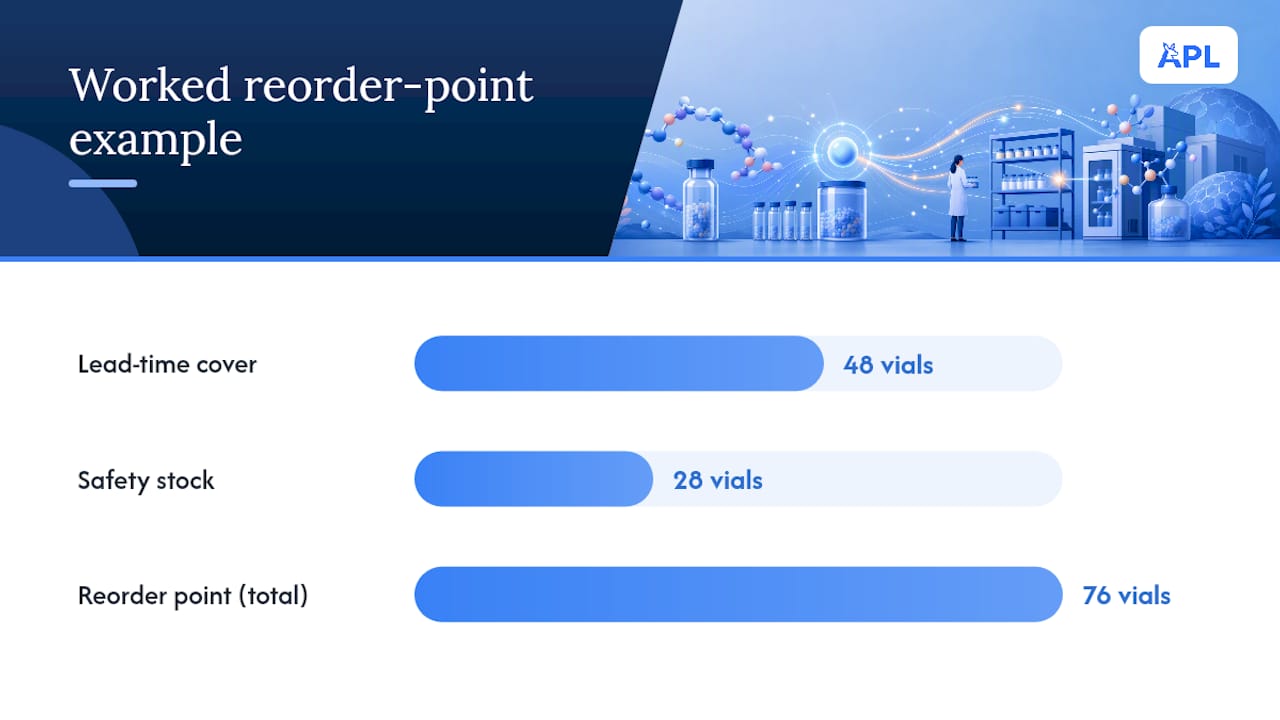
Worked example: A peptide with average daily usage of 4 vials, a 90th-percentile lead time of 12 days, and moderate volatility needs a reorder point of roughly 48 vials plus 7 days of safety stock (28 vials), landing near 76 vials. For a brand-new SKU with no usage history, skip the formula and negotiate a larger standing order against the minimum order quantity instead, reviewing it after the first 90 days of real data.
None of this works if the count you're forecasting from is wrong. Weekly physical counts and inventory accuracy above 95% are the floor below which even a well-built reorder formula fails, because it's calculating against numbers that don't reflect what's actually on the shelf.

How many peptide suppliers should a lab qualify?
One supplier is a liability, no matter how reliable they've been. A tiered sourcing model, primary, approved secondary and emergency tertiary, gives you a documented fallback for every critical SKU rather than a scramble when the primary supplier misses a date.
- Qualify backups properly, not just on paper: request sample batches, check certificates of analysis against your own testing, and run a small periodic order to keep the relationship live.
- Document each tier with its own lead-time history, minimum order quantity and quality track record, reviewed at least twice a year.
- Request lead-time SLAs and allocation clauses in supplier contracts, including a notification window if their delivery estimate changes.
- Consider regionalising sourcing for your highest-value SKUs. Sourcing closer to your own market reduces exposure to geopolitical and shipping shocks, even at a slightly higher unit cost.
Qualifying a genuine secondary source, one that could actually step in during a disruption rather than just existing on a vendor list, typically takes six to eighteen months. Start that process before you need it, not after your primary supplier misses a shipment. A checklist for verifying manufacturers before committing to a new source is worth running against every candidate, backup or otherwise.
Pro Tip: Run a small qualification batch from every secondary supplier once a year, even if you never order from them otherwise. It keeps their lead-time estimate accurate and their COA process current, so they're actually ready when you need them, not just approved on paper.
Which cold-chain controls actually stop batch loss?
A shipment that arrives late is annoying. A shipment that arrives on time but has spent six hours above its validated temperature range is a stockout you haven't noticed yet, because the units exist but can't be used.
- Validate storage ranges per peptide and treat any excursion beyond the manufacturer's stated window as a quarantine trigger, not a judgement call at the bench.
- Use continuous data loggers on temperature-sensitive shipments, not spot checks at delivery, so you have a full transit record rather than a single reading.
- Quarantine on receipt until the certificate of analysis is matched, the packaging is visually inspected, and any logger data is reviewed.
- Choose packaging that reduces thermal risk, particularly for longer transit legs where ambient temperature swings are more likely.
| Excursion duration | Typical action |
|---|---|
| Under 1 hour, within buffer range | Log and release, no quarantine needed |
| 1 to 4 hours, above validated range | Quarantine, request stability data before use |
| Over 4 hours or repeated excursions | Reject batch, escalate to supplier |
Reviewing packaging materials suited to your climate and transit times is worth doing before your next bulk order, not after a batch fails inspection.
What should a lab's shortage response plan look like?
The European Medicines Agency's guidance on shortage prevention plans sets out a useful structure even for labs well outside its direct jurisdiction: classify the risk, hold safety stock proportionate to that risk, and monitor continuously rather than reactively.
- Classify the shortage risk. High risk means a single-source SKU underpinning an active protocol with no substitute. Medium risk means a backup exists but is untested. Low risk means multiple qualified suppliers and modest safety stock already in place.
- Reallocate remaining stock to active, funded projects first, and communicate expected delays to affected teams immediately rather than after the fact.
- Identify and validate substitutes carefully. Any alternative peptide or compounding option needs the same COA and purity verification as your primary source before it enters a protocol.
- Run a supplier escalation checklist after every incident: what caused the delay, what warning signs were missed, and what changes to reorder points or supplier tiers prevent a repeat.
Treating this as a live document rather than a filed-away policy is what separates labs that recover in days from labs that recover in months.
Au Peptide Labs: reducing stockout risk for your lab
Every control above depends on a supplier that behaves predictably, and that's the operational gap Au Peptide Labs is built to close. Dispatch happens from Australia within one business day, which removes the customs delay that turns a two-week lead time into a five-week guessing game, and packaging is discreet for labs that need it. A 4.6/5 satisfaction rating from verified reviews reflects consistency across repeat orders, the same consistency your reorder-point formula assumes when calculating lead-time percentiles. For labs building a tiered sourcing model, Au Peptide Labs functions well as either a primary or a qualified secondary supplier, depending on your existing arrangements.
Which lever should procurement move first?
Forecasting discipline and supplier backups come before expanding inventory, and most labs get this order backwards. Buying more stock without fixing a broken reorder formula just delays the same stockout by a few weeks.
Cold-chain visibility and weekly physical counts protect the inventory you already have, and they're cheaper to fix than most procurement teams assume, a data logger and a Friday afternoon count sheet, not a system overhaul. Monthly cross-team reviews between procurement and the researchers actually placing orders catch demand shifts before they become emergencies. The labs that avoid stockouts consistently aren't the ones with the biggest freezers. They're the ones with the tightest feedback loop between usage data and reorder decisions.
— Dr. Authur
Ready to lock in reliable peptide supply?
Every control in this article, forecasting, safety stock, backup suppliers, cold-chain discipline, works better when your primary supplier isn't the weak link you're planning around. Au Peptide Labs dispatches pharmaceutical-grade research peptides from Australia within one business day, with third-party certificates of analysis available for every batch and discreet packaging as standard.
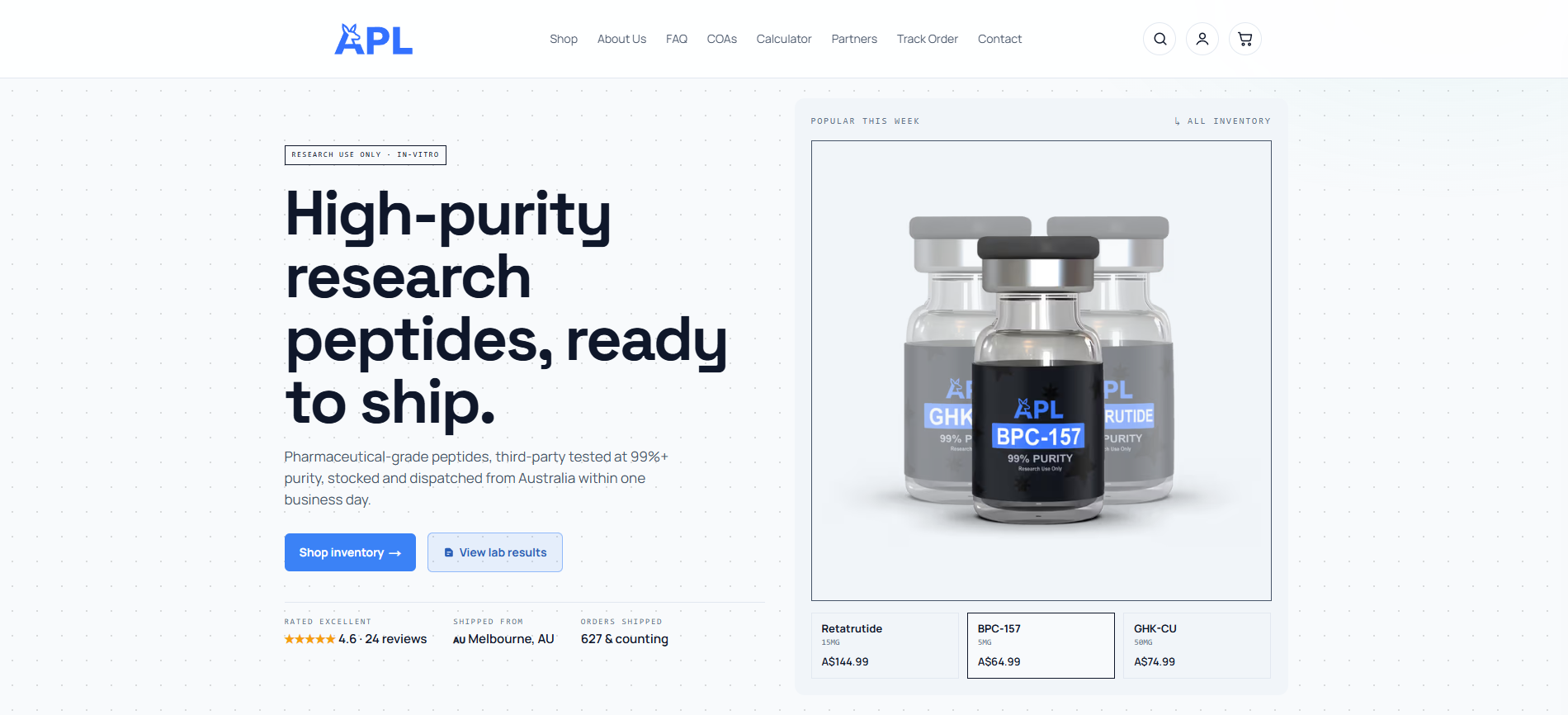
For labs setting up a tiered sourcing model, that same-day dispatch window makes Au Peptide Labs a practical primary or secondary supplier rather than a fallback you hope you never need. Bulk fulfilment and standing order arrangements are available for labs that want to lock in reorder points against a known lead time instead of a variable one. Browse the current range of research peptides and pull the certificates of analysis for any SKU you're qualifying before your next order goes in.
Sources
- Building a Resilient Global Peptide Supply Chain in 2026 | PeptideStaff
- Inventory forecasting for research peptide practices | YPB