
Preventing peptide aggregation starts before the first coupling reaction: run a composition check (an amino acid composition–vector model where available), then layer in pseudoproline or backbone-protection chemistry during solid-phase peptide synthesis, add a surfactant and lyoprotectant at formulation, and keep every solution at least one pH unit from the peptide's isoelectric point. Each layer catches failures the previous one misses. A supplier of high-purity starting material provides the foundation this whole chain depends on, but the sequence itself, tested against a composition-vector model, is where prevention actually begins.
Which peptide aggregation prevention strategy should you try first?
The right first move depends on where the aggregation is showing up. A cloudy coupling during solid-phase peptide synthesis needs a different fix from a lyophilised vial that turns turbid on reconstitution six months into storage. Treat the following as an escalation ladder, not a menu to work through in order.
Design stage (before synthesis begins):
- Run the sequence through a composition-vector or machine-learning aggregation predictor if one is accessible; this is a high-impact, low-cost check that flags problem residues before you spend reagent on a doomed synthesis, per the validation reported for the Nature Chemistry composition-vector study.
- Flag stretches of three or more consecutive hydrophobic or beta-sheet-prone residues; these are the usual aggregation seeds during chain elongation.
Synthesis stage (SPPS in progress):
- Insert pseudoproline dipeptides at predicted aggregation hotspots. High impact, strong evidence: this single substitution lifted crude purity from 23% to 69% for human growth hormone fragments and from 17% to 75% for GB1 in experimental validation.
- Switch to a low-loading or PEG-based resin if pseudoprolines alone don't resolve a sluggish coupling. Medium impact, moderate evidence.
- Add a chaotropic salt (for example, sodium perchlorate) or shift the solvent ratio toward more polar mixes. Medium impact, situational.
Formulation stage (moving to solution or dried product):
- Add a surfactant such as polysorbate 20 at a low percentage to protect against interface-nucleated aggregation. Medium impact, well documented, but watch assay interference at higher concentrations.
- Include a lyoprotectant (trehalose, sucrose, or mannitol) before freeze-drying. Medium to high impact for anything going through a freeze–thaw cycle.
Handling stage (day-to-day lab work):
- Keep working concentrations below the peptide's apparent critical aggregation concentration and avoid vortexing on reconstitution. Low cost, consistently useful.
Escalate to a sequence change only when formulation and process fixes plateau, or when the end application demands a structural fix such as extended plasma half-life. Reach for formulation first: it's reversible, fast to test, and doesn't touch the biology.
Why does sequence composition drive aggregation during SPPS?
Composition, not just contiguous sequence, is turning out to be the dominant predictor of aggregation risk during solid-phase peptide synthesis. A 2026 study trained an ensemble of 100 XGBoost classifiers on inline UV–vis deprotection data from automated fast-flow synthesis, then used amino acid composition vectors, rather than exact sequence order, to predict which peptides would aggregate on-resin. The model successfully flagged high-risk syntheses and recommended pseudoproline substitutions, and when researchers applied the model's suggested substitution, crude purity for a difficult hGH fragment jumped from 23% to 69%, and for a GB1 domain fragment from 17% to 75%, in the same validation work.
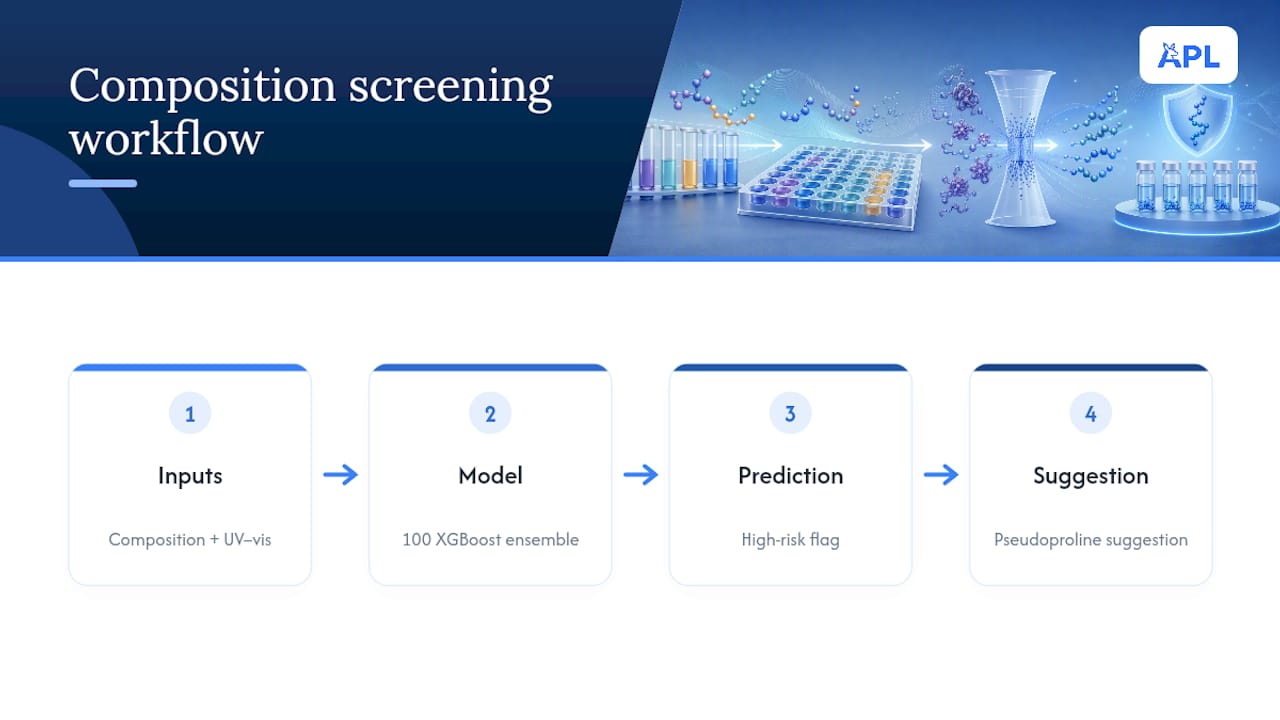
That composition-first framing matters practically: two peptides with identical hydrophobic residue counts but different sequence order can show similar aggregation propensity, which means you can screen risk using composition alone before you've finalised exact residue order. It also explains why swapping a single residue rarely fixes chronic on-resin aggregation. The problem usually lives in a stretch of residues, not one position, and inline deprotection UV–vis traces during automated fast-flow synthesis correlate with these aggregation events in real time, giving both a training signal for prediction models and an immediate diagnostic for whatever difficult coupling you're staring at right now.
Stepwise SPPS tactics that address composition-driven aggregation
- Screen the sequence first. Run it through a composition-vector model if you have access to one, or at minimum map hydrophobicity, aromatic content, and beta-sheet propensity across the chain manually.
- Insert pseudoproline dipeptides at flagged positions. These masked serine, threonine, or cysteine residues disrupt secondary structure formation during elongation and are cleaved back to the native residue during final trifluoroacetic acid treatment, so the finished peptide is unaffected.
- Consider Dmb or Hmb backbone protection for sequences where pseudoprolines aren't chemically compatible (positions lacking Ser/Thr/Cys). These N-alkylated backbone protecting groups work on a similar principle, disrupting hydrogen-bonded aggregate formation during synthesis, and are removed on cleavage.
- Switch to a low-loading or PEG-based resin if aggregation persists despite backbone protection. Lower substitution density gives each growing chain more physical space, reducing chain-to-chain contact.
- Adjust the solvent system. Shifting toward DMF/NMP mixes with added chaotropic salts (sodium perchlorate is a common choice) or introducing more polar co-solvents can disrupt the hydrophobic collapse that drives on-resin aggregation.
- Move to in situ neutralisation Boc chemistry or microwave-assisted coupling for particularly stubborn stretches; both approaches shorten exposure time at aggregation-prone stages of the synthesis.
- Sonicate briefly between coupling cycles if swelling appears uneven, and consider a modest temperature ramp (typically to 50 to 60 degrees Celsius for microwave-assisted synthesis) to improve resin swelling and reagent access without degrading sensitive residues.
These interventions target long-range aggregation that spans several residues, and pseudoprolines or Dmb/Hmb surrogates are restored to native residues on final cleavage, which makes them minimally invasive for downstream biological activity, per the technical guidance on overcoming SPPS aggregation.
Pro Tip: Before redesigning a stubborn sequence from scratch, check whether your synthesiser logs deprotection UV–vis traces. A sudden drop in absorbance intensity partway through elongation is often your earliest warning of aggregation, well before the crude HPLC trace confirms it.
What formulation excipients actually reduce peptide aggregation?
Excipient choice depends on whether the peptide sits in aqueous solution, is heading into a freeze-dryer, or needs to survive both. Three excipient classes cover most practical cases: lyoprotectants, surfactants, and co-solvents, each working through a different mechanism.
Lyoprotectants such as trehalose, sucrose, and mannitol work through preferential exclusion: the sugar is thermodynamically excluded from the peptide's immediate hydration shell, which favours the compact, folded monomeric state over aggregation-prone extended conformations during freeze concentration. This mechanism is well supported in the Pharmaceutics formulation review, which also notes that excipient choice affects the glass transition temperature of the dried cake, a critical variable for storage stability.
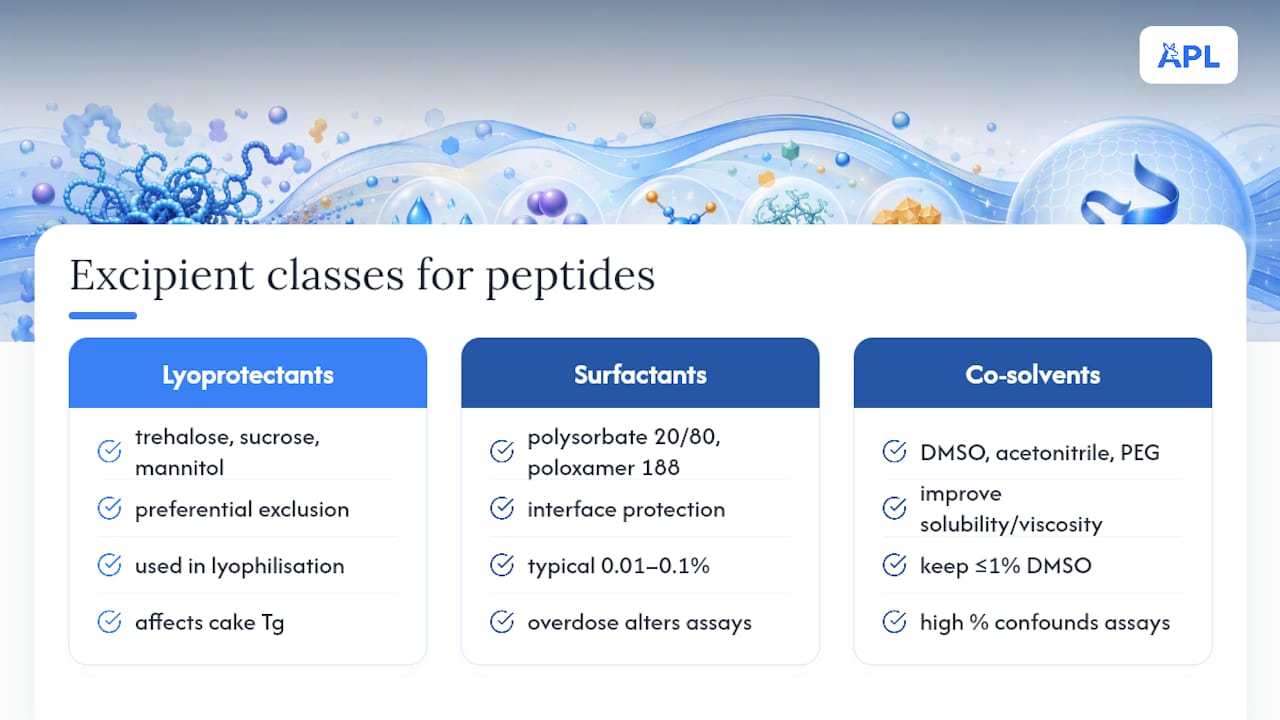
Surfactants including polysorbate 20, polysorbate 80, and poloxamer 188 protect against interface-nucleated aggregation, the kind that starts at the air-liquid interface during shaking, filtration, or filling. They're effective at very low concentrations, typically in the range of 0.01% to 0.1%, but overdosing can distort downstream assay readings or even perturb peptide conformation itself, so titrate rather than assume more is better.
Co-solvents and viscosity enhancers, such as small percentages of DMSO or acetonitrile, or the addition of PEG as a viscosifier, buy stability by improving solubility or slowing molecular collision rates. A useful working range is a low percentage v/v co-solvent addition, high enough to aid solubility, low enough to avoid interfering with cell-based or enzymatic assays downstream. Anything above roughly 1% DMSO starts showing up as a confound in many bioassay formats, so document the exact percentage used and control for it.
Statistic callout: Applying an ML-recommended pseudoproline substitution during synthesis, upstream of formulation entirely, raised crude peptide purity from 23% to 69% for one hGH-derived sequence and from 17% to 75% for a GB1 fragment in validated experiments. Formulation excipients manage aggregation risk downstream; composition screening prevents a share of it from ever reaching the bench.
For lyophilisation specifically, three variables decide whether you get a stable cake or a collapsed, hygroscopic mess: excipient selection (see above), the glass transition temperature of the formulation relative to your primary drying shelf temperature, and residual moisture content in the finished cake. Most peptide lyophilisates target a residual moisture content low enough to limit hydrolytic and aggregation reactions during storage, though the exact target depends on the specific peptide and excipient system. A practical guide to peptide hygroscopicity covers how residual moisture interacts with storage stability in more depth, and the choice between lyophilised and liquid formats is worth revisiting for any peptide showing marginal solution stability, a decision covered in this comparison of lyophilised versus liquid peptide formats.
How do pH, concentration, and handling affect aggregation risk?
Process controls catch the aggregation that composition screening and formulation excipients don't. These are the variables you control every single time you open a vial, and getting them wrong undoes good synthesis and formulation work in minutes.
- Keep solution pH at least one full pH unit away from the peptide's isoelectric point (pI). Near the pI, net charge approaches zero, electrostatic repulsion between molecules drops, and aggregation risk climbs sharply. Check pI using standard prediction tools before choosing a buffer, and adjust ionic strength cautiously. Some salt stabilises charged peptides through screening effects, but high ionic strength can also promote aggregation in borderline sequences, so treat this as a variable to test empirically, not assume.
- Respect the critical aggregation concentration (CAC). Most peptides show a concentration threshold above which self-association accelerates disproportionately. Prepare concentrated stocks only when necessary, and dilute to dilute working concentrations for anything that will sit at bench temperature for extended periods.
- Aliquot before you freeze, and never refreeze a thawed working stock. Repeated freeze-thaw cycles concentrate peptide at ice-water interfaces during freezing and mechanically stress it during thaw. This is one of the most common, and most avoidable, causes of aggregation in stored peptide stock.
- Avoid vortexing during reconstitution. Add solvent slowly down the vial wall, then use a gentle swirl rather than vigorous mixing, and let the peptide rest for 15 to 30 minutes to fully dissolve before use. Vortexing introduces air-liquid interfaces exactly where interface-nucleated aggregation starts.
- Choose low-protein-binding filters and pre-wet them before filtering peptide solution. Standard cellulose filters can adsorb peptide at their surface and nucleate aggregation at that interface; low-binding PVDF or PTFE membranes reduce this loss. The same logic applies to storage containers: glass and certain polypropylene formulations reduce interface-driven aggregation compared with untreated plastics.
These recommendations echo the mechanistic drivers summarised across sequence, concentration, pH, excipients, surface interactions, and physical stress in the PMC review of peptide physical stability factors. For hydrophobic peptides specifically, reconstitution problems compound quickly, and a dedicated guide to hydrophobic peptide solubilisation is worth consulting before you assume a peptide has aggregated when it may simply be poorly dissolved. Broader solubility troubleshooting is covered in this guide to peptide solubility.
Which assay should you run to detect peptide aggregation?
No single assay tells the whole story, so the practical answer is to run a cheap screen first and confirm with orthogonal methods before committing to a mitigation strategy.
- Dynamic light scattering (DLS) gives a fast size distribution readout from a small solution volume and flags the presence of larger species, but it's biased toward detecting larger particles and won't distinguish soluble oligomers from monomer reliably.
- Size-exclusion chromatography (SEC), particularly high-performance SEC, separates monomer from soluble aggregates quantitatively and is the workhorse assay for routine batch-to-batch QC.
- Analytical ultracentrifugation resolves subtle oligomeric states and molecular weight distributions with high precision, though it's slower and more instrument-intensive than SEC, making it better suited to characterisation work than routine screening.
- Transmission electron microscopy (TEM) reveals aggregate morphology directly, distinguishing amorphous clumps from ordered fibrillar structures, which matters because the two often respond to different mitigation strategies.
- ANS fluorescence assays detect exposed hydrophobic surfaces, a hallmark of partially unfolded or aggregation-prone conformations, and work well as an early kinetic screen before aggregates become visible by other methods.
- Inline UV–vis deprotection monitoring during SPPS flags aggregation-driven coupling failures in real time, before the peptide ever leaves the resin, and is the same data type used to train composition-vector prediction models.
A practical development workflow runs DLS and SEC as an initial screen on any new batch, confirms suspicious results with TEM or ANS fluorescence for mechanistic detail, then locks in SEC and DLS as routine QC once the formulation is set. This staged approach, moving from broad screen to targeted confirmation to routine monitoring, mirrors the mitigation logic across sequence, concentration, and handling factors detailed in the PMC stability review.
When do lipidization, stapling, or D-amino acids make sense?
Design-level modifications solve aggregation permanently, but they alter the molecule, so they're not a first response. They earn their place when formulation and process controls have plateaued, or when the therapeutic goal (extended half-life, protease resistance) demands a structural fix anyway.
- Lipidization attaches a fatty acid or lipid chain to the peptide backbone, which promotes albumin binding in vivo and reduces intermolecular peptide-peptide contact, both extending half-life and lowering aggregation propensity, as summarised in a 2023 review of lipidization and delivery strategies. The trade-off is added synthetic complexity and a real risk of altering receptor binding if the lipid tail interferes with the pharmacophore.
- Hydrocarbon stapling locks a peptide segment into a stable alpha-helical conformation using a synthetic hydrocarbon crosslink. This increases protease resistance and can reduce aggregation by removing the conformational flexibility that drives beta-sheet formation, though stapling reagents and purification add cost and the staple itself can occasionally reduce target binding affinity, a trade-off discussed in the review on peptide stabilisation strategies.
- D-amino acid substitution and retro-inverso peptides swap L-amino acids for their D-enantiomers, either at select positions or across the whole backbone reversed in sequence. This confers strong resistance to proteolytic degradation and can reduce aggregation by disrupting native beta-sheet packing, but it frequently costs some biological activity, since many receptor interactions are stereospecific. Test activity retention early rather than assuming the swap is neutral.
Peptides engineered with a defined balance of flexible, aliphatic, and aromatic residues within typical moderate ranges, and a hydrophobicity-to-hydrophilicity ratio near 1, inhibited both amorphous and fibrillar aggregation pathways in the same experimental system, based on peptide inhibitor design work published in Chemistry – A European Journal. That composition rule is worth keeping in mind if you're designing an aggregation-resistant sequence from scratch rather than retrofitting an existing one.
Pro Tip: Reserve sequence redesign, lipidization, and stapling for cases where formulation and process fixes have genuinely failed, or where the clinical application demands the structural benefit regardless. Reversing a design decision costs a resynthesis; reversing a formulation decision costs an afternoon. This mirrors a broader distinction covered in this comparison of peptides versus small molecules in drug discovery, where structural modification trade-offs come up repeatedly.
A lab-ready checklist for preventing peptide aggregation
Work through this sequence when you're troubleshooting a live aggregation problem rather than designing from a blank page:
- Confirm aggregation is actually occurring. Run DLS or SEC before assuming a cloudy or low-yield sample is aggregated; poor solubility looks similar but needs a different fix.
- Try quick, reversible fixes first. Shift pH at least one unit from the pI, add a low percentage of DMSO as co-solvent, or introduce 0.01% polysorbate to the buffer.
- If the problem originates during synthesis, feed the sequence through a composition-vector model and apply the recommended pseudoproline substitutions at flagged positions.
- If aqueous stability is still marginal, move to formulation: add a lyoprotectant ahead of lyophilisation, and lock in a surfactant concentration through a short titration.
- Source high-purity starting material. Aggregation troubleshooting is far harder when the input peptide already carries impurity-driven heterogeneity, which is where consistent, verified purity from a supplier like Aupeptidelabs removes a variable before you've even started.
Reliable supply matters here too: a sequence-level fix is only as good as the batch you're testing it on, and maintaining consistent stock is covered in this guide to forecasting peptide supply for research labs.
What the composition-vector data actually changes for researchers
The conventional advice on peptide aggregation has always centred on sequence, spot the hydrophobic stretch, redesign around it. That framing isn't wrong, but it's incomplete, and the composition-vector findings expose the gap directly. Aggregation risk tracks with the overall balance of residue types across a peptide more reliably than with exact positional order in many cases. That reframes the whole diagnostic process: instead of scanning a sequence by eye for suspicious stretches, run the composition through a model first, then verify with inline synthesis data if it's available.
What's overrated is treating design modifications like stapling or lipidization as default solutions. They're powerful, but they're also irreversible commitments to a specific molecular structure. Most aggregation problems resolve with a pseudoproline substitution, a surfactant, or a pH adjustment, all reversible, all testable in an afternoon. Save structural redesign for when the biology genuinely demands it.
What researchers should prioritise first is upstream screening. A composition check before synthesis begins costs nothing and prevents downstream waste that no amount of formulation cleverness can fully recover.
— Dr. Authur
Sources
- Amino acid composition drives aggregation during peptide synthesis | Nature Chemistry
- A peptide strategy for inhibiting different protein aggregation pathways
- Designing formulation strategies for enhanced stability of therapeutic peptides in aqueous solutions — Pharmaceutics review
FAQ
How do you prevent peptide aggregation?
Screen sequence composition before synthesis, apply pseudoproline or backbone-protecting substitutions during solid-phase synthesis, then add a surfactant and lyoprotectant at formulation while keeping pH at least one unit from the pI. Escalate to structural redesign only if these layers don't resolve the problem.
What is peptide aggregation?
Peptide aggregation is the self-association of peptide molecules into larger, often insoluble structures, ranging from amorphous clumps to ordered fibrils, driven by sequence composition, concentration, pH, and interface exposure during synthesis, formulation, or storage.
Can peptide aggregation be reversed?
Some aggregation is reversible, particularly early-stage, non-fibrillar aggregates formed near the pI or at high concentration, and gentle dilution, pH adjustment, or mild heating can sometimes restore monomer. Mature fibrillar aggregates are generally far harder to redissolve and often require prevention rather than reversal as the practical strategy.
How can I reduce protein and peptide aggregation in the lab?
Keep concentrations below the critical aggregation concentration, avoid freeze-thaw cycles and vortexing, use low-protein-binding filters, and add a surfactant at a low percentage such as 0.01% polysorbate to protect against interface-nucleated aggregation during handling.
Which assay should I run first to check for aggregation?
Run dynamic light scattering or size-exclusion chromatography as an initial screen. Both give a fast readout of size distribution or aggregate presence, and results that look suspicious can then be confirmed with TEM or ANS fluorescence for mechanistic detail.