
For most hydrophobic research peptides, dissolve a small aliquot in a minimal volume of DMSO, or another compatible organic solvent where DMSO is contraindicated, then dilute it dropwise into assay buffer. Before starting, check the sequence for cysteine or methionine residues, since both are unstable in DMSO, and confirm your assay tolerates the organic co-solvent load. If solvent-based dissolution fails after a genuine attempt, stop guessing and plan for solubilising tags or chaotropes rather than repeatedly adding more solvent to a sample that has already gone cloudy.
Which solvents and additives work for hydrophobic peptide solubilization?
Hydrophobic interactions between peptide side chains are what defeat aqueous dissolution in the first place, and the standard fix is a strong organic solvent that can disrupt those interactions before the peptide ever meets buffer. Supplier technical guidance consistently ranks three solvents as the first line for solubility guidelines on difficult sequences: DMSO, DMF, and acetonitrile.
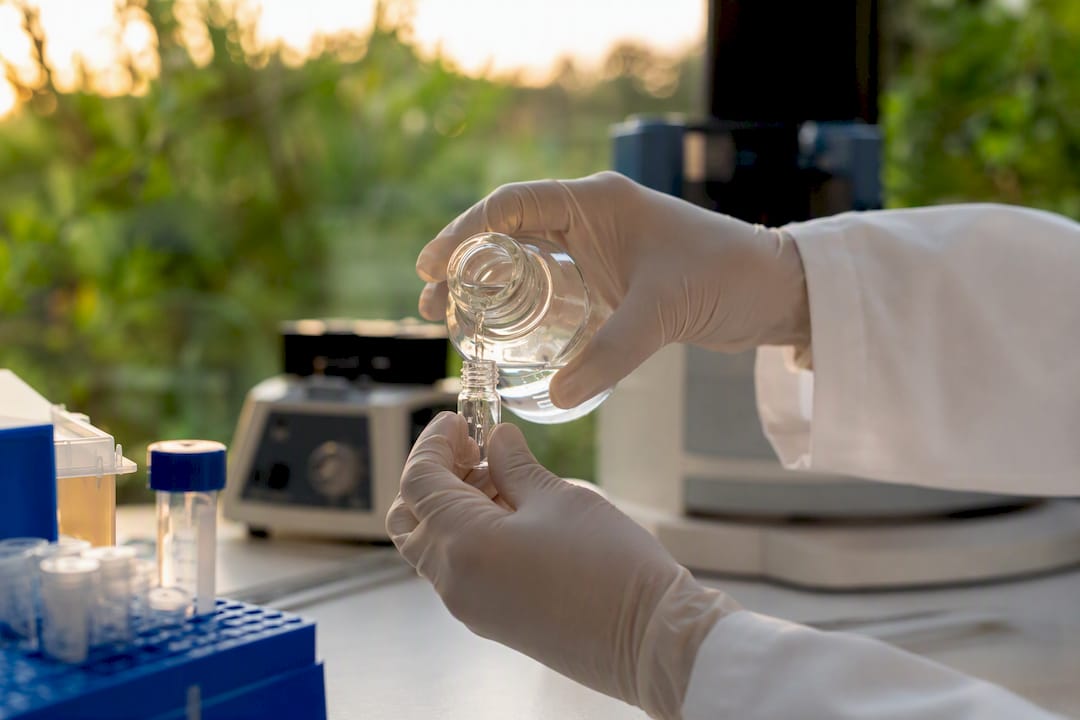
DMSO is the default starting point for bench stocks because it dissolves a broad range of hydrophobic sequences and is not volatile, which suits samples you'll hold at the bench for hours. Acetonitrile is the better choice when the stock is headed for HPLC or mass spectrometry, since its volatility means it won't contaminate downstream analytical runs the way DMSO can. DMF sits between the two in polarity and is worth trying when DMSO alone leaves visible turbidity.
When these three solvents don't fully clear the sample, fluorinated alcohols become the next escalation. Trifluoroethanol (TFE) and hexafluoroisopropanol (HFIP) are reported to solubilise extremely hydrophobic peptides that resist DMSO, DMF, and acetonitrile outright, and HFIP in particular has been used successfully as a co-solvent in desulfurization and native chemical ligation workflows where solubility failure would otherwise stall the synthesis.
Beyond pure solvents, several additive classes disrupt aggregation by different mechanisms:
- Chaotropes (guanidine hydrochloride, urea): used at low to moderate concentrations, these disrupt hydrophobic networks and hydrogen bonding that hold aggregates together, though they must be dialysed or diluted out before most functional assays.
- Nonionic detergents (Tween 20, Tween 80, octyl glucoside): these shield hydrophobic patches from water and prevent aggregation during handling, but many bioassays are sensitive to even trace detergent and will need a detergent-free control.
- Zwitterionic detergents (DPC and similar): useful when you need a membrane-mimetic environment, particularly for peptides derived from transmembrane domains.
- Fluorinated alcohols (TFE, HFIP): effective for the most resistant sequences but volatile and often incompatible with cell-based assays at meaningful concentrations.
Volatility also matters for material choice: DMSO will slowly attack some plastics over long storage, and acetonitrile evaporates fast enough to concentrate a stock unexpectedly if left uncapped on the bench.
How do you dissolve a hydrophobic lyophilised peptide step by step?
Before you touch a solvent, look at the sequence itself. Calculating the grand average of hydropathy (GRAVY score), isoelectric point (pI) and net charge at your working pH takes a few minutes and reliably points you toward the right starting solvent. A peptide with a strongly positive GRAVY score and few charged residues is a strong candidate for DMSO or DMF from the outset; a sequence closer to neutral with some charged residues might dissolve in a dilute acid or base before you need an organic solvent at all.
Supplier protocols consistently recommend testing a small aliquot before committing your full stock, since a failed attempt on 1mg tells you what you need to know without risking the whole vial. A repeatable bench sequence looks like this:
- Weigh a small test aliquot (1 to 2mg is plenty for a first attempt) rather than reconstituting the entire vial in one go.
- Add the minimum volume of your chosen solvent needed to bring the peptide to roughly 1 to 10mg/mL, since starting too dilute makes it harder to judge whether dissolution is genuinely complete.
- Vortex briefly, then sonicate for short bursts if the peptide resists, checking visually between bursts rather than sonicating continuously.
- Warm gently to no more than 37°C if needed, since higher temperatures risk degrading heat-sensitive residues without meaningfully improving solubility.
- Once the solvent phase is visibly clear, dilute dropwise into your working buffer, mixing gently after each addition rather than pouring the whole volume in at once.
- Check the final concentration by UV absorbance at 280nm (if aromatic residues are present), a BCA assay, or simple gravimetric back-calculation from the weighed mass.
- Filter and store, then log everything before the tube goes anywhere near a freezer.
This staged approach mirrors peptide handling protocols that emphasise complete dissolution in the initial solvent before dilution, because a peptide that's only partially dissolved in DMSO will simply precipitate the moment it hits aqueous buffer. A peptide dilution calculator removes the arithmetic risk from step 5, which matters more than it sounds, since a miscalculated dilution factor is one of the more common reasons researchers end up with an unexpectedly cloudy working stock.
Pro Tip: Keep a running stock map for every peptide in your freezer: solvent used, final concentration, dissolution date, and any stability notes from repeated freeze-thaw cycles. Six months from now, that five-minute logging habit saves you from re-deriving the whole protocol from scratch on a peptide you thought you already knew how to handle.
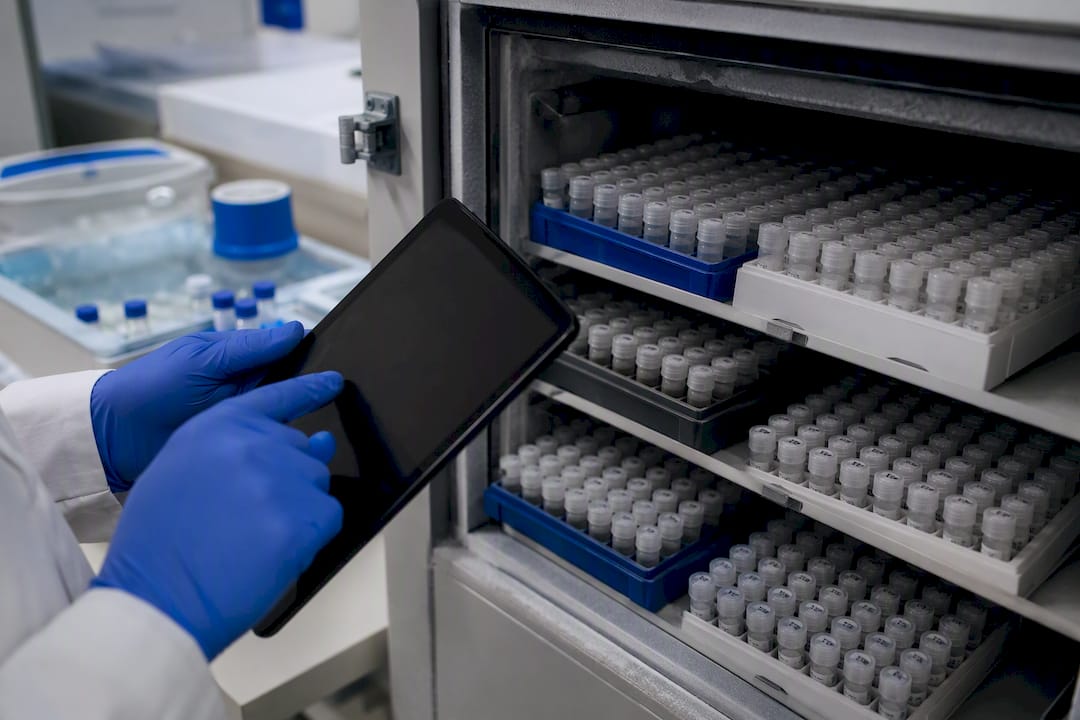
Documentation matters more with hydrophobic peptides than with straightforward hydrophilic ones, because the solvent choice itself becomes a variable in every downstream result. If a colleague repeats your assay with the same peptide dissolved in acetonitrile instead of DMSO, don't be surprised if the numbers shift.
Why do Cys and Met residues change your solvent choice?
Cysteine and methionine are the two residues most likely to sabotage an otherwise sound solubilisation attempt, not through solubility itself but through chemical instability once dissolved. DMSO is a mild oxidising agent, and technical notes on solvent compatibility flag that Cys and Met residues can oxidise in DMSO over time, altering the peptide's chemistry before you've even run your assay. For a peptide with a free thiol or an unprotected methionine, that's a real risk during anything beyond a brief dissolution step.
Where possible, the safer path is to swap DMSO for DMF or acetonitrile for Cys/Met-containing sequences, or to minimise the time the peptide spends dissolved in DMSO before dilution into buffer. If DMSO is genuinely the only solvent that works for a given sequence, dissolve immediately before use rather than holding a DMSO stock at the bench for hours.
Beyond solvent choice, pH adjustment is a legitimate second lever. Adding dilute acetic acid or ammonium hydroxide shifts the peptide's net charge relative to its pI, and moving the peptide away from its isoelectric point (where it is least soluble) can improve aqueous solubility without any organic solvent at all. This works best on sequences with at least a few acidic or basic residues; a peptide that is almost entirely hydrophobic with no ionisable groups won't respond much to pH tricks.
Chaotropes deserve a mention here too, since guanidine hydrochloride or urea can be added at the buffer stage to reduce aggregation once the peptide is technically in solution but forming higher-order clusters. Before reaching for any additive, run through a short compatibility checklist:
- Does the downstream assay tolerate residual chaotrope, or will it need dialysis first?
- Will the pH shift affect antibody binding, receptor interaction, or enzymatic activity in the assay?
- Is the peptide stable at the pH extreme required to move it away from its pI?
- Does the buffer system used for dilution match the ionic strength your assay expects?
When should you use solubilising tags instead of solvents?
Some sequences simply won't dissolve reliably no matter how the solvent strategy is adjusted, and peer-reviewed synthesis literature is direct about this: there is no single universal protocol for the most hydrophobic "difficult sequences." At that point, the fix moves from the bench to the synthesis stage itself.
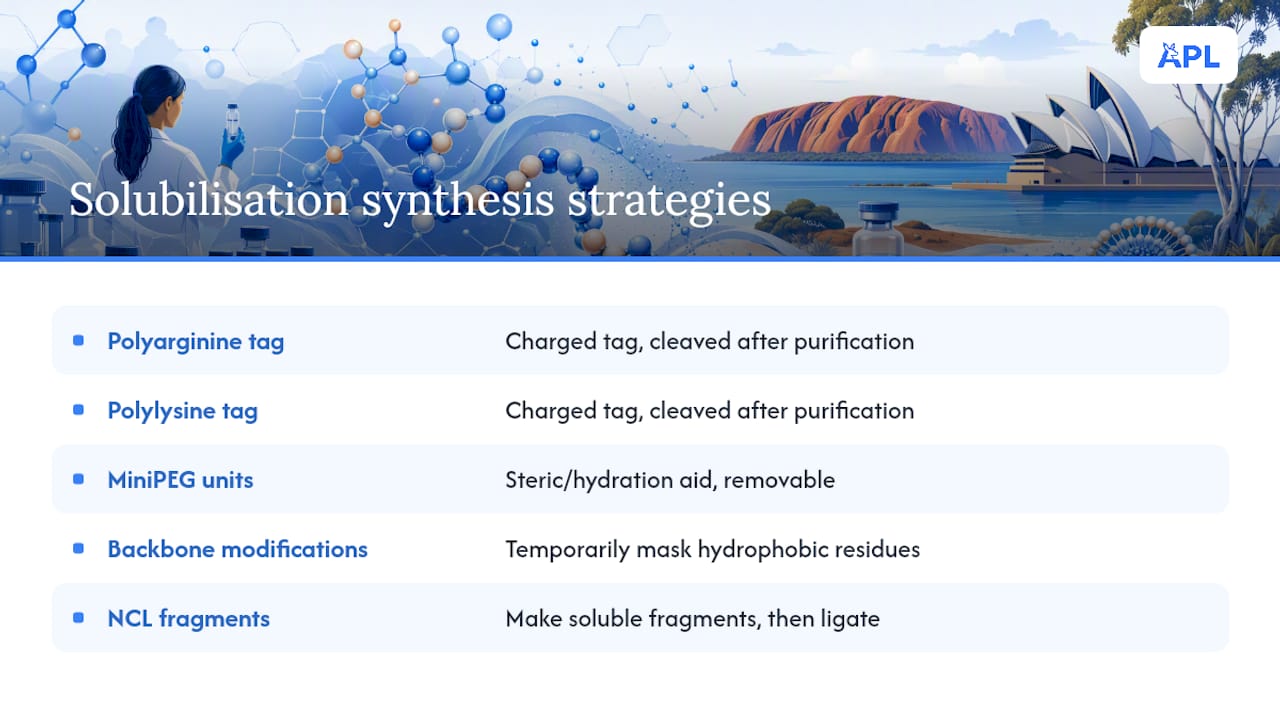
Solubilising tags are short stretches of charged residues, typically polyarginine or polylysine, attached at the C-terminus or on a side chain during solid-phase peptide synthesis (SPPS). They carry enough charge to drag an otherwise insoluble sequence into aqueous solution for purification, then get cleaved off once the peptide no longer needs the assist. MiniPEG units serve a similar purpose through steric and hydration effects rather than charge.
Removable backbone modifications and orthogonal protecting group strategies achieve something similar without adding a discrete tag, temporarily masking the hydrophobic character of specific residues during synthesis. For larger targets, fragmentation and native chemical ligation (NCL) let researchers build a hydrophobic peptide from smaller, individually soluble fragments, each carrying its own solubility unit through purification, before removing those units during the final ligation step.
The trade-off is straightforward: every tag or protecting group adds synthesis steps, cost, and time, but for a sequence that's already failed multiple solvent attempts, that investment usually beats losing the batch entirely to a purification step that never worked.
Why is your peptide cloudy instead of dissolved?
A cloudy or gel-like sample after a dissolution attempt almost always means the peptide is suspended, not dissolved, and this is the point where researchers most often make things worse rather than better. Adding more of the same solvent to a visibly cloudy sample rarely clears it. If the peptide didn't dissolve in the volume you already added, more volume just dilutes a suspension rather than dissolving it, and you've now used up material trying to fix a batch that needs a different approach entirely.
The recovery sequence that actually works:
- Stop adding solvent the moment you see persistent cloudiness rather than continuing to top up.
- Lyophilise the sample back down to recover the peptide in solid form rather than leaving it as a wasted wet suspension.
- Retry with a stronger or different solvent, moving from DMSO to a fluorinated alcohol like TFE or HFIP, or reconsidering the sequence-based solvent choice entirely.
- Centrifuge briefly before use if a small amount of undissolved material persists after a genuine dissolution attempt, using the clarified supernatant rather than the whole sample.
Sonication and warming both have real limits here. Short sonication bursts can help break up loose aggregates, but continuous sonication generates localised heating that risks degrading sensitive residues, and warming beyond 37°C carries the same risk without a proportional solubility benefit. Neither technique will dissolve a peptide that fundamentally needs a different solvent chemistry.
Pro Tip: If a second solvent attempt still leaves visible turbidity, that's a sequence issue, not a technique issue. Contact your supplier for a solubility consultation before burning through the rest of the batch. Resynthesis with a solubilising tag is often faster than a fourth failed dissolution attempt.
How do you store and handle a peptide once it's dissolved?
Once a hydrophobic peptide is genuinely in solution, the risk shifts from dissolution failure to slow re-precipitation during storage or dilution. A few handling rules keep a hard-won stock usable:
- Store at the temperature your solvent and peptide chemistry call for, and avoid repeated freeze-thaw cycles, which encourage aggregation in peptides that were already borderline soluble.
- Aliquot the stock into single-use volumes immediately after confirming concentration, rather than repeatedly thawing one large stock tube.
- Dilute dropwise into the target buffer with gentle mixing, never by pouring, since a fast bulk addition creates local pockets of supersaturation where the peptide falls out of solution before it can equilibrate.
- Filter sterile using a filter material compatible with your solvent, since some membrane materials degrade or leach under high-DMSO or high-acetonitrile content.
- Log every batch, recording solvent, final concentration, dilution steps, and any turbidity observed, so the next dilution starts from a known reference rather than trial and error.
Humidity is a quieter threat during storage of the lyophilised starting material itself, and it's worth understanding how peptide hygroscopicity affects weighing accuracy and long-term stability before you even reach the dissolution step.
What do most labs get wrong about peptide solubilization?
The most common mistake isn't choosing the wrong solvent. It's persistence with the wrong solvent past the point where the evidence says stop. Researchers see a partially cloudy sample and add more DMSO, then more again, convinced that one more millilitre will finish the job. Usually it just dilutes a suspension and wastes a batch that a fluorinated alcohol or a solubilising tag would have handled on the first try.
The second habit worth breaking is skipping the sequence check. Running a GRAVY and pI calculation before touching a solvent takes minutes and tells you whether you're dealing with a peptide that needs an organic solvent, a pH shift, or a synthesis-stage fix, rather than finding out the hard way after three failed attempts.
A short checklist covers most of what goes wrong in practice: test a small aliquot before committing the full vial, document the solvent and concentration every single time, and keep a stock map so nobody on the team repeats a dissolution attempt that already failed once. None of this is complicated. It's just consistently skipped under time pressure, and it's the difference between a reproducible result and a mystery you're still debugging three experiments later.
— Dr. Authur
How Aupeptidelabs supports peptide solubility testing in Australia
Aupeptidelabs ships every order from Australia within one business day, which matters most exactly when a solubilisation attempt goes sideways and you need a fresh aliquot fast rather than waiting weeks through customs.
If a sequence resists every solvent in your kit, Aupeptidelabs can talk through solubility testing options and, where a synthesis-level fix is the better route, discuss custom order requirements before you commit to a bulk purchase. That conversation, paired with documentation you can file straight into your lab notebook, is usually faster than a second failed attempt on your own bench. Browse the current research peptide catalogue and get in touch with customer support to request a solubility consultation before your next order ships.
Sources
- Challenges and perspectives in chemical synthesis of highly hydrophobic peptides (Frontiers, 2020)
- Synthesis and purification of highly hydrophobic peptides (Condron et al., PMC)
- Solubility Guidelines for Peptides (Sigma-Aldrich)
- Synthetic peptide handling & storage protocol (Merck Millipore)