
DMSO will dissolve most peptides that resist aqueous solvents. The single-line protocol: dissolve a small aliquot in anhydrous DMSO to make a concentrated stock, then dilute dropwise into your aqueous buffer while monitoring for precipitation. For cell-based assays, keep the final DMSO concentration low to avoid cytotoxic artefacts, though some assay systems tolerate low percentages with appropriate vehicle controls.
- Recommended stock range: a practical range in anhydrous DMSO
- Safe working limit for cell assays: keep final DMSO concentration low and within a safe range for your assay
- First step: always test a small aliquot before committing the full peptide mass
The ChemVerify Peptide Solvent Compatibility Guide describes DMSO as a broadly effective peptide solvent that disrupts hydrophobic aggregation across a wide range of sequences, making it the practical fallback when aqueous approaches fail.
When should you try DMSO versus aqueous solvents?
The decision turns on three factors: the peptide's net charge at physiological pH, its hydrophobic residue content, and the downstream assay's DMSO tolerance.
Start with water or dilute aqueous buffer when the sequence carries a high net positive or net negative charge. Charged peptides are generally water-soluble at neutral pH because electrostatic repulsion between chains limits aggregation. If water alone fails, try acetic acid for net-positive sequences or ammonium bicarbonate buffer for net-negative ones before reaching for DMSO.
Switch to DMSO when the sequence is predominantly hydrophobic, when the vendor's certificate of analysis (CoA) notes poor aqueous solubility, or when prior aqueous attempts produce a cloudy suspension that does not clear on vortexing. DMSO acts as a strong hydrogen-bond acceptor and dissolves both polar and non-polar compounds, which is why it improves solubility for poorly soluble molecules that resist water-based systems.
Sigma-Aldrich's peptide handling guidance recommends keeping final DMSO as low as possible, with 0.5–1% generally safe for most cell assays. Always run a matched vehicle control at the same DMSO concentration used in your experimental wells.
Pro Tip: If the vendor CoA lists solubility data, treat it as the starting point, not a guarantee. CoA solubility tests are often run at a single concentration and pH; your assay conditions may differ substantially.
What sequence properties predict whether you will need DMSO?
Checking four properties before opening the vial saves both peptide mass and time. Peer-reviewed solubility studies confirm that solubility is strongly sequence-dependent and that DMSO alters hydrogen-bonding and hydrophobic interactions differently from aqueous or alcohol-based solvents, so the same sequence can behave very differently across solvent systems.
Net charge at pH 7. Calculate the sum of ionisable residues: Arg (+1), Lys (+1), His (+0.1 at pH 7), Asp (−1), Glu (−1), and the N/C termini. A net charge of ±1 or 0 at pH 7 is a strong predictor of poor aqueous solubility and a likely need for DMSO.
Bachem's peptide solubility resources note that peptides with many non-polar residues prefer organic solvents such as DMSO.
Cysteine and methionine content. Both residues are oxidation-prone. Cysteine is particularly problematic in DMSO: free thiols can undergo oxidative dimerisation, forming disulfide-linked dimers that alter biological activity. If your sequence contains unpaired cysteines, consider whether DMSO is appropriate or whether a degassed, slightly acidic aqueous buffer is preferable.
Aggregation motifs. Sequences with β-sheet propensity (alternating hydrophobic/hydrophilic patterns, poly-Ala or poly-Val stretches) and proline-rich sequences that adopt rigid conformations can aggregate even in DMSO at high concentrations. Keep stocks below 20 mM for these sequences and inspect visually after each freeze–thaw cycle.
Pro Tip: A rapid mental check: count hydrophobic residues, note any Cys, and calculate net charge. If two of the three flags are present (high hydrophobicity, near-zero charge, Cys present), plan your DMSO protocol carefully and prepare a small-aliquot test first.
Step-by-step protocol for making a DMSO peptide stock
This protocol follows the stepwise reconstitution approach described in the STAR Protocols reconstitution guide, adapted for bench use.
-
Pre-warm the peptide vial to room temperature (approximately 20–22 °C) in a desiccated container before opening. Condensation on a cold vial introduces water, which can precipitate hydrophobic peptides immediately.
-
Weigh or record the supplied mass. For a lyophilised peptide supplied as 1 mg with a molecular weight of 1,000 g/mol, a 10 mM stock requires 100 µL of DMSO (calculation: 1 mg ÷ 1,000 g/mol = 1 µmol; 1 µmol in 100 µL = 10 mM). For a 20 mM stock, use 50 µL.
-
Use anhydrous DMSO. Molecular-grade or anhydrous DMSO (water content <0.005%) is critical; standard DMSO absorbs atmospheric moisture rapidly and water contamination reduces solubility for hydrophobic sequences.
-
Add DMSO in a low-bind microcentrifuge tube. Add the calculated DMSO volume directly to the peptide powder. Low-bind polypropylene tubes reduce adsorption losses, particularly relevant for short or hydrophobic peptides at low concentrations.
-
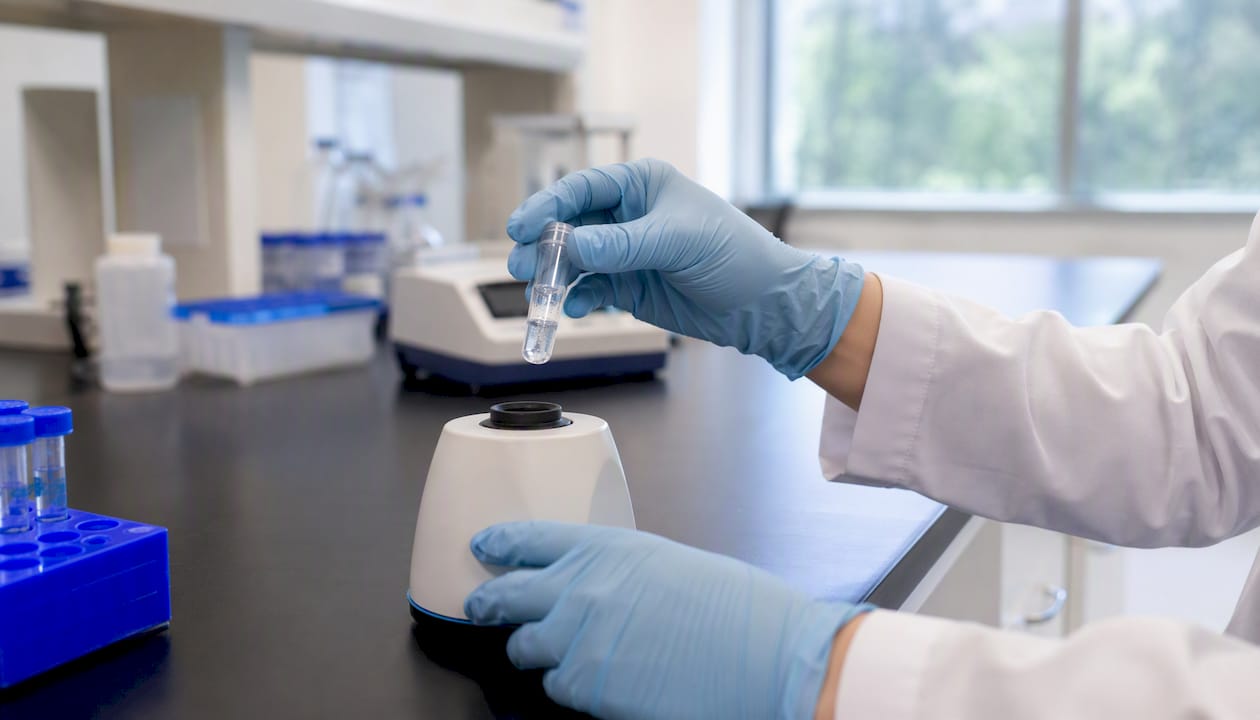
Vortex for 30–60 seconds, then apply 3–5 short sonication bursts (5 seconds each) in a bath sonicator. Sonication disrupts aggregated particles without the thermal stress of prolonged vortexing.
-
Centrifuge at 10,000 × g for 2–3 minutes to pellet any undissolved material. Transfer the supernatant to a fresh low-bind tube. Do not assume the pellet is inert; it may represent a significant fraction of the peptide mass.
-
Record the final volume, concentration, date, and lot number. If the solution is visually clear, proceed to aliquoting. If turbid, see the troubleshooting section.
Concentration guidance. Stocks in the 5–50 mM range are practical for most research peptides. Very hydrophobic or high-molecular-weight peptides (>3,000 Da) may only reach 5–10 mM reliably; pushing beyond this risks supersaturation and delayed precipitation.
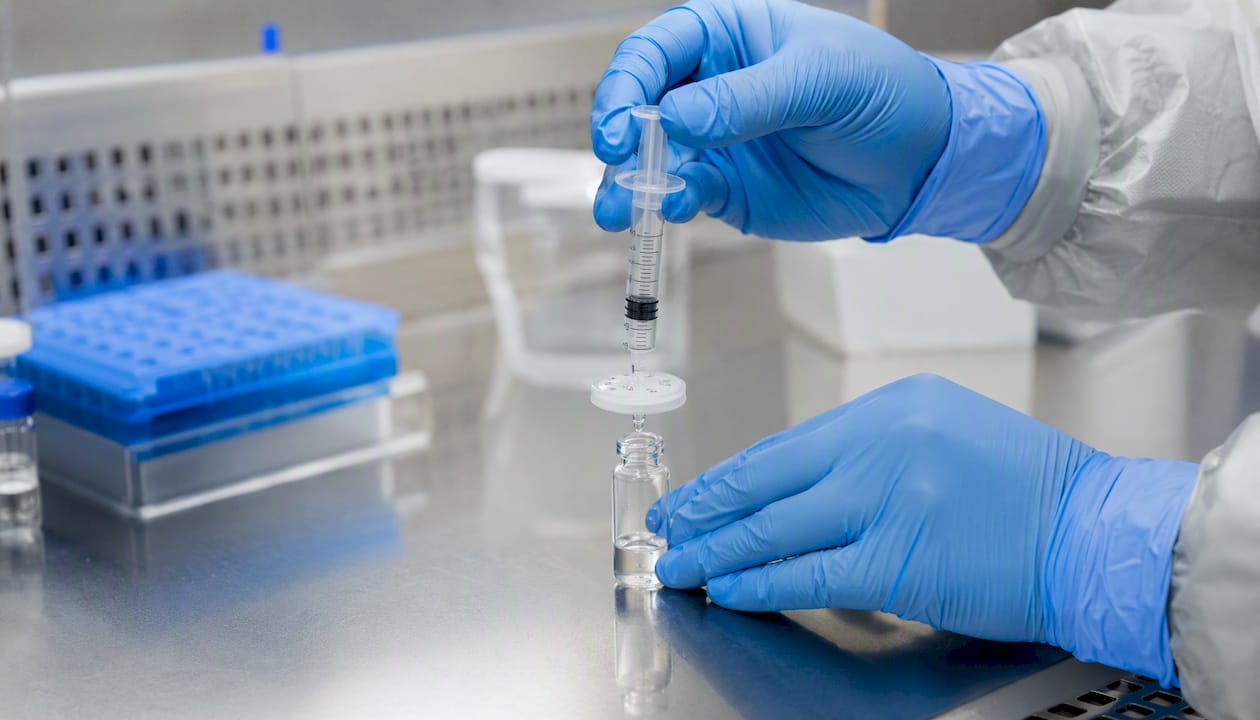
Sterility and filtration. For cell-based assays, filter the DMSO stock through a 0.22 µm PVDF syringe filter rated for DMSO compatibility. Do not use cellulose acetate filters, which degrade in DMSO. Warming above 37 °C is discouraged; elevated temperature accelerates oxidation of sensitive residues and can promote aggregation of β-sheet-prone sequences.
Pro Tip: Avoid repeated freeze–thaw cycles of DMSO stocks. DMSO freezes at approximately 18.5 °C, so stocks stored at −20 °C are solid and require thawing before each use. Each cycle risks oxidation and concentration changes from partial evaporation. Aliquot into single-use volumes before the first freeze.
How do you dilute a DMSO stock into aqueous buffers and cell assays?
The critical rule is to add the DMSO stock into the aqueous phase, not the reverse. Adding water to a concentrated DMSO stock causes an immediate drop in organic solvent content and can precipitate the peptide before it disperses.
Worked example. Starting with a 20 mM DMSO stock, to reach a 10 µM working concentration in 1 mL of assay buffer:
-
Required volume of stock: (10 µM × 1 mL) ÷ 20 mM = 0.5 µL
-
Final DMSO in 1 mL: 0.5 µL ÷ 1,000 µL = 0.05% (v/v)
-
Add the DMSO stock dropwise into pre-warmed buffer (37 °C for cell work) while pipetting or gently vortexing to encourage immediate dispersion.
-
Use an intermediate dilution step when the direct dilution would exceed 1% DMSO. Dilute the 20 mM stock 1:10 in buffer to make a 2 mM intermediate, then dilute again to reach the working concentration.
-
Monitor for precipitation at each dilution step. A cloudy intermediate solution indicates the peptide is coming out of solution; reduce the intermediate concentration or switch to a buffer with a higher organic co-solvent tolerance.
-
Run a vehicle control at the same final DMSO percentage as the highest experimental concentration. This is non-negotiable for cell viability, proliferation, and receptor assays.
-
Temperature matters. Cold buffers increase the risk of precipitation for hydrophobic peptides. Equilibrate buffers to room temperature or 37 °C before dilution.
How should you store peptide stocks prepared in DMSO?
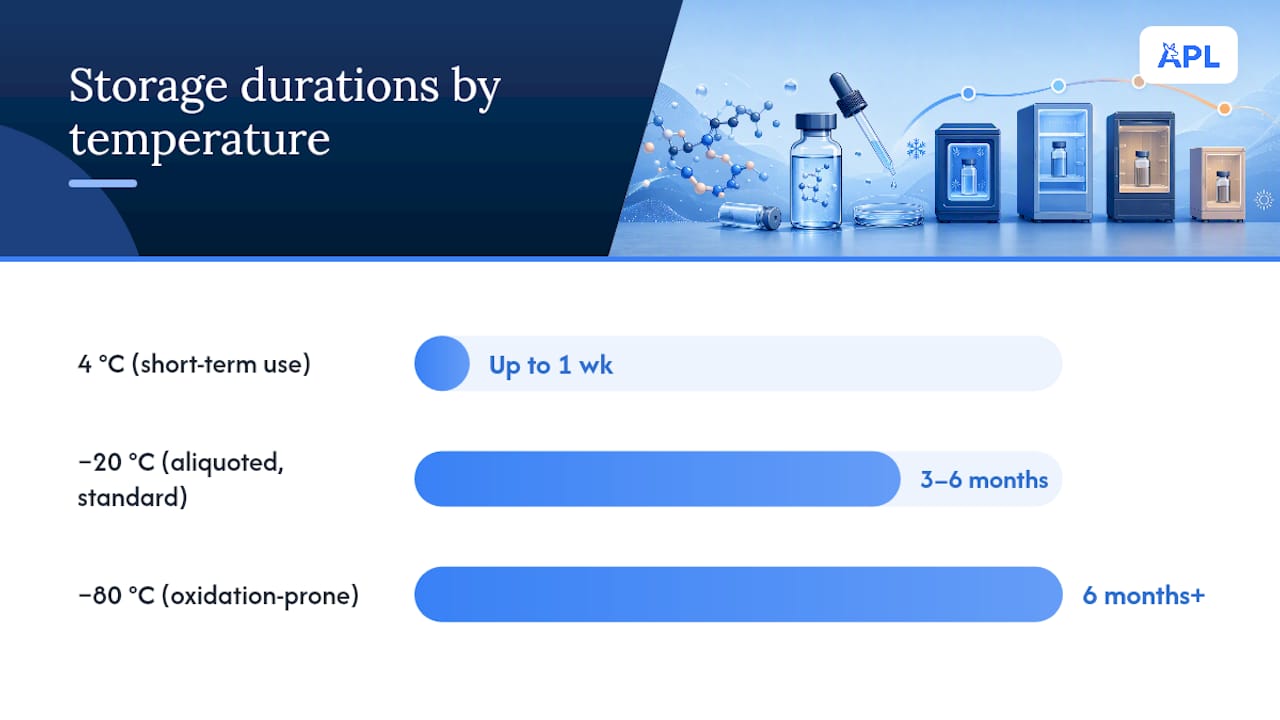
| Storage condition | Recommended duration | Notes |
|---|---|---|
| 4 °C (refrigerated) | Up to 1 week | Short-term only; use for active experiments |
| −20 °C (aliquoted) | 3–6 months | Standard for most research peptides |
| −80 °C (aliquoted) | 6 months or longer | Preferred for oxidation-prone sequences |
Aliquoting before the first freeze is the single most effective measure against degradation. For a typical cell assay workflow using 0.5 µL per well, prepare aliquots of 10–20 µL to allow 20–40 uses per tube without freeze–thaw cycling. Label each aliquot with peptide name, lot number, concentration, solvent, date prepared, and initials.
Cysteine-containing peptides stored in DMSO are susceptible to oxidative dimerisation over time, even at −80 °C. Where possible, prepare fresh stocks from lyophilised material for each experimental series rather than relying on aged DMSO stocks. Methionine-containing sequences are similarly susceptible to sulphoxide formation; storage under inert gas (argon or nitrogen) in the headspace of the aliquot tube reduces this risk, though this measure is only practical when the analytical consequence of oxidation has been validated.
Maintain a written or electronic log of all stocks, including visual inspection notes at each thaw. Discard any aliquot that shows visible particulate, colour change, or unexpected turbidity.
What safety and sterility precautions apply when working with DMSO?
DMSO carries a specific hazard that distinguishes it from most laboratory solvents: it penetrates intact skin rapidly and carries dissolved solutes with it. This means any peptide or contaminant on gloved hands can be transported transdermally if DMSO contacts the glove surface.
- Wear nitrile gloves and change them immediately if DMSO contacts the outer surface. Standard latex gloves offer inadequate protection; nitrile provides better, though not indefinite, resistance.
- Use eye protection (safety glasses or goggles) when handling open vials or performing filtration steps.
- Work in a well-ventilated area. DMSO vapour at room temperature is low but not negligible; prolonged inhalation is discouraged.
- Use sterile anhydrous DMSO from sealed, single-use ampoules or freshly opened bottles for cell-based work. Once opened, DMSO absorbs moisture from the atmosphere; seal bottles immediately after use.
- Filter-sterilise stocks intended for cell assays through a 0.22 µm PVDF membrane. Perform this step in a biosafety cabinet when working with primary cells or sensitive culture systems.
- Use sterile, low-bind consumables throughout: sterile microcentrifuge tubes, sterile pipette tips, and sterile syringes for filtration.
- Follow your institution's MSDS and chemical safety procedures for DMSO. In Australia, DMSO is classified as a Schedule 4 poison in some formulations; consult your institution's safety officer and the relevant Safety Data Sheet before use. Disposal must comply with local environmental regulations.
How do you troubleshoot a peptide that will not dissolve in DMSO?
Work through fixes in order from least invasive to most disruptive.
- Step 1 — Mix and sonicate. Vortex for 60 seconds, then apply 5–10 short sonication bursts (5 seconds each) in a bath sonicator. Many apparent insolubility problems are kinetic, not thermodynamic; the peptide is soluble but dissolves slowly.
- Step 2 — Centrifuge and inspect. Spin at 10,000 × g for 3 minutes. If the supernatant is clear, the pellet is undissolved material; record the recovered volume and recalculate the effective concentration.
- Step 3 — Reduce the target concentration. If the pellet is substantial, dilute the stock further in DMSO to reduce the concentration below the solubility limit. A 5 mM stock that is fully dissolved is more useful than a 20 mM stock with 40% of the peptide pelleted.
- Step 4 — Add a small amount of a chaotropic co-solvent. A brief addition of 6 M urea or guanidinium hydrochloride (GuHCl) to the aqueous dilution step (not the DMSO stock) can disrupt aggregated β-sheet structures. Use this only when the downstream assay tolerates chaotropes, and validate the vehicle control accordingly.
- Step 5 — Consider an alternative organic solvent. Acetonitrile or dimethylformamide (DMF) may dissolve sequences that resist DMSO, though both carry greater toxicity and assay compatibility concerns. This is a last-resort step.
Cysteine-containing peptides that appear insoluble in DMSO may have undergone disulfide dimerisation during storage. Treat with 1–5 mM dithiothreitol (DTT) or tris(2-carboxyethyl)phosphine (TCEP) in a degassed aqueous buffer before attempting DMSO dissolution, then re-lyophilise if necessary.
Loss of activity after room-temperature exposure is most commonly attributable to oxidation or aggregation rather than true insolubility. Prepare fresh aliquots from lyophilised stock and keep working solutions on ice during assay setup.
Pro Tip: Run a rapid solubility screen on 0.1 mg before committing the full batch. Add 5 µL of anhydrous DMSO to 0.1 mg of peptide in a low-bind tube, vortex, and inspect visually. This small-aliquot test, recommended in vendor handling guidelines, takes under five minutes and protects the remainder of your material.
Aupeptidelabs recommended workflow for DMSO peptide stocks
- Receive and inspect. Confirm lot number, purity certificate, and molecular weight against the CoA before opening the vial.
- Equilibrate to room temperature in a sealed desiccator for 15–30 minutes.
- Calculate DMSO volume for a 10–20 mM stock using the formula: V(µL) = [mass(mg) ÷ MW(g/mol)] × 10⁶ ÷ target concentration(mM). For a 1 mg peptide at MW 1,200 g/mol targeting 10 mM: V = (1 ÷ 1,200) × 10⁶ ÷ 10 = 83.3 µL.
- Add anhydrous DMSO, vortex 30–60 seconds, sonicate briefly, centrifuge at 10,000 × g for 2 minutes.
- Aliquot into 10–20 µL single-use volumes in labelled, low-bind tubes. For a peptide like LL-3700015-7), which is a 37-residue cationic antimicrobial peptide, 10 µL aliquots at 10 mM provide sufficient material for multiple replicate assays without repeated freeze–thaw.
- Store at −80 °C for long-term stability; use within one week once thawed.
- Use the Peptide Dilution Calculator to convert between mass, molarity, and volume for any stock concentration or target working concentration. This removes calculation errors at the bench.
Aupeptidelabs dispatches all orders from Australia within one business day, eliminating customs delays that compromise peptide integrity during transit. Research-grade peptides are available with rapid local fulfilment for Australian laboratories.
A note on pilot testing and assay validation
Every new peptide/assay combination warrants a pilot experiment before committing to a full study. Solubility behaviour in DMSO is sequence-dependent, and even peptides from the same structural family can differ substantially in their dissolution kinetics and stock stability. A pilot run using a small aliquot, a matched vehicle control, and a visual inspection at each dilution step takes less than a day and prevents the loss of weeks of experimental work to an undetected precipitation event or DMSO-mediated cytotoxicity artefact.
For sequences that present persistent solubility challenges, contact Aupeptidelabs directly for sequence-specific reconstitution advice, or use the Peptide Dilution Calculator to model intermediate dilution steps before going to the bench.
Sources
- Sequence-dependent dipeptide solubility in ethanol-water and DMSO-water solutions
- Peptide Solvent Compatibility Guide | ChemVerify