
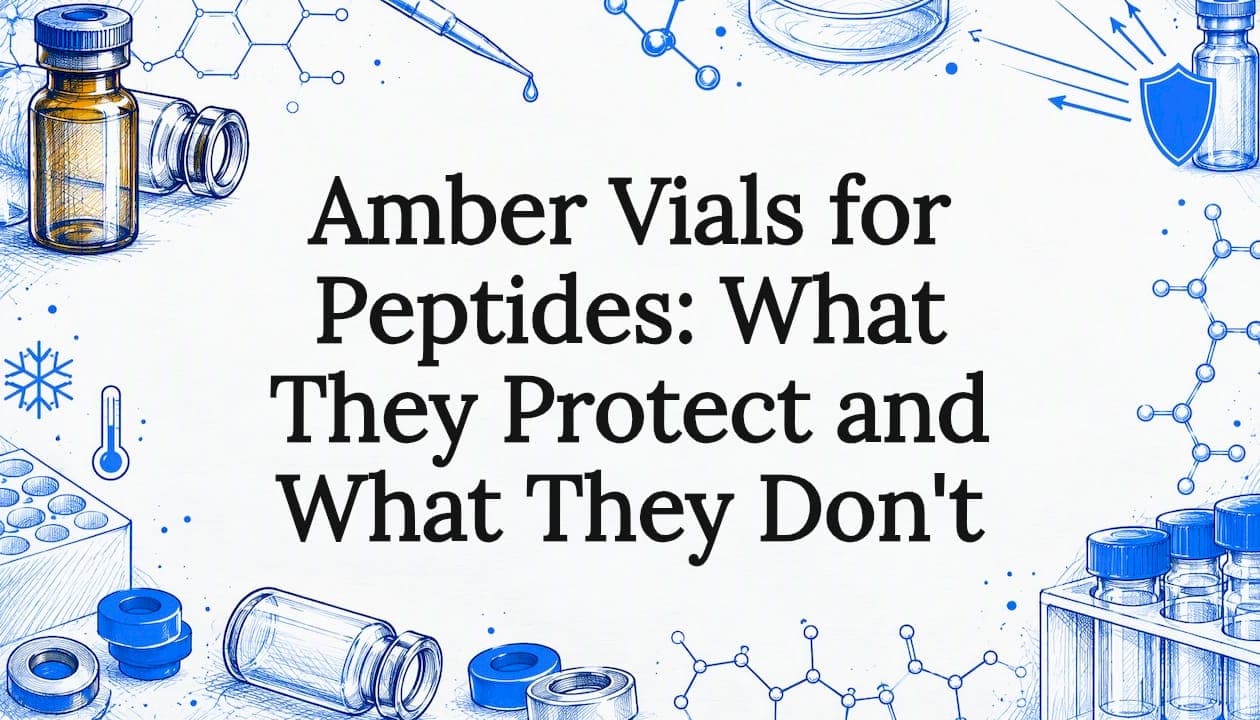
An amber vial reduces the amount of ultraviolet and short-wavelength visible light that reaches a peptide, which limits photodegradation in sequences that are light-sensitive. It does not make a peptide stable on its own. Temperature, moisture, oxygen, pH, adsorption and repeated freeze-thaw cycling remain separate variables, and amber glass should be treated as one control within a wider storage protocol. This article sets out what amber glass does, how it differs from clear glass, which vial features matter beyond colour, and how laboratories in Australia can handle research peptides in a way that preserves sample integrity.
All products referred to in this article are supplied strictly for laboratory research and are not intended for human or veterinary use.
What an Amber Vial Is Designed to Do
The primary function of an amber vial is to attenuate light. Peer-reviewed peptide-handling recommendations for mass-spectrometry work advise amber or dark storage tubes for photochemically active sequences, which places the colour of the container within standard laboratory practice rather than marketing convention.
The relevant chemistry concerns the side chains of particular residues. Sequences containing tryptophan or tyrosine, and peptides carrying a conjugated label such as a fluorophore, are the usual candidates for photochemical change. Amber glass absorbs a substantial share of radiation in the ultraviolet and short visible range, commonly described as roughly 300 to 500 nm, which is the region most likely to excite these chromophores.
Two points follow from this:
- The benefit is sequence-dependent. A peptide with no photoactive residues gains little from amber glass compared with clear glass, although amber remains a reasonable default when the sequence is unknown or the sample will be handled over a long period.
- The benefit is partial. Amber glass reduces transmission but does not eliminate it, so prolonged exposure or an intense light source can still cause degradation in a sensitive sequence.
Amber Versus Clear Vials
Clear borosilicate glass transmits ultraviolet and visible light with little attenuation. It has legitimate uses, particularly where visual inspection of the contents is required, but it offers minimal protection against photodegradation. Amber glass attenuates the shorter wavelengths, and that is the entire basis of its advantage.
| Property | Amber glass | Clear glass |
|---|---|---|
| UV and short-visible transmission | Substantially reduced | Largely transmitted |
| Protection for light-sensitive sequences | Partial mitigation | Minimal |
| Visual inspection of contents | More difficult | Straightforward |
| Suitability for UV-Vis or fluorescence readings | Unsuitable, as the glass absorbs in the relevant regions | Suitable (quartz or clear glass cuvettes preferred) |
| Typical use | Storage of photosensitive material | Short-term handling, inspection, optical analysis |
The last row matters in practice. Amber vials are unsuitable for UV-Vis or fluorescence measurements because the glass itself absorbs in the regions being measured. Where a sample must be analysed optically, it is transferred to a clear cuvette for the measurement and returned to protected storage afterwards, with exposure kept as brief as the method allows.
Glass composition is not identical across colours
Colour is not the only difference. Manufacturer technical documentation notes that USP Type I glass is the least reactive glass available, and that one manufacturer's amber vials use 51-expansion glass, which has a different composition and a higher free-ion content than its clear 33-expansion glass. For trace-level analytical work this can matter, because extractable ions may interact with a sample. For routine storage of lyophilised peptide it is a lesser concern, but it is a reason to specify the glass type and not only the colour when ordering vials.
Vial Features That Matter Beyond Colour
A vial selected on colour alone can still compromise a sample. The following specifications are reviewed alongside it.
Glass type
Type I borosilicate glass is the standard for parenteral and analytical containers because of its chemical resistance. Lower-grade glass can release alkali ions and alter the pH of a small-volume solution. Specifying Type I in procurement documents is a simple control.
Closure and seal integrity
The stopper and crimp or flip-cap assembly determine whether moisture and oxygen enter the vial between uses. Self-healing elastomer stoppers allow repeated needle access, but each puncture is a potential ingress point and a contamination risk. Lyophilised peptide is hygroscopic to varying degrees, so a closure that is intact at dispatch and kept sealed until use is a practical requirement. Aseptic technique at the bench, including aliquoting under controlled conditions, is covered in the Au Peptide Labs guide to aseptic bench handling and COA-verified aliquots.
Surface adsorption
Peptides in dilute solution can adsorb to glass and plastic surfaces, and the peer-reviewed recommendations list adsorption among the factors that affect stability. Where working concentrations are low, the container material should be matched to the experiment, and the effect should be checked rather than assumed to be negligible. Lyophilised material stored dry is less exposed to this problem than reconstituted solution.
Sterility and fill volume
Sterile, depyrogenated vials are appropriate where the reconstituted material will be handled aseptically. Fill volume should also be proportionate: a large headspace in a small quantity of solution increases the oxygen available for oxidation of susceptible residues such as methionine or cysteine. Infection-prevention practice in clinical settings is addressed by the NHMRC Australian Guidelines for the Prevention and Control of Infection in Healthcare, which provide a risk-management framework; research laboratories typically adapt the principles to their own institutional biosafety requirements.
Light Is One of Several Stability Variables
A frequent error is to treat an amber vial as evidence that a peptide is stable. The peer-reviewed recommendations treat amber storage as one control within a broader stability protocol, alongside inert gas, suitable temperature, moisture control, appropriate containers and avoidance of repeated freeze-thaw cycles. The factors that can affect peptide stability include:
- Temperature. Elevated temperature accelerates hydrolysis, deamidation and aggregation.
- Moisture and humidity. Water uptake by lyophilised powder promotes hydrolytic degradation.
- Oxygen. Oxidation of methionine, cysteine, tryptophan and histidine is a common pathway.
- pH. Solution pH influences deamidation, isomerisation and solubility.
- Microbial contamination. Reconstituted solutions are a growth medium if sterility is breached.
- Adsorption. Loss of peptide to container surfaces, as above.
- Freeze-thaw cycling. Repeated cycles can cause aggregation and loss of activity.
- Light. Relevant for susceptible sequences, and the variable amber glass addresses.
Using an amber vial should not be read as proof of a peptide's potency, shelf life or overall stability. In Australia, the regulator's own approach illustrates the point: for prescription medicines, stability testing examines high temperature, high humidity and light to determine appropriate storage conditions and shelf life. Conclusions about stability come from testing under relevant conditions, not from the packaging colour.
Storage Practice for Research Peptides
The peer-reviewed recommendations state that peptides are most effectively stored lyophilised at −20 to −80 °C. After reconstitution, stability is peptide-dependent, and working solutions should generally be prepared close to the time of use and protected from repeated freeze-thaw exposure. A defensible routine therefore looks like this:
- Receive the shipment, inspect closures and labelling, and compare the batch against its certificate of analysis.
- Transfer sealed vials to cold storage promptly, in an opaque secondary container.
- Equilibrate the vial to room temperature before opening, so that condensation does not form on the powder.
- Reconstitute only the quantity required, using the diluent specified in the protocol.
- Divide any stock solution into single-use aliquots to avoid repeated freeze-thaw cycling.
- Record the date of reconstitution, the diluent, the concentration and the storage location.
Bench time is the larger light exposure
The largest contributor to light exposure is typically bench time under room lighting, not storage. Minimising the time a vial sits under fluorescent or direct light, and using opaque secondary packaging or foil wrapping for added protection, usually has more effect than changing the vial colour. The same editorial view holds that the mechanism of degradation, and not vial colour alone, should dictate handling protocols.

A related practical point concerns the refrigerator. A domestic or laboratory unit with an interior lamp exposes vials to light each time the door opens, and a lidded opaque box inside the unit addresses this at negligible cost.
Perspective
At Au Peptide Labs, vial selection is treated as part of product integrity and not as packaging detail. Our position is that amber glass is a sound default for lyophilised research peptides, because most laboratories receive material without a complete photostability profile for each sequence, and a container that attenuates ultraviolet and short-wavelength light removes one avoidable variable at no analytical cost.
The more consequential controls sit around the vial. Every batch we supply is tested independently by a third party to a purity of 99% or above, and a certificate of analysis accompanies each batch so that the material in the vial can be verified and not assumed. Purity data, correct closures, cold storage and disciplined bench practice together determine whether a sample behaves consistently across a study.
Domestic dispatch is relevant to stability for the same reason. Orders ship from Melbourne within one business day, which removes the extended transit and customs holds that expose temperature-sensitive material to uncontrolled conditions. A shorter, predictable chain of custody is a stability measure in its own right, and we regard it as inseparable from the quality of the peptide itself.
Researchers should continue to verify, not infer. An amber vial is a mitigation, not a guarantee, and the appropriate response is documented storage conditions and, where the study demands it, stability testing under the conditions of use.
Dr. Authur
Regulatory Context in Australia
Laboratories sourcing peptides in Australia operate within a defined regulatory framework. Peptide products are regulated as therapeutic goods, and the TGA advises that those not included in the Australian Register of Therapeutic Goods (ARTG) are considered unapproved and have not been assessed for safety, quality or efficacy. Generally, a compounded good is exempt from ARTG inclusion when it is dispensed or extemporaneously compounded for a particular person, or compounded in a hospital by a relevant pharmacist for hospital patients.
The TGA has also stated that pharmacist extemporaneous compounding of medicines containing GLP-1 receptor agonist analogues has been prohibited in Australia since 1 October 2024. A vial's colour, label or packaging does not change the regulatory status of its contents. Research peptides are supplied for laboratory use only, and laboratories remain responsible for compliance with institutional and legal requirements. Further background is available in the guides on whether peptides are legal in Australia, import permits for researchers and customs seizure risks and a lawful path.
Verifying What Is Inside the Vial
Glass colour says nothing about identity or purity. Verification rests on documentation: a batch-specific certificate of analysis from an independent laboratory, a lot number that matches the vial label, and consistency between the stated purity and the analytical method reported. Counterfeit and mislabelled material is a recognised risk in the grey market, and a structured set of checks is described in the guide to five checks laboratories use to spot counterfeit peptides. The meaning of the term in an Australian context is addressed separately in the explainer on pharmaceutical-grade peptides.
For logistics, the guide to peptide shipping in Australia covers transit conditions, while formal arrangements for recurring orders are outlined in the article on peptide supply agreements.
Au Peptide Labs Research Supplies
Au Peptide Labs supplies pharmaceutical-grade research peptides, stocked and dispatched from Melbourne, with independent third-party purity testing to 99% or above and a verifiable certificate of analysis for each batch. The catalogue is organised by research area: Metabolic and GLP-1, Recovery and Repair, GH Secretagogues, Cognitive and Sleep and Longevity and Cellular.
Supporting laboratory consumables, including bacteriostatic water, insulin syringes and alcohol wipes, are listed under Lab Supplies. Orders are dispatched within one business day in discreet packaging, and Express Post is available for $10 as a one-off fee, as published on the Au Peptide Labs store. Custom and bulk orders are available on request. All products are strictly for laboratory research.
Frequently Asked Questions
What is the main purpose of amber vials for peptides?
Amber vials reduce exposure to ultraviolet and short-wavelength visible light, which limits photodegradation in light-sensitive sequences, particularly those containing tryptophan or tyrosine or carrying a conjugated label. They are a mitigation and not a complete barrier. They should be combined with cold storage, moisture control and limited bench time.
What is the difference between amber and clear vials?
Amber glass attenuates ultraviolet and short visible light, while clear glass transmits most of it. Clear glass allows easier visual inspection and is required for optical measurements such as UV-Vis or fluorescence, because amber glass absorbs in the relevant regions. Amber is generally preferred for storage and clear for analysis.
Does an amber vial prove a peptide is stable or potent?
No. Stability depends on temperature, humidity, oxygen, pH, contamination, adsorption and freeze-thaw cycling as well as light. Shelf life and potency are established by stability testing under relevant conditions, which is the approach the TGA describes for prescription medicines, and not by the colour of the container.
Are peptides available as prescription medicines in Australia?
Some peptide-based medicines are approved and included in the ARTG, and are supplied under prescription. Peptide products not on the ARTG are unapproved and have not been assessed by the TGA for safety, quality or efficacy. Research peptides are supplied for laboratory use only and are not a substitute for an approved medicine. Anyone considering a therapeutic product should consult a registered medical practitioner.
Sources
- Recommendations for the generation, quantification, storage and handling of peptides used for mass spectrometry-based assays
- Light Sensitivity in Peptide Handling
- Waters Certified Sample Vials White Paper
- Australian Guidelines for the Prevention and Control of Infection in Healthcare (NHMRC)
- Stability testing for prescription medicines (TGA)
- Understanding your responsibilities when importing, compounding and supplying unapproved peptide products (TGA)
- Manufacturing, supplying and advertising compounded medicines lawfully (TGA)