
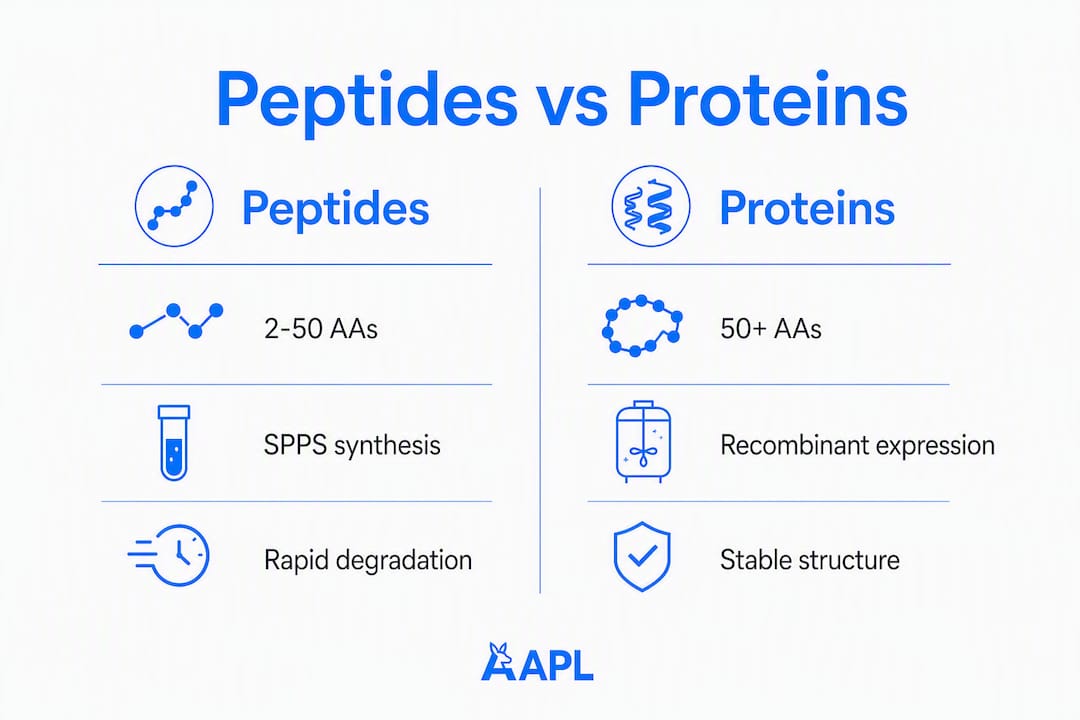
The simplest practical distinction between peptides and proteins is size and structural complexity. Peptides are short amino-acid chains, typically in the range of 2–50 amino acids, that generally remain linear or adopt only simple conformations. Proteins are longer chains, commonly exceeding 50–100 amino acids, that fold into defined three-dimensional architectures and often assemble into multi-chain complexes. Insulin and oxytocin are peptide hormones; haemoglobin is a protein. For production, short sequences are typically made by chemical synthesis via Solid-Phase Peptide Synthesis (SPPS), the route Aupeptidelabs uses for its research catalogue, while larger proteins require recombinant biological expression. That ~50 aa boundary is an operational convention used across the literature, not a rigid biological law.
- Peptides: short amino-acid chains (~2–50 aa), linear or simple cyclic structures, chemically synthesised
- Proteins: longer chains (>50–100 aa), complex folded structures, biologically expressed
- Key examples: insulin (51 aa peptide hormone), oxytocin (9 aa peptide), haemoglobin (protein, ~574 aa total across subunits)
- Synthesis routes: SPPS for peptides; recombinant expression for proteins
- Caveat: the 50 aa cut-off is a working convention; the transition zone (~40–100 aa) is genuinely debated
What are peptides, and why do they matter in research?
Peptides are short polymers of amino acids linked by peptide bonds, the covalent amide linkages formed between the carboxyl group of one residue and the amino group of the next. The operational range most commonly cited in the literature is 2–50 amino acids, though the term polypeptide is sometimes applied to chains in the upper portion of that range before they acquire the folding complexity associated with proteins.
Structurally, peptides are predominantly linear. Some naturally occurring examples, such as cyclotides, adopt cyclic or constrained conformations that confer additional stability, but the absence of large folded domains is the defining structural feature that separates most peptides from proteins.
Biologically, peptides function primarily as signalling molecules, hormones, and regulators:
- Insulin (51 aa): regulates glucose metabolism; the canonical example of a peptide hormone with therapeutic application
- Oxytocin (9 aa): neuropeptide involved in social bonding and uterine contraction
- GLP-1 agonists (e.g. semaglutide, the active compound in Ozempic): engineered peptide therapeutics that mimic endogenous glucagon-like peptide-1 signalling to regulate appetite and glycaemia
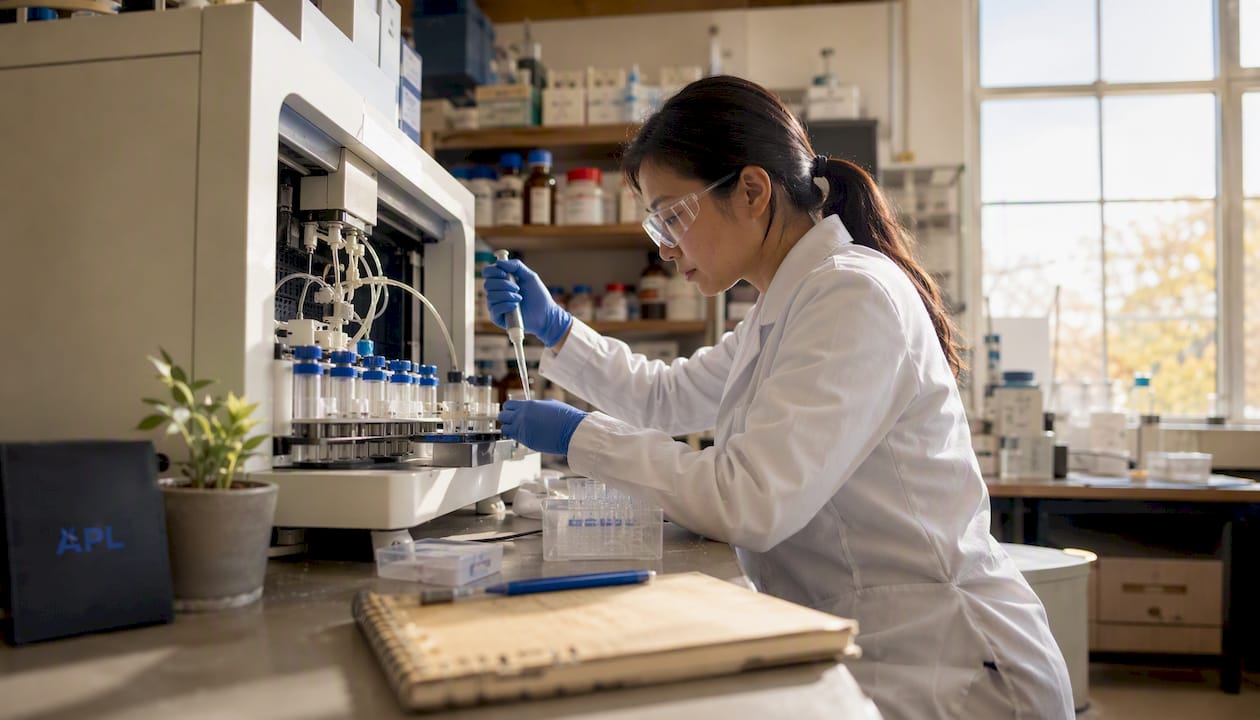
For research applications, SPPS is the dominant laboratory synthesis method because it allows precise sequence control, incorporation of non-natural amino acids, and backbone modifications that would be impossible in a biological system. That precision is why pharmaceutical-grade research peptides produced by SPPS can achieve purity levels exceeding 99% when manufactured under rigorous quality controls.
One practical challenge is in vivo instability. Peptides are susceptible to rapid proteolytic degradation, and their oral bioavailability is generally poor, which is why most peptide therapeutics are administered by injection and why stability-enhancing modifications are common in both therapeutic development and functional assay design.
Pro Tip: When designing a functional assay with a short peptide, confirm whether the sequence has been modified for stability (e.g. cyclisation, D-amino acid substitution, or lipidation). An unmodified linear peptide may degrade within minutes under physiological conditions, confounding your results.
What are proteins, and how does their structure define their function?
Proteins are amino-acid polymers that exceed the length threshold at which spontaneous or chaperone-assisted folding produces a defined three-dimensional structure. That structure, not the sequence alone, is what makes a protein functional. Correct tertiary and quaternary folding, along with post-translational modifications (PTMs) such as glycosylation and disulfide bond formation, often requires the cellular machinery that recombinant expression systems provide.
The four levels of protein structure are:
- Primary: the linear amino-acid sequence encoded by the gene
- Secondary: local folding patterns (alpha-helices, beta-sheets) stabilised by hydrogen bonds
- Tertiary: the overall three-dimensional fold of a single polypeptide chain, stabilised by hydrophobic interactions, disulfide bonds, and electrostatic forces
- Quaternary: the assembly of two or more polypeptide subunits into a functional complex (e.g. haemoglobin's four globin subunits)
Proteins serve a far broader functional range than peptides. Collagen provides tensile strength to connective tissue. Haemoglobin transports oxygen through the bloodstream. Enzymes catalyse virtually every biochemical reaction in the cell. Antibodies, including monoclonal antibodies used as therapeutics, are proteins whose activity depends entirely on the precise geometry of their antigen-binding domains.
Manufacturing proteins for therapeutic or research use is substantially more complex than peptide synthesis. Gene cloning, selection of an appropriate host cell line (bacterial, yeast, or mammalian), optimisation of expression conditions, and downstream purification all contribute to timelines that can extend to years for a new therapeutic protein. For many proteins, mammalian expression is non-negotiable because bacterial systems cannot perform the glycosylation required for correct folding and activity.
How do peptides and proteins compare across key research dimensions?
| Dimension | Peptides | Proteins |
|---|---|---|
| Size (aa) | approximately 2 to 50 amino acids (operational) | more than 50 amino acids, often exceeding 100 (operational) |
| Structural complexity | Linear or simple cyclic; minimal folding | Secondary, tertiary, quaternary structure |
| Synthesis method | Chemical (SPPS, Fmoc/t-Boc) | Recombinant expression (bacteria, yeast, mammalian) |
| Typical biological function | Signalling, hormonal regulation | Structural, catalytic, transport, immune |
| Stability / half-life | Generally short; protease-susceptible | Variable; often more stable due to folded structure |
| Delivery challenges | Poor oral bioavailability; injection preferred | Injection or infusion; cold-chain requirements |
| Typical examples | Insulin, oxytocin, semaglutide | Haemoglobin, collagen, monoclonal antibodies |
Note: the 2–50 aa / >50 aa boundary is a working convention. The 40–100 aa transition window is where classification is genuinely contested in the literature.
Key practical takeaways from this comparison:
- If your target sequence is ≤50 aa, SPPS will typically deliver faster turnaround and higher sequence precision than expression.
- If your target requires PTMs or quaternary assembly, recombinant expression is the only viable route.
- Stability data should be requested for any peptide intended for functional assays, particularly those run under physiological conditions.
- Delivery route planning differs substantially: peptide therapeutics almost always require parenteral administration, while some protein therapeutics can be formulated for subcutaneous depot delivery.
How are peptides and proteins produced in the laboratory?
SPPS for peptides
SPPS proceeds by stepwise addition of protected amino acids to a resin-bound chain, with each cycle involving coupling, washing, and deprotection. The two dominant strategies are Fmoc (9-fluorenylmethoxycarbonyl) and t-Boc (tert-butyloxycarbonyl) chemistry, with Fmoc now the more widely used in research settings due to milder deprotection conditions.
The practical upper limit for stepwise SPPS is generally up to about 40 to 50 amino acid residues. Beyond that, cumulative coupling inefficiencies and by-product accumulation reduce yield and homogeneity. Longer sequences can be accessed through native chemical ligation or segment condensation, though these add complexity and cost.
| SPPS parameter | Typical value |
|---|---|
| Practical length limit (stepwise) | ~40–50 amino acids |
| Achievable purity (research grade) | >95–99% with HPLC purification |
| Synthesis timeline | Days to weeks |
| Allows non-natural amino acids | Yes |
Pro Tip: For pharmaceutical-grade research peptides, always request a Certificate of Analysis (COA) that includes HPLC purity data and mass spectrometry confirmation. A purity figure without MS verification leaves sequence fidelity unconfirmed.
Recombinant expression for proteins
Protein production via recombinant expression requires gene cloning into an expression vector, transformation into a host cell line, and optimisation of culture conditions for yield and solubility. Bacterial systems (typically E. coli) are cost-effective for proteins that do not require glycosylation. Yeast systems (e.g. Pichia pastoris) offer some glycosylation capacity. Mammalian cell lines (CHO, HEK293) are required for complex glycoproteins and most therapeutic monoclonal antibodies.

For therapeutic supply, cGMP-compliant manufacturing adds regulatory documentation, environmental monitoring, and batch release testing that can extend development timelines considerably.
Why the peptide/protein distinction matters for stability, delivery and therapeutics
The functional consequences of size and folding extend well beyond classification. Peptides are digested rapidly by proteases in vivo, which limits their half-life and drives the formulation strategies used in both therapeutic development and experimental design:
- Cyclisation: constrains the backbone, reducing protease access and improving metabolic stability
- Lipidation: attaches fatty-acid chains to improve membrane association and extend half-life (semaglutide uses fatty-acid conjugation to achieve its once-weekly dosing profile)
- PEGylation: attachment of polyethylene glycol chains reduces renal clearance and immunogenicity
- D-amino acid substitution: replaces L-amino acids with their mirror-image counterparts, which most proteases cannot cleave
Delivery route is directly tied to these stability constraints. Most peptide therapeutics, including insulin and GLP-1 agonists such as semaglutide, are administered subcutaneously or intravenously because gastrointestinal proteases and the intestinal epithelial barrier prevent meaningful oral absorption of intact peptides. Protein therapeutics face similar parenteral requirements, with the additional challenge of cold-chain logistics for large, folded molecules.
Analytically, the distinction between a peptide and a protein in the laboratory is confirmed by mass spectrometry (which provides precise molecular mass and sequence coverage) and SDS-PAGE electrophoresis (which separates molecules by size and can reveal multi-chain assemblies under reducing versus non-reducing conditions). For peptide recovery research, these analytical methods are standard quality checkpoints before functional assays proceed.
Common misconceptions about where peptides end and proteins begin
The most persistent misconception is that peptides and proteins are categorically distinct. They are not. Both are amino-acid polymers connected by peptide bonds; the difference is one of length, folding complexity, and functional consequence rather than chemistry.
- Misconception: "Peptides and proteins are different types of molecules." Correct framing: they occupy different regions of a continuum of amino-acid chain length and structural complexity.
- Polypeptide terminology: the term polypeptide refers to any amino-acid chain regardless of length; it is a structural descriptor, not a functional classification. A polypeptide becomes a protein when it folds into a functional three-dimensional structure.
- Recommended phrasing for papers: use "peptide (operationally defined as ≤50 aa)" or "protein (>50 aa)" and cite the boundary you are using. Different journals and textbooks apply slightly different thresholds.
- Modified and cyclic peptides: cyclotides, lipopeptides, and backbone-modified peptides may exhibit stability and binding properties more typical of proteins despite their short sequences. Classification by length alone can be misleading for these compounds.
- Analytical identification: when classification is ambiguous, mass spectrometry provides the definitive molecular mass, and SDS-PAGE mobility under denaturing conditions confirms approximate size. A molecule in the 5–15 kDa range may be either a peptide or a small protein depending on its sequence and modifications.
How Aupeptidelabs approaches peptide versus protein decisions in procurement
The practical question researchers most frequently bring to Aupeptidelabs is straightforward: should this target be ordered as a synthesised peptide, or does it require expression? The answer depends on three factors: sequence length, whether PTMs are required for activity, and the intended assay conditions.
For sequences at or below 50 amino acids with no required glycosylation, SPPS is the preferred route. It delivers faster turnaround, precise sequence control, and the ability to incorporate non-natural residues or stability modifications. Aupeptidelabs stocks an extensive catalogue of research peptides synthesised by SPPS to >99% purity, with third-party COAs available for every product. All orders are dispatched from Australia within one business day, which eliminates the customs delays that routinely disrupt imported peptide supply.
Procurement checklist for Australian researchers:
- Confirm sequence length and whether PTMs are required before selecting synthesis route
- Request a COA that includes HPLC purity data, MS confirmation, and recommended storage conditions
- Check whether the peptide requires stability modifications (cyclisation, lipidation) for your assay conditions
- Review compliance requirements under Australian research regulations for the intended use
- For bulk or custom orders, contact Aupeptidelabs directly to discuss sequence-level purity data and stability studies
Pro Tip: For peptides intended for functional assays, request sequence-level purity data and, where available, stability studies under your intended assay buffer conditions. A peptide that is 99% pure by HPLC may still contain a single truncated sequence that competes with your target at the receptor.
Researchers sourcing research peptides in Australia can access Aupeptidelabs' full catalogue, COA documentation, and procurement support directly through the website.
Authoritative sources for further reading
- Explainer: Peptides vs proteins — Institute for Molecular Bioscience, University of Queensland: concise academic explainer covering definitions, cut-offs, synthesis routes, and the continuum concept
- Biochemistry, Peptide — StatPearls, NCBI Bookshelf: peer-reviewed reference covering peptide biochemistry, hormonal functions, and analytical methods
- What Is the Difference Between a Peptide and a Protein? — Britannica: accessible encyclopaedia entry with discussion of operational cut-offs and the continuum
- Peptide synthesis — Wikipedia: technical overview of SPPS, Fmoc/t-Boc strategies, native chemical ligation, and practical length limits
- Understanding the Basics of Peptide and Protein Production — BioProcess International: industry-facing review of SPPS advantages, recombinant expression complexity, and cGMP considerations
- Proteins — Michigan State University, Department of Chemistry: detailed reference on protein structure levels, functional categories, and examples including haemoglobin and collagen
- Biochemistry, Protein Synthesis — StatPearls, NCBI Bookshelf: ribosomal protein synthesis mechanism and eukaryotic translation machinery
- Aupeptidelabs — Research Peptides Australia: procurement, COA documentation, and catalogue queries for Australian research laboratories
The boundary between peptides and proteins is a research decision, not just a definition
The peptide/protein distinction is frequently treated as a matter of nomenclature. For researchers, it is a procurement and experimental design decision with direct consequences for synthesis route, stability, delivery, and assay validity.
The conventional 50 aa boundary is a useful working rule, but the transition zone between 40 and 100 amino acids is where classification genuinely depends on context: does the molecule fold? Does it require PTMs? Does it function as a signalling molecule or a structural scaffold? Those questions determine whether SPPS or recombinant expression is the appropriate production route, and they determine what analytical verification is required before the material enters an assay.
Researchers who treat the peptide/protein boundary as a hard rule risk misclassifying targets in that transition zone and selecting the wrong synthesis strategy. The more productive frame is to ask what the molecule needs to do, and then choose the production method that delivers the sequence fidelity, modifications, and purity required for that function.