

TL;DR:
- Reliable peptide reviews in Australia must include verified customer ratings, accessible Certificates of Analysis, and compliance with TGA regulations. Vendors with local stock, third-party verification, and transparent scheduling support trustworthy procurement. Researchers should verify batch-specific COAs via Janoshik and ensure peptides, especially Schedule 4 compounds, are obtained with valid prescriptions.
Peptide reviews in Australia are defined by three non-negotiable criteria: verified customer ratings, publicly available Certificates of Analysis (COAs), and compliance with Therapeutic Goods Administration (TGA) regulations. The Australian peptide market shifted significantly after 2023, when the TGA reclassified compounds including BPC-157, Ipamorelin, and CJC-1295 as Schedule 4 substances requiring prescriptions. Aupeptidelabs holds a verified customer satisfaction rating of 4.6/5, reflecting the standard researchers now expect from local suppliers. This guide covers what makes a peptide review trustworthy, how Australian regulations affect purchasing, and how to read lab reports with confidence.
1. What makes peptide reviews Australia reliable?
A reliable peptide review combines verified purchase data, independent lab confirmation, and regulatory compliance. Reviews that lack COA links or ignore TGA scheduling are incomplete, regardless of star ratings. Researchers and clinicians need all three elements to make an informed procurement decision.

The most credible Australian peptide guides reference third-party lab verification through portals like Janoshik, which allow independent confirmation of purity data rather than relying on vendor-uploaded PDFs. Reputable suppliers maintain an average rating of 4.5/5 or above with 100 or more community reviews. That volume of verified feedback reduces the influence of outlier opinions and reflects consistent product quality over time.
Key criteria for assessing any Australian peptide review:
- Verified ratings: Minimum 100 reviews on a third-party platform such as Trustpilot
- COA availability: Publicly accessible lab reports linked to specific batch numbers
- Third-party verification: Janoshik portal confirmation, not just a PDF upload
- Local fulfilment: Australian stock with dispatch within 1–2 business days
- TGA compliance: Vendor acknowledges Schedule 4 classifications and prescription requirements
- Pricing transparency: Clear pricing with no hidden fees or misleading discount structures
- Customer support: Accessible communication channels and documented return or refund policies
Pro Tip: Before trusting any review, check whether the reviewer mentions a batch number or links to a COA. Reviews without this detail cannot confirm product identity or purity.
2. Vendor fulfilment models and what they mean for you
Fulfilment model is the single most practical factor in Australian peptide procurement. Three models operate in this market: fully local stock, hybrid local and overseas, and direct overseas dispatch.
Fully local vendors hold Australian inventory and dispatch within one business day. Aupeptidelabs operates this model, dispatching all orders from Australia within one business day to eliminate customs delays. That matters because imported peptides without a valid prescription are subject to seizure under the Therapeutic Goods Act.
Hybrid fulfilment models offer local stock for standard orders and direct-from-manufacturer shipping for bulk or less common compounds. Local stock delivers fast Australian shipping. Overseas shipping offers lower cost with longer wait times, typically two to four weeks. Researchers with time-sensitive protocols should confirm stock location before ordering.
Direct overseas dispatch carries the highest customs risk for Schedule 4 compounds. Any peptide classified under Schedule 4 requires a valid Australian prescription to clear customs legally. Vendors operating solely from overseas cannot guarantee delivery for these compounds.
3. How Australian regulations affect peptide purchasing
Schedule 4 classification is the defining legal framework for peptide procurement in Australia. Since 2023, peptides including BPC-157, Ipamorelin, and CJC-1295 require a prescription from a qualified Australian practitioner and must be dispensed through a registered compounding pharmacy. The research-use loophole that previously allowed personal importation no longer applies.
Compounding pharmacies play a central role in legal supply. They prepare peptide formulations to a practitioner's specification and dispense them under Schedule 4 controls. Researchers working within institutional frameworks should confirm their institution's procurement pathway before ordering.
Possession of Schedule 4 peptides without a valid prescription risks customs seizure and legal penalties under the Australian Therapeutic Goods Act. Importing these compounds without prescription is considered unlawful, regardless of the stated purpose.
Not all peptides fall under Schedule 4. Unscheduled peptides and topical compounds occupy a different regulatory category and may be purchased without a prescription. Vendors with strong compliance practices clearly distinguish between scheduled and unscheduled products in their catalogues. Aupeptidelabs lists scheduling status alongside each product to support compliant procurement decisions.
Key regulatory points for Australian researchers:
- BPC-157, Ipamorelin, CJC-1295, and related growth hormone secretagogues are Schedule 4
- A valid Australian doctor's prescription is required for Schedule 4 compounds
- Dispensing must occur through a registered compounding pharmacy
- Importing without prescription risks seizure and legal consequences
- Unscheduled peptides remain accessible without prescription through compliant vendors
4. How to interpret Certificates of Analysis in peptide reviews
A Certificate of Analysis is the primary quality document for any research peptide. It records purity percentage, batch number, testing method, and the date of analysis. Researchers should treat any vendor that does not publish COAs as a significant procurement risk.
COA reports often include batch-specific purity and testing methods, but may redact confidential supplier data. Redaction of supplier identity is standard practice. What cannot be redacted without raising concern is the batch number, purity result, and test date. If these three fields are missing or illegible, the COA cannot be verified.
The Janoshik portal is the preferred verification method for Australian researchers. It allows independent confirmation of a COA by entering the report number directly into the portal. This process confirms the document is genuine and has not been altered. Vendors publishing full lab reports with direct Janoshik verification earn significantly greater buyer confidence than those relying on PDF uploads alone.
| COA field | What to check | Red flag |
|---|---|---|
| Purity percentage | Should exceed 98% for research grade | Below 95% or not stated |
| Batch number | Must match product label | Missing or generic |
| Test method | HPLC or MS preferred | Not specified |
| Test date | Within 12–18 months | Undated or very old |
| Verification link | Janoshik portal link | PDF only, no portal |
Pro Tip: Use the Aupeptidelabs peptide dilution calculator to confirm accurate preparation once you have verified purity from the COA. Purity percentage directly affects reconstitution volumes.
5. Shipping standards and delivery expectations
Australian vendors processing orders before 12pm AEST commonly dispatch the same day. Same-day dispatch is standard before 12pm AEST, with delivery completing within one to three business days depending on location. Metro areas in Sydney, Melbourne, and Brisbane typically receive orders within one to two business days via express post.
Free express shipping thresholds vary by vendor. Many Australian suppliers offer free express shipping on orders over $199 AUD. Researchers placing regular orders should factor this threshold into their procurement planning to reduce per-unit shipping costs.
Discreet packaging is a standard practice among compliant Australian vendors. Aupeptidelabs uses discreet packaging on all shipments, which protects both the product and the researcher's privacy. Cold-chain packaging is relevant for temperature-sensitive peptides and should be confirmed with the vendor before ordering.
6. Vendor education and transparency as review criteria
Nearly all Australian peptide vendors now provide online educational resources explaining how to verify lab reports and understand peptide research standards. This shift reflects both regulatory pressure and researcher demand for greater accountability. Vendors that invest in education signal a commitment to long-term compliance rather than short-term sales volume.
Education resources worth evaluating include COA interpretation guides, scheduling status explanations, reconstitution protocols, and storage guidelines. A vendor that publishes this material publicly demonstrates confidence in its product quality. One that restricts this information to post-purchase communications raises questions about transparency.
Researcher preference is strongly toward vendors with direct lab verification capability and clear supplier education on quality assurance. This preference has become a reliable differentiator between vendors operating at a professional standard and those targeting less informed buyers.
7. Pricing structures and what they signal about quality
Price alone does not indicate peptide quality. The relevant question is whether the price reflects verified purity, local fulfilment, and compliant sourcing. Vendors offering prices significantly below market rate without published COAs are a procurement risk, not a bargain.
Discount structures are common in the Australian market. Bulk pricing, loyalty discounts, and first-order codes are standard. Aupeptidelabs offers competitive pricing on its full catalogue of research peptides, with purity levels exceeding 99% confirmed by third-party testing. That purity standard justifies the price point for researchers who require consistent, reproducible results.
Researchers should calculate total cost including shipping, not just unit price. A lower unit price from an overseas vendor with $30 shipping and a two-week delivery window may cost more in practice than a local vendor with free express shipping above $199 AUD.
8. Red flags to identify in peptide reviews
Unreliable reviews share identifiable patterns. Generic five-star ratings with no product-specific detail, no mention of batch numbers, and no COA references are the most common indicators of low-quality or incentivised feedback.
Watch for reviews that praise delivery speed but say nothing about product quality or testing. Fast shipping from an overseas vendor with no COA is not a positive indicator. It means the vendor prioritised logistics over compliance, which is the wrong trade-off for research-grade procurement.
Vendors with no publicly accessible COA library, no Janoshik verification links, and no clear scheduling disclosures should be excluded from consideration regardless of their rating volume. A 4.9/5 rating built on unverifiable reviews carries less weight than a 4.6/5 rating from confirmed purchasers with documented COA access.
My view on navigating the Australian peptide market
By Dr. Authur
The most common mistake I see researchers make is treating star ratings as a proxy for product quality. A high rating confirms that customers received their orders and felt satisfied with the experience. It does not confirm that the peptide was what the label claimed, at the purity stated, or sourced through a compliant pathway.
The 2023 TGA Schedule 4 changes forced a genuine reckoning in this market. Vendors that previously operated in a grey area had to either build compliance infrastructure or exit. The ones that stayed and invested in COA libraries, Janoshik verification, and local fulfilment are now meaningfully different from those that did not. That distinction is visible in their review profiles if you know what to look for.
My recommendation is to apply a three-point check before any purchase: confirm the COA is batch-specific and Janoshik-verifiable, confirm the vendor holds local Australian stock, and confirm the product's scheduling status matches your procurement pathway. Researchers who apply this check consistently will avoid the majority of quality and compliance failures I have seen in this market.
The vendors worth trusting are not necessarily the cheapest or the most visible. They are the ones that make verification easy, publish scheduling information clearly, and dispatch from Australian soil. Aupeptidelabs meets all three criteria, which is why it appears consistently in credible Australian peptide guides as a reference-standard supplier.
— Dr. Authur
Aupeptidelabs: verified, local, and compliant
Aupeptidelabs supplies pharmaceutical-grade research peptides from Australian stock, with purity exceeding 99% confirmed by third-party testing. All orders dispatch within one business day, removing the customs risk that comes with overseas fulfilment for Schedule 4 compounds.
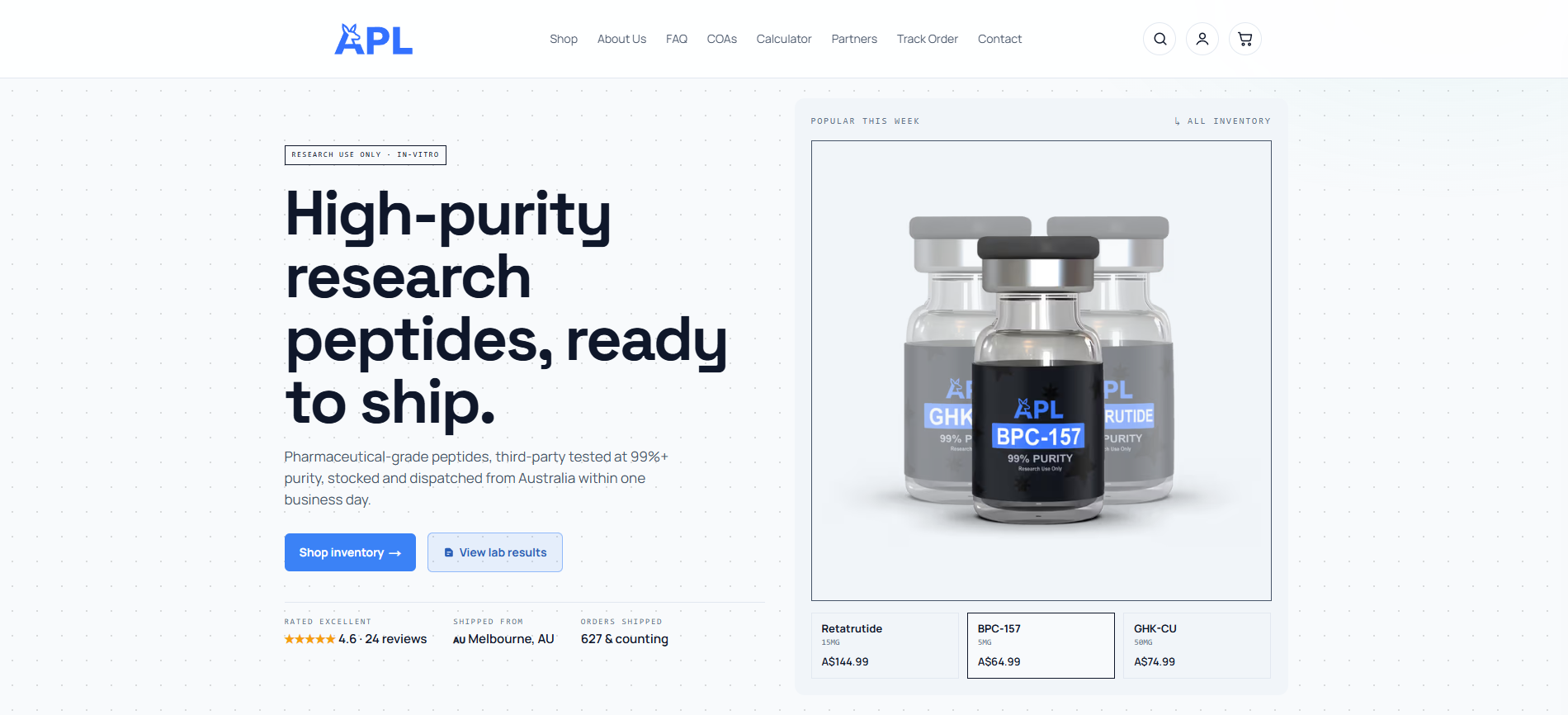
The full COA library is publicly accessible, with Janoshik verification links available for each batch. Scheduling status is listed on every product page, supporting compliant procurement for researchers and clinicians. Aupeptidelabs holds a verified customer satisfaction rating of 4.6/5. You can browse the full catalogue and place an order directly at Aupeptidelabs. For Schedule 4 compounds such as Sermorelin, confirm your prescription pathway before ordering.
FAQ
What are the most important criteria in peptide reviews Australia?
The three most important criteria are verified customer ratings above 4.5/5 with 100 or more reviews, publicly accessible COAs with Janoshik portal verification, and confirmed local Australian fulfilment with TGA-compliant scheduling disclosures.
Which peptides require a prescription in Australia?
BPC-157, Ipamorelin, and CJC-1295 are classified as Schedule 4 substances under TGA regulations since 2023. They require a valid Australian doctor's prescription and must be dispensed through a registered compounding pharmacy.
How do I verify a peptide COA is genuine?
Enter the report number from the COA directly into the Janoshik verification portal. A genuine report will return matching purity, batch, and test date data. A PDF without a portal link cannot be independently confirmed.
Is it legal to import peptides into Australia without a prescription?
Importing Schedule 4 peptides without a valid Australian prescription is unlawful under the Therapeutic Goods Act and risks customs seizure. Unscheduled peptides occupy a different category and may be sourced through compliant local vendors.
What does a 99% purity rating mean for research peptides?
A 99% purity rating means 99% of the measured compound is the target peptide, with 1% or less comprising impurities or degradation products. This standard is required for reproducible research outcomes and is confirmed through HPLC or mass spectrometry testing.