
Insulin syringes can deliver laboratory‑acceptable accuracy for small reagent and peptide volumes, but only when barrel capacity is matched to the target dose and the result is verified by gravimetric checks. Accuracy at this scale depends on two variables: the syringe's own engineering (dead space, graduation resolution) and the operator's technique. Skip verification and you're trusting marketing copy, not measurement.
What determines insulin syringe accuracy at microvolume scale
Product datasheets list capacity and needle gauge, but the numbers that actually govern delivered volume at the microlitre scale rarely get top billing.
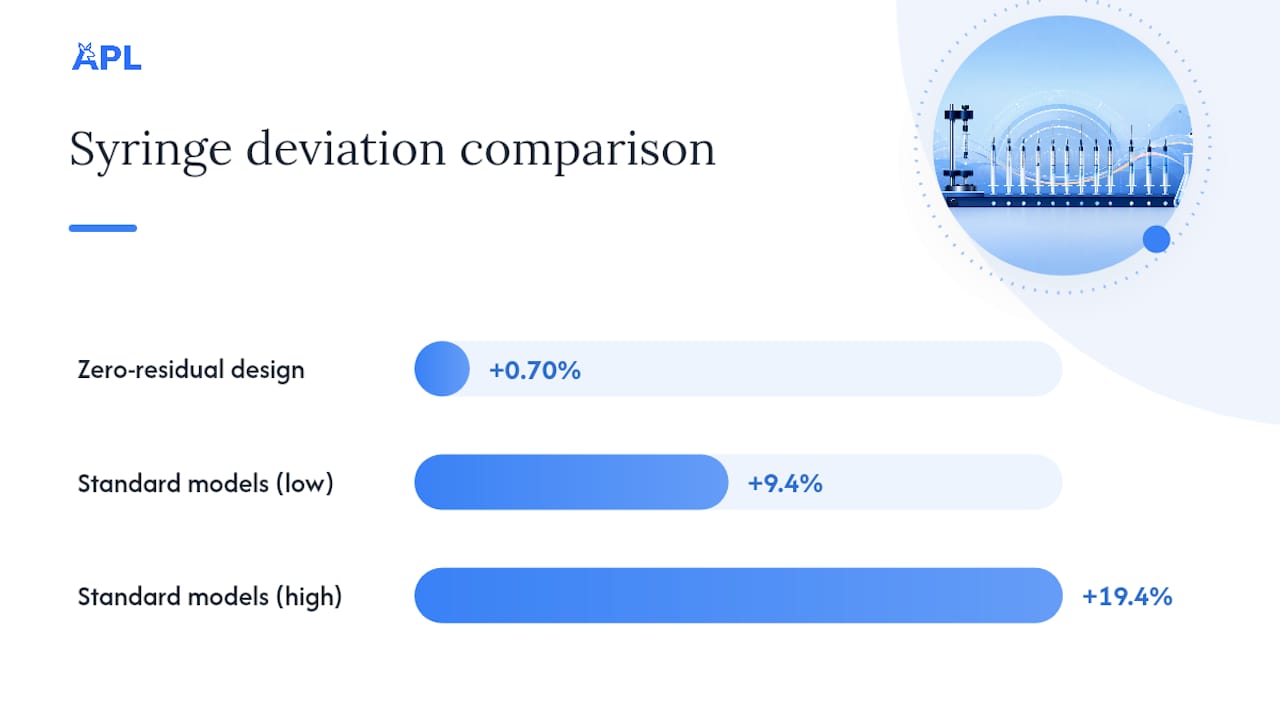
Dead space (residual volume) is the liquid trapped in the needle hub and syringe tip after the plunger bottoms out. It barely matters when drawing 5 mL of buffer. At 30–50 µL, it can represent a meaningful fraction of the dose. A comparative study of commonly used syringes measured percentage deviation across models delivering 50–70 µL doses and found "Zero Residual" silicone oil‑free designs landed at roughly +0.70% deviation from target, while several standard models drifted between 9.4% and 19.4% overdeliver. That's not a rounding error in reagent work; it's the difference between a usable dilution series and one you have to discard.
Graduation resolution is the second lever. A 1 mL barrel graduated in 0.02 mL increments looks fine for full‑scale draws, but reading 40 µL against those lines invites parallax error and rounding bias. A 0.3 mL or 0.5 mL barrel puts that same 40 µL draw closer to mid‑scale, where the graduation lines are proportionally wider and easier to read precisely.
Material and coating matter too:
- Silicone oil‑free polypropylene barrels reduce liquid adhesion to the barrel wall, cutting variability between draws.
- Glass syringes offer excellent chemical inertness for reagent work but cost more and need washing between uses.
- Fixed needles eliminate the dead space in a needle hub luer joint; detachable needles add flexibility but add trapped volume.
Choosing between these isn't cosmetic. It's the first accuracy decision you make, before technique ever enters the picture.
Operator technique that changes accuracy in practice
Two technicians using an identical syringe can produce meaningfully different results, and the gap almost always traces back to a handful of habits.
- Hold the syringe vertically during aspiration. Tilting introduces air pockets near the plunger seal and skews the meniscus reading, particularly at sub‑50 µL volumes.
- Pre‑wet the syringe two to three times by drawing and expelling the target solution before the working draw. This coats the barrel wall and reduces the adhesion‑related variability that pipetting technique studies consistently flag as an underestimated error source.
- Prime the needle so no air sits between the tip and the liquid column.
- Aspirate slowly and pause one to three seconds before reading the graduation line. Rushing the read is one of the most common sources of insulin syringe errors in routine use.
- Avoid target volumes that sit right at the barrel base, where residual volume effects are proportionally largest.
For viscous solutions, glycerol‑heavy diluents or concentrated peptide stocks, consider a dilution step or reverse pipetting‑style dispensing rather than direct aspiration.
Pro Tip: Run your pre‑wetting cycles with the actual working solution, not water. Viscosity and surface tension differ enough between reagents that a water‑primed syringe won't behave the same way once you switch to your real sample.
Calibration and verification methods for the lab
Manufacturer specifications tell you what a syringe is designed to do. Gravimetric verification tells you what it actually does in your hands, with your reagent, on your bench. That distinction is the entire basis of insulin syringe calibration practice.
The method is straightforward: draw the target volume, dispense it into a pre‑weighed vessel on an analytical balance, and convert the mass to volume using the solution's density. Repeat across ten to fifteen draws, then calculate the mean, the percentage deviation from target, and the expanded uncertainty. Gravimetric protocols for microlitre volumes have achieved expanded uncertainties around 0.2–0.25% (k=2) at 10 µL for carefully selected glass and polypropylene syringes, evidence that microvolume precision is achievable when the protocol accounts for evaporation losses.
Set your acceptance criteria before you start testing, not after you see the numbers. Reasonable starting points:
- Percentage deviation within a few percent of target is reasonable for routine reagent work; tighter tolerances may be needed for quantitative peptide reconstitution. Re‑verification triggers typically include new syringe lot, new operator, or a defined periodic QA interval.
Even syringes with good precision (tight clustering of repeat draws) can carry a systematic bias, meaning every draw runs consistently high or low, according to comparative accuracy research. Routine gravimetric spot checks catch that bias before it contaminates a dataset.
If your gravimetric checks repeatedly fall outside acceptance limits, that's a signal to escalate to a traceable calibration service or move to a different device class entirely, rather than keep tolerating a syringe that isn't fit for the job.
How to choose an insulin syringe for peptide and reagent dosing
Procurement decisions should follow the measurement task, not the other way around. Before ordering, check the spec sheet against this list:
- Barrel capacity matched to target volume. For draws under 50 µL, a 0.3 mL or 0.5 mL barrel typically reads more precisely than the default 1 mL size, since the target volume sits closer to mid‑scale.
- Low dead space, silicone oil‑free construction. These consistently show the smallest residual volume and the tightest percentage deviation from target in comparative testing.
- Needle gauge and length suited to the transfer task. A finer gauge reduces trapped volume in the needle bore but can slow aspiration of viscous solutions, so match it to what you're actually drawing.
- Sterility and batch documentation. For anything feeding into a quantitative assay, insist on lot‑traceable, single‑use lab‑grade product rather than unverified stock.
The ISO standard for piston‑operated volumetric apparatus covering manually operated precision laboratory syringes sets out marking requirements and maximum permissible errors. It's worth requesting confirmation of compliance from any supplier before you standardise on a model.
For labs unclear on where insulin syringes fit against other small‑volume options, this comparison of insulin and tuberculin syringes and this guide to matching needle sizes to peptide research tasks cover the practical trade‑offs in more depth.
A quick SOP for an accurate micro‑draw and dispense
A short, repeatable protocol removes most of the variability that individual habits introduce. This sequence works as a starting SOP for reagent or peptide micro‑dosing.
- Confirm target volume and concentration against your calculation sheet before touching the syringe. If reconstitution is involved, check hygroscopicity notes for the peptide first, since moisture uptake shifts effective concentration.
- Pre‑wet the syringe two to three times with the working solution.
- Hold the syringe vertically, prime the needle, and aspirate slowly to the target graduation.
- Pause one to three seconds, confirm the meniscus against the graduation line, then dispense.
- Every ten to fifteen draws, run a gravimetric spot check to confirm the mean and variance sit inside your acceptance limits.
- Log the syringe lot number, operator, target volume, and gravimetric check result in the experiment record.
Pro Tip: Keep the gravimetric spot‑check data in the same log as your experiment results, not a separate QA file. When an assay produces an odd result months later, you want the calibration history sitting right next to it.
For handling and priming detail specific to reconstitution work, see this guide on choosing a reconstitution needle.
What most labs get wrong about syringe accuracy
Most accuracy problems traced back through a lab's SOP don't originate with the syringe at all. They originate with the assumption that a syringe rated for one purpose behaves identically at every volume across its barrel. It doesn't. A 1 mL insulin syringe is accurate at 0.8 mL and considerably less trustworthy at 0.04 mL, and no datasheet makes that scaling behaviour obvious to a new technician.
The second habit worth challenging is treating calibration as a one‑off event rather than an ongoing check. A syringe that passed a gravimetric verification on day one can still drift in practice if a new lot ships with a different needle hub tolerance, or if a new operator holds the barrel at a slightly different angle out of habit. Precision and accuracy are not the same property, and a device can be tightly reproducible while still running a consistent bias that only a repeated gravimetric check will catch.
If there's one adjustment worth making immediately, it's matching barrel size to the actual target volume rather than defaulting to whatever syringe is already sitting in the drawer. It costs nothing and it's the single biggest lever available before technique or calibration even enter the conversation.
— Dr. Authur
Sourcing verified insulin syringes for your lab
Aupeptidelabs stocks lab‑grade insulin syringes selected for the low dead‑space, silicone oil‑free characteristics that comparative testing consistently associates with lower percentage deviation from target volume. Every order ships from Australia within one business day, which matters when a QA verification schedule depends on having stock on the bench rather than in transit through customs.
Specification sheets and lot documentation are available on request for labs building out traceability records, and the team can advise on capacity and needle gauge matching for specific reagent or peptide dosing tasks. Customer satisfaction sits at 4.6/5 based on verified reviews, a reflection of consistent supply rather than a one‑off shipment. To order syringes matched to your target volume range or request technical documentation, visit the Au Peptide Labs store and specify your dosing requirements, or check the dedicated insulin syringe product page for current stock and specifications.
Sources
- Accuracy, precision, and residual volume of commonly used syringes for intravitreal injections
- Determination of micro‑litre volumes with high accuracy for flow cytometric blood cell counting
- Impact of pipetting techniques on precision and accuracy (Eppendorf user guide)
- Original article comparing accuracy, precision and residual volume of commonly used syringes