
For pharmaceutical-grade laboratory research in Australia, the most appropriate insulin syringes are single-use, sterile, non-pyrogenic devices constructed from polypropylene barrels with permanently attached stainless steel needles. Standard volumes include small, moderate, and standard sizes, with needle gauges suitable for a range of injection needs and lengths appropriate for superficial to deeper tissue delivery. Researchers must account for the distinction between U-100 insulin unit markings and absolute volumetric millilitre scales, as this calibration difference directly affects dosing accuracy when working with peptides or non-insulin reagents. Key features influencing reproducibility and safety include low dead space needle designs, advanced bevel geometry, silicone coatings, and comprehensive safety shielding.
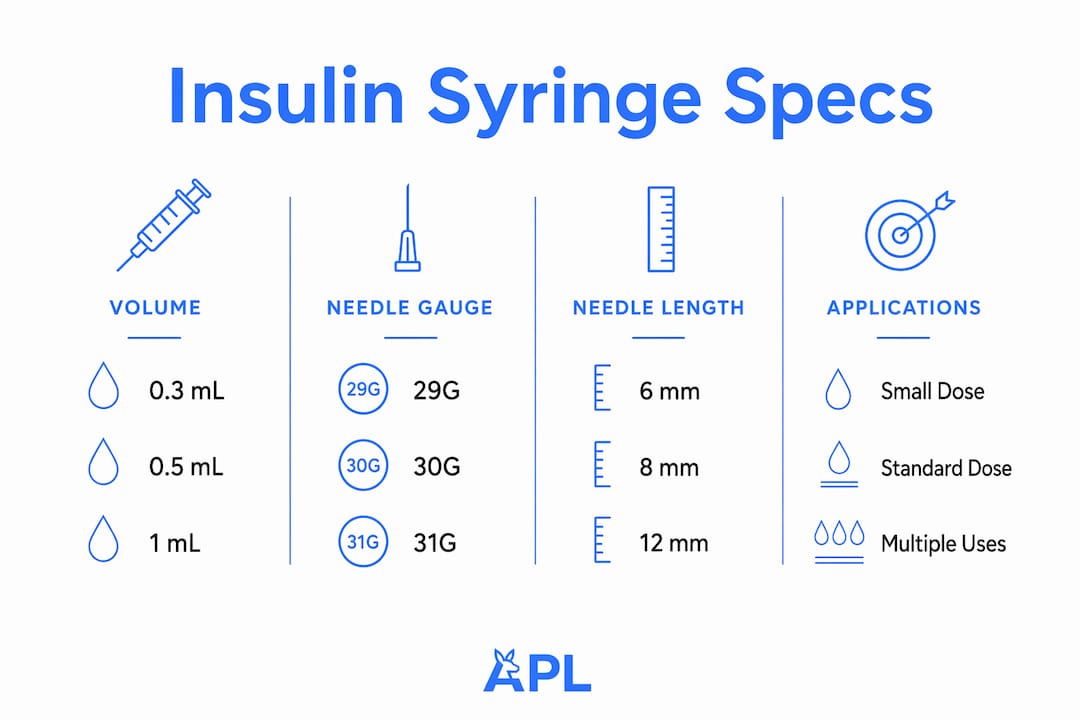
- Volumes: 0.3 mL for micro-dose precision, 0.5 mL for moderate volumes, 1 mL for standard peptide reconstitution doses
- Needle gauges: 27G–31G are standard; 30G–31G are preferred for delicate injections due to reduced tissue disruption
- Needle lengths: 8 mm (5/16") and 13 mm (1/2") are the main options for superficial and deeper tissue delivery, respectively
- Calibration: U-100 unit markings versus millilitre volumetric scales; verify which scale matches your research substance
- Construction: Polypropylene barrel, stainless steel needle, silicone lubricant coating, electromagnetically polished finish
- Safety: Barrel-based 360-degree needle shielding; permanently attached needle minimises dead space and contamination risk
- Sterility: Single-use, non-pyrogenic, individually packaged; not intended for re-use in any research setting
What technical specifications define insulin syringes for Australian lab use?
Standard configurations available in Australia feature commonly used volume-gauge-length combinations serving various research needs. Each volume serves a distinct research function: the 0.3 mL format suits micro-dosing protocols where sub-unit precision is required; the 0.5 mL format balances capacity with graduation resolution; the 1 mL format accommodates full reconstitution volumes typical in peptide research.
| Volume | Gauge | Needle length | Primary lab application |
|---|---|---|---|
| 0.3 mL | 30G–31G | 8 mm (5/16") | Micro-dose precision, small-animal studies |
| 0.5 mL | 31G | 8 mm (5/16") | Moderate-volume peptide dosing |
| 1 mL | 29G or 30G (8 mm), 29G (13 mm) | 8 mm (5/16") or 13 mm (1/2") | Standard reconstitution and reagent delivery |
U-100 calibration means each unit marking corresponds to 0.01 mL at that concentration. When dosing non-insulin substances, researchers must either convert to volumetric millilitre readings or confirm the syringe carries a parallel mL scale. Thin-wall needle construction improves flow rate without increasing outer diameter, preserving tissue integrity and reducing sample loss. Packaging formats range from individually wrapped units to boxes of 100, with sterility guaranteed until the original seal is broken.
How do safety and sterility requirements apply in Australian research labs?
Insulin syringes used in Australian laboratories must be single-use, sterile, and non-pyrogenic, consistent with national medical device standards governing pharmaceutical research settings. Re-use is not permissible under any research protocol.
- Barrel-based safety shielding: 360-degree needle protection activates post-injection, reducing needle-stick risk and simplifying downstream disposal
- Transport lock: Shield extends to a locked position for safe movement between bench stations without recapping
- Permanently attached needles: Eliminate the detachment risk that introduces contamination and increases dead space
- Needle surface treatment: Silicone coating and electromagnetic polishing reduce insertion drag, limiting experimental variability across repeated injections
- Disposal: Used syringes are classified as biomedical sharps waste; deposit directly into an approved sharps container immediately after use
- Storage: Retain syringes in original sterile packaging at controlled room temperature until the moment of use
Pro Tip: Never pre-draw reagents into syringes and store them assembled. Draw immediately before injection to preserve sterility and prevent reagent degradation or adsorption onto the barrel wall.
What quality factors determine measurement accuracy in research syringes?
Scale graduation precision and plunger tip alignment are the primary determinants of dosing reproducibility. Plunger tip alignment with scale markings ensures the volume read corresponds exactly to the volume delivered, a requirement that becomes critical when working with high-purity peptides where microgram-level accuracy affects experimental outcomes.
- Scale graduation resolution: Finer graduations (0.01 mL per division on a 1 mL syringe) reduce interpolation error between markings
- Plunger tip alignment: The flat leading edge of the plunger must align flush with the graduation line, not the rubber shoulder
- Needle attachment security: A permanently fixed needle prevents rotational play that would shift the dead space volume between injections
- Bevel geometry: Triple-faceted bevel needles produce a consistent puncture profile, reducing variability in injection resistance across replicates
- Silicone lubricant quality: Uniform coating prevents stick-slip plunger movement, which introduces dose-to-dose volume error
- Low dead space volume: Permanently attached needles minimise trapped liquid, conserving expensive peptide reagents across high-replicate protocols
- Barrel transparency: A clear polypropylene barrel allows visual confirmation of air bubble absence before injection
How do you match syringe type to peptides and lab reagents?
Syringe selection depends on the physical and chemical properties of the substance being dosed. U-100-calibrated syringes require volumetric conversion when used with non-insulin peptides; researchers working with substances reconstituted in bacteriostatic water should verify the mL scale is legible and accurate for their target dose. For guidance on reconstitution procedures, the bac water technical guide covers compatible diluents and volume calculations relevant to peptide research.
- Viscosity matching: Higher-viscosity reagents require a wider-gauge needle (27G–29G) to maintain flow without excessive plunger force
- Low dead space priority: For peptides exceeding 99% purity, minimising trapped volume in the needle hub is directly proportional to reagent conservation
- Material compatibility: Polypropylene barrels are chemically inert to most aqueous peptide solutions; verify compatibility for organic solvent-based reagents
- Scale verification: Confirm whether your dosing protocol specifies insulin units or absolute volume in microlitres before selecting a syringe format
- Volume selection: Use the smallest syringe volume that accommodates the full dose; larger barrels reduce graduation resolution per unit volume
Regulatory standards, storage, and disposal in Australian pharmaceutical labs
Australian pharmaceutical research laboratories operate under strict medical device compliance requirements. Syringes must carry documentation confirming sterility, single-use classification, and appropriate packaging integrity before use in any regulated research protocol.
- Regulatory compliance: Syringes must meet Australian medical device sterility standards, including single-use designation and intact original packaging at point of use
- Storage temperature: Maintain at controlled room temperature, away from direct light and humidity, in original sealed packaging
- Pre-use inspection: Check packaging integrity and expiry date; discard any unit with a compromised seal or visible particulate contamination
- Handling protocol: Use aseptic technique throughout; avoid touching the needle or plunger tip at any stage
- Sharps disposal: Deposit used syringes immediately into a compliant sharps container; never recap, bend, or shear needles
- Waste classification: Used insulin syringes are regulated as biomedical waste in Australian laboratories; disposal must follow institutional biosafety procedures and relevant state-level guidelines
- Documentation: Maintain records of syringe lot numbers and sterility certificates as part of research data integrity requirements
How do insulin syringes compare with other precision dosing devices?
Insulin syringes occupy a specific niche in the precision dosing spectrum. For needle selection in peptide research, the choice between insulin syringes and alternative devices depends on volume range, fluid viscosity, and required accuracy.
- Micropipettes: Suited to volumes below 1 mL in open-vessel transfers; lack needle delivery capability and are not appropriate for injection-based protocols
- Luer-lock syringes: Offer interchangeable needle compatibility and higher volume capacity, but lack pre-calibrated insulin unit scales and typically have greater dead space
- Automated dispensers: Provide high-throughput reproducibility for large sample sets but introduce equipment validation overhead and are cost-prohibitive for low-replicate studies
- Insulin syringes: Pre-calibrated scales, low dead space, permanently attached needles, and single-use sterility make them the preferred tool for sub-1 mL injection-based peptide dosing in pharmaceutical research
- Device selection criteria: Accuracy requirement, sample volume, fluid viscosity, safety classification, and cost per replicate collectively determine the appropriate device for each protocol
Understanding GLP-1 receptor agonist dosing requirements illustrates why syringe calibration precision matters: even small volumetric errors at the microgram scale can alter receptor-level outcomes in pharmacological studies.
Aupeptidelabs supplies research-grade syringes with same-day Australian dispatch
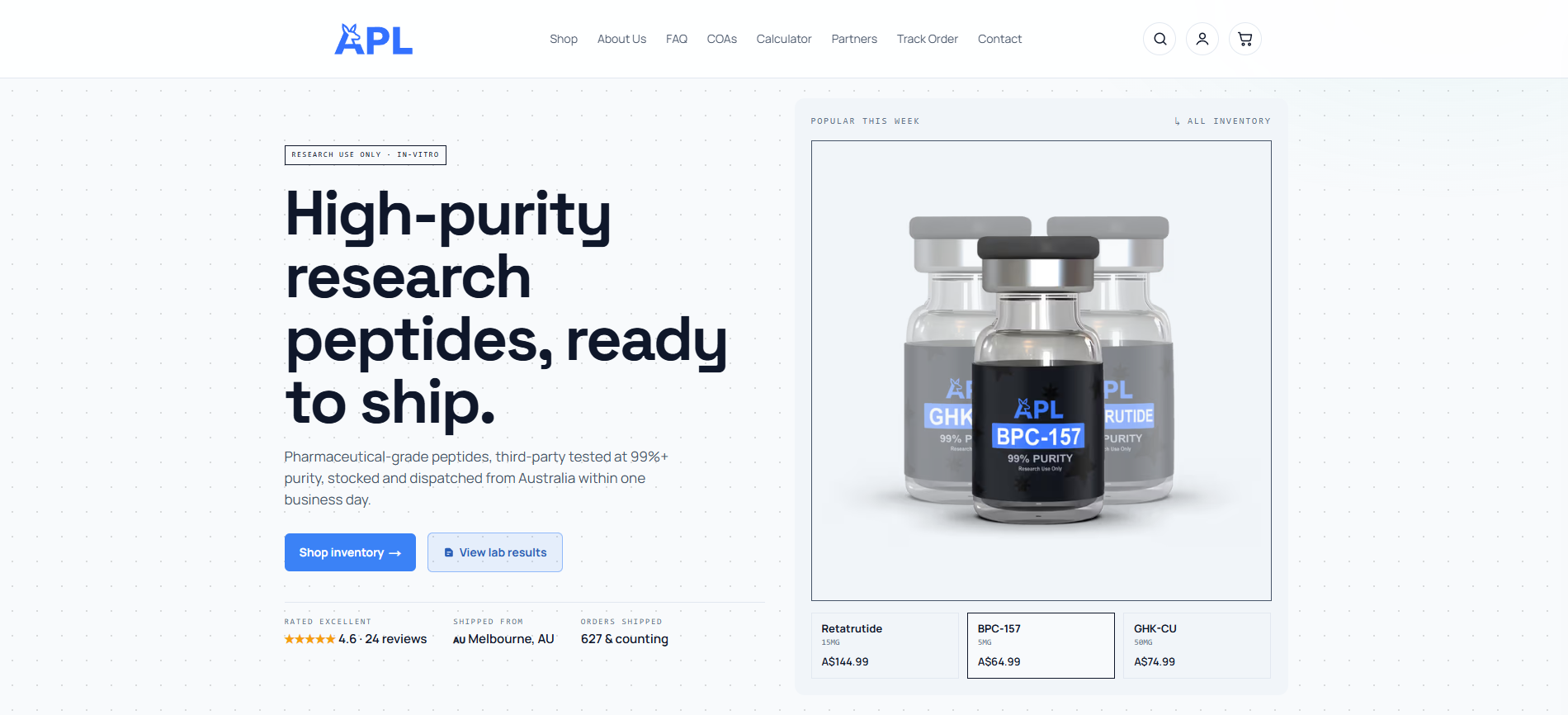
Aupeptidelabs stocks pharmaceutical-grade insulin syringes alongside its full catalogue of high-purity research peptides, all held in Australian inventory and dispatched within one business day. There are no customs delays, no minimum order thresholds for standard lines, and every peptide product ships with a third-party certificate of analysis confirming purity above 99%. Researchers sourcing both dosing equipment and peptide compounds through a single Australian supplier eliminate the procurement friction that slows protocol timelines. Visit Aupeptidelabs to browse the current inventory and place an order for next-business-day dispatch.