
Use an insulin syringe (U-100 calibrated) for subcutaneous insulin delivery and a 1 mL tuberculin syringe for intradermal procedures such as the Mantoux test. These two syringe types are not interchangeable for insulin dosing. Confusing them has produced documented 10× insulin overdoses in clinical settings, a risk acknowledged by the Therapeutic Goods Administration (TGA), the Australian Immunisation Handbook, and patient-safety bodies including the Pennsylvania Patient Safety Authority. Aupeptidelabs stocks research-grade insulin syringes for laboratory use within Australia.
| Feature | Insulin syringe | Tuberculin syringe |
|---|---|---|
| Intended use | Subcutaneous insulin delivery; research dosing | Intradermal Mantoux/BCG; small-volume mL injections |
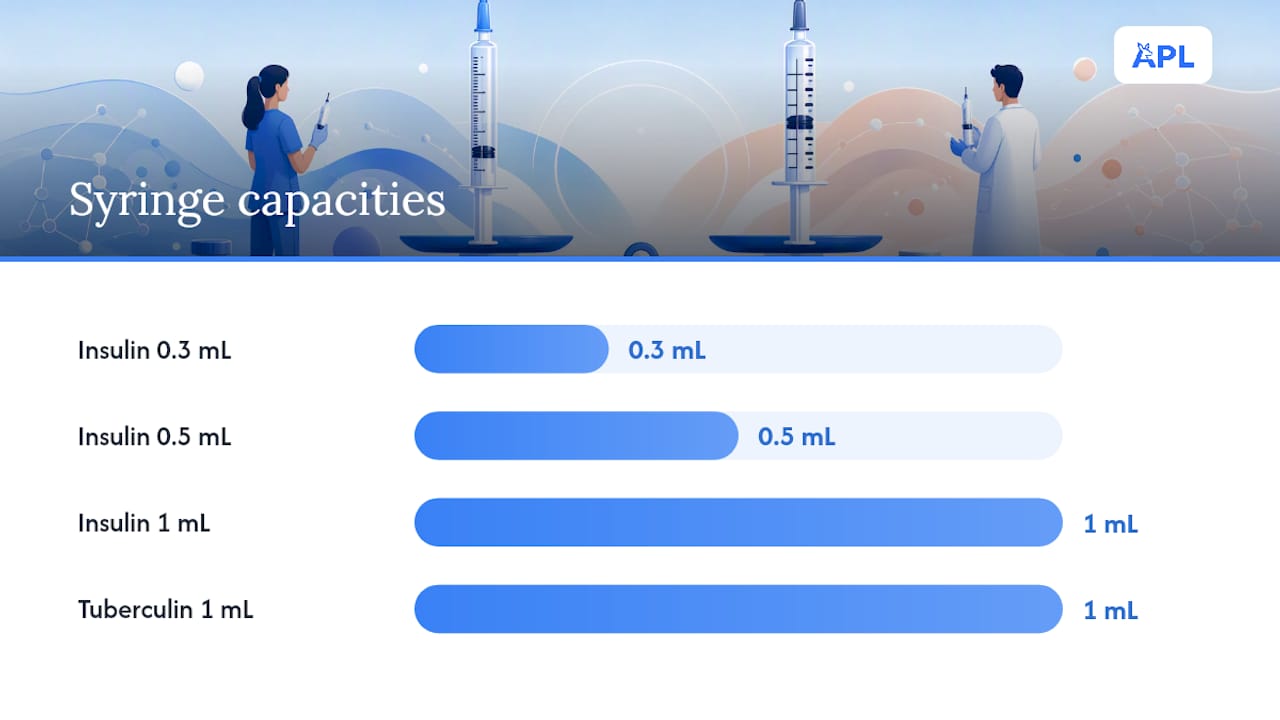
| Capacity | 0.3 mL, 0.5 mL, or 1 mL (30, 50, or 100 U) | 1 mL |
| Graduation markings | Insulin units (U-100 scale) | Millilitres (0.01 mL increments) |
| Needle gauge | 28–31G | 25–27G |
| Needle length | 5/16–1/2 inch | 1/2–5/8 inch |
| Injection route | Subcutaneous | Intradermal (primarily) |
What are insulin and tuberculin syringes actually used for?
The two syringe types serve distinct clinical purposes, and understanding those purposes is the first line of defence against selection errors.
Insulin syringe uses:
- Subcutaneous delivery of insulin in diabetes management, typically at abdominal, thigh, or upper-arm sites
- Self-injection by patients using fixed unit doses (30 U, 50 U, or 100 U capacity options)
- Short-needle configurations (5/16 inch) suited to paediatric patients or those with low body-fat mass
- Precise small-volume dosing in pharmaceutical and peptide research, where U-100 calibration allows reproducible sub-0.1 mL draws
Tuberculin syringe uses:
- Intradermal Mantoux tuberculin skin testing, where a precise 0.1 mL injection must raise a defined wheal
- BCG vaccine administration and other intradermal vaccine protocols per the Australian Immunisation Handbook
- Allergy skin testing and small-volume intradermal medication delivery in clinic settings
- Subcutaneous delivery of medications measured in mL rather than insulin units, where the 0.01 mL graduation provides adequate resolution
For laboratory researchers requiring insulin syringes in Australia, Aupeptidelabs supplies research-grade U-100 style syringes dispatched within one business day.
Why graduation markings matter more than you might expect
The calibration difference between these two syringe types is the direct cause of the most serious documented errors. Insulin syringes are graduated in insulin units on a U-100 scale, meaning 100 units occupies 1 mL of barrel volume. A 0.5 mL insulin syringe therefore holds 50 units, and each graduation mark represents a fixed unit count rather than a volume fraction.
Tuberculin syringes are graduated in millilitres, typically at 0.01 mL increments across a 1 mL barrel. When a clinician draws insulin into a tuberculin syringe and reads the mL markings as though they were unit markings, the dose delivered can be ten times the intended amount. The American Journal of Nursing documented this measurement risk explicitly, noting that the two measurement systems are not equivalent and that clinical caution is warranted whenever syringes of similar appearance are stored together.
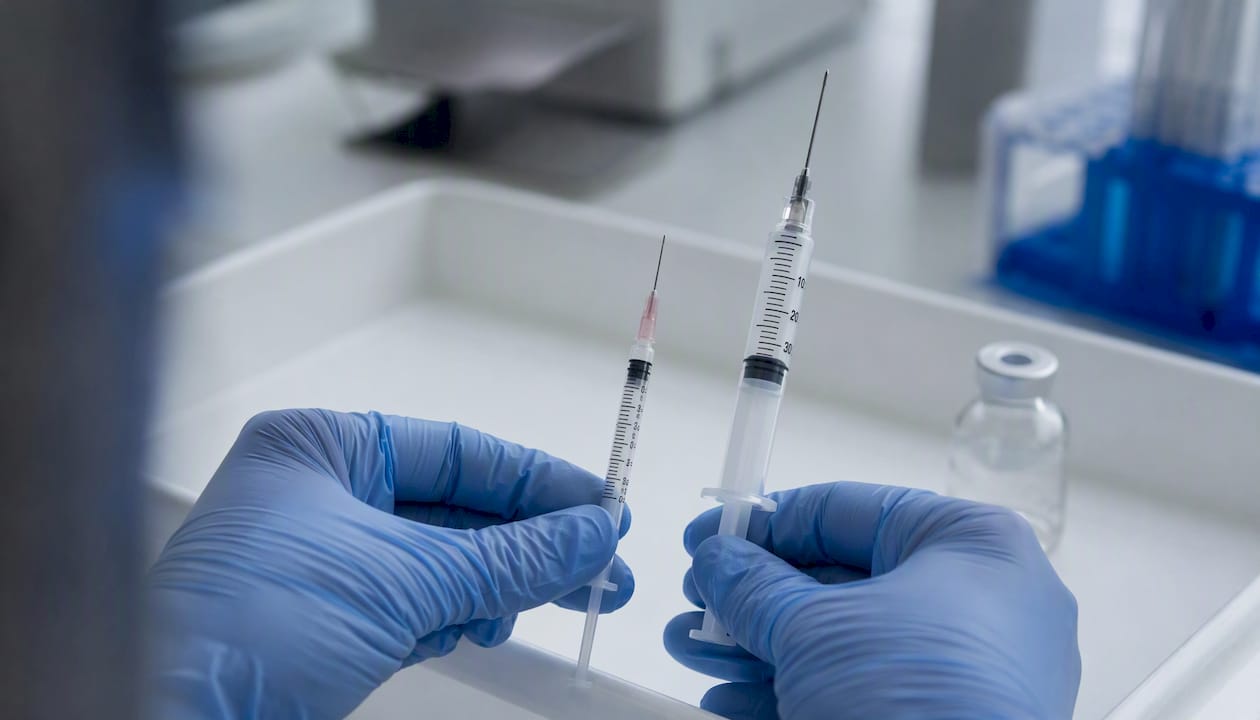
Pro Tip: Before drawing any dose, check the barrel for a 'U' marking and confirm the scale reads in units, not mL. A tuberculin syringe will show '0.1', '0.2', '0.3' along the barrel; an insulin syringe will show '10', '20', '30' (units). If the leading zero is present and the increments are decimal fractions, you have a tuberculin syringe.
Needle gauge and length: what the specifications mean for injection route
Needle gauge and length determine whether a syringe physically delivers medication to the correct tissue layer. Selecting the wrong gauge or length shifts the injection from subcutaneous to intramuscular or from intradermal to subcutaneous, altering pharmacokinetics and, in the case of the Mantoux test, invalidating the result.
| Syringe type | Gauge range | Needle length | Capacity | Injection route |
|---|---|---|---|---|
| Insulin | 28–31G | 5/16–1/2 in | 0.3–1 mL | Subcutaneous |
| Tuberculin | 25–27G | 1/2–5/8 in | 1 mL | Intradermal |
Insulin syringes use finer gauges (28–31G) to minimise discomfort during frequent subcutaneous self-injection. The shorter needle length keeps the tip within subcutaneous adipose tissue rather than penetrating muscle. Tuberculin syringes use a slightly coarser gauge (25–27G) and a longer needle to allow the bevel to sit precisely within the dermis at a shallow angle, producing the characteristic wheal of an intradermal injection. Nipro Australia's hypodermic syringe range illustrates how these specifications are standardised across locally available products. For a detailed breakdown of needle sizes for peptide research, the Aupeptidelabs technical overview covers gauge selection for sub-0.1 mL laboratory applications.
Can you use insulin and tuberculin syringes interchangeably?
The direct answer is no, not for insulin dosing. The Pennsylvania Patient Safety Authority documented multiple cases in which patients received ten times their prescribed insulin dose because a tuberculin syringe was used in place of an insulin syringe. The mL graduations on the tuberculin barrel were misread as unit markings, and the resulting overdoses required emergency intervention.
Patient safety advisory finding: Syringe mix-ups involving insulin and tuberculin syringes have caused serious, preventable harm. The Pennsylvania Patient Safety Authority identified lookalike packaging, shared storage locations, and inadequate labelling as the primary system-level contributors to these events, and recommended physically separating insulin supplies from tuberculin syringes as an immediate corrective measure.
The AHRQ PSNet case analysis identified additional environmental contributors: poor lighting, mixed stock in shared drawers, and staffing pressures that reduced verification time. Common error scenarios include:
- Tuberculin syringes stored alongside insulin syringes in a shared medication drawer
- Similar packaging colour or labelling font between product lines
- Staff unfamiliar with the unit/mL distinction selecting by barrel size rather than scale type
If there is any doubt about which syringe is in hand, discard it and obtain a clearly labelled insulin syringe before proceeding.
Australian regulatory guidance and safe sourcing
The TGA regulates syringes as medical devices in Australia, and syringe selection for clinical procedures is governed by the standards and protocols referenced in the Australian Immunisation Handbook, particularly for intradermal procedures such as the Mantoux test and BCG vaccination. The Handbook specifies needle gauge, length, and injection technique for each procedure, and those specifications should be followed rather than substituted with available stock.
Practical Australian safety recommendations include storing insulin syringes and tuberculin syringes in physically separate, clearly labelled locations; applying double-check procedures for all insulin doses as required by most Australian health service medication safety policies; and disposing of used sharps in a TGA-compliant sharps container, available through most local councils and pharmacies.
For research-grade insulin syringes, Aupeptidelabs supplies U-100 style syringes from within Australia, with same-day dispatch and discreet packaging. All products are for laboratory research only and are not for human or veterinary use. Researchers should verify sterility certification and manufacturer labelling on any syringe procured for laboratory work.
A note on syringe selection from the publisher
The confusion between insulin and tuberculin syringes is not a theoretical concern. Aupeptidelabs supplies research-grade insulin syringes to laboratories across Australia and recognises that correct syringe identification is a prerequisite for accurate dosing in any research workflow. The guidance in this article reflects the documented patient-safety literature and the calibration standards that apply equally in clinical and laboratory contexts.
All products supplied by Aupeptidelabs are for laboratory research purposes only and are not intended for human or veterinary use. Clinicians and patients with questions about syringe selection for clinical procedures should consult a registered health professional and refer to the Australian Immunisation Handbook and TGA guidance for authoritative procedural detail. Aupeptidelabs ships all orders from Australia within one business day, and all syringe products carry third-party purity and sterility documentation.
Research-grade syringes and supplies available from Aupeptidelabs
Researchers requiring precise small-volume dosing tools can source research-grade insulin syringes, alcohol wipes, and compatible laboratory supplies directly through Aupeptidelabs, with Australian fulfilment and same-day dispatch.
Aupeptidelabs stocks U-100 style insulin syringes suited to sub-0.1 mL laboratory dosing, alongside bacteriostatic water and alcohol wipes for complete research preparation workflows. All products are pharmaceutical-grade, third-party tested, and dispatched from within Australia, removing customs delays that affect international suppliers. Products are for laboratory research only and are not for human or veterinary use; researchers should follow TGA and applicable institutional guidance for all laboratory procedures.
Browse the full range of research peptides and laboratory supplies at Aupeptidelabs, or go directly to the insulin syringe product page to review specifications and place an order.
This article provides general information only and is not a substitute for professional medical or clinical advice. Confirm current syringe selection and disposal requirements with the TGA, the Australian Immunisation Handbook, or a qualified health professional.
Authoritative sources and further reading
The following primary sources informed the clinical and safety content in this article. Clinicians are encouraged to consult local health service policy alongside these references.
- ncbi.nlm.nih.gov
- Interchangeable Syringes? : AJN, American Journal of ..
- Overdoses Caused by Confusion Between Insulin and Tuberculin Syringes
- It's All in the Syringe | PSNet
- Hypodermic Syringes — Nipro Australia
- Tuberculin vs Insulin Syringe: Differences, Sizes & Uses
- Student Question : Describe the differences between insulin syringes and tuberculin syringes. | Health Studies | QuickTakes
- Buy Insulin Syringes Australia | Au Peptide Labs
Clinicians should consult the Australian Immunisation Handbook (immunisationhandbook.health.gov.au) and applicable local health service medication safety policies for procedural detail on intradermal and subcutaneous injection technique. The TGA's medical device guidance covers syringe classification and supply standards applicable to Australian purchasers.