

For routine subcutaneous peptide and insulin dosing in research settings, 31G–32G needles at 4–6 mm length represent the standard starting specification. This combination reliably reaches the subcutaneous layer while minimising tissue trauma and reducing the risk of inadvertent intramuscular injection, a critical consideration when protocol reproducibility depends on consistent absorption. Insulin needle sizes across the common range span a variety of gauges and lengths typically suitable for subcutaneous dosing; for most peptide research applications, the upper end of that gauge range and the shorter end of the length range are the appropriate defaults.
Key procurement and protocol defaults for Australian research labs:
- Gauge selection: Higher gauge numbers indicate thinner needles. 31G–32G needles offer a thinner profile associated with reduced tissue trauma and improved comfort during repeated subcutaneous administration.
- Length selection: Prefer 4–6 mm lengths for subcutaneous delivery. Needles ≤6 mm reduce the risk of inadvertent intramuscular injection across a range of body compositions, simplifying SOP design.
- Barrel selection: Match barrel capacity to dose volume. Use 0.3 mL, 0.5 mL, or 1 mL barrels matched approximately to your dose volume. Smaller barrels have wider unit markings, which helps improve measurement precision for smaller volumes.
- Purity and traceability: For Australian procurement, confirm lot-specific certificates of analysis (COA) and domestic dispatch to avoid customs delays and maintain supply continuity.
Pro Tip: Clinical guidance recommends selecting needle size on a case-by-case basis and using the shortest, thinnest needle that achieves consistent delivery. For peptide research, apply this principle at the protocol level: specify gauge and length per compound and concentration, not as a single lab-wide default.
Quick reference: insulin syringe sizes by gauge and length
| Gauge × Length | Typical research use | Notes | Procurement note |
|---|---|---|---|
| 32G × 4 mm | Routine subcutaneous peptide dosing; low-viscosity solutions | Thinnest common profile; minimal tissue trauma; may slow aspiration of viscous reconstitutions | Preferred for 31G–32G short-needle protocols |
| 31G × 4 mm | Subcutaneous peptide and insulin dosing; standard lab SOP | Slightly higher flow than 32G; reliable subcutaneous delivery | Good general-purpose specification |
| 31G × 6 mm | Subcutaneous dosing where 4 mm is insufficient for tissue depth | Still within the recommended ≤6 mm range; low IM risk | Suitable for varied subject morphology |
| 29G × 6 mm | Viscous reconstituted peptides requiring easier aspiration | Thicker bore assists draw-up; slightly higher insertion force | Specify when reconstitution viscosity is confirmed |
| — | Higher-volume or higher-viscosity applications | Increased IM risk at 8 mm; use only when protocol explicitly requires | Avoid for routine subcutaneous work |
Barrel-to-unit matching (U-100 standard): 0.3 mL barrels hold a smaller dose volume, while 0.5 mL and 1 mL barrels hold progressively larger doses consistent with standard U-100 insulin syringes.. Needle lengths exceeding 8 mm carry a materially higher risk of intramuscular delivery and should not appear in routine subcutaneous peptide protocols without explicit justification.
How do you choose the right needle gauge, length, and barrel?
Selecting the correct combination of gauge, length, and barrel capacity follows a logical sequence that begins with the dose, not the hardware.
Step 1: Convert dose to volume. Using the U-100 standard (100 units = 1 mL), calculate the draw volume in mL by dividing the dose in units by 100. For peptides reconstituted at a known concentration (e.g., mg/mL or mcg/mL), divide the target dose by the concentration to obtain mL, then multiply by 100 to read the syringe in units.
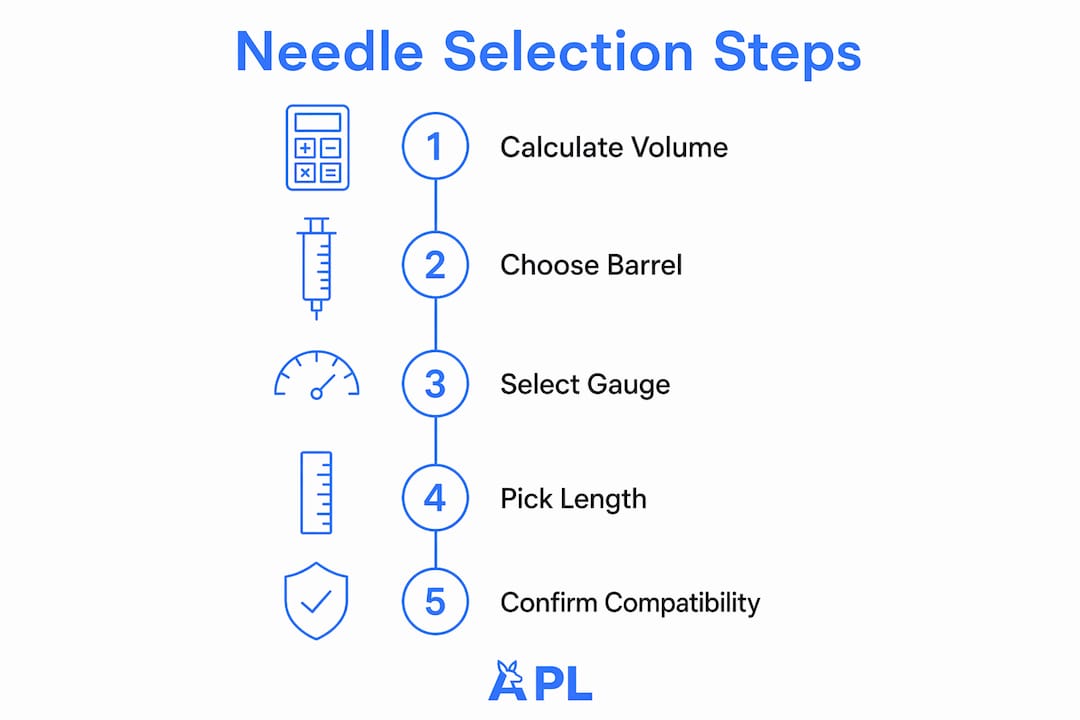
Step 2: Select the smallest adequate barrel. Choose the smallest barrel that accommodates the full draw without overfilling. A 0.3 mL barrel suits draws up to 30 units; a 0.5 mL barrel covers 31–50 units; a 1 mL barrel is appropriate for volumes above 50 units. Smaller barrels produce wider spacing between unit marks, which materially reduces measurement error on microvolume draws.

Step 3: Select gauge and length. For subcutaneous delivery, specify the shortest needle length that reliably reaches the subcutaneous layer. The 4 mm length is considered the safest universal option for avoiding intramuscular injection; 5–6 mm lengths are appropriate when protocol or subject morphology requires it. Pair with 31G–32G for routine low-viscosity peptide solutions.
Step 4: Verify hub and compatibility. Confirm that the needle hub matches the syringe tip type (fixed-needle vs luer-lock). For very small draws, specify low dead-space assemblies to minimise compound loss.
- Doses above 50 units: use a 1 mL barrel and consider 6 mm needle lengths to avoid dose splitting.
- Viscous reconstitutions: a slightly lower gauge (29G) may be required for practical aspiration without excessive draw time.
- Always confirm the printed increment on the barrel before use; some 1 mL barrels use 2-unit steps.
Pro Tip: When working with viscous reconstituted peptides, draw up slowly and allow the solution to equilibrate to room temperature before aspiration. Forcing a viscous solution through a 32G needle under pressure can introduce air and compromise dose accuracy.
Why does syringe barrel size affect measurement precision?
Barrel selection is the primary determinant of measurement accuracy for low-volume peptide work, and the mechanism is straightforward. Under the U-100 convention, 100 units occupies exactly 1 mL of volume, meaning 1 unit equals 0.01 mL. A 0.3 mL barrel distributes 30 unit marks across the same physical length that a 1 mL barrel uses for 100 marks. Each graduation is therefore physically wider on the smaller barrel, reducing the ambiguity of reading between marks.
- 0.3 mL barrel: Holds 30 units; typically graduated at 1-unit or 0.5-unit increments. Recommended for draws ≤30 units where maximum precision is required.
- 0.5 mL barrel: Holds 50 units; typically graduated at 1-unit increments. Appropriate for 31–50 unit draws; precision is reduced relative to the 0.3 mL barrel but remains adequate for most peptide protocols.
- 1 mL barrel: Holds 100 units; many 1 mL barrels use 2-unit increments, which can introduce reading error on small draws. Reserve for volumes exceeding 50 units or when the protocol explicitly requires it.
Always read the printed scale on the specific barrel before committing to a specification. Increment patterns vary by manufacturer, and a 1 mL barrel with 2-unit steps is a meaningful source of dosing error when working with sub-10-unit peptide draws.
Safety, handling, and sharps disposal for Australian research labs
All insulin syringes and needles used in Australian research settings are single-use items. Reuse compromises sterility, degrades the needle's silicone coating, and introduces dosing error through dead-space contamination.
- Single-use policy: Discard each needle and syringe assembly immediately after use. Never recap a used needle by hand; use a one-handed scoop technique or a mechanical recapping device if recapping is required before disposal.
- Sharps disposal: Follow your institution's biosafety procedures and the relevant state health authority guidelines. Use approved sharps containers rated to Australian standards, and arrange collection through a licensed clinical waste contractor.
- Labelling and storage: Maintain research-use-only labelling on all items. Keep needles and syringes in manufacturer sterile packaging until the point of use; store at the temperatures specified on the packaging to preserve coating integrity and sterility.
- Research-use-only restriction: All insulin syringes and needles procured for laboratory research are strictly for in vitro and animal model research use. They are not for human or veterinary clinical use.
Shorter needles (≤6 mm) are recommended to reduce the risk of inadvertent intramuscular injection and to deliver reliably to the subcutaneous layer. Any change in delivery device or needle specification within an active protocol should be treated as a variable requiring validation, as absorption characteristics may differ between assemblies.
Needle and syringe materials, dead-space, and hub compatibility
Dead-space is the volume of fluid retained in the needle hub and barrel tip after the plunger reaches its stop. For small-volume peptide draws, this residual volume represents a proportionally significant compound loss. Low dead-space syringes, where the needle is fused or permanently bonded to the barrel, eliminate most of this retention and are the preferred specification for draws below 20 units.
- Dead-space: Specify low dead-space (fixed-needle or integrated-hub) assemblies for microvolume peptide work. Standard luer-lock assemblies retain a small but non-trivial volume in the hub that can skew dose delivery on sub-0.1 mL draws.
- Materials: Standard insulin syringes use stainless steel needles and polypropylene barrels. For protocols requiring pyrogen-free or low-particulate specifications, request the relevant certificate from the supplier at the time of order.
- Hub compatibility: Confirm that the needle gauge and hub type are rated for the barrel volume specified. Pre-assembled insulin syringes (fixed-needle) are generally the most reliable option for subcutaneous peptide work; luer-lock assemblies offer flexibility but require confirmation of a secure, leak-free connection before each use.
- Coating integrity: The silicone lubrication on the needle tip degrades with repeated insertion. Single-use practice preserves this coating and maintains consistent insertion force, which is relevant when standardising injection technique across a protocol.
For needle selection guidance specific to peptide research, including practical recommendations on avoiding intramuscular administration, Aupeptidelabs maintains a dedicated technical resource on its blog.
Procurement priorities and specification checklist for Australian labs
Procurement officers specifying insulin syringes and needles for peptide research should treat the following as a minimum checklist for each purchase order.
Gauge and length must be specified explicitly (e.g., 31G × 4 mm), not left to supplier discretion. Barrel capacity should be matched to the dose range in the active protocol, with multiple barrel sizes held in inventory when doses fluctuate. Low dead-space assemblies should be the default for any draw below 20 units. All items must be sterile, single-use, and individually packaged.
For Australian procurement specifically, domestic stock and same-business-day dispatch are material requirements. Customs delays on imported sharps can disrupt active protocols; sourcing from an Australian warehouse eliminates this variable. Lot-specific COAs should accompany every order to support audit trails and reproducibility documentation. Rotate stock by lot number and label all research-use-only items clearly at the point of receipt.
On cost versus performance: for routine low-volume peptide work, the marginal cost difference between standard and low dead-space 31G–32G assemblies is small relative to the compound cost being dosed. Prioritise low dead-space and short fine-gauge needles to preserve sample integrity and improve inter-run consistency.
Research-grade syringes and peptides, dispatched from Australia
Aupeptidelabs supplies pharmaceutical-grade research peptides and research insulin syringes with lot-specific COAs, domestic Australian dispatch, and procurement support for single packs, bulk orders, and custom fulfilment. All products are labelled research-use only and are not for human or veterinary clinical application.
Every order is dispatched from the Australian warehouse within one business day, removing customs delays from the supply chain and supporting protocol continuity. Purity levels exceed 99% across the peptide inventory, verified by third-party analysis. Aupeptidelabs holds a verified customer satisfaction rating of 4.6/5. For exact SKU details, unit counts, and technical specifications on syringe assemblies, visit the Aupeptidelabs product catalogue and confirm the specification against your current SOP before placing a bulk order.
This article provides general laboratory information only and does not constitute medical, veterinary, or clinical advice. Researchers should confirm applicable biosafety, waste disposal, and regulatory requirements with their institutional biosafety officer and the relevant state health authority.
Authoritative sources for protocol and procurement decisions
The following references support SOP language, procurement justification, and protocol design for Australian research labs working with insulin syringes and peptide dosing.
- Formulary MK / Third Injection Technique Workshop guidance: Clinical recommendations on needle length selection, subcutaneous vs intramuscular delivery risk, and case-by-case gauge selection. Directly applicable to SOP language for subcutaneous peptide protocols.
- Medical News Today (insulin syringe sizes): Clear explanation of U-100 barrel conversions, unit markings, and barrel selection rationale for low-volume draws.
- Healthline (insulin pen needles and syringe sizes): Practical overview of needle length ranges (4–12 mm), gauge options (29G–32G), and the evidence base for shorter needle lengths across body types.
- InjectBuddy syringe capacity guide: Detailed breakdown of 0.3 mL, 0.5 mL, and 1 mL barrel increments and precision trade-offs; useful for specifying barrel type in SOPs.
- Australian state health authorities and institutional biosafety offices: The primary source for sharps disposal requirements, clinical waste contractor approval, and research-use compliance in your jurisdiction. Consult your institution's biosafety office directly for current state-specific requirements.
- Aupeptidelabs COA and product documentation: Lot-specific certificates of analysis, storage specifications, and technical data for research peptides and syringe assemblies are available directly from the supplier. Retain COAs and lot numbers with each batch record to support reproducibility and audit requirements.