
TL;DR:
- HPLC is ideal for routine purity and potency testing, while LC-MS offers molecular identity confirmation and trace detection. Using both in an integrated workflow ensures regulatory compliance and enhances analytical confidence when needed.
Use HPLC for routine quantitative purity and potency testing; use LC-MS (or LC-MS/MS) when you need molecular identity confirmation, trace-level detection, or structural information from complex matrices. The two techniques differ fundamentally in detection principle: HPLC measures light absorbance or refractive index, while LC-MS measures mass-to-charge ratio (m/z), giving it a molecular fingerprint that UV detectors cannot provide. Sensitivity thresholds reflect this gap: HPLC operates reliably at relatively higher concentration levels, LC-MS reaches much lower concentration levels, and LC-MS/MS extends to even more sensitive detection limits.
Quick decision guide:
- Stick with HPLC when the task is routine QC, batch release purity, potency assays, or any high-throughput application where validated UV quantitation is sufficient and budget is a constraint.
- Move to LC-MS when you need identity confirmation, must resolve co-eluting impurities by mass, or are working at trace concentrations in biological or environmental matrices.
- Run both in an integrated workflow when regulatory expectations require both quantitative purity (HPLC) and identity confirmation (LC-MS), as is standard practice for pharmaceutical-grade peptide release.
How do HPLC and LC-MS compare side by side?
The table below maps the nine decision dimensions that lab managers and analytical chemists use most often when selecting a platform.
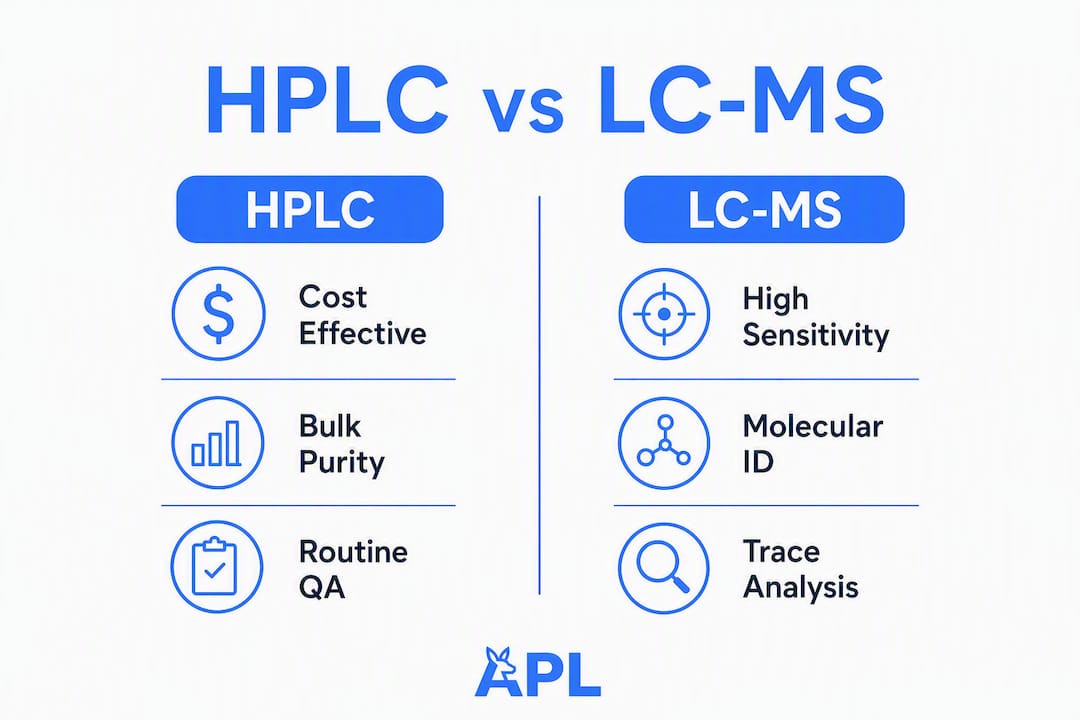
| Dimension | HPLC | LC-MS | LC-MS/MS |
|---|---|---|---|
| Detection principle | UV/PDA absorbance or refractive index | Mass-to-charge ratio (m/z) | Precursor → fragment ion transitions |
| Sensitivity / LOD | relatively higher | much lower | extremely low |
| Selectivity / specificity | Moderate; co-eluting peaks can interfere | High; molecular mass discrimination | Very high; structural fragment confirmation |
| Quantitation accuracy & dynamic range | Excellent; RSDs routinely under 0.5% | Good; requires internal standards for best accuracy | Excellent with isotope-labelled internal standards |
| Typical applications | Purity, potency, dissolution, QC release | Identity confirmation, metabolite ID, biomarker assays | Trace residue, clinical quantitation, pharmacokinetics |
| Capital & operating cost | Lower; AUD tens of thousands | Higher; AUD hundreds of thousands | Highest; plus MS/MS tuning and maintenance |
| Sample prep & consumables | 0.45 μm filtration; standard HPLC vials | 0.22 μm filtration; certified low-background vials | As LC-MS, plus stable isotope standards |
| Throughput & ease of use | High; well-automated; shorter training cycle | Moderate; source maintenance adds downtime | Lower; method development more complex |
| Validation / regulatory complexity | Well-established (ICH Q2); straightforward | Higher; internal standards, matrix effects, ion suppression must be addressed | Highest; full MS/MS transition validation required |
Three quick selection takeaways:
- If your primary question is "how much?" and the matrix is relatively clean, HPLC delivers faster, cheaper answers.
- If your primary question is "what is it?" or "is this the correct sequence?", LC-MS is the only reliable answer.
- For peptide release in a regulated context, the two platforms are complementary, not interchangeable.
How does HPLC work?
HPLC separates analytes by passing a pressurised mobile phase through a stationary-phase column, exploiting differential affinities between analyte molecules and the column packing material. The instrument chain runs: solvent reservoir → high-pressure pump → injector or autosampler → analytical column → detector → waste or fraction collector. Modern UHPLC systems extend this architecture with sub-2 μm particle columns and pressures exceeding 1,000 bar, delivering faster run times and sharper peak resolution without changing the underlying separation principle.
Detectors and what they measure
The UV/PDA detector is the workhorse of analytical HPLC. It measures absorbance at one or more wavelengths as analyte bands elute, and the area under each peak (AUC) is directly proportional to analyte concentration once the detector response is calibrated. A photodiode array (PDA) captures a full UV spectrum at every data point, which allows spectral purity confirmation and can flag co-eluting impurities that share a retention time but differ in their absorbance profile. Refractive index (RI) detectors are used for compounds with no UV chromophore, such as sugars and some polymers, but they are incompatible with gradient elution and are considerably less sensitive than UV.
Reading the chromatogram
A chromatogram plots detector signal against time. Peak retention time identifies the compound (relative to a reference standard); peak area or height quantifies it. Co-elution appears as a shouldered or asymmetric peak on a UV trace, and a PDA overlay can sometimes resolve whether two compounds are present. Routine HPLC precision is well-characterised, with RSDs often under 0.5% for well-optimised methods.
System suitability parameters to record for every QC run:
- Retention time reproducibility (RSD across injections)
- Peak symmetry factor (tailing factor ≤ 2.0 per USP convention)
- Theoretical plate count (N) for the main peak
- Resolution (Rs ≥ 1.5 between critical pairs)
- Signal-to-noise ratio for the LOQ standard
Pro Tip: Run a minimum of five replicate injections of the system suitability standard at the start of each sequence. If the RSD on peak area exceeds 1.0%, investigate the injector and column equilibration before proceeding with sample analysis.
How does LC-MS work?
LC-MS couples the separation power of liquid chromatography with the molecular identification capability of a mass spectrometer. The LC effluent passes through an ion source, where analyte molecules are converted to gas-phase ions, then into the mass analyser, which sorts those ions by m/z, and finally to a detector that records ion abundance. The result is a total ion chromatogram (TIC) overlaid with full mass spectra at every retention time point.
Ionisation and mass analysers
Electrospray ionisation (ESI) is the dominant interface for biological molecules, peptides, and polar compounds because it operates at atmospheric pressure and transfers intact molecular ions into the gas phase with minimal fragmentation. Atmospheric pressure chemical ionisation (APCI) suits less polar, thermally stable compounds. Once ionised, the mass analyser separates ions by m/z: quadrupole analysers are robust and well-suited to targeted quantitation; time-of-flight (TOF) instruments deliver high mass accuracy for molecular formula confirmation; Orbitrap analysers offer ultra-high resolution for complex mixture characterisation; ion traps enable multi-stage fragmentation (MS^n) for structural elucidation.

Tandem MS (MS/MS) selects a precursor ion of interest, fragments it in a collision cell, and monitors specific product ions. This selected reaction monitoring (SRM) or multiple reaction monitoring (MRM) approach dramatically improves selectivity and sensitivity, which is why LC-MS/MS reaches ppt detection limits in complex biological matrices.
Key MS terms
- m/z: mass-to-charge ratio; the fundamental measurement axis of a mass spectrum.
- Precursor ion: the selected parent ion submitted to fragmentation in MS/MS.
- Fragment ion: product ions generated from precursor fragmentation; used for structural confirmation.
- ESI: electrospray ionisation; produces multiply charged ions from large molecules such as peptides.
- Ion suppression: reduction in ionisation efficiency caused by co-eluting matrix components; the most common source of quantitative error in LC-MS.
Key insight: Viewing LC-MS as simply a more sensitive detector for an existing HPLC method is a common and costly mistake. LC-MS is a distinct analytical paradigm. Method development must account for mobile phase volatility, ionisation efficiency, matrix effects, and MS/MS transition optimisation — none of which are relevant to UV-based HPLC. Treating it as a drop-in upgrade typically results in ion suppression artefacts, ghost peaks, and unreliable quantitation.
Pro Tip: When developing an LC-MS method, always run a post-column infusion experiment to map ion suppression across the chromatographic run before finalising your gradient. This identifies retention time windows where matrix components suppress the analyte signal and allows you to adjust the gradient or sample clean-up accordingly.
What are the real sensitivity and selectivity differences?
Detection limits are not just numbers on a specification sheet; they determine whether a method can answer the analytical question at hand. HPLC sensitivity is generally at higher concentration thresholds, LC-MS offers significantly greater sensitivity, and LC-MS/MS provides the highest level of sensitivity among the three platforms.
Sensitivity tiers in practice
| Platform | Typical LOD | Practical context |
|---|---|---|
| HPLC (UV/PDA) | relatively higher levels | Bulk purity, potency, dissolution testing |
| LC-MS (single quad/TOF) | lower concentration levels | Identity confirmation, metabolite screening |
| LC-MS/MS (MRM) | extremely low concentration detection | Trace residues, clinical PK, environmental contaminants |
For peptide purity work in a pharmaceutical context, HPLC at ppm sensitivity is entirely adequate for reporting total impurity profiles above 0.1% (w/w). When the question shifts to confirming the molecular mass of a synthetic peptide or detecting a low-abundance degradation product at sub-ppm levels, LC-MS becomes necessary.
Selectivity is where the two platforms diverge most consequentially. A UV detector cannot distinguish two compounds that co-elute and share similar absorbance spectra; the chromatogram will show a single peak with a combined area, and the error may go undetected without a PDA spectral overlay. An MS detector resolves co-eluting compounds by their m/z values, provided their masses differ by more than the instrument's resolution. LC-MS/MS adds a second layer of selectivity through fragment ion monitoring, making false positives extremely rare even in highly complex matrices such as plasma or tissue homogenate.
Quantitation accuracy considerations:
- HPLC with external calibration is straightforward and well-validated; dynamic range typically spans three to four orders of magnitude.
- LC-MS quantitation is susceptible to matrix effects; isotope dilution using stable isotope-labelled internal standards is the preferred strategy for accurate quantitation in biological matrices.
- For trace quantitation in complex matrices, isotope dilution with stable isotope internal standards plus MS/MS monitoring offers the best accuracy and most effectively reduces matrix-effect bias.
What do HPLC and LC-MS actually cost to run?
HPLC is lower cost and faster to validate for routine QA/QC; LC-MS delivers specificity and trace detection but raises validation and competency requirements. That trade-off plays out across every budget line.
Capital and consumable costs
A standard analytical HPLC system sits in the lower tens of thousands of AUD for a basic isocratic or gradient system; a UHPLC with PDA detector adds to that figure but remains well within the reach of most university or contract laboratory budgets. An entry-level single-quadrupole LC-MS instrument starts in the mid-to-upper hundreds of thousands of AUD, and a triple-quadrupole or high-resolution LC-MS/MS system can exceed AUD 500,000 before installation, qualification, and service contract costs are factored in.
Running costs compound the difference. LC-MS systems require LC-MS grade solvents and stricter sample preparation, including 0.22 μm filtration and certified low-background vials, compared with the 0.45 μm filtration and standard HPLC vials acceptable for UV-based work. LC-MS grade acetonitrile and water carry a significant price premium over HPLC grade equivalents, and the volume consumed in a busy laboratory adds up quickly.
Hidden operational costs to budget for:
- Nitrogen or dry air generator for the ESI source (or cylinder supply and logistics)
- Stable power supply and dedicated air-conditioning for the MS instrument
- Annual service contract (typically 8–15% of instrument purchase price)
- Specialist training: LC-MS method development and data interpretation require skills beyond standard HPLC competency
- Tune solution and calibration standards for regular MS calibration
- Increased method development time, often two to four times longer than equivalent HPLC methods
When the extra cost is justified
The cost premium of LC-MS is justified when the analytical question cannot be answered by UV detection alone: identity confirmation of a synthetic peptide, detection of trace metabolites below HPLC LOD, multiplexed biomarker quantitation in plasma, or regulatory requirements that mandate mass confirmation. LC-MS can replace immunoassays in clinical laboratories because of higher specificity and the ability to quantify multiple analytes simultaneously, which can offset reagent and assay kit costs over time.
Pro Tip: Before committing to an LC-MS purchase, audit your method list for the proportion of assays that genuinely require mass detection. If a small portion of your routine workload needs very low-level sensitivity or identity confirmation, a contract laboratory arrangement for LC-MS work may deliver better value than in-house capital expenditure.
Sample preparation, consumables and troubleshooting
Sample preparation is where many LC-MS methods fail in practice, and the requirements are materially stricter than for HPLC.
Filtration and vial specifications
HPLC methods routinely use 0.45 μm syringe filters and standard borosilicate glass or polypropylene vials. LC-MS methods require 0.22 μm filtration to protect the ion source and column from particulates that would cause source contamination or column blockage at the higher pressures typical of LC-MS-compatible columns. Vials must be certified low-background: standard glass vials can leach plasticisers, silicone from septa, or metal ions that appear as ghost peaks or suppress ionisation at trace concentration levels.
Mobile phase compatibility
This is the single most common failure point when transferring an HPLC method to LC-MS. Non-volatile buffers used in HPLC, particularly phosphate and citrate salts, will deposit as crystals in the ion source, blocking the spray needle and causing rapid signal degradation. LC-MS methods require volatile mobile phase additives: formic acid (0.1%), acetic acid, ammonium formate (5–10 mM), or ammonium acetate are the standard choices. Replacing phosphate with ammonium formate often changes chromatographic selectivity, requiring re-optimisation of the gradient before the method transfer is complete.
Consumables checklist for LC-MS work:
- 0.22 μm PTFE or nylon syringe filters (certified low-extractable)
- Certified low-background glass vials with pre-slit PTFE/silicone septa
- Low-bleed LC-MS compatible column (check manufacturer's MS compatibility rating)
- LC-MS grade solvents (water, acetonitrile, methanol) from a certified supplier
- Volatile buffer salts only (ammonium formate, ammonium acetate, formic acid)
- Stable isotope-labelled internal standards for quantitative assays
Troubleshooting checklist:
- Ghost peaks: switch to certified low-background vials; replace septa; run a blank gradient and identify the retention time of the ghost peak to trace its source.
- Ion suppression: perform a post-column infusion experiment; adjust gradient to move the analyte away from suppression windows; add or optimise a sample clean-up step (protein precipitation, SPE).
- Source contamination: reduce injection volume; increase mobile phase flow rate through the source; schedule regular source cleaning per the instrument manufacturer's protocol.
- Column bleed: verify the column is rated for LC-MS use; reduce column temperature; check for column overload.
- Co-elution artefacts (HPLC): increase gradient steepness or change column chemistry; use PDA spectral overlay to confirm peak purity.
Pro Tip: Ghost peaks and ion suppression are frequently traced to low-grade vials and insufficient filtration rather than the instrument itself. Switching to certified consumables resolves the majority of these issues before any instrument intervention is needed.
When should you use HPLC, LC-MS, or both?
The choice of platform follows directly from the analytical question, the matrix, the required detection limit, and the regulatory context.
Application mapping
HPLC is the preferred platform for:
- Routine purity and potency assays in pharmaceutical QC and batch release
- Dissolution testing and content uniformity
- Stability-indicating methods where impurity profiles are tracked over time
- High-throughput screening where throughput and cost per sample are primary constraints
- Methods requiring straightforward ICH Q2 validation with UV calibration
LC-MS and LC-MS/MS are required for:
- Molecular identity confirmation and sequence verification of synthetic peptides
- Metabolite identification and profiling in drug metabolism studies
- Trace residue analysis in environmental, food safety, or clinical matrices
- Multiplexed biomarker quantitation in plasma or tissue
- Resolving co-eluting impurities that share UV absorbance profiles
Run both in an integrated workflow when:
- Regulatory submissions require both quantitative purity data (HPLC) and identity confirmation (LC-MS)
- A peptide batch passes HPLC purity but a suspect peak requires mass confirmation before release
- Method development requires HPLC to optimise chromatographic conditions before transferring to LC-MS detection
Decision checklist
Work through these five questions before selecting a platform:
- Required LOD: Is ppm sufficient, or do you need ppb/ppt? If ppm is adequate, HPLC is appropriate.
- Matrix complexity: Is the sample a clean standard solution or a biological/environmental matrix with co-eluting interferences? Complex matrices favour LC-MS.
- Regulatory requirement: Does the method need to provide identity confirmation or mass accuracy data? If yes, LC-MS is mandatory.
- Throughput and budget: How many samples per day, and what is the cost-per-sample tolerance? High throughput with tight budgets favours HPLC.
- Available expertise: Does the laboratory have trained LC-MS operators and a qualified method development scientist? LC-MS without adequate expertise produces unreliable data.
Understanding purity versus net peptide content is also relevant here: HPLC reports area-percent purity, while net peptide content requires a separate quantitative determination, and neither figure alone constitutes full identity confirmation.
Validation and regulatory considerations for regulated laboratories
Method validation requirements under ICH Q2(R1) apply to both HPLC and LC-MS, but the practical complexity differs substantially between the two platforms.
Core validation parameters and how they change
The six core parameters, accuracy, precision, specificity, LOD/LOQ, linearity, and robustness, are required for both platforms. Specificity is where the most significant difference arises. For HPLC-UV, specificity is demonstrated by showing that the analyte peak is resolved from known impurities and that the PDA spectral purity passes threshold. For LC-MS, specificity is demonstrated through mass accuracy, MS/MS transition confirmation, and the absence of interfering ions at the analyte m/z in a blank matrix. The latter requires a more extensive validation package, including matrix effect assessment and recovery experiments across multiple matrix lots.
Validation differences between HPLC and LC-MS:
- Precision: HPLC RSDs are typically tighter and easier to achieve; LC-MS precision depends heavily on internal standard performance.
- Linearity: Both platforms can achieve four to five orders of magnitude, but LC-MS dynamic range is more susceptible to matrix-dependent compression at high concentrations.
- Robustness: LC-MS methods are more sensitive to changes in mobile phase composition, source temperature, and instrument tuning; robustness testing must cover these parameters explicitly.
- System suitability: LC-MS system suitability must include MS-specific parameters (mass accuracy, signal-to-noise for the MRM transition) in addition to chromatographic parameters.
Regulatory expectations for Australian GMP laboratories
Australian laboratories operating under the Therapeutic Goods Administration (TGA) framework and GMP guidelines must maintain data integrity records, instrument qualification logs, and personnel competency records for all analytical methods. LC-MS methods carry a higher change-control burden: any modification to ionisation parameters, MRM transitions, or mobile phase composition constitutes a method change requiring re-validation or at minimum a partial re-validation with documented justification.
Regulatory note: ICH Q2(R1) does not prescribe the detection technology; it prescribes the validation characteristics that must be demonstrated. When moving from HPLC-UV to LC-MS for a regulated method, the full specificity, matrix effect, and internal standard performance data must be generated and documented before the method is used for release decisions. A change in detection principle is not a minor method modification under most GMP frameworks.
Practical documentation requirements for Australian regulated labs:
- Instrument qualification records (IQ/OQ/PQ) for the LC-MS system
- MS-specific system suitability criteria in the analytical procedure
- Internal standard response ratio acceptance criteria in every analytical run
- Matrix effect and recovery data in the validation report
- Personnel training records demonstrating LC-MS competency for all operators
How Australian peptide labs integrate HPLC and LC-MS in practice
A well-designed peptide QC workflow uses HPLC and LC-MS at distinct, complementary stages rather than treating them as alternatives. The following stepwise approach reflects standard practice for pharmaceutical-grade peptide testing in Australian research and contract laboratories.
Stepwise release workflow
- Incoming material QC by HPLC: Every batch undergoes HPLC-UV or HPLC-PDA purity analysis. Area-percent purity is calculated, and the impurity profile is compared against the certificate of analysis. For research peptides such as TB-500 or VIP, a purity threshold of ≥99% by HPLC is the primary release criterion.
- Suspect peak flagging: Any peak above the reporting threshold (typically 0.1% area) that cannot be assigned to a known impurity triggers a targeted LC-MS investigation.
- LC-MS identity and mass confirmation: The molecular mass of the main component is confirmed by LC-MS using ESI in positive ion mode. For peptides, the multiply charged ion envelope is matched against the theoretical isotope pattern calculated from the amino acid sequence.
- Sequence verification (if required): For novel or complex peptides, LC-MS/MS fragmentation of the [M+nH]^n+ precursor generates a b/y ion series that confirms the amino acid sequence.
- Final release decision: HPLC purity data and LC-MS identity data are reviewed together. Both must meet acceptance criteria before the batch is released.
Aupeptidelabs applies this integrated approach across its inventory, with third-party purity certificates accompanying each batch and all products dispatched from Australia within one business day, eliminating the customs delays that complicate international procurement for time-sensitive research programmes.
Operational notes for Australian laboratories
Local supply of LC-MS grade solvents is available through major scientific distributors operating in Australia, including Sigma-Aldrich (Merck), Thermo Fisher Scientific, and Chem-Supply. Turnaround for certified low-background consumables is typically two to five business days from metropolitan distribution centres. Laboratories in regional or remote locations should maintain a minimum four-week buffer stock of critical LC-MS consumables given longer freight lead times.
Pro Tip: When planning a peptide QC programme, run HPLC and LC-MS on the same sample preparation where possible. Using a volatile mobile phase (ammonium formate/formic acid) from the outset means the same sample and the same chromatographic run can feed both the UV detector and the MS detector in a single injection, halving sample consumption and reducing analysis time.
A practical perspective on method selection for Australian researchers
The most persistent error in analytical method selection is treating HPLC and LC-MS as a hierarchy, where LC-MS is simply the "better" instrument. They answer different questions. A laboratory that runs all its routine purity work on LC-MS because the instrument is available is spending more per sample, generating more complex data, and creating a larger validation burden than the analytical question requires. Conversely, a laboratory that relies solely on HPLC for peptide identity confirmation is producing data that cannot definitively distinguish a correctly synthesised peptide from a closely related analogue or a truncated sequence.
The practical recommendation for Australian research groups is to design the workflow around the question, not the instrument. Invest in HPLC automation and robust method validation for the high-throughput quantitative work that constitutes the majority of a QC laboratory's output. Reserve LC-MS capacity, whether in-house or through a contract laboratory, for the identity confirmation, trace detection, and structural elucidation tasks where it is genuinely irreplaceable. Training investment matters as much as instrument investment: an LC-MS operated by an undertrained analyst produces less reliable data than a well-maintained HPLC in competent hands.
For Australian labs procuring research peptides, the analytical quality of the starting material is a prerequisite for any downstream method to be meaningful. Sourcing from a supplier that provides third-party HPLC purity data and LC-MS identity confirmation with each batch removes one variable from an already complex analytical picture.
Sourcing research-grade peptides with verified analytical data
Aupeptidelabs supplies pharmaceutical-grade research peptides with purity exceeding 99%, verified by third-party HPLC analysis and accompanied by LC-MS identity certificates. All orders are dispatched from Australia within one business day, with no customs delays and discreet packaging as standard. For researchers who need analytically verified starting materials for HPLC or LC-MS method development, browse the full peptide catalogue or use the peptide dilution calculator to plan your sample preparation before analysis.
Authoritative references and further reading
The following sources support the technical content in this article and provide pathways for deeper method development and regulatory detail.
- Principles and applications of liquid chromatography-mass spectrometry in clinical biochemistry — PubMed Central; covers ESI ionisation, clinical LC-MS applications, and multiplexing advantages over immunoassays.
- The essence of modern HPLC: advantages, limitations, fundamentals, and opportunities — Chromatography Today; covers UHPLC advances, automation, and QC method validation frameworks.
- Liquid chromatography–mass spectrometry — Wikipedia overview; useful as a starting reference for instrument architecture and ionisation method comparisons.
- Purity versus net peptide content — Aupeptidelabs resource explaining how HPLC area-percent purity and net peptide content differ and why both figures matter for research applications.
- Peptide testing in Australia: approaches and alternatives — Aupeptidelabs blog article covering laboratory testing approaches relevant to method selection for peptide QC.