

Most Australian peptide orders dispatch the same business day when placed before the supplier's cutoff, with metro deliveries arriving in 1–2 business days, regional areas in 2–4, and remote postcodes in 3–7. The single most effective way to guarantee the fastest arrival is ordering before the cutoff and selecting express post. Payment verification, courier choice, and address accuracy determine everything else.
How order processing and same‑day dispatch actually work
Dispatch timing depends on what happens before the parcel ever reaches a courier. Payment clearance and identity or institutional verification are the two most common causes of delay, particularly for first‑time laboratory accounts that require billing confirmation before an order is released to the warehouse floor.
Many Australian peptide suppliers set a same‑day dispatch cutoff sometime between 2:00pm and 5:00pm AEST/AEDT on business days. Orders placed after that window, or on a weekend, roll over to the next business day's dispatch run. Public holidays push processing back further, since most warehouses simply don't pack or hand off to couriers on those days.
Backorders and pre‑orders add another variable. If a peptide is awaiting fresh batch testing before its certificate of analysis is finalised, dispatch waits for that COA, not the other way around.
A few habits keep orders moving without friction:
- Use an approved billing method already linked to your institutional account.
- Place time‑sensitive orders well ahead of the daily cutoff, not right on it.
- Confirm your shipping address matches your account details exactly.
- Flag urgent orders to the supplier directly if a batch is on backorder.
What are realistic delivery windows across Australia?
Delivery speed comes down to two things: how fast the order leaves the warehouse, and which courier service carries it from there. Australia Post's typical reference ranges sit at 2–8 business days for standard post and 1–3 business days for express, though actual transit shifts with location and seasonal parcel volume.
Typical delivery windows by region:
- Metro (capital cities): often 1 business day on express, 1–2 on standard.
- Regional centres: 2–4 business days, standard or express.
- Remote postcodes: 3–7 business days, with contingencies for weather or courier network gaps.
Statistic callout: When same‑day dispatch is paired with express post, metro deliveries commonly arrive the next business day. That combination is the fastest reliable path available to Australian labs, short of local pickup.
Peak periods (end of financial year stock‑ups, pre‑Christmas ordering) stretch every one of these windows by a day or two, simply because courier networks are handling higher volumes across the board. If your research timeline has no slack, build in that buffer rather than assuming best‑case transit every time. For a broader breakdown of how processing and transit interact, Aupeptidelabs' own shipping timeline guide is worth bookmarking.
How do shipping costs affect delivery speed?
Most Australian suppliers use a threshold model: a flat fee under a set order value, and free standard shipping above it (commonly somewhere in the $200 to $500 range, depending on the supplier). That threshold is a cost decision, not a speed decision. Meeting it doesn't make standard post faster.
Paying for express matters most when the research timeline is tight. Once a parcel is dispatched, the courier's transit speed does more work than anything else in the chain. Bulk or consolidated orders can shift dispatch handling slightly, since larger orders sometimes need extra packing time.
- Time‑critical experiment on a fixed start date? Pay for express and confirm the cutoff was met.
- Flexible schedule with stock already on hand? Standard post and the free‑shipping threshold make more sense.
- Ordering for multiple projects? Consolidate into one order where possible to simplify tracking.
Pro Tip: If two experiments are starting the same week, place separate express orders rather than one consolidated order. A single delay affects everything in a combined shipment; separate parcels isolate the risk.
When does tracking start and what do the status updates mean?
Tracking numbers issue at the point of dispatch, and updates typically appear within 12 to 24 hours of the parcel leaving the warehouse. A gap longer than that isn't automatically a problem, but it's worth watching.
- Check the status label first. "In transit" is normal; "out for delivery" means it's arriving that day; "exception" means something needs attention (address issue, missed connection, damage flagged in transit).
- Wait 24 hours past the last scan before escalating. Courier networks batch scans, so a quiet period isn't automatically a lost parcel.
- Contact the supplier if dispatch information looks wrong, and the courier directly if the parcel shows movement but has stalled mid‑route.
- Log the expected arrival date internally and designate one team member to check tracking daily. For a fuller walkthrough of what each courier status actually means, see Aupeptidelabs' guide to peptide shipping in Australia.
What should labs check when a peptide shipment arrives?
Reputable suppliers ship peptides in discreet outer packaging with protective inner materials, adding cold packs or insulation where the product's stability profile calls for it. That packaging approach is standard across the Australian supply chain, and it's worth checking before you assume anything is wrong with a shipment.
On arrival, match the batch ID on the vial or box against the certificate of analysis provided with the order. A mismatch, or a COA that's missing entirely, should be flagged before the product goes anywhere near storage.
- Photograph the packaging before opening it, especially if there's any sign of damage or temperature exposure.
- Move temperature‑sensitive peptides into proper storage immediately, not after paperwork is done.
- Quarantine anything that arrived visibly compromised rather than logging it into active stock.
- Keep the shipping label and COA together in your batch records.
Pro Tip: Reagent suppliers such as ABMIUM use comparable cold‑chain packaging standards for antibodies and ELISA kits. If your lab already has a receiving protocol for those reagents, the same checklist applies almost unchanged to peptide shipments.
Why in‑country dispatch changes the delivery equation
Delivery uncertainty in this category usually traces back to one thing: international transit and customs clearance. An order shipped from overseas stock can sit in customs for days with no visibility, regardless of how fast the courier moves once it's released.
Au Peptide Labs dispatches every shipment from Australian stock within one business day, which removes that customs variable entirely.
In‑country dispatch doesn't just shave a day or two off transit. It replaces an unpredictable international variable with a fixed, checkable one: your own courier network's normal domestic performance.
Customer satisfaction ratings based on verified reviews can indicate reliability in practice, not just on paper. For labs weighing suppliers on delivery certainty alone, ordering from verified Australian stock is the variable most worth controlling.
Speed versus cost: a practical view on peptide shipping
Express shipping earns its cost when an experiment has a fixed start date and no slack for a delayed reagent. Outside of that, standard post and a longer transit window are a reasonable trade for saving a few dollars.
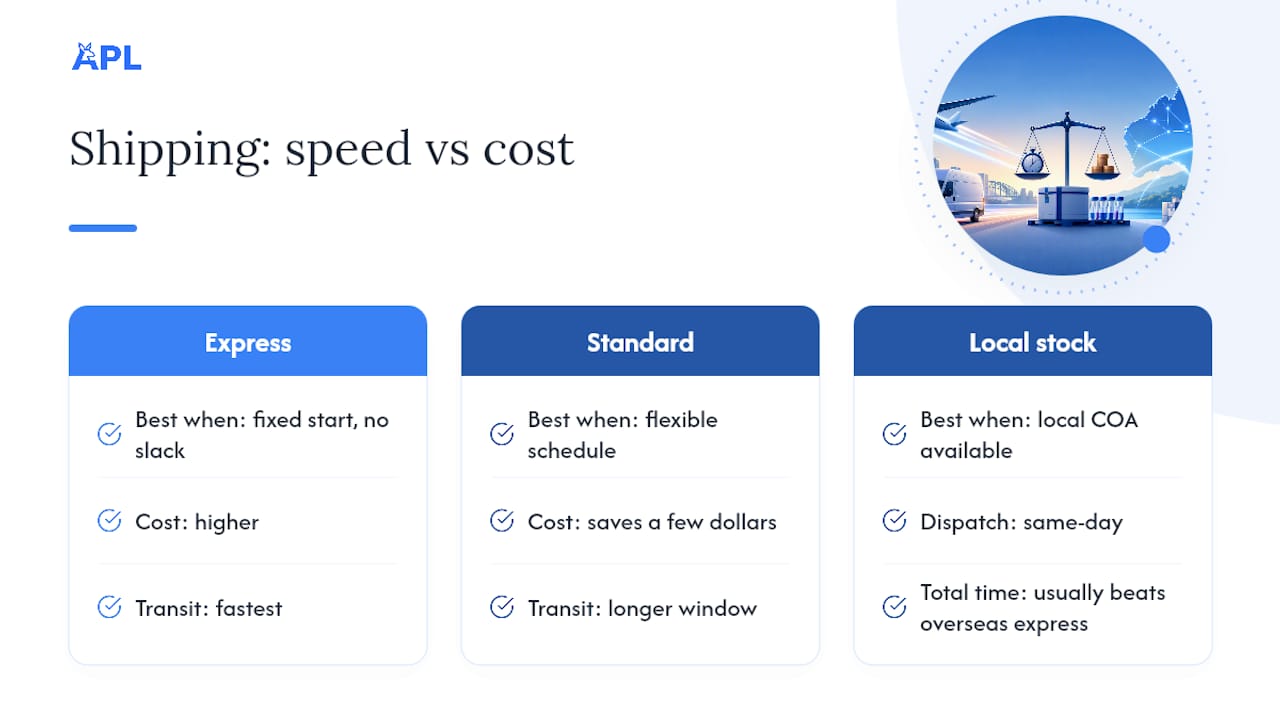
What matters more than either, in practice, is stock location and COA availability. A supplier holding local Australian stock with same‑day dispatch will usually beat an overseas supplier's express option on total elapsed time, cost aside.
Before placing an order: confirm your payment method is approved, check today's cutoff time, and make sure someone is rostered to receive and inspect the parcel on arrival.
— Dr. Authur
Order with confidence: how Au Peptide Labs keeps delivery predictable
Reliable delivery is often impacted by international transit delays. Dispatching orders promptly from local stock can provide delivery windows based on domestic courier performance, avoiding unpredictable customs delays.
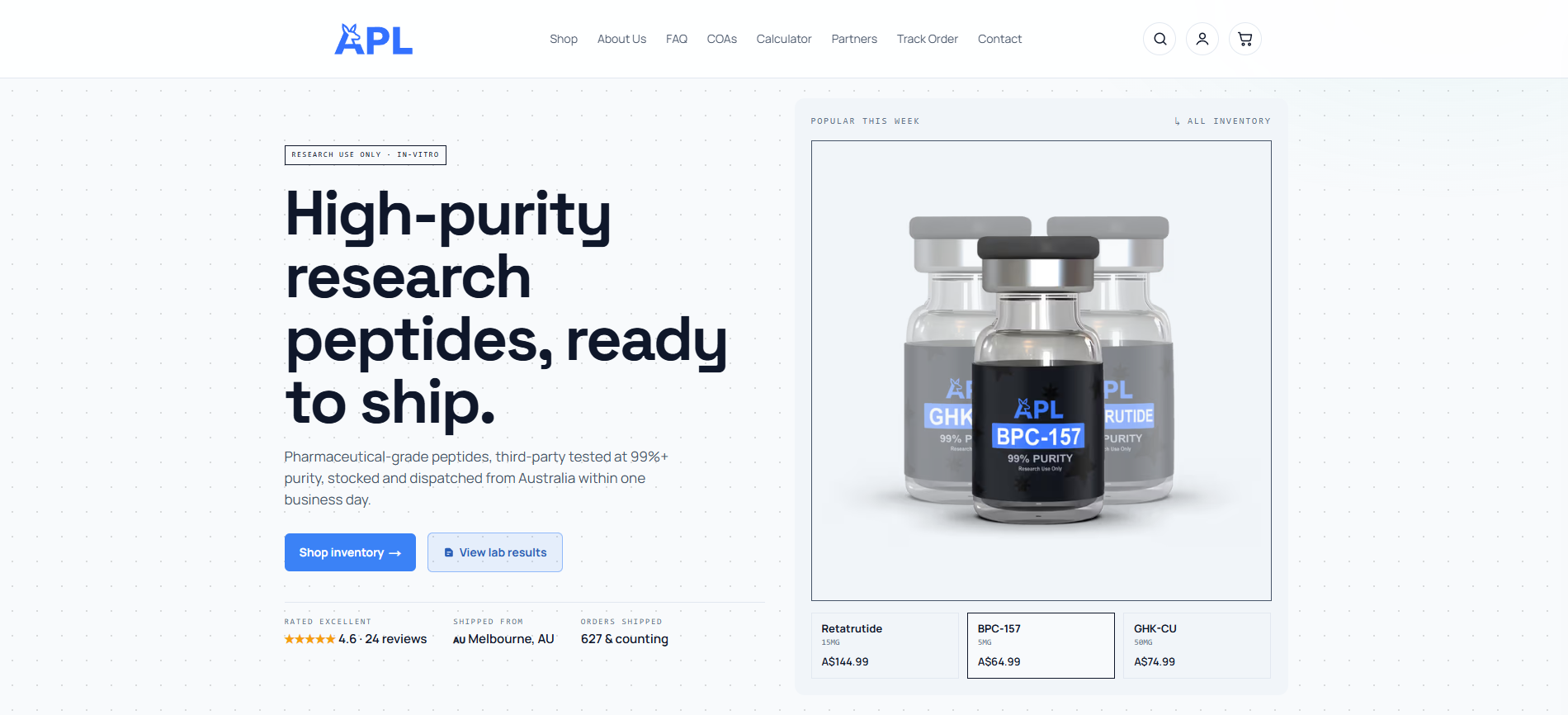
Such reliability is supported by positive customer feedback rather than just marketing claims. If your research timeline is tight, browse Au Peptide Labs' full peptide catalogue and place your order before today's dispatch cutoff, or check a specific product page like LL-37 if you already know what your protocol requires. For urgent shipping requests, contact the supplier directly before ordering to confirm same-day dispatch availability.
Where to check current dispatch and delivery details
Live shipping details change, so verify specifics directly before placing a time‑sensitive order:
- Au Peptide Labs shipping and packaging blog for handling and storage guidance.
- Supplier COA and batch documentation, usually linked on the product page or included with dispatch confirmation.
FAQ
How long does it take for peptides to be delivered in Australia?
Most orders dispatched from Australian stock before the daily cutoff arrive within 1–2 business days in metro areas, 2–4 days regionally, and 3–7 days in remote postcodes, depending on the courier service selected.
Is it legal to order peptides in Australia?
Research peptides can be legally purchased in Australia for laboratory research use when sold by a supplier operating within relevant regulations and are not intended for human or veterinary use; always confirm the product's stated purpose with the supplier before ordering.
What is the most reliable peptide company in Australia for fast delivery?
Suppliers that hold local Australian stock and commit to same‑day dispatch, such as Au Peptide Labs, remove the customs delays that affect overseas‑sourced orders and give labs a more predictable delivery window.
How quickly do peptide suppliers ship after an order is placed?
Orders placed before the supplier's stated cutoff, commonly between 2:00pm and 5:00pm AEST/AEDT, are typically dispatched the same business day; orders placed after that time ship the next business day.