

TL;DR:
- Bacteriostatic water contains a preservative, making it suitable for multi-dose reconstitution, while sterile water has no additives and is for single use only. The presence of benzyl alcohol in bacteriostatic water inhibits microbial growth but is contraindicated in neonates and certain routes like intrathecal or epidural injections. Proper handling, storage, and verification against product labels ensure safe use aligned with protocol requirements.
The main difference is the preservative. Bacteriostatic water contains 0.9% benzyl alcohol (9 mg/mL); sterile water for injection contains no preservatives or additives whatsoever. The practical rule follows directly: use bacteriostatic water for multi-dose reconstitution workflows where the same vial will be accessed repeatedly over days or weeks, and use sterile water when the entire vial will be consumed in a single session or when the compound or protocol requires a preservative-free diluent.
Quick decision summary:
- Multi-dose vial, repeated withdrawals: bacteriostatic water is the correct choice.
- Single-use reconstitution or preservative-sensitive compound: sterile water for injection.
- Safety note: bacteriostatic water is contraindicated in neonates and must not be used intrathecally or epidurally. Always verify against the product label and applicable TGA guidance before use.
What exactly are bacteriostatic water and sterile water?
Bacteriostatic water for injection (BWFI) is sterile, pyrogen-free water to which a bacteriostat has been added. The standard formulation contains 0.9% benzyl alcohol (9 mg/mL) as the preservative and is supplied in multi-dose vials, typically 10 mL or 30 mL. It is also referred to as BAC water or bac water in research settings.
Sterile water for injection (SWFI) is purified water that has been sterilised and rendered pyrogen-free, with no preservatives or additives of any kind. It is supplied in single-dose vials or ampoules and is intended for immediate, single-use reconstitution only.
Both are USP-grade injectable waters, and neither alters the concentration mathematics when reconstituting a lyophilised compound. As the peptide reconstitution guidance at Peptide Protocol confirms, the choice of diluent does not change the dilution maths — mg divided by mL remains constant regardless of which water is used.
Key distinction: BWFI and SWFI are not interchangeable in multi-dose workflows. The presence or absence of benzyl alcohol determines whether a vial can be safely re-accessed over an extended period or must be discarded after a single draw.
How the preservative works: composition and chemistry
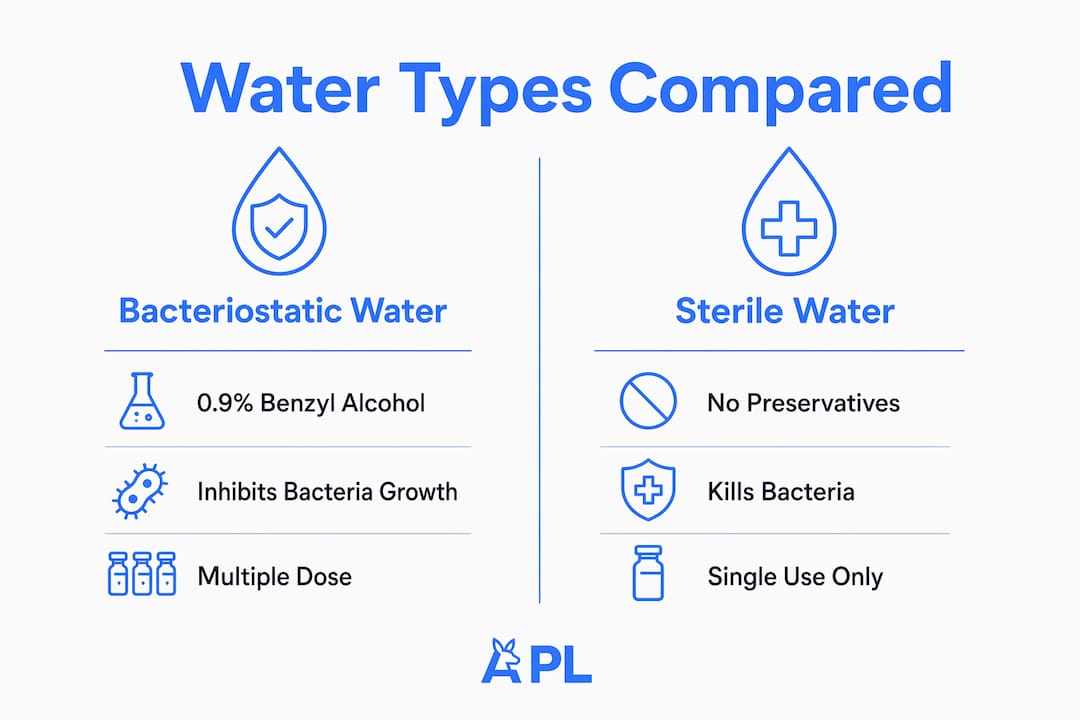
Benzyl alcohol functions as a bacteriostat, not a bactericide. It inhibits microbial multiplication rather than actively killing organisms already present in a contaminated solution. Good aseptic technique — including swabbing the rubber stopper with a 70% isopropyl alcohol wipe before each draw — remains non-negotiable even when using bacteriostatic water.
| Property | Bacteriostatic water (BWFI) | Sterile water for injection (SWFI) |
|---|---|---|
| Preservative | 0.9% benzyl alcohol (9 mg/mL) | None |
| Vial type | Multi-dose (10 mL, 30 mL) | Single-dose vials or ampoules |
| Post-opening use | Limited duration with proper aseptic technique | Single use only; discard remainder |
| Compound compatibility | Most research peptides | All peptides, including benzyl alcohol-sensitive compounds |
The concentration of benzyl alcohol is consistent across most commercial BWFI products, though label concentrations should always be verified against the specific product datasheet, as occasional variant formulations exist.
Pro Tip: Before reconstituting any compound, cross-reference the product's certificate of analysis (COA) or manufacturer datasheet with the benzyl alcohol concentration on your BWFI label. If the datasheet specifies "preservative-free diluent only," that instruction overrides any general preference for bacteriostatic water.
When to use each: practical decision checklist
The choice between bacteriostatic and sterile water is determined by two factors: how many times the vial will be accessed, and whether the compound tolerates benzyl alcohol.
Use bacteriostatic water when the vial will be accessed multiple times over an extended period in protocols involving repeated draws.
- The compound is compatible with benzyl alcohol (the majority of research peptides fall into this category).
- Minimising waste and handling time across a multi-dose course is a practical priority.
Use sterile water for injection when:
- The entire reconstituted volume will be used in a single session.
- The compound is sensitive to benzyl alcohol — certain peptides and biologics require a preservative-free diluent per manufacturer instructions.
- The route of administration or patient group contraindicates benzyl alcohol (see Section 5).
- The research protocol specifies preservative-free diluent explicitly.
Worked example: reconstituting a 5 mg peptide vial
A researcher reconstitutes a 5 mg lyophilised peptide vial with 2 mL of bacteriostatic water, yielding a concentration of 2.5 mg/mL. Each 0.25 mg dose requires 0.1 mL (10 units on a U-100 insulin syringe). The vial will be accessed daily for approximately 20 days — well within the 28-day multi-dose window — making bacteriostatic water the appropriate diluent. Had the researcher used sterile water, the vial would need to be discarded after the first draw, generating significant waste and requiring daily reconstitution. A peptide dilution calculator can verify these volumes before the first draw.
Safety and contraindications you must know
Benzyl alcohol carries specific, well-documented contraindications that must be observed regardless of research context.
Neonatal contraindication: Benzyl alcohol has been associated with gasping syndrome in premature infants, a potentially fatal toxic reaction characterised by metabolic acidosis, CNS depression, and cardiovascular collapse. Bacteriostatic water must never be used in neonatal preparations. Preservative-free sterile water is the only appropriate diluent in those cases.
Additional contraindications and cautions for bacteriostatic water include:
- Intrathecal and epidural routes: bacteriostatic water is contraindicated for intrathecal (spinal) and epidural administration due to the neurotoxic potential of benzyl alcohol at these sites.
- Intravenous use: BWFI is not formulated for direct IV infusion as supplied; it must be made isotonic and confirmed compatible before any IV application. Refer to institutional protocols and TGA product information.
- Preservative sensitivity: some peptides and biologics are incompatible with benzyl alcohol. Always check the product label and manufacturer datasheet before reconstitution.
- Allergy: individuals with known hypersensitivity to benzyl alcohol must not be exposed to BWFI-reconstituted preparations.
For Australian researchers and clinicians, the product label and TGA-approved product information are the authoritative references for route-specific guidance. When in doubt, contact the supplier's technical support before proceeding.
Handling, storage, and disposal of opened vials
Correct handling of multi-dose bacteriostatic vials is as important as the initial choice of diluent. The beyond-use window applies only when aseptic technique is maintained and the vial is properly stored.
Bacteriostatic water (multi-dose vials):
- Mark the date and time of first puncture on the vial immediately.
- Store at room temperature (15–30°C) or refrigerate; protect from direct light and do not freeze.
- Discard the vial at 28 days after first puncture, or earlier if any sign of particulate matter, discolouration, or contamination is observed.
- Use a fresh, sterile needle and syringe for each withdrawal; swab the stopper with a 70% isopropyl alcohol wipe before each access.
Sterile water for injection (single-dose vials/ampoules):
- Use the entire contents immediately upon opening; discard any unused remainder.
- Single-dose ampoules must never be re-capped or re-used.
- Opened vials left at room temperature without a preservative can support bacterial growth within hours.
Disposal: discard expired or opened vials in accordance with local laboratory waste protocols and applicable Australian regulations. Sharps and contaminated materials require appropriate sharps containers and disposal pathways.
Pro Tip: For shared laboratory supplies, keep a simple open-date log on the fridge door listing each vial, its first-puncture date, and its 28-day expiry. When the log shows a vial is past date or the entry is unclear, discard it without exception.
Aupeptidelabs on testing, supply, and recommended practice in Australia
Aupeptidelabs supplies pharmaceutical-grade bacteriostatic water and research peptides to Australian laboratories, with all orders dispatched from Australia within one business day. Every product is subject to third-party purity testing, and the company's technical guide on bac water for peptide research provides detailed reconstitution protocols for common laboratory workflows.
The composition and Australian best-practice guidance for bacteriostatic water is covered in detail in the Aupeptidelabs blog, including storage recommendations and compatibility notes for common research peptides. Researchers with compound-specific compatibility questions are encouraged to contact Aupeptidelabs technical support directly.
Pro Tip: All Aupeptidelabs products are for research use only. Confirm that your intended application aligns with laboratory research protocols and that you have reviewed the relevant product datasheet before ordering.
Source your lab-grade diluents from Aupeptidelabs
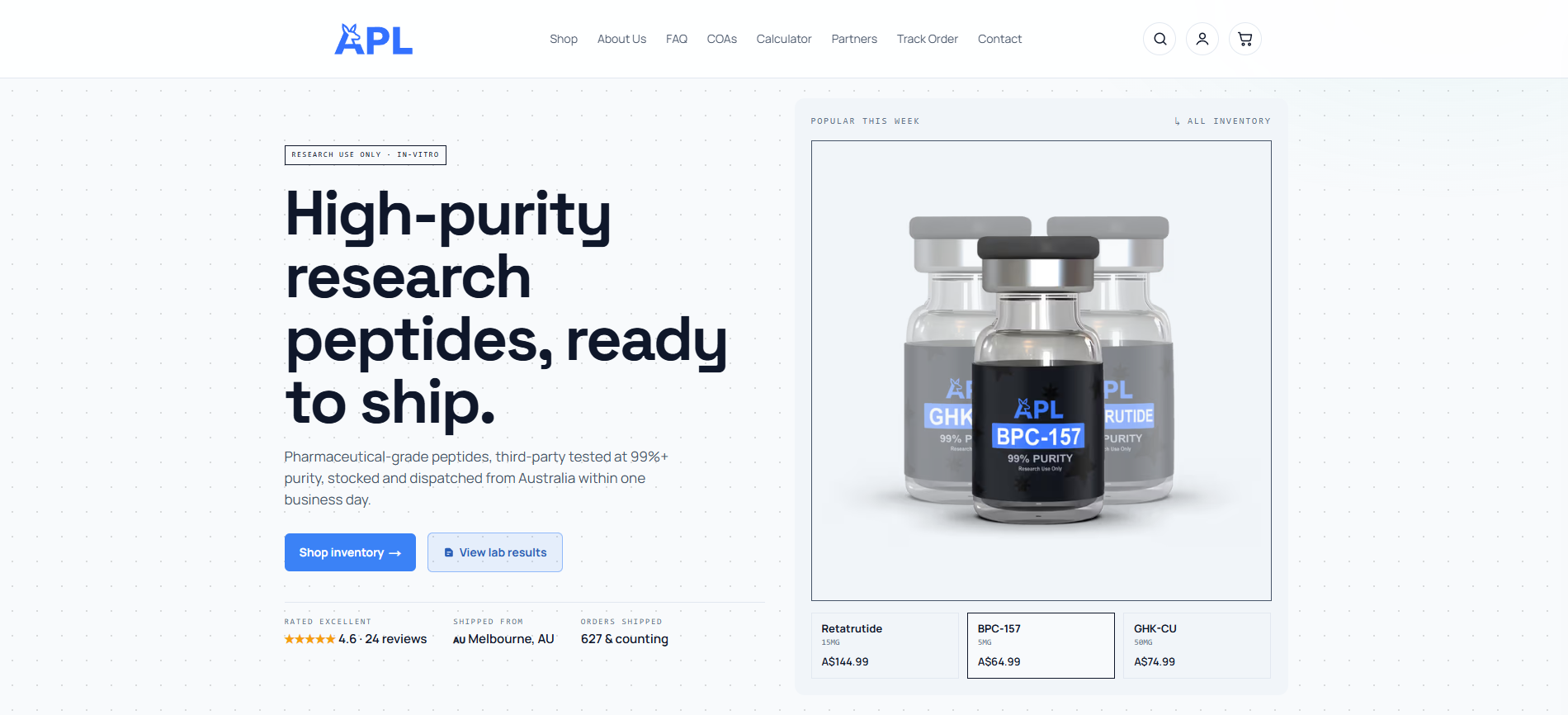
Aupeptidelabs stocks pharmaceutical-grade bacteriostatic water and research peptides, all third-party tested for purity exceeding 99% and dispatched from Australia within one business day. No customs delays, no uncertainty about supply chain provenance. For Australian researchers who need a reliable, tested diluent alongside their peptide orders, Aupeptidelabs provides both in a single transaction, with discreet packaging and a verified customer satisfaction rating of 4.6/5. Browse the full range of research peptides and lab supplies and place your order today.
Useful sources and where to verify Australian guidance
The following primary and reference sources support the technical content in this article. For Australian-specific directions, the TGA product information and the manufacturer's product label are the authoritative references; contact your supplier's technical support for compound-specific compatibility questions.
| Source | Type | Relevance |
|---|---|---|
| Bacteriostatic Water for Injection, USP (DailyMed) | Primary product label / FDA database | Benzyl alcohol concentration, neonatal contraindication, label warnings |
| Peptide reconstitution guide (Peptide Protocol) | Educational / technical guide | Diluent selection, concentration maths, multi-dose vs single-use |
| Bac water for peptide research (Aupeptidelabs blog) | Publisher technical guide | Australian lab workflows, reconstitution protocols |
| Bacteriostatic water composition guide (Aupeptidelabs blog) | Publisher reference | Composition, storage, Australian best practice |
| TGA product information (product-specific) | Regulatory / primary | Australian-specific directions, route contraindications |
| Manufacturer product label / COA | Primary / regulatory | Compound-specific diluent requirements, preservative compatibility |
- For route-specific contraindications (intrathecal, epidural, IV), consult your institution's infection control protocols and the applicable TGA product information.
- For concentration calculations, use the Aupeptidelabs peptide dilution calculator.
- When a compound's COA or datasheet specifies "preservative-free diluent," that instruction supersedes general guidance. Contact Aupeptidelabs technical support for compatibility questions specific to your research protocol.
This article is general research information only and does not constitute medical, pharmaceutical, or veterinary advice. Verify current product labelling, TGA guidance, and institutional protocols for your specific application.