
Join the Au Peptide Labs affiliate program as your starting point. It pairs a competitive commission structure with verifiable trust signals researchers actually check before clicking a link.
- Sign up: visit the affiliate landing page and submit your channel details.
- Prepare: gather Certificates of Analysis (COAs) and reference a very high purity standard in your first pieces of content.
- Why it works: research audiences convert on evidence, not enthusiasm, and Au Peptide Labs gives you documentation to back every claim.
How do peptide affiliate programs actually work?
The mechanics are simpler than most creators expect, but the details determine whether you get paid correctly.
Every program issues a unique tracking link, and many also assign a coupon code, so the merchant's system can match a completed order back to your referral. That link drops a cookie in the visitor's browser, and the affiliate dashboard logs the click, the eventual transaction ID, and whether the order was confirmed or refunded.
Before promoting anything, verify three mechanics:
- How the merchant attributes conversions when a visitor uses your coupon on a different device than the one that clicked your link.
- Whether coupon-code use bypasses cookie tracking entirely (some carts prioritise the code over the click).
- How refunds and cancelled orders affect commissions already logged in your dashboard.
Distribution channels matter here too. Traffic from search behaves predictably, but community platforms like Discord often need special link handling to preserve attribution when links get reshared inside servers.
What commission rates and cookie windows should you expect?
Commission structures in the peptide research space vary more than in mainstream retail affiliate programs, largely because product margins and compliance overhead differ from consumer goods.
Most programs run either a flat percentage on every sale or a tiered structure that increases your rate once you clear a monthly volume threshold. Tiered plans reward consistent promoters, but they also mean your effective rate can quietly drop in a slow month, so read the tier reset rules closely.
- Cookie length: anywhere from a few days to 30+ days; longer windows favour educational content creators whose audience takes time to convert.
- Attribution model: last-click is the industry default, meaning the most recent affiliate link before checkout gets credit, even if you sent the original visitor.
- Payout timing: typically monthly, with minimum thresholds before funds release and payment via bank transfer or PayPal.
- Returns and chargebacks: clawed back from your next payout cycle in almost every program worth joining.
Pro Tip: Prioritise programs with a real-time dashboard over ones that email you a monthly PDF. Reconciling your own click data against a merchant's report is the only way to catch tracking discrepancies before they cost you a full commission cycle.
What rules and eligibility requirements apply to affiliates?
Peptide affiliate programs tend to run tighter eligibility filters than typical supplement affiliate networks, largely because the product category sits under closer regulatory attention.
- Eligibility filters: minimum age requirements, geographic restrictions on payout eligibility, and outright bans on self-referrals (buying through your own link to earn a commission).
- Channel restrictions: many programs prohibit paid search ads bidding on the brand's own name, and some exclude affiliate networks with a history of coupon-stuffing.
- Disclosure and coupon rules: affiliates must disclose the relationship clearly and use coupon codes only as issued, not repackaged under a different name.
On the compliance side, one guardrail matters above all others: promotional content should stick to research-use language and avoid any claim implying human or veterinary use, dosage recommendations, or therapeutic outcomes. That's not just a brand preference. It's the line that keeps both you and the merchant on the right side of advertising standards for research chemicals.
What promotional assets and support can you expect?
A functional program gives you more than a naked tracking link. Expect coupon codes, pre-built banners, product photography, and links to COAs you can embed directly in reviews or comparison content.
Better programs go further with a dedicated affiliate manager, co-op campaign support around product launches, and occasional performance bonuses tied to volume spikes. Before you commit content hours to a program, confirm three things: how often creative assets get refreshed, whether you have explicit permission to republish COA documents on your own site, and whether product pages carry lab-grade documentation you can link to rather than paraphrase.
- Coupon codes and unique tracking links issued at signup.
- Banner sets, product images, and sample marketing copy.
- COA links and lab-grade documentation for evidence-based content.
- Affiliate manager access for questions or campaign coordination.
How do you compare peptide affiliate programs side by side?
Score every program you're considering against the same six dimensions, and weight them according to your content style.

| Criterion | What to check | Matters most for |
|---|---|---|
| Commission rate & tiers | Flat vs performance tier, reset frequency | High-volume promoters |
| Cookie length & attribution | Days of cookie life, last-click vs first-click | Long-consideration content (guides, comparisons) |
| Payout schedule & minimum | Frequency, minimum threshold, payment method | Anyone budgeting on affiliate income |
| Dashboard transparency | Real-time data vs delayed reporting | Anyone reconciling their own click data |
| Promotional tools | Custom codes, creative refresh rate | Volume creators running paid or social campaigns |
| Product quality & testing | COAs, independent purity verification | Niche lab educators and review sites |
Volume creators running paid traffic or high-frequency content should weight cookie length and dashboard transparency above everything else, since a short window or laggy reporting quietly erodes earnings you never see reflected accurately. Niche lab educators writing deep comparison content should weight product quality and COA access higher, because that's the material their audience actually reads before buying.
Pro Tip: If a program can't produce public, verifiable COAs on request, treat that as a hard disqualifier for research-focused content. Your audience is more scientifically literate than the average retail shopper, and a missing COA is the first thing a skeptical reader checks.
Why does Au Peptide Labs stand out as an affiliate partner?
Au Peptide Labs backs its affiliate offer with trust signals that hold up under scrutiny, not just marketing copy.
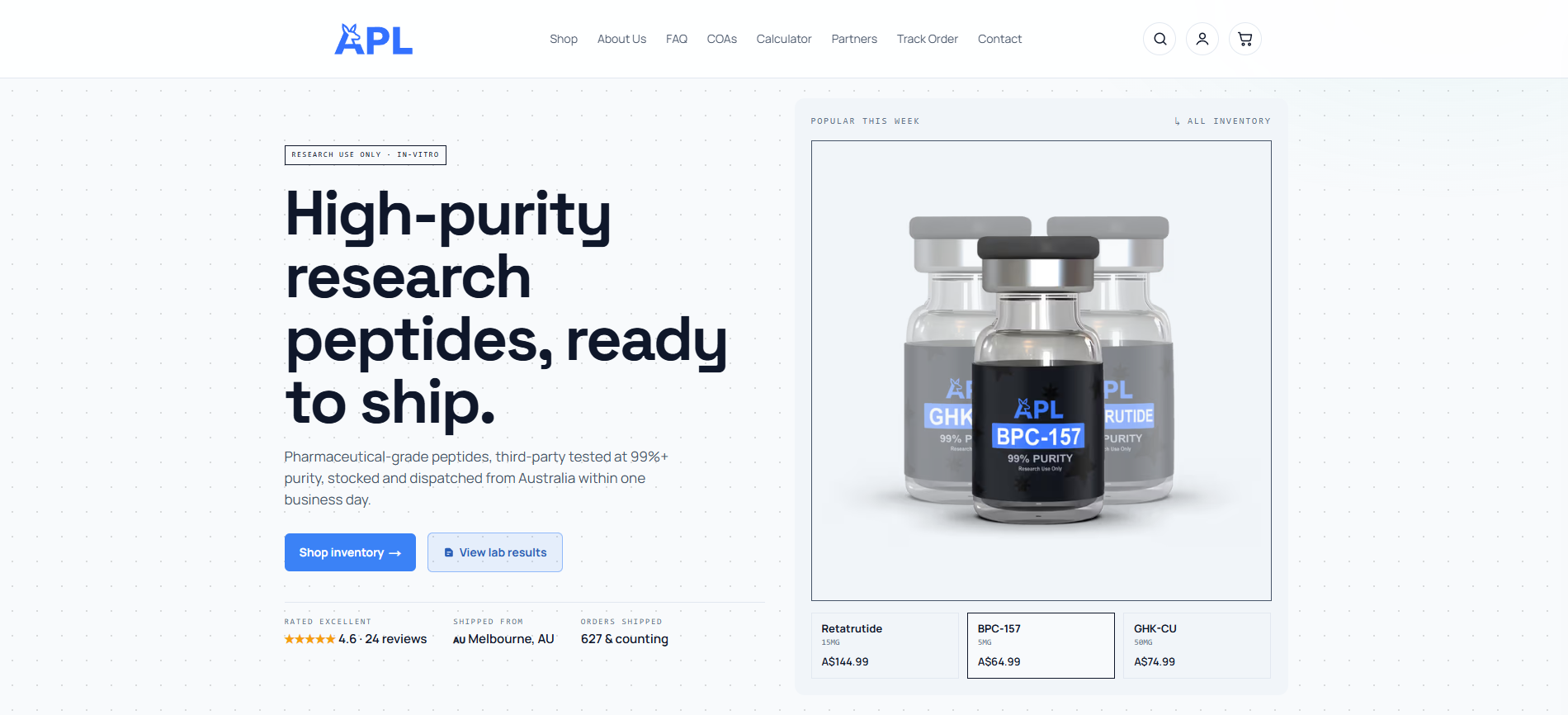
Packaging stays discreet, and the brand carries a verified 4.6/5 customer rating.
99%+ independent purity verification backs every listed product, with third-party COAs available for reference in affiliate content.
For affiliates, the practical features are just as relevant: clean tracking links, working coupon codes, ready-made promotional assets, and an affiliate manager available to answer questions.
- Link COAs directly when discussing product quality claims.
- Quote the 99% purity threshold when explaining lab-grade sourcing.
- Reference one-business-day domestic dispatch when writing for time-sensitive researchers.
- Use the 4.6/5 rating as a social-proof point in review-style content.
This mirrors a broader shift across the sector. A recent 50/50 net revenue share partnership between MMA.INC and Precision Peptide, disclosed in a public SEC filing, put the same emphasis on domestic manufacturing and third-party testing as the deal's core value proposition, not an afterthought.
How do you apply and how long does approval take?
- Sign up through the affiliate landing page with your channel URL and audience details.
- Submit examples of past promotional content, if you have any, and agree to the program terms.
- Wait for review. Most peptide affiliate programs approve within a few business days once your channel checks out.
- Receive your tracking link and coupon code, then request pre-approval to embed COA links in your content.
Pro Tip: Include real audience metrics and be upfront about which channels you'll use (blog, YouTube, Discord, email). Vague applications get slower reviews than specific ones.
Publisher viewpoint on creator partnerships
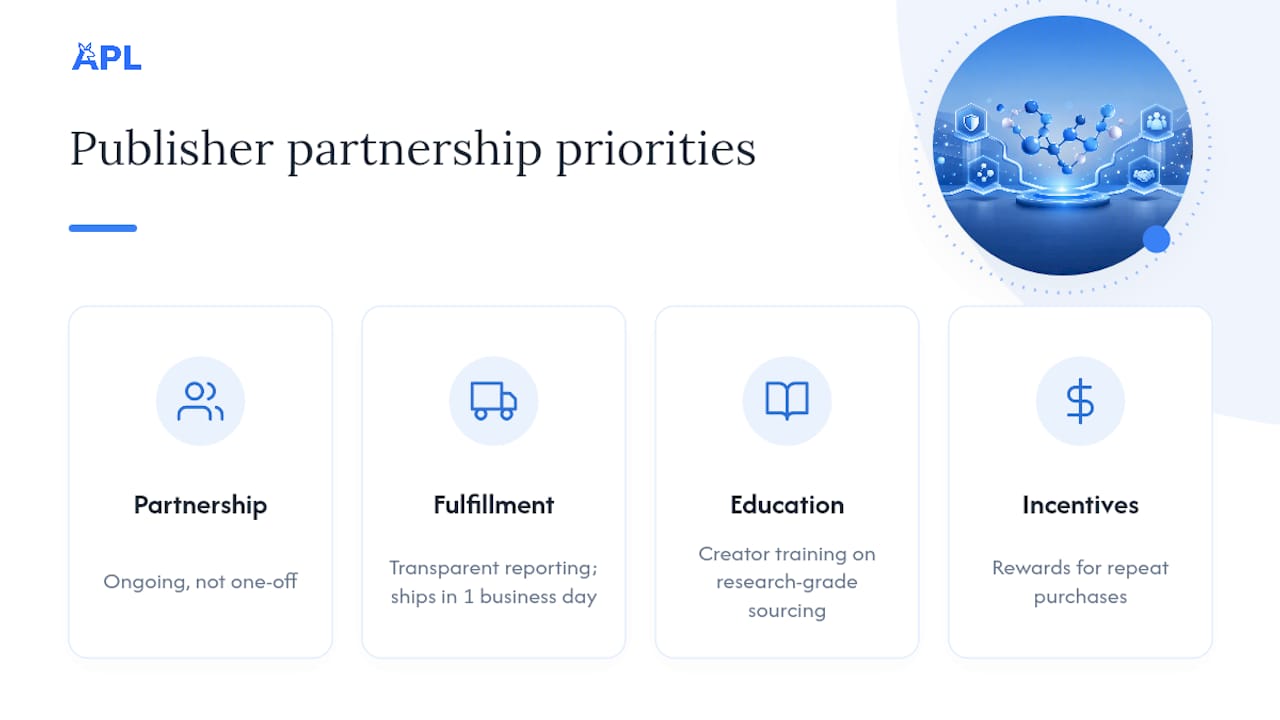
Au Peptide Labs approaches affiliate relationships as ongoing partnerships, not one-off transactions. That means transparent reporting, dispatch within one business day so your audience gets what you promised, and a genuine investment in creator education around research-grade sourcing. Collaborative promotions and performance incentives are structured to reward repeat purchases, aligning the publisher's interests with yours over the long term.
Ready to start earning as a peptide affiliate?
Most affiliate networks in this category ask you to promote generic supplement listings with no real documentation behind them.
That difference shows up directly in your conversion rate, because research-minded buyers hesitate on unverifiable claims and act on documentation. Before you apply, pull together a few pieces of your existing content, note your audience size across whichever channels you use, and have your disclosure language ready. Then visit the Au Peptide Labs affiliate page to submit your application and get your tracking link issued.
Sources
- MMA.INC (NYSE American: MMA) Enters Exclusive 50/50 Revenue Share Peptide Partnership with Precision Peptide (CSE: BPC)
FAQ
What is the typical commission rate for peptide affiliate programs? Rates vary by merchant and often run as either a flat percentage per sale or a tiered structure that rises with monthly volume. Confirm the exact figures directly with the program before promoting, since public rate cards aren't standardised across the category.
How long is the cookie window on most peptide affiliate deals? Windows range from a few days to over 30, with last-click attribution as the industry default. A longer cookie favours creators writing educational or comparison content where readers take time to decide.
Do peptide affiliate programs allow paid advertising? Many restrict bidding on the brand's own name in paid search and prohibit certain affiliate networks known for coupon abuse. Always check channel restrictions before running any paid campaign.
Can I promote peptides without making health claims? Research-use language only, no dosage guidance, and no implied human or veterinary use. This isn't optional. It's the line that keeps your content compliant with advertising standards for research chemicals.
How fast does Au Peptide Labs approve new affiliates? Most applications with clear channel details and audience metrics are reviewed within a few business days, after which you'll receive your tracking link and coupon code.