
TL;DR:
- Bacteriostatic water contains 0.9% benzyl alcohol that inhibits bacterial growth in multi-dose vials. It is preferred over sterile water for peptide reconstitution because of its preservative, which extends vial usability when handled aseptically. Proper handling, storage, and timely discarding ensure research integrity and safety.
Bac water is defined as a sterile aqueous solution containing 0.9% w/v benzyl alcohol as a preservative, produced to USP pharmaceutical-grade standards for laboratory and research applications. The formal industry term is bacteriostatic water for injection, and both terms refer to the same formulation. Its defining characteristic is the capacity to inhibit bacterial proliferation within a vial after the initial puncture, making it the preferred diluent for multi-dose peptide reconstitution workflows. Researchers working with lyophilised peptides in Australian laboratories rely on bacteriostatic water Australia-wide because it extends vial usability without compromising sterility. This guide covers the chemical basis of that preservation, the practical differences from sterile water, safe handling protocols, and the specific advantages bacteriostatic water delivers in peptide research.
What is bac water and how does benzyl alcohol work?
Benzyl alcohol at 0.9% w/v is the functional core of bacteriostatic water. At this concentration, the compound disrupts bacterial cell membrane integrity, preventing replication without necessarily losing existing cells. That distinction matters: bacteriostatic action halts growth, whereas bactericidal agents kill organisms outright. For laboratory multi-dose vials, halting growth is sufficient because aseptic technique removes the introduction of large inocula in the first place.
The mechanism is concentration-dependent. Below 0.9%, benzyl alcohol loses its preservative efficacy. Above that threshold, cytotoxicity risks increase for sensitive biological preparations. The 0.9% w/v figure is therefore not arbitrary; it represents the validated balance between antimicrobial activity and compatibility with peptide compounds.
Multi-dose vial safety depends on this preservative remaining active throughout repeated needle punctures. Each puncture introduces a small risk of microbial ingress. Benzyl alcohol suppresses any organisms introduced, provided the vial is accessed under aseptic conditions and the solution has not exceeded its post-opening window.
Pro Tip: Always confirm the benzyl alcohol concentration on the certificate of analysis before use. Formulations labelled simply as "preserved water" may use alternative preservatives that are not equivalent to 0.9% benzyl alcohol for peptide reconstitution purposes.
How does bacteriostatic water differ from sterile water?
Sterile water lacks benzyl alcohol, making it a single-use diluent only. Once the stopper is punctured, no preservative mechanism prevents bacterial colonisation of the remaining solution. Using sterile water for injection across multiple withdrawals introduces a measurable contamination risk that bacteriostatic water eliminates.
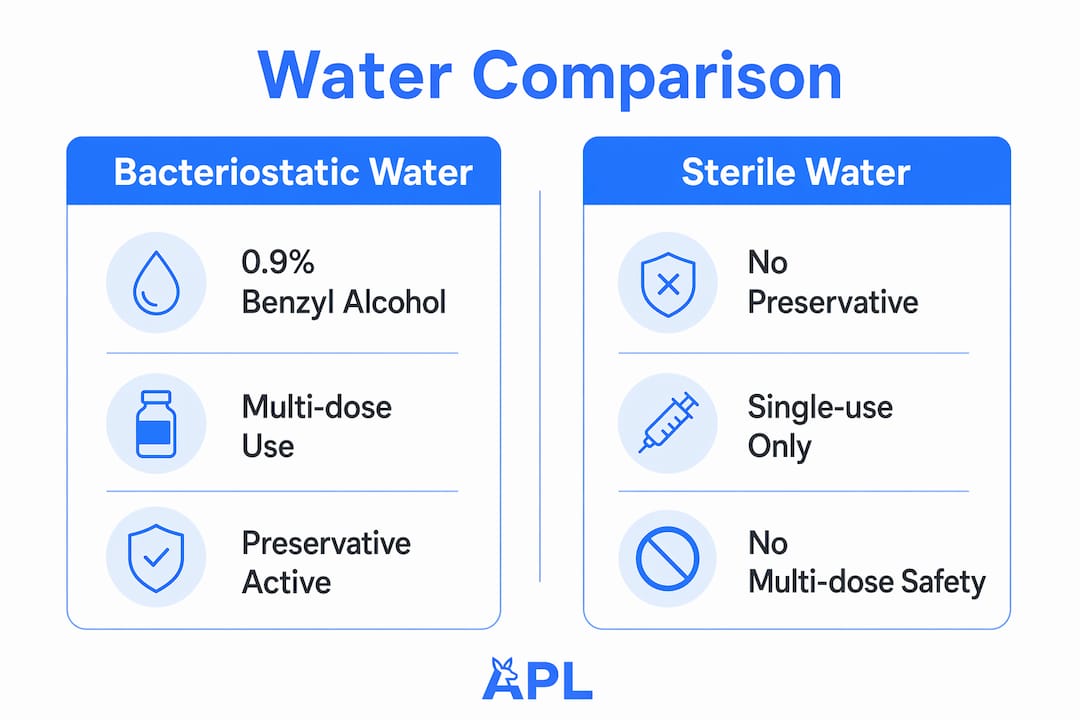
The distinction between the two is often misunderstood among laboratory practitioners, which can lead to improper experimental technique and compromised results. Selecting the wrong diluent is not a minor procedural error. It can invalidate an entire experimental series if contamination is introduced mid-protocol.
The table below summarises the key functional differences for researchers choosing between the two formulations.
| Feature | Bacteriostatic water | Sterile water for injection |
|---|---|---|
| Preservative | 0.9% w/v benzyl alcohol | None |
| Multi-dose suitability | Yes | No |
| Post-opening shelf life | Up to 28 days | Single use only |
| Contamination risk after puncture | Low (with aseptic technique) | High |
| Compatibility with peptides | Broad | Broad |
| Neonatal or inhalation use | Contraindicated | Acceptable in some protocols |
| Typical vial size | 10 ml, 20 ml, 30 ml | 10 ml, 20 ml |
Bacteriostatic water is preferred for multi-dose peptide workflows precisely because the benzyl alcohol preservative maintains sterility during repeated vial access. Sterile water remains appropriate for single-use reconstitutions where the entire volume is consumed immediately, or where benzyl alcohol is contraindicated for the specific compound or application.
Safe handling, storage, and shelf life in research environments
Proper handling of bacteriostatic water for injection begins before the vial is opened. Inspect each vial for particulate matter, discolouration, or stopper damage. Any vial showing visible contamination or physical compromise must be discarded, regardless of its stated expiry date.
Aseptic technique during vial access
Every withdrawal requires strict aseptic technique. Swab the rubber stopper with a 70% isopropyl alcohol wipe and allow it to dry fully before needle insertion. Use a new, sterile needle for each withdrawal. Reusing needles introduces particulate matter and increases the risk of coring the stopper, which can deposit rubber fragments into the solution.
Storage conditions
Store unopened vials at room temperature, between 15°C and 30°C, away from direct light. Refrigeration is not required for unopened stock but does not harm the formulation. After opening, some laboratories refrigerate vials to further reduce any residual microbial risk, though the benzyl alcohol preservative functions adequately at room temperature within the 28-day window.
The 28-day discard rule
Discard bac water approximately 28 days after opening. This recommendation exists because benzyl alcohol's bacteriostatic efficacy is not indefinite. Repeated punctures gradually degrade stopper integrity, and cumulative exposure to the laboratory environment increases contamination probability over time. The 28-day figure is a conservative, validated threshold, not an estimate.
Key handling protocols for laboratory use:
- Label each vial with the date of first puncture immediately upon opening.
- Record the number of withdrawals per vial in your laboratory notebook or electronic records system.
- Use insulin syringes calibrated for the intended volume to maintain dosing accuracy across multiple withdrawals.
- Never pool residual volumes from two opened vials into a single container.
- Discard any vial where the solution appears cloudy, discoloured, or contains visible particles, regardless of the 28-day window.
Pro Tip: Attach a small adhesive label to each vial recording the opening date and withdrawal count. This takes under 10 seconds and eliminates the most common source of protocol deviation in multi-dose workflows.
Benzyl alcohol is contraindicated for neonatal use and for inhalation applications. Researchers must consult their institutional safety protocols before incorporating bacteriostatic water into any protocol outside standard injectable peptide reconstitution.
Why is bac water the preferred choice for peptide reconstitution?
Lyophilised peptides require a compatible aqueous diluent that will not degrade the compound, introduce contamination, or limit the number of doses that can be drawn from a single vial. Bacteriostatic water satisfies all three requirements simultaneously. The benzyl alcohol preservative is chemically inert relative to most peptide structures at the concentrations used in standard reconstitution.
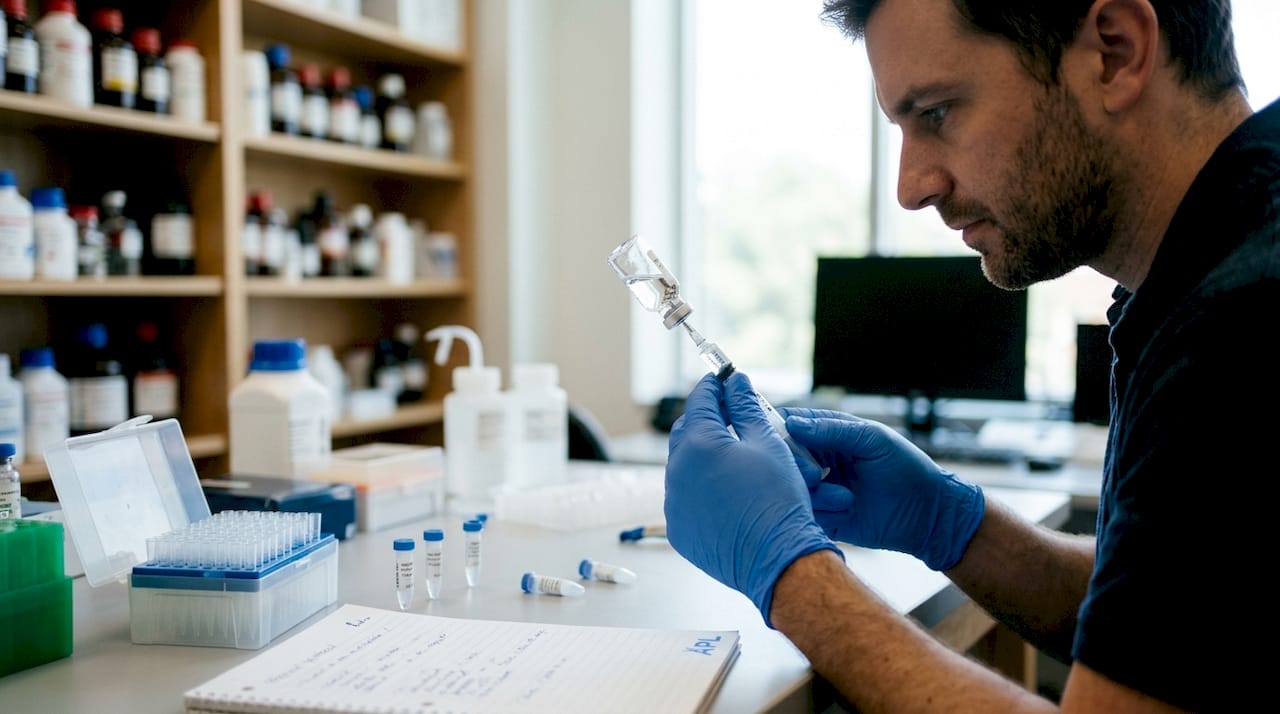
Bacteriostatic water extends vial usability and reduces bacterial contamination risk in peptide reconstitution workflows. That extended usability translates directly into research efficiency: a single reconstituted vial can serve multiple experimental time points without requiring fresh preparation for each session.
A typical peptide reconstitution workflow using bacteriostatic water proceeds as follows:
- Remove the lyophilised peptide vial and the bacteriostatic water vial from storage. Allow both to reach room temperature before proceeding.
- Calculate the required reconstitution volume using a validated peptide dilution calculator to achieve the target concentration.
- Swab both vial stoppers with 70% isopropyl alcohol. Allow to dry.
- Draw the calculated volume of bacteriostatic water into a sterile syringe.
- Inject the bacteriostatic water slowly down the inner wall of the peptide vial. Do not inject directly onto the lyophilised cake, as this can cause mechanical degradation of the peptide structure.
- Gently swirl the vial. Do not vortex. Allow the peptide to dissolve fully before withdrawing the first dose.
- Label the reconstituted vial with the peptide name, concentration, reconstitution date, and diluent used.
- Store the reconstituted vial according to the peptide's specific stability requirements, typically at 2°C to 8°C.
This workflow applies to a broad range of research peptides, including compounds such as LL-37 and SS-31, where multi-dose access across experimental sessions is standard practice. The bacteriostatic water's preservative function maintains the sterility of the diluent throughout this process, provided the 28-day window and aseptic protocols are observed.
WFI-quality water as the base for bacteriostatic water formulations is a critical quality indicator. Water for Injection grade meets pharmacopoeial standards for endotoxin limits and particulate matter, both of which are relevant to in vitro and in vivo peptide research. Researchers should verify that their supplier uses Low-grade water in the formulation, not simply purified or deionised water.
My perspective on quality, sourcing, and common mistakes
Working with bacteriostatic water in peptide research settings has made one thing clear to me: the quality of the diluent is treated as an afterthought far too often. Researchers spend considerable effort verifying peptide purity certificates but accept bacteriostatic water from any available source without scrutiny. That asymmetry is a real risk to experimental integrity.
The most consequential variable is manufacturing quality. Sterile filtration and high-quality rubber stoppers determine whether a vial maintains its sterility from production to the final withdrawal. A vial with a substandard stopper can lose its airtight seal during shipping or storage, rendering the benzyl alcohol preservative irrelevant. I always request a certificate of analysis that confirms sterility testing, not just benzyl alcohol concentration.
The second mistake I see regularly is conflating bacteriostatic water with sterile water for injection. These are not interchangeable. Using sterile water across multiple withdrawals because it was the only option available in the laboratory at the time is a protocol deviation that should be documented, not quietly accepted. The contamination risk is real, and the consequences for downstream assays can be significant.
My practical recommendation: source bacteriostatic water from a supplier that manufactures to USP standards, ships from within Australia to avoid transit degradation, and provides batch-specific documentation. Aupeptidelabs supplies pharmaceutical-grade bacteriostatic water with verified 0.9% benzyl alcohol concentration, dispatched from Australia within one business day. That combination of quality documentation and local dispatch removes two of the most common failure points in the supply chain.
— Dr. Authur
Aupeptidelabs: pharmaceutical-grade bacteriostatic water for Australian researchers
Researchers requiring reliable bacteriostatic water australia-wide can source pharmaceutical-grade stock directly from Aupeptidelabs, with all orders dispatched from Australia within one business day.
Aupeptidelabs supplies bacteriostatic water for injection formulated with 0.9% benzyl alcohol to USP standards, with purity verification exceeding 99% across its product range. Each order ships in discreet packaging with batch documentation available on request. The Aupeptidelabs catalogue also includes a full range of research peptides for reconstitution, supporting complete laboratory workflows from diluent to compound. For researchers calculating reconstitution volumes, the Aupeptidelabs peptide dilution calculator provides a validated tool for determining precise diluent quantities before each preparation session.
FAQ
What is bac water used for in peptide research?
Bac water is used to reconstitute lyophilised peptides for research applications. Its 0.9% benzyl alcohol preservative allows multiple withdrawals from a single vial while maintaining sterility under aseptic conditions.
How long can you use bacteriostatic water after opening?
Bacteriostatic water should be discarded approximately 28 days after the first puncture. Beyond this window, stopper degradation and cumulative contamination risk outweigh the preservative's protective capacity.
Is bacteriostatic water the same as sterile water for injection?
No. Sterile water for injection contains no preservative and is suitable for single-use only. Bacteriostatic water contains 0.9% benzyl alcohol, enabling safe multi-dose use across repeated vial access events.
Where can researchers buy bac water in Australia?
Bacteriostatic water for injection is available from pharmaceutical-grade suppliers operating within Australia. Aupeptidelabs dispatches bacteriostatic water from Australia within one business day, with USP-standard documentation included.
Can bacteriostatic water be used for neonatal applications?
No. Benzyl alcohol is contraindicated for neonatal use and for inhalation applications. Researchers must consult institutional safety protocols before using bacteriostatic water outside standard injectable peptide reconstitution workflows.